E-mail: [email protected] Whatsapp: +8618266768780
E-mail: [email protected] Whatsapp: +8618266768780


You will usually save the most time and money by choosing a trencher for standard trenching jobs. When you compare Trencher vs Mini Excavator, trenchers often finish the work three to four times faster and can cost up to $182 less per day to rent. For example, a trencher can complete most trenches in under eight hours, while a mini excavator may take more than fifteen. If you want efficient, straightforward trenching, you should consider a trencher first.
When you compare trencher vs mini excavator for trenching projects, you need to look at speed, cost, cleanup, and accuracy. The following table summarizes the main differences:
| Recurso | Valetadeira | Miniescavadeira |
|---|---|---|
| Average Speed | 300-600+ ft/day | 75-200 ft/day |
| Rental Cost (1 Day) | $325 | $350 |
| Rental Cost (1 Week) | $1300 | $1400 |
| Labor Hours (100 ft) | 6-7 hours | 12-15 hours |
| Cleanup | Minimal, narrow spoil pile | More soil displacement, larger cleanup |
| Precisão | High for straight, shallow trenches | Good for complex shapes, less precise for straight lines |
You will notice a significant difference in speed when you compare trencher vs mini excavator for straight, shallow trenches. Field tests and contractor reports show that trenchers can complete 300 to over 600 feet per day, while mini excavators typically manage only 75 to 200 feet. For example, one contractor finished 425 feet of water line in just 5.5 hours with a trencher. The same job took 15 hours with a mini excavator. If you need to dig a 100-foot trench, you can expect a trencher to finish in about 6 hours, while a mini excavator may require twice as long. This speed advantage means you can complete more work in less time, reducing overall project duration.
Rental rates for both machines are similar, but you will often pay less for a trencher. A typical one-day rental for a mini excavator costs around $350, while a mini skid trencher rents for about $325. Weekly rates follow the same pattern, with trenchers costing $1300 and mini excavators $1400. Labor costs also favor trenchers. Because trenchers work faster and require less manual cleanup, you spend fewer hours on the job. Over time, this can save you hundreds of dollars, especially on longer projects. Trenchers also have lower maintenance needs, with fewer moving parts and simple upkeep like chain sharpening and lubrication. Mini excavators require more frequent hydraulic and engine servicing, which adds to long-term costs.
Trenchers create a narrow, clean trench with minimal soil disturbance. You will have less spoil to move and less ground to restore after the job. This reduces both labor and disposal costs. Mini excavators, on the other hand, remove more soil and create a wider trench, which means more cleanup and backfilling. If your project requires straight, shallow trenches—such as for irrigation or utility lines—a trencher delivers better accuracy and a neater finish. For complex layouts or jobs with many obstacles, a mini excavator offers more flexibility but may sacrifice some precision and increase cleanup time.
Dica: For most standard trenching jobs, especially those that are long, straight, and shallow, a trencher will save you both time and money. Choose a mini excavator if your project involves curves, obstacles, or requires digging in tough soil conditions.
Você deve choose a trencher when your project demands speed, cost efficiency, and precise trench dimensions. Contractor surveys highlight several scenarios where trenchers consistently outperform mini excavators. Consider a trencher for these types of jobs:
If your project matches any of these scenarios, you will likely save both time and money by choosing a trencher.
Site conditions play a major role in your equipment choice. Use the table below to determine when a trencher is the best fit:
| Site Condition | Recommended Equipment | Reason |
|---|---|---|
| Soft, open soil | Valetadeira | Fast, clean trenching |
| Rocky or root-heavy | Miniescavadeira | Fewer breakdowns |
| Tight spaces | Miniescavadeira | Maneuverable |
| Underground obstacles | Miniescavadeira | Safe removal |
You will get the best results from a trencher in soft, open soil with few obstacles. If your site is rocky or filled with roots, or if you need to work in tight spaces, a mini excavator may be more suitable.
A trencher gives you a clean, narrow trench with minimal soil disturbance. This accuracy means you spend less time on backfilling and site restoration. You also reduce labor costs because there is less spoil to move and less ground to repair. For landscaping or utility projects where neatness and precision matter, a trencher delivers professional results with less effort.
When you compare Trencher vs Mini Excavator for cleanup and accuracy, trenchers stand out. Their design allows you to create trenches with exact dimensions, which is critical for proper pipe installation and long-term durability. You will also appreciate the reduced cleanup, especially on larger projects where time and labor savings add up quickly.
Dica: If you want to finish your trenching project faster, with less mess and lower labor costs, a trencher is often your best choice.
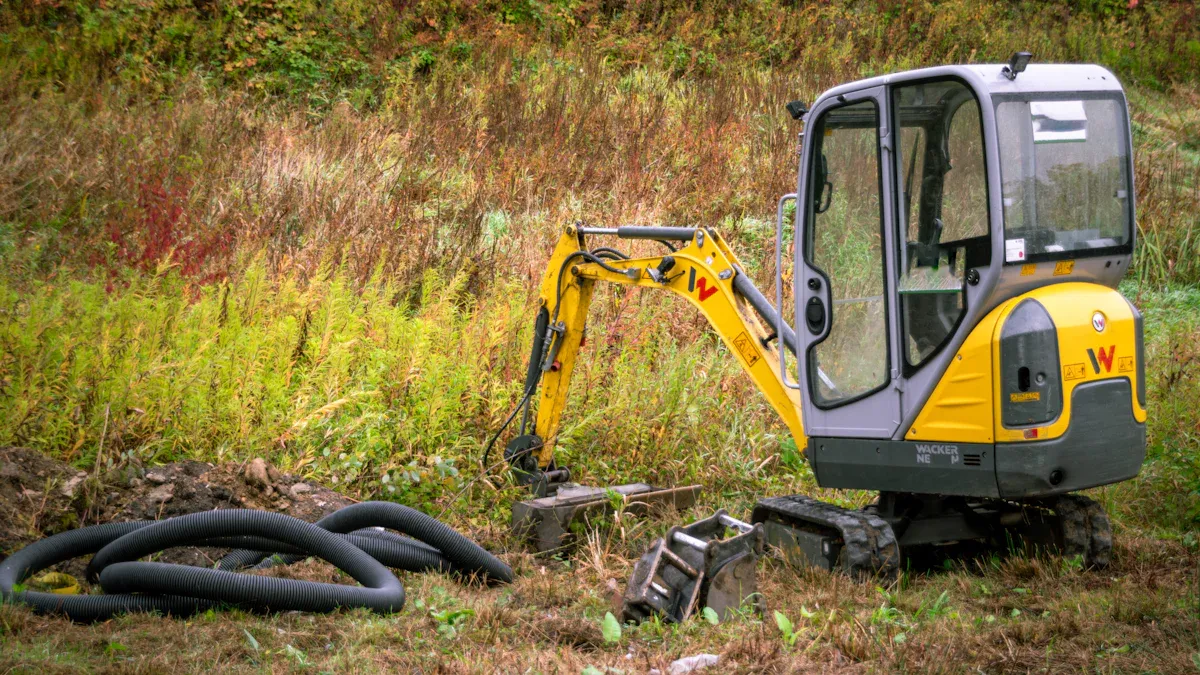
You should consider a miniescavadeira when your trenching project demands flexibility and adaptability. Mini excavators excel in situations where you need to switch between tasks quickly. You can equip them with a range of attachments, such as buckets for digging, grading blades, hydraulic hammers, and compactors. This versatility allows you to tackle more than just trenching. For example, you can dig, grade, and backfill without changing machines. If you encounter unexpected obstacles like rocks or utility crossings, you can adjust your approach by swapping attachments. This adaptability saves time and reduces the need for additional equipment, making mini excavators more efficient than trenchers in complex projects.
Dica: If your job site requires multiple types of excavation or frequent changes in task, a mini excavator will help you complete the work faster and with fewer interruptions.
Mini excavator attachments enhance your workflow by:
You will benefit from a mini excavator when working in tough environments. Experts recommend mini excavators for sites with large rocks, tree roots, or concrete debris. These machines can power through rocky soil using reinforced buckets and switch to hydraulic hammers for breaking up concrete. You can expose and cut roots before digging, which minimizes damage to valuable landscaping. The ability to rotate the cabin fully gives you superior maneuverability in tight spaces, where long trenchers cannot fit.
| Doença | Mini Excavator Capability | Trencher Limitation |
|---|---|---|
| Rocky Soil | Can power through with reinforced buckets | Chain can be damaged |
| Tree Roots | Can expose and cut roots before digging | Limited ability to navigate around roots |
| Espaços apertados | Can rotate cabin fully, allowing for maneuverability | Long trenchers cannot fit in small areas |
You should choose a mini excavator if your site presents unpredictable challenges or limited access. Their ability to adapt to obstacles makes them a reliable choice for complex trenching jobs.
Mini excavators stand out when your project involves more than just trenching. You can use them for digging, lifting, and backfilling, all with the same machine. This multi-tasking ability streamlines your workflow and boosts overall project efficiency. You do not need to switch equipment for different tasks, which saves you time and labor costs. If you face unexpected issues, such as buried debris or the need to move heavy materials, you can handle these problems without bringing in extra machinery.
| Recurso | Miniescavadeiras | Trenchers |
|---|---|---|
| Versatilidade | Can dig, lift, and backfill | Specialized for digging only |
| Equipment Switching | No need to switch equipment | Requires switching for other tasks |
| Project Efficiency | Enhances overall project efficiency | Limited to trenching tasks |
| Handling Unexpected Issues | Can manage unexpected problems without additional equipment | Limited flexibility |
When you compare Trencher vs Mini Excavator for multi-tasking jobs, mini excavators offer a clear advantage. You can complete a wider range of tasks with one machine, making them ideal for projects that require flexibility and efficiency.
Observação: If your trenching project involves varied trench shapes, multiple tasks, or tough soil conditions, a mini excavator will help you overcome challenges and finish the job with fewer delays.
You need to match your equipment to the soil conditions on your site. Soil composition directly affects how efficiently you can trench. In ideal soils like sand or loam, trenchers deliver the fastest and cleanest results. You will notice that trenchers cut through these materials quickly, leaving a narrow, uniform trench with minimal effort. Mini excavators do not offer a speed advantage in these conditions.
However, when you face rocky ground or hardpan, mini excavators become the better choice. Their robust buckets and hydraulic power allow you to break through tough materials that would slow or even damage a trencher. If your site has mixed or unpredictable soil, mini excavators adapt more easily to changing ground conditions.
| Soil Condition | Trencher Performance | Mini Excavator Performance |
|---|---|---|
| Ideal (sand or loam) | Faster and more efficient | N / D |
| Rocky or hardpan | N / D | Matches or exceeds trencher productivity |
| Challenging conditions | N / D | Better suited for obstacles and adjustments |
Dica: Always inspect your soil before choosing equipment. You will save time and avoid costly repairs by matching the right machine to your ground type.
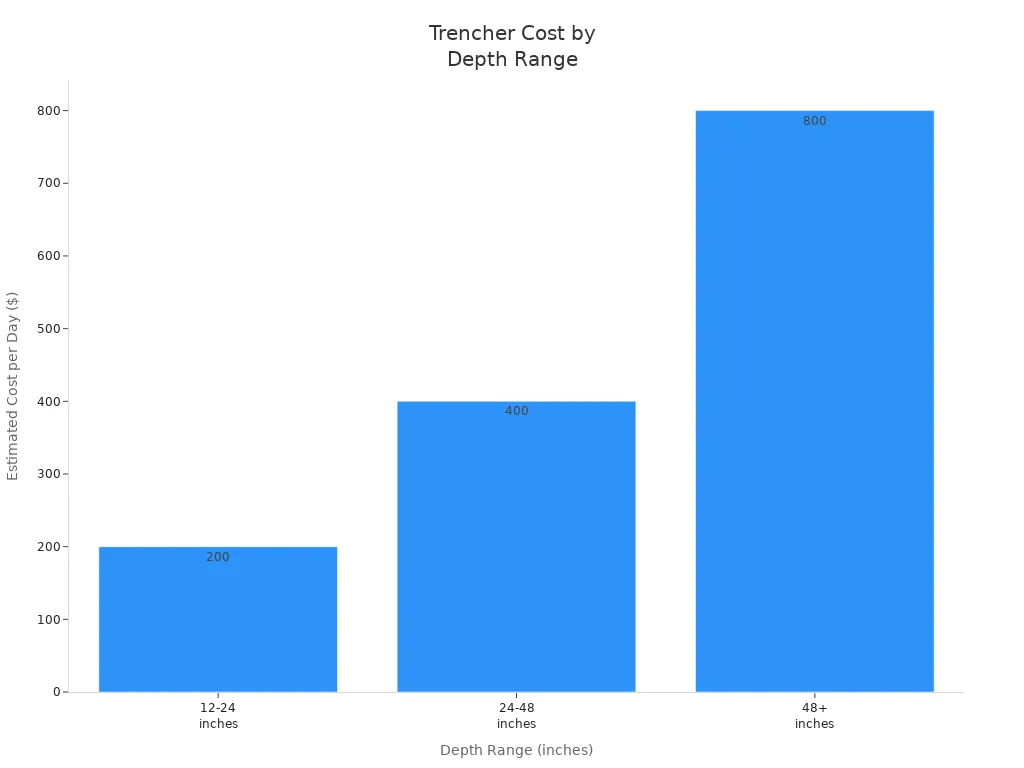
Trench dimensions play a major role in your equipment decision. Trenchers excel at creating uniform, shallow to medium-depth trenches. For most irrigation, electrical, or drainage lines, you will need a trench between 12 and 48 inches deep. Walk-behind trenchers handle shallow jobs efficiently, while ride-on and track trenchers tackle deeper cuts.
The table below helps you select the right trencher for your required depth and budget:
| Depth Range (inches) | Recommended Trencher Type | Estimated Cost per Day |
|---|---|---|
| 12-24 | Walk-behind trencher | $200 |
| 24-48 | Mid-size ride-on trencher | $400 |
| 48+ | Large track trencher | $800 |
Always add 6 inches to your required depth for proper bedding material.
Mini excavators offer more flexibility for variable trench widths and depths. If your project requires trenches deeper than 48 inches or with irregular shapes, you will benefit from the excavator’s adjustable boom and bucket sizes. You can also use a mini excavator for wider trenches or when you need to dig footings and pits in addition to standard trenches.
Observação: For long, straight, shallow trenches, a trencher will save you time and money. For deep, wide, or irregular trenches, a mini excavator gives you more control and versatility.
Obstacles on your site can quickly change your equipment needs. You may encounter tree roots, underground utilities, or uneven terrain. Mini excavators handle these challenges better due to their design and maneuverability.
Trenchers perform best on open, obstacle-free sites. If you need to trench around trees, across slopes, or near existing utilities, you will find a mini excavator safer and more precise. You can dig carefully around hazards and adjust your trench path as needed.
Dica profissional: Walk your site before starting. Identify obstacles and plan your trench route. If you see many roots, slopes, or buried lines, choose a mini excavator for safety and flexibility.
Your budget and experience level play a major role in choosing between a trencher and a mini excavator. You want to maximize value while minimizing risk and unexpected costs. Start by looking at your total project budget, including equipment rental or purchase, fuel, maintenance, and labor.
If you have a tight budget or run a small contracting business, compact trenchers often make more sense. You spend less up front and keep operating costs low. Here are some reasons why compact machines help you stay within budget:
When you rent, compare daily and weekly rates. Trenchers usually cost less per day and require fewer labor hours, which means you save on both equipment and wages. Mini excavators cost more to rent and operate, especially if you need attachments or extra time for cleanup.
Dica: Always factor in the cost of cleanup and backfilling. Trenchers create less mess, so you spend less on labor and site restoration.
Skill level matters just as much as budget. If you have limited experience with heavy equipment, you will find trenchers easier to operate. Most walk-behind and ride-on trenchers use simple controls and require minimal training. You can dig straight, uniform trenches with little practice. This reduces the risk of mistakes and costly rework.
Mini excavators demand more skill. You need to master multiple controls, manage attachments, and work safely around obstacles. If you lack experience, you may need to hire a skilled operator, which adds to your labor costs. Mistakes with a mini excavator can lead to wider trenches, more soil to move, and higher cleanup expenses.
| Fator | Valetadeira | Miniescavadeira |
|---|---|---|
| Custo inicial | Mais baixo | Mais alto |
| Fuel & Maintenance | Mais baixo | Mais alto |
| Skill Requirement | Básico | Avançado |
| Labor & Cleanup | Mínimo | More extensive |
| Versatilidade | Limited to trenching | Multi-tasking capability |
Observação: If you want to keep costs down and finish the job with minimal training, choose a trencher. If your project requires more versatility and you have the skills or access to a trained operator, a mini excavator can be a smart investment.
You should always match your choice to your budget and comfort level. By doing so, you avoid costly surprises and ensure your trenching project runs smoothly from start to finish.
You want to install a new irrigation system for a large backyard. The project requires 250 feet of straight, shallow trenching through soft loam. You choose a walk-behind trencher. You finish the job in under five hours, including cleanup. The narrow trench leaves minimal soil to backfill, and you restore the lawn quickly. Your total rental and labor costs stay under $350.
A neighbor attempts the same project with a mini excavator. The digging takes nearly ten hours. The wider trench creates a large spoil pile, which adds two more hours for cleanup and backfilling. The total cost rises to over $500 due to extra labor and equipment time. For straightforward irrigation jobs, you save both time and money by choosing a trencher.
Dica: For long, straight irrigation lines in soft soil, a trencher delivers the fastest, cleanest results.
Utility contractors often face strict deadlines and need precise trench dimensions. Consider a project that involves installing 425 feet of electrical conduit along a straight path. You use a trencher and complete the work in 5.5 hours. The trench meets code requirements for width and depth, and you finish the job in one day.
If you use a mini excavator for the same job, you spend 15 hours digging and cleaning up. The trench is wider and less uniform, which increases backfilling time. The project stretches into a second day, raising labor and rental costs.
You can compare the two machines using the table below:
| Doença | Trencher Performance | Mini Excavator Performance |
|---|---|---|
| Long, Straight Utilities | Completes in half the time (e.g., 425 ft in 5.5 hrs) | Takes 15 hours for the same job |
| Soil Type (Sand, Loam, Clay) | Cuts through easily, 40-100+ ft/hr | Slower in these conditions |
| Precise Trench Dimensions | Exact widths and flat bottoms | Less precision |
| Soil Disruption | Removes 30-50% less soil | Digs more soil |
| Tight Timelines | Finishes in one day | May take 2-3 days |
You gain a clear advantage with a trencher for utility line projects that require speed and accuracy in open, soft ground.
You encounter rocky soil while trenching for a drainage line. The trencher struggles with rocks larger than a few inches. The cutting teeth wear down quickly, and you risk damaging the machine if you hit buried debris or concrete. Progress slows, and you spend extra time on repairs.
You switch to a mini excavator equipped with a reinforced rock bucket. You adjust your digging approach when you hit resistance. You use a hydraulic hammer to break up larger rocks and concrete. The mini excavator powers through the obstacles, allowing you to finish the trench safely and efficiently.
Observação: For rocky or unpredictable soil, you avoid costly delays and equipment damage by choosing a mini excavator.
Choosing between a trencher and a mini excavator can feel overwhelming, but a clear checklist helps you make the right call for your project. Use this guide to quickly compare your options and avoid costly mistakes.
Follow these steps to decide which machine fits your needs:
Ask yourself: For a straight, shallow trench in soft soil, will a trencher save you time and money? For complex layouts or tough ground, does a miniescavadeira offer more value? The Trencher vs Mini Excavator decision often comes down to these practical details.
Watch for these warning signs that you may need to reconsider your equipment choice:
If you spot any of these issues, pause and reassess before renting or buying equipment.
Industry experts recommend these strategies to keep your trenching costs low:
| Consideration | Valetadeira | Loader with Trencher Attachment |
|---|---|---|
| Custo inicial | Mais alto | Mais baixo |
| Versatilidade | Limitado | More versatile for other tasks |
| Frequência de uso | Alto | Baixo |
| Produtividade | Mais alto | Mais baixo |
Tip: Review your checklist before making a final decision. The right choice between trencher and mini excavator can save you both time and money on every project.
You will save the most time and money by matching your equipment to your project’s specific needs. For straight, shallow trenches in soft soil, a trencher delivers speed and lower costs. Mini excavators excel in rocky ground or when you need versatility. Use the checklist to assess:
Careful planning ensures you choose the right machine and maximize your savings. Review your project details, select your equipment, and start your trenching job with confidence.
You use a trencher for fast, straight, shallow trenches with minimal cleanup. You choose a mini excavator for versatility, deeper or irregular trenches, and when you need to handle obstacles or multiple tasks on the job site.
You can operate most walk-behind trenchers with basic instruction. Mini excavators require more skill and practice. For safety and efficiency, review the equipment manual and consider watching training videos from reputable sources like OSHA.
You should use a mini excavator in rocky or root-filled soil. Its reinforced bucket and hydraulic power help you break through tough ground. Trenchers may struggle or suffer damage in these conditions.
You compare rental rates, labor hours, and cleanup time. Trenchers usually cost less for straight, shallow trenches. Mini excavators may save money on complex jobs. Use online calculators from industry sites like Para profissionais da construção for detailed estimates.
You must call your local utility locator service before digging. Mark all underground lines. Wear proper safety gear, including gloves, boots, and eye protection. Review safety guidelines from 811 and follow all local regulations.
Yes, you can. Mini excavators handle digging, grading, lifting, and demolition with the right attachments. This versatility makes them valuable for projects that require more than just trenching.
You choose a trencher for minimal soil disturbance and a narrow spoil pile. For mini excavators, plan your spoil placement and backfill as you go. Always restore the site promptly to reduce labor and prevent hazards.
You can follow construction forums and professional groups on LinkedIn ou Reddit’s Construction community. Industry websites like Mundo dos Equipamentos also provide regular updates and best practices.


-1.png)