E-mail: [email protected] Whatsapp: +8618266768780

E-mail: [email protected] Whatsapp: +8618266768780

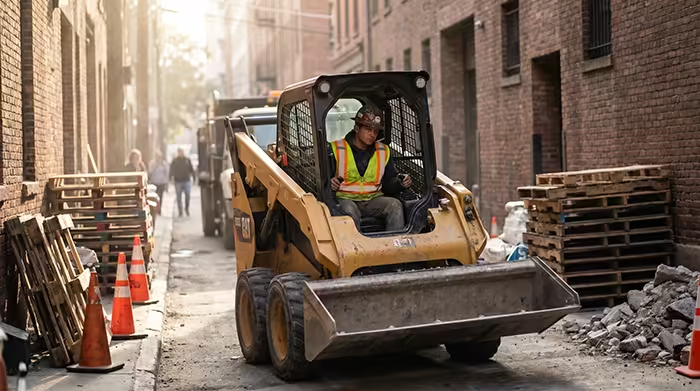
Today’s compact skid steer loader isn’t a compromise — it’s a deliberate engineering response to how modern construction actually works.
Índice
AlternarJob sites have fundamentally changed. Urban densification, tighter permitting zones, and the explosive growth of residential renovation projects mean contractors increasingly operate in spaces where a full-sized excavator simply can’t turn around. Narrow alleyways, enclosed backyards, and indoor demolition corridors demand machines that fit the environment — not the other way around.
The construction equipment industry has evolved to meet these demands. The global skid steer loader market is projected to reach approximately $12.56 billion by 2030, growing at a CAGR of 4.4% — a trajectory driven by contractor demand. That growth isn’t accidental. It tracks directly with urbanization rates, infrastructure retrofit cycles, and the rising cost of operating oversized equipment in undersized spaces.
Beyond the market numbers, what defines the modern compact skid steer is its role as a fleet consolidator. A single machine paired with the right attachment library can grade, dig, auger, sweep, and lift — tasks that once required three or four separate pieces of equipment. For small-to-mid-size contractors, that translates directly to lower overhead, simpler logistics, and faster job mobilization. Operators looking at high-capacity options for confined spaces are finding that compact doesn’t mean limited anymore.
The underlying engineering philosophy driving all of this is straightforward: maximize productive output within the smallest possible chassis footprint. Hydraulic system advancements, reinforced boom geometry, and refined counterweight distribution have pushed rated operating capacities to levels that would have seemed implausible in a machine this size just a decade ago.
This is where the conversation becomes interesting — because understanding how manufacturers are squeezing serious lifting power into compact frames requires a closer look at the engineering behind rated operating capacity, and why that single number has become the defining benchmark for job site performance.
Compact skid steer loaders have redefined what “capable” means on a jobsite by packing industry-competitive lifting power into a fraction of the footprint traditional machinery requires.
Capacidade Operacional Nominal (ROC) is the cornerstone metric every operator needs to understand before selecting a machine. Defined as 50% of a loader’s tipping load, ROC represents the maximum weight a machine can safely lift without compromising stability or operator safety. It isn’t just a spec-sheet number — it’s a legal and practical safety threshold that determines which tasks a machine can handle without risking tip-overs or structural stress.
De acordo com SkyQuest Technology, mid-range skid steer loaders rated between 1,251 and 2,200 lbs ROC hold the largest market share in the segment — and the reason is straightforward. That range hits the sweet spot between raw power and the kind of maneuverability that tight residential lots, landscaping corridors, and urban renovation sites actually demand.
Hydraulic system advancements are largely responsible for this performance leap. Modern compact loaders now feature high-flow auxiliary hydraulics that deliver exceptional breakout force and lift height — capabilities once reserved for machines twice their size. The practical benefits of that 1,251–2,200 lbs ROC range include:
When contrasted directly with traditional full-sized excavators, compact loaders win on speed and accessibility for tasks under 2,000 lbs — digging shallow trenches, grading driveways, or clearing demolition debris.
Bold callout: A modern compact loader in the mid-ROC range can consume up to 40% less fuel per operating hour than a full-sized excavator performing comparable light-to-medium tasks.
That efficiency advantage compounds further when you consider what happens when the right attachments enter the picture — which is exactly where this machine’s true versatility begins to unfold.
A compact skid steer loader’s true value isn’t measured by its bucket alone — it’s measured by how many specialized machines it can replace in a single workday.
The right attachment library transforms one loader into an entire equipment fleet. For anyone asking o que é uma minicarregadeira beyond its most basic definition, the honest answer is: a universal power platform. Hydraulic hammers break concrete and hardpan. Augers drill fence posts and footings. Trenchers cut utility lines with precision that manual crews simply can’t match at scale.
The productivity difference between attachment-assisted work and traditional manual labor is significant. According to the Construction Efficiency Journal, specialized attachments like hydraulic hammers and augers can increase jobsite productivity by up to 40% compared to manual labor. The table below illustrates how that plays out in practice:
| Tarefa | Manual Labor Speed | Attachment-Assisted Speed |
|---|---|---|
| Digging a 100-ft trench | 6–8 hours (2-person crew) | ~1.5 hours (trencher) |
| Drilling 10 fence post holes | 3–4 hours | ~45 minutes (auger) |
| Breaking 50 sq. ft. of concrete | 4+ hours | ~1 hour (hydraulic hammer) |
Morning-to-afternoon workflow flexibility is where the financial argument becomes undeniable. As noted by Coherent Market Insights, a single skid steer equipped with a trencher in the morning and a bucket or sweeper in the afternoon replaces multiple specialized machines — each of which would otherwise carry its own purchase price, insurance, and maintenance overhead.
For contractors evaluating which loader capacity fits your operation, the ROI calculation becomes straightforward: one machine plus a targeted attachment library consistently outperforms five narrow-purpose tools, both in upfront cost and long-term utilization rate.
That same operational flexibility proves equally compelling in specialized environments — which is why landscapers and farmers have made compact loaders their go-to choice.
Compact construction equipment is the gold standard for landscaping and farming professionals who need serious capability without tearing up the environments they’re hired to improve.
Low ground pressure is often the deciding factor — not raw horsepower — when choosing equipment for sensitive turf, cultivated soil, or finished lawns. Wheeled and tracked mini skid steers distribute their weight across a wider footprint than traditional heavy machinery, meaning they move through a residential backyard or a planted field without leavingg the deep ruts that trigger expensive restoration work afterward. In practice, that translates directly to lower post-job costs and stronger client relationships.
Landscaping applications are where compact loaders have become nearly indispensable. A single machine paired with the right attachment handles grading, mulch spreading, sod installation, and debris removal across a single visit. According to the Construction Efficiency Journal, augers can dig post holes five times faster than manual methods, while brush cutters clear overgrowth three times faster — a productivity edge that compounds across a busy season. For tight residential gates and landscaped beds where a full-size machine simply won’t fit, options like this side-by-side capacity comparison help operators match the right frame to the job.
Farming use cases extend well beyond the fields themselves:
On the other hand, operators working on particularly delicate agricultural soil should weigh tracked configurations carefully, as track spread further reduces ground pressure on soft terrain. As the equipment landscape itself continues to evolve — with new manufacturers and power sources entering the conversation — the options available to landscapers and farmers are only expanding.
The global earthmoving equipment landscape is shifting fast, and Chinese OEMs are now a legitimate force reshaping how compact loaders are designed, priced, and powered.
The quality gap between Chinese-manufactured and legacy Western brands has narrowed significantly — and in some categories, closed entirely. Manufacturers entering global markets from China are now delivering machines with competitive hydraulic systems, robust steel frames, and increasingly sophisticated operator controls. Global supply chains have made components — from high-flow hydraulic pumps to reinforced lift arms — more accessible across regions, driving down costs and accelerating product development cycles for buyers everywhere.
One practical pattern is seeing this shift play out at the controls level. The “old-school vs. new-tech” debate is real: experienced operators often favor traditional hand-and-foot lever systems for their tactile feedback, while newer ISO/H-pattern joystick controls are winning over a younger generation of operators. Some current-generation machines now offer switchable control patterns, effectively ending the argument by accommodating both preferences on the same platform.
Perhaps the most consequential development, however, is the emergence of electric skid steer loaders. According to Briefing Construção, Chinese OEMs have recently launched electric models specifically to meet urban noise ordinances and tightening emissions regulations — a direct response to municipalities and contractors working in zero-emission zones, warehouses, and indoor demolition environments.
“Electric skid steers represent a fundamental rethinking of where compact loaders can work — not just what they can do.” — Industry commentary reflecting the 2025 shift toward emission-free job sites.
For contractors managing indoor concrete work, greenhouse grading, or urban utility projects, a zero-emission machine isn’t a luxury. It’s the only viable option. On the other hand, diesel models retain a clear advantage in remote or heavy-cycle outdoor applications where charging infrastructure doesn’t exist.
Mastering which power source fits which job site is only part of the equation — knowing how to operate these machines safely and efficiently is where real productivity gains are unlocked.
Knowing how to operate a compact skid steer correctly is what separates a productive job site from a costly one — and the gap is wider than most operators expect.
Best practices, safety discipline, and consistent maintenance together determine whether you capture a machine’s full potential.
Grading and earthmoving in tight spaces demand deliberate technique. Approach cuts in small, controlled passes rather than attempting to move maximum material in a single push. Feathering the hydraulic controls — rather than making sharp, jerky inputs — keeps the machine stable and protects surrounding structures. According to Industry Training Standards, proper grading technique with a skid steer can reduce project timelines by 20% compared to traditional methods, a gain that compounds across multi-phase projects.
High-ROC operations introduce additional risk. When running a machine near its rated operating capacity, understanding the tipping load threshold is non-negotiable. Check out this breakdown of safe ROC limits and engine specs before pushing a machine to its upper range. Always keep the bucket low during travel, and never raise a loaded attachment over personnel.
⚠ Safety Callout: Never operate near the rated operating capacity on uneven or sloped terrain without first confirming ground stability. A skid steer’s center of gravity shifts significantly under full load — always lower the attachment before repositioning on grades.
Manutenção do sistema hidráulico is the single most overlooked factor in long-term machine durability. Replace hydraulic fluid at manufacturer-specified intervals, inspect hose fittings weekly for micro-leaks, and monitor fluid temperature during heavy-cycle operations. Heat is the primary killer of hydraulic components.
Operator training is where the phrase “small frame big power” becomes more than a marketing claim. Certified operators consistently outperform untrained counterparts, and that training investment directly underpins the 40% productivity gains cited across the industry’s 2025 performance data.
All of this raises a natural question: once you’ve mastered operations, is ownership actually the smartest financial move for your fleet?
Compact skid steers consistently deliver strong long-term asset value — making the buy-vs.-rent decision one of the most important calls any fleet manager will face in 2025.
Ownership beats rental when utilization exceeds roughly 60–70% of available working hours. Below that threshold, rental models reduce capital exposure without sacrificing access. However, as infrastructure spending accelerates globally — driven by urbanization in emerging economies, according to Grand View Research — machine demand is climbing steadily, which is pushing rental rates upward and making ownership increasingly attractive for contractors with consistent workloads.
Valor de revenda for compact loaders remains healthy compared to full-size equipment. Machines with versatile skid steer attachments compatibility, documented maintenance records, and lower hour counts routinely hold 50–65% of their original value at the three-year mark, according to auction data tracked by Ritchie Bros.. Total cost of ownership (TCO) analysis typically favors purchase when attachment versatility allows one machine to replace two or more specialized tools on a job site.
Wheeled vs. Tracked: A Quick Comparison
For operators working across mixed terrain, comparing platform options by capacity early in the buying process can prevent costly mismatches down the line.
Ultimately, the right configuration depends on job site conditions, utilization rate, and attachment needs — factors that tie directly into the broader buying framework covered in the next section.
Compact skid steer loaders have moved from job site convenience to strategic fleet asset — and buyers who recognize that shift are outpacing competitors on cost, speed, and versatility.
As noted by Coherent Market Insights, the machine’s primary value proposition is its ability to consolidate a fleet. That single insight captures why compact units are outperforming traditional heavy machinery across so many project types in 2025. Here’s what every equipment buyer should carry forward:
The bottom line: compact skid steers reward informed buyers. Matching ROC to workload, building a purposeful attachment inventory, and sourcing from proven manufacturers delivers the strongest long-term returns. If specific comparisons, lift capacities, or attachment recommendations are still on your list, the questions most buyers ask next are answered directly below.
Compact skid steer loaders generate plenty of questions from first-time buyers and seasoned operators alike — here are the answers that matter most.
Qual é a diferença entre um skid steer e um carregador de esteira?
The core distinction comes down to ground contact. A skid steer rides on four rubber tires, making it faster on hard surfaces like concrete and asphalt. A compact track loader uses rubber tracks, which distribute weight more evenly and perform better on soft, muddy, or uneven terrain. According to Gregory Poole Equipment, skid steers typically cost less upfront and are easier to transport between job sites, while track loaders offer superior traction in challenging ground conditions.
How much can a compact skid steer loader lift?
Rated operating capacity varies widely by model size. Entry-level mini units typically handle loads in the 300–500 kg range, while mid-size machines can lift 600–900 kg or more. Always reference the rated operating capacity — not the tipping load — when selecting a machine for a specific task. For example, the QL1100 mini skid steer carries a rated operating capacity of 300 kg with a tipping load of 500 kg, a practical balance for residential and light commercial work.
Are Chinese-made skid steers reliable for US job sites?
Reliability increasingly depends on the manufacturer, not the country of origin. According to SkidPro’s 2025 brand analysis, buyers should evaluate warranty terms, parts availability in the US, and documented field performance before purchasing. In practice, well-engineered Chinese-made machines equipped with recognized component brands — Cummins engines, Bosch hydraulics — perform competitively on American job sites when maintained correctly.
What are the most essential attachments for landscaping?
For landscaping applications, bucket, auger, trencher, and brush cutter attachments cover the broadest range of tasks. Mini skid steers are increasingly preferred for landscaping work because they fit through standard 36-inch gates, according to Landscaping Equipment Digest — making compact size as important as raw power when selecting your configuration.
Shandong Qilu Industrial Co., Ltd. é um fabricante e exportador profissional que integra o desenvolvimento e produção de escavadeiras, carregadeiras e tratores. Nós fornecemos o melhor serviço, absolutamente.


-1.png)
Alguma dúvida, orçamento ou consulta? Clique no botão para enviar mensagem.
A Qilu Industrial estará sempre aqui para ajudar.