E-mail: [email protected] WhatsApp: +8618266768780
E-mail: [email protected] WhatsApp: +8618266768780


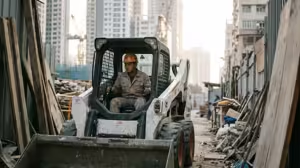
Urban job sites are shrinking. Deadlines aren’t. That pressure is rewriting the equipment playbook — and the mini excavator for construction is emerging as the defining machine of the decade.
The global mini excavator market is projected to grow at a CAGR of 4.4% through 2030, driven largely by urban infrastructure demands and an accelerating labor shortage across North America and Europe (Grand View Research). That’s not incremental growth — it’s a structural shift in how fleet managers think about ROI per square foot of job site.
Market Outlook Compact equipment adoption is accelerating as cities densify and skilled operator pools shrink. The 0.8T–3.5T segment is positioned to capture a disproportionate share of new fleet investment through 2026 and beyond. Factory-direct sourcing is fast becoming the preferred channel for procurement teams managing 5+ unit fleets.
Three forces are converging to push mini excavators past their full-size counterparts in fleet priority. First, urban infrastructure projects increasingly require zero-tail-swing capability — the ability to rotate a full 360 degrees without the counterweight overhanging the machine’s track width. In tight corridors, utility trenches, and basement renovations, that feature isn’t a luxury; it’s a job prerequisite. The sub-4-ton segment is dominating procurement conversations precisely because these machines fit where standard iron simply can’t.
Second, labor shortages are driving demand for machines that experienced operators and newer hires alike can run efficiently. Intuitive controls, reduced fatigue designs, and multi-attachment compatibility are reducing training time and increasing daily output per operator.
Third, the procurement model itself is evolving. Traditional dealer retail — with its markup layers and inventory constraints — is losing ground to factory-direct B2B sourcing, which delivers better per-unit pricing, configurable specifications, and faster fleet scaling.
Menurut Mini Excavator Buyer’s Guide 2026, the sweet spot for ROI sits firmly in the 0.8T to 3.5T range — versatile enough for diverse site conditions, light enough to transport without special permits, and powerful enough to handle the majority of commercial and agricultural tasks.
The question isn’t whether a mini excavator belongs in your 2026 fleet. It’s which tonnage, which configuration, and which sourcing strategy will maximize your return — and that starts with understanding exactly what your job site demands.
Before evaluating a single spec sheet, the most productive question a fleet manager can ask is brutally simple: what will this machine actually do, day in and day out? The answer determines everything — tonnage class, attachment compatibility, undercarriage type, and ultimately whether a factory-direct order will pay off or become an expensive mismatch sitting idle on-site.
Urban and commercial construction demands a fundamentally different machine profile than open-ground work. Tight foundation digs, utility trenching between existing structures, and basement excavations all require zero-tail-swing design — a feature that’s rapidly shifting from premium option to baseline expectation. According to Dunia Peralatan, zero-tail-swing models are becoming the regulatory standard for urban construction sites to prevent accidents in confined areas.
A mini excavator for tight spaces also needs robust auxiliary hydraulics to power concrete-breaking attachments — hydraulic breakers, augers, and plate compactors. Without the right hydraulic flow rate, even the best attachment becomes unreliable. Precision arm control and a tight swing radius aren’t just conveniences; on a dense urban site, they’re liability reducers. If you’re sourcing for construction-focused fleets, explore compact model comparisons to identify which configurations ship ready for auxiliary tool use.

Farm and rural site work flips the priority list. Soft, wet soil conditions demand low ground pressure — typically achieved through rubber tracks with wider footprints — to avoid tearing up fields or becoming stuck. Reach matters enormously for drainage channel work, where the machine may need to work from an embankment edge at full arm extension. Fence post installation and orchard management add versatility requirements: quick-coupler systems and a reliable tilt-rotator interface save hours across a full season.
| Industri | Key Requirement | Recommended Tonnage |
|---|---|---|
| Konstruksi Perkotaan | Zero-tail swing, breaker-ready hydraulics | 1.7T – 3.5T |
| Utility / Infrastructure | Dig depth, trench precision | 2.5T – 3.5T |
| Agriculture / Landscaping | Low ground pressure, versatility | 1.0T – 2.0T |
| Rural Site Clearing | Reach and bucket capacity | 2.5T – 3.5T |
The 1.0T class excels in greenhouse or indoor applications where weight is critical. The 3.5T range is the workhorse ceiling for most B2B fleet operators before you move into mid-range excavator territory.
Before finalizing any order, confirm the following four points against your actual site conditions:
Nailing this duty-cycle assessment protects your sourcing decision from the start — and sets up the next critical evaluation: whether the machine’s hydraulic system is built to perform that duty cycle efficiently over years of real-world use.
Once you’ve mapped your duty cycle — whether that’s urban construction, agricultural trenching, or a hybrid of both — the next filter is mechanical: does the machine’s hydraulic system match the demands you’ve just defined? In 2026, that answer increasingly comes down to one architecture.
Load-sensing hydraulics are no longer a premium upgrade. They’re the baseline expectation for any serious B2B fleet acquisition.
Traditional fixed-displacement hydraulic systems deliver constant pressure regardless of what the attachment is actually doing — an inefficient approach that wastes energy and accelerates wear. Advanced hydraulic systems in modern mini excavators now allow for load-sensing capabilities that automatically adjust power flow based on resistance, according to Equipment World. In practice, this means the pump delivers exactly the pressure needed for each task — no more, no less.
For a fleet manager, the downstream effect is straightforward: consistent breakout force on heavy clay one minute, precise bucket control during grading the next — all without manual adjustment between tasks.
Load-sensing architecture directly enables the kind of fine-motor control that distinguishes a capable operator from a frustrated one. This is especially relevant for the zero tail swing mini excavator category, where the machine’s entire value proposition hinges on working accurately within tight structural clearances. Poor hydraulic response in confined spaces doesn’t just slow production — it creates liability. For a deeper breakdown of how these configurations perform across real-world scenarios, this overview of compact excavator configurations is worth reviewing before finalizing specs.
On the other hand, it’s worth noting that load-sensing systems do introduce greater hydraulic complexity. More sophisticated components mean more detailed maintenance protocols — a caveat worth building into your total cost of ownership estimate.
Fuel is one of the most controllable operating costs in a mini excavator fleet, and hydraulic efficiency is the primary lever. Because load-sensing systems eliminate unnecessary pressure generation during low-resistance tasks, fuel draw drops proportionally during lighter work cycles. Across a multi-unit fleet operating daily, those incremental savings compound quickly.
Verification Checkpoint: During any demo or pre-purchase inspection, test hydraulic responsiveness across three scenarios — maximum dig depth under load, slow-speed grading on flat terrain, and rapid directional changes during swing cycles. Inconsistent response times, audible pressure spikes, or delayed attachment engagement are red flags that indicate either an outdated fixed-displacement system or worn components in a used machine.
Understanding what the hydraulic standard should look like is one thing. Knowing how to source a machine built to that standard — without paying retail margins — is where the real fleet strategy begins.
With your hydraulic requirements mapped and your duty cycle clearly defined, the next critical decision is where you source your machines. For fleet managers operating at scale — whether deploying equipment for urban construction or sourcing a reliable mini excavator for farm work — the difference between a dealer-purchased unit and a factory-direct import can represent a margin-defining cost advantage.
Dealer networks serve a purpose, but that purpose comes at a price. A standard distribution chain typically adds 18–30% in cumulative markup before a machine reaches your fleet. Factory-direct sourcing eliminates those intermediary layers, redirecting that margin back into your capital budget. For a fleet manager acquiring five to fifteen units annually, that savings differential compounds quickly into a meaningful ROI improvement — often enough to fund one additional machine per procurement cycle.
The business logic is straightforward: when you buy directly from a manufacturer like Shandong Qilu, you’re paying for the machine, not the logistics of the dealer ecosystem. Understanding how to evaluate the right machine specs before entering those manufacturer conversations ensures you’re negotiating from an informed position.
One practical advantage that rarely appears in dealer catalogs is factory-level customization. Machines in the 0.8T to 3.5T range can be configured to your precise operational requirements — from bucket capacity and arm length to cab configuration, auxiliary hydraulic circuits, and track width for specific soil conditions.
The typical factory-direct process follows a clear flow:
“A factory-direct relationship isn’t just a purchasing decision — it’s a service infrastructure decision. The manufacturer who builds your machine is also your fastest path to parts, technical documentation, and field support when something needs to be resolved.”
After-sales capability is where many importing arrangements break down. A 24-hour resolution standard — meaning a manufacturer commits to responding to technical or parts inquiries within one business day — should be treated as a non-negotiable benchmark, not a bonus feature. According to the Mini Excavator Buyer’s Guide 2026, downtime costs in the compact equipment segment often exceed the value of the repair itself when project timelines are factored in.
Before executing an export contract, confirm the following directly with the manufacturer:
Getting clear, documented answers to these questions separates credible manufacturing partners from fulfillment-only vendors. How well a manufacturer answers them also previews something equally important: how their support structure will affect your long-term costs — which is exactly where the next conversation needs to go.
Memilih best mini excavator 2026 isn’t just about peak performance on the job site — it’s about what the machine costs you every month for the next five to seven years. After locking in your sourcing strategy, the total cost of ownership (TCO) calculation is where smart fleet managers separate short-term price wins from long-term financial gains.
Factory-direct units built to 2026 standards increasingly prioritize centralized lubrication points and open-access engine bays as baseline design features, not premium add-ons. According to Panduan Peralatan Konstruksi, maintenance costs can be reduced by up to 25% when machines are designed with centralized lubrication systems and easy-access engine compartments.
Key serviceability features to verify before purchasing:
These aren’t cosmetic preferences — they directly reduce technician labor hours per service interval, especially critical when managing a fleet across multiple job sites.

Modern factory-direct excavators now ship with embedded telematics and load-monitoring sensors that feed real-time data to fleet management dashboards. What typically happens in practice is that operators receive component-specific alerts — hydraulic filter saturation, abnormal swing bearing temperatures, idle-time waste — before failures escalate into costly downtime. This technology shifts maintenance from reactive to condition-based scheduling, protecting both margins and project timelines.
| Kategori Biaya | Annual Estimate |
|---|---|
| Scheduled maintenance | $2,800 – $4,200 |
| Unscheduled repairs | $900 – $2,500 |
| Telematics/software | $300 – $600 |
| Total Annual TCO | $4,000 – $7,300 |
Reviewing compact options with strong serviceability ratings — such as those covered in this breakdown of tight-space performers — reinforces that the best machines for long-term fleet ROI balance dig performance with field-friendly design.
Even with a solid maintenance plan, however, there are acquisition and operational mistakes that consistently erode TCO gains in the 2026 market — and knowing them in advance can save significant capital.
Any solid panduan pembeli mini excavator 2026 will tell you that knowing what not to do is just as valuable as knowing what to buy. Even experienced fleet managers make avoidable errors when purchasing pressure is high and timelines are tight. Here are the five most costly mistakes — and how to sidestep each one.
1. Over-prioritizing initial price over hydraulic technology. A lower sticker price loses its appeal fast when auxiliary hydraulic flow can’t power your most productive attachments. Solution: Compare auxiliary flow rates and hydraulic pressure specs directly against your planned attachment requirements before any price negotiation begins.
2. Ignoring zero-tail-swing requirements for urban contracts. Urban job sites — utility trenching, streetscape renovation, tight residential lots — demand machines that rotate within their own footprint. Winning those contracts then discovering your fleet can’t operate safely close to walls is an expensive oversight. If compact urban work is part of your growth strategy, matching swing radius to your site constraints should be a non-negotiable early filter, not an afterthought.
3. Failing to verify 24-hour technical support availability. Menurut Typhon Machinery, many buyers fail to account for the “hidden” costs of downtime when purchasing from brands without dedicated 24-hour technical support. A machine sitting idle for 48 hours waiting on a callback can erase weeks of margin on a single project. Solution: Request documented support SLAs before signing any purchase agreement.
4. Underestimating attachment compatibility. Not all quick-coupler systems are universal. Purchasing a machine that requires proprietary adapters — or worse, can’t accept your existing attachments — multiplies your equipment costs unnecessarily. Solution: Confirm coupler standards and hydraulic compatibility across your entire planned attachment inventory. Our overview of versatile compact models illustrates how the right platform design dramatically broadens your tool-carrying options.
5. Neglecting factory-direct customization capabilities. Standard configurations rarely match every fleet’s operational reality. Buyers who skip the customization conversation often pay premium aftermarket prices for modifications that a factory-direct supplier could have built in from the start. Solution: Ask prospective suppliers explicitly about available hydraulic flow adjustments, boom configurations, and cab options before finalizing specifications.
Avoiding these five mistakes positions your procurement process well — and sets up the real-world questions that experienced operators still ask most often.
The video above walks through real-world model comparisons for 2026 — a strong final checkpoint before you commit to a purchase decision.
The right mini excavator purchase is never just about the machine — it’s about the total system surrounding it. After covering specs, TCO, factory-direct sourcing, and common pitfalls, a few critical questions consistently surface among B2B fleet buyers.
What is the best tonnage for residential landscaping?
In practice, the 1.5- to 2-ton range hits the sweet spot for residential landscaping. These machines navigate standard gate openings, minimize turf damage, and still deliver meaningful digging force. A compact zero-tail-swing unit in this class can work alongside fences and foundations without costly rework. For heavier grading tasks, 3-ton models offer more versatility without sacrificing maneuverability significantly.
How do factory-direct warranties work for international buyers?
Factory-direct warranties typically cover 12–24 months on major components, with terms outlined in the sales contract. Reputable manufacturers ship full parts documentation, provide remote diagnostic support, and maintain regional parts depots. Always clarify whether warranty claims require return shipping or allow local repair reimbursement — this detail materially affects your total cost of ownership.
Can I customize hydraulic flow for specific attachments?
Yes — and this is a meaningful advantage of going factory-direct. According to Shandong Qilu Industrial, factory-direct manufacturers typically offer more flexible customization for hydraulic auxiliary lines than mass-market retail brands, allowing flow rates and pressure settings to be matched precisely to augers, breakers, or mulching heads before the unit ships.
The 2026 factory-direct mini excavator market rewards prepared buyers. Prioritize verified suppliers, total lifecycle cost, and customization flexibility — and your fleet investment will compound well beyond the first job site.


-1.png)