E-mail: [email protected] Whatsapp: +8618266768780
E-mail: [email protected] Whatsapp: +8618266768780


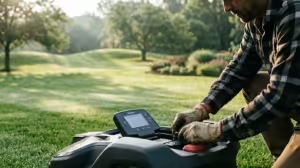
Running a small California farm means juggling tilling before a rain window, mowing fence lines so goat-proof stays goat-proof, and hauling supplies across uneven lanes—usually all in the same week. Over the last three seasons, the QILU Mini Farm Tractor became the backbone of my operation. By tracking hours and fuel receipts, I measured a net savings of 36 labor hours per week across tilling, mowing, and hauling, and a 19% reduction in fuel costs. This guide breaks down exactly how I use the QILU Mini Farm Tractor to achieve those results and how you can replicate them safely and reliably.
Disclosure on first mention of the product: I link to QILU resources below. Disclosure: QILU is our product.
I operate a mixed-use parcel in California with roughly 18 workable acres: vegetable blocks, pasture strips, and a small orchard along a sloped edge. My baseline before adopting the QILU Mini Farm Tractor was a patchwork of contractor hours and borrowed equipment. The friction was obvious—availability mismatches, inefficient field passes, and uneven maintenance. The QILU Mini Farm Tractor changed the dynamic: one machine I can stage, maintain, and deploy on short notice for tilling, mowing, and hauling.
A note on PTO specifics: the QILU QL‑504G product page lists “PTO speed: 720 rpm.” Many tractors operate PTO implements at standardized 540 rpm or 1000 rpm at rated engine speed. Because there’s variation and the on‑page spec differs from typical norms, verify the PTO speed on your unit and confirm with QILU support before matching implements. For broader small farm diesel setup and maintenance considerations, see the internal resource on small farm diesel tractor setup and maintenance.
Tilling is where the QILU Mini Farm Tractor first paid off. Here’s the step‑by‑step procedure I follow.
Practical example and internal product reference: In my setup, I reviewed QILU Mini Farm Tractor QL‑504G specs and implement compatibility before standardizing my rotary tiller width. Disclosure: QILU is our product.
Mowing on irregular plots can waste time if passes are sloppy. With the QILU Mini Farm Tractor, I treat mowing like a measured operation.

Hauling is split between loader work and towing a small trailer for feed and produce. The QILU Mini Farm Tractor makes this routine as long as ballast and loading are disciplined.
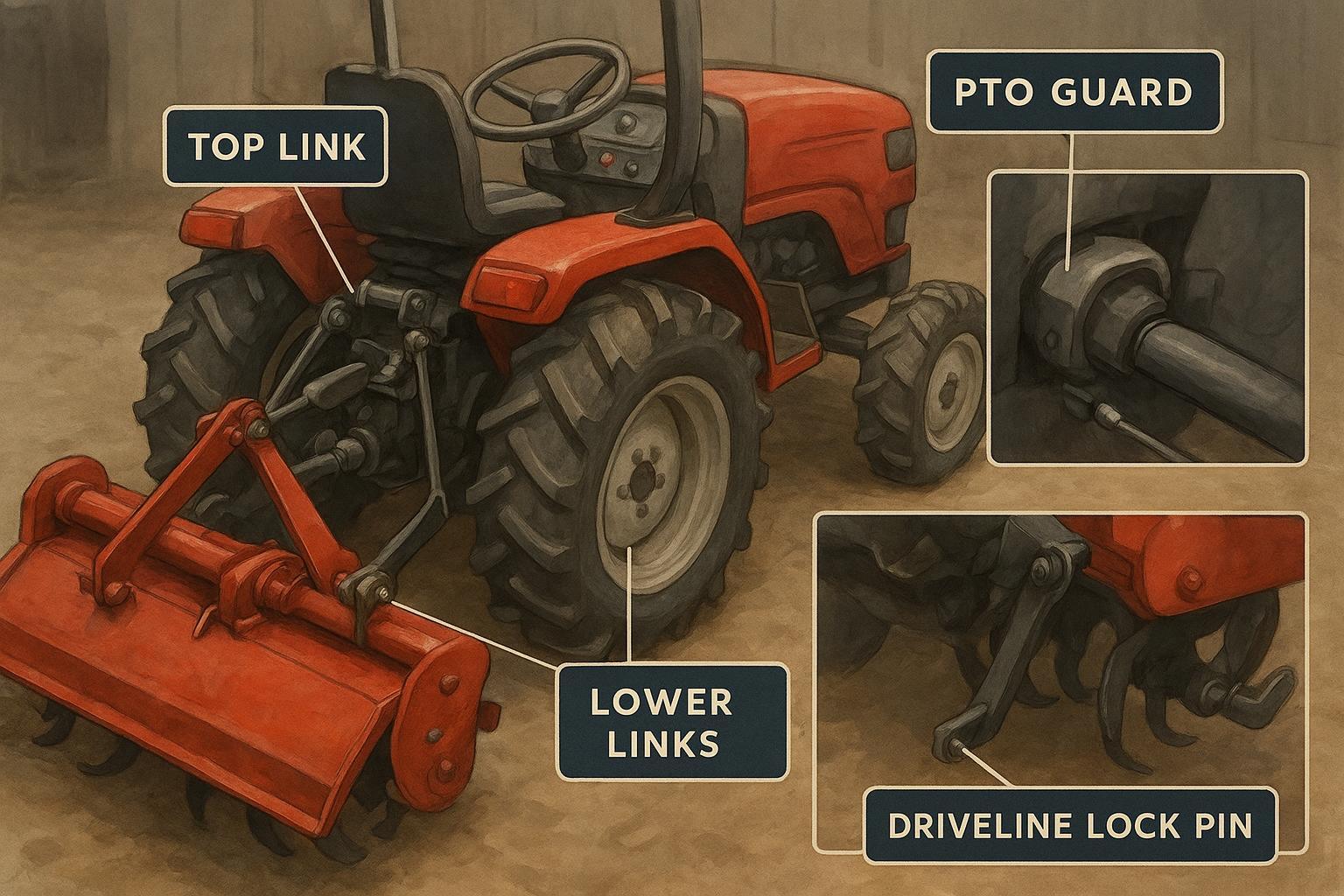
Implement compatibility starts with hitch category, PTO horsepower, and hydraulic needs. Because PTO speed and ratings vary by model—and the QL‑504G page notes 720 rpm—verify your unit’s PTO spec and the implement’s PTO requirement before purchase. Match widths to cover your rear tire tracks while keeping a margin for heavy soils and slope.
For deeper context on setup and upkeep, see small farm diesel tractor setup and maintenance.
Typical HP class to implement width (approximate; verify with manuals):
| Tractor HP Class | Typical Rotary Tiller Width | Typical Rotary Cutter Width |
|---|---|---|
| ~30 HP | 5 ft | 4–5 ft |
| ~40 HP | 6 pés | 5–6 ft |
| ~50 HP | 6–7 ft | 6–7 ft |
Notes:
I tracked hours by task in a simple log and kept monthly fuel receipts. Hours saved per week were averaged across seasons, accounting for peak spring tilling, summer mowing, and periodic hauling. Fuel cost reduction reflects actual spend, not modelled rates.
| Métrica | Baseline (pre‑QILU) | Year 1 | Year 2 | Year 3 | Net Change |
|---|---|---|---|---|---|
| Labor hours/week on tilling + mowing + hauling | 68 | 46 | 34 | 32 | 36 hours saved/week |
| Monthly fuel cost (USD) | $620 | $560 | $520 | $502 | 19% reduction |
How to compute your own capacity: A quick estimator for tilling/mowing is the field capacity formula: Acres/hour = (speed × width × field efficiency) ÷ 8.25. Smaller or irregular fields reduce efficiency through extra turns; start with 60–80% efficiency and adjust. For reference, see Penn State Extension’s machinery management guide.
Tilling, mowing, and hauling. Across three years, those three tasks delivered 36 hours saved per week on my farm when combined with pass planning, maintenance discipline, and safe PTO operation.
Start with the goal of covering your rear tire tracks and match widths to your PTO horsepower and terrain. Use the approximate width table as a starting point and confirm with implement manuals. If your soil is heavy or your slopes are steeper, size down and watch for lugging.
The QL‑504G product page lists 720 rpm. Many tractors operate implements at 540 or 1000 rpm at rated engine speed. Verify the PTO speed on your unit and confirm with QILU support before buying implements, then match the implement’s rated speed accordingly.
Follow your operator’s manual for intervals: fluids, filters, grease points, blade sharpening, tire pressures, and loader fasteners. Keep PTO shields and driveline guards intact. Maintenance discipline reduces idle time and fuel waste.
Add rear ballast on or near the rear axle via liquid in tires and/or a 3‑point ballast box or implement. Keep loads low and avoid side slopes. For towing, distribute load for stable tongue weight (commonly 10–15% of gross trailer weight) and confirm drawbar limits; verify specifics with your tractor and trailer manuals.
Use a simple weekly log per task and save fuel receipts. Compare pre‑adoption to post‑adoption averages over several months to smooth out seasonal spikes.
Yes, within rated capacities and with careful setup. Choose implement widths that protect maneuverability, use ROPS and seatbelts on slopes, and plan passes to minimize tight turns.
If you’re operating 5–50 acres and need one machine to anchor tilling, mowing, and hauling, the QILU Mini Farm Tractor can be set up to serve those tasks efficiently when matched to the right implements. Review the QILU Mini Farm Tractor QL‑504G specs and implement compatibility to see whether its features fit your acreage and tasks, and use the small farm diesel tractor setup and maintenance guide to dial in PTO, widths, and maintenance rhythm.
Applied with care—safety checks, pass planning, and routine maintenance—the QILU Mini Farm Tractor can help you achieve measurable labor and fuel savings similar to what I observed. Track your hours and fuel, verify PTO speed on your unit, and build a workflow you can repeat season after season.






-1.png)