Bem-vindo ao Shandong Qilu Industrial Co., Ltd

 Portuguese
 English
 Arabic
 Bulgarian
 Bengali
 Czech
Czech
 Danish
 German
 Greek
Greek
 Spanish
 Finnish
 French
 Hindi
Hindi
 Croatian
 Hungarian
 Indonesian
 Italian
 Japanese
 Korean
 Lithuanian
 Dutch
Dutch
 Norwegian
 Polish
 Romanian
 Russian
 Slovak
 Slovenian
 Swedish
 Thai
Thai
 Turkish
 Ukrainian
 Vietnamese
 Tagalog
 Malay
Malay
 Estonian
 Catalan
 Latvian
 Urdu
Urdu
 Serbian
 Persian
 Swahili
 Albanian
 Armenian
 Icelandic
 Bosnian
 Luxembourgish
 Afrikaans
Portuguese English
Arabic
Bulgarian
Bengali
Czech
Danish
German
Greek
Spanish
Finnish
French
Hindi
Croatian
Hungarian
Indonesian
Italian
Japanese
Korean
Lithuanian
Dutch
Norwegian
Polish
Romanian
Russian
Slovak
Slovenian
Swedish
Thai
Turkish
Ukrainian
Vietnamese
Tagalog
Malay
Estonian
Catalan
Latvian
Urdu
Serbian
Persian
Swahili
Albanian
Armenian
Icelandic
Bosnian
Luxembourgish
Afrikaans
Afrikaans
Portuguese English
Arabic
Bulgarian
Bengali
Czech
Danish
German
Greek
Spanish
Finnish
French
Hindi
Croatian
Hungarian
Indonesian
Italian
Japanese
Korean
Lithuanian
Dutch
Norwegian
Polish
Romanian
Russian
Slovak
Slovenian
Swedish
Thai
Turkish
Ukrainian
Vietnamese
Tagalog
Malay
Estonian
Catalan
Latvian
Urdu
Serbian
Persian
Swahili
Albanian
Armenian
Icelandic
Bosnian
Luxembourgish
Afrikaans

Como escolher um polegar hidráulico para sua mini escavadeira
Escolher o polegar hidráulico certo para sua miniescavadeira pode fazer com que o paisagismo e o manuseio de materiais funcionem de forma mais rápida, segura e limpa, especialmente quando você está colocando pedras, movendo toras ou apertando escovas sem arranhar superfícies acabadas. Este guia oferece um fluxo de trabalho passo a passo comprovado para dimensionar e especificar um polegar, verificar o ajuste com seu balde e acoplador e planejar o sistema hidráulico e o roteamento da mangueira para obter um controle preciso sem surpresas.
Principais conclusões
- Comece com a geometria: combine o comprimento do polegar com o raio da ponta do balde e inclua qualquer altura de pilha de acoplador rápido em sua medição.
- Para rochas, troncos e arbustos, polegares curvos e serrilhados de vários dentes aumentam a mordida e a cobertura; perfis retos podem melhorar a estiva e a visibilidade.
- O polegar do pino principal cobre normalmente cerca de 120010° de rotação; projetos de elos progressivos podem se aproximar de aproximadamente 180°, melhorando o alcance e a precisão.
- Minis comumente rodam cerca de 3,00 gpm em torno de 4,10 p com 82 gpm em sistema hidráulico auxiliar padrão; verifique sempre as especificações do modelo exato no manual do operador.
- Planeje o roteamento da mangueira, o alívio/válvula e uma verificação de ajuste a seco para evitar interferências, vazamentos ou contato com a lança.
Como funciona um polegar hidráulico e por que a geometria é importante
Um polegar hidráulico adiciona um “clamp” controlável que funciona contra o balde, permitindo agarrar e colocar materiais irregulares com finesse As duas chaves para o controle previsível são:
- Combinar o comprimento do polegar e o espaçamento dos dentes com o arco dentário e o espaçamento dos dentes do balde; e
- Garantir que o caminho de rotação completo limpe seu bastão/lança e o solo nas posições de trabalho e retraída.
Para contextualizar a mecânica subjacente, consulte os fundamentos da energia fluida na visão geral de hidráulica, o papel de cilindros hidráulicos em força e movimento, e o layout geral de um escavadeira arranjo de lança/vara Essas referências explicam como a pressão e o fluxo se traduzem em força e velocidade de fixação.
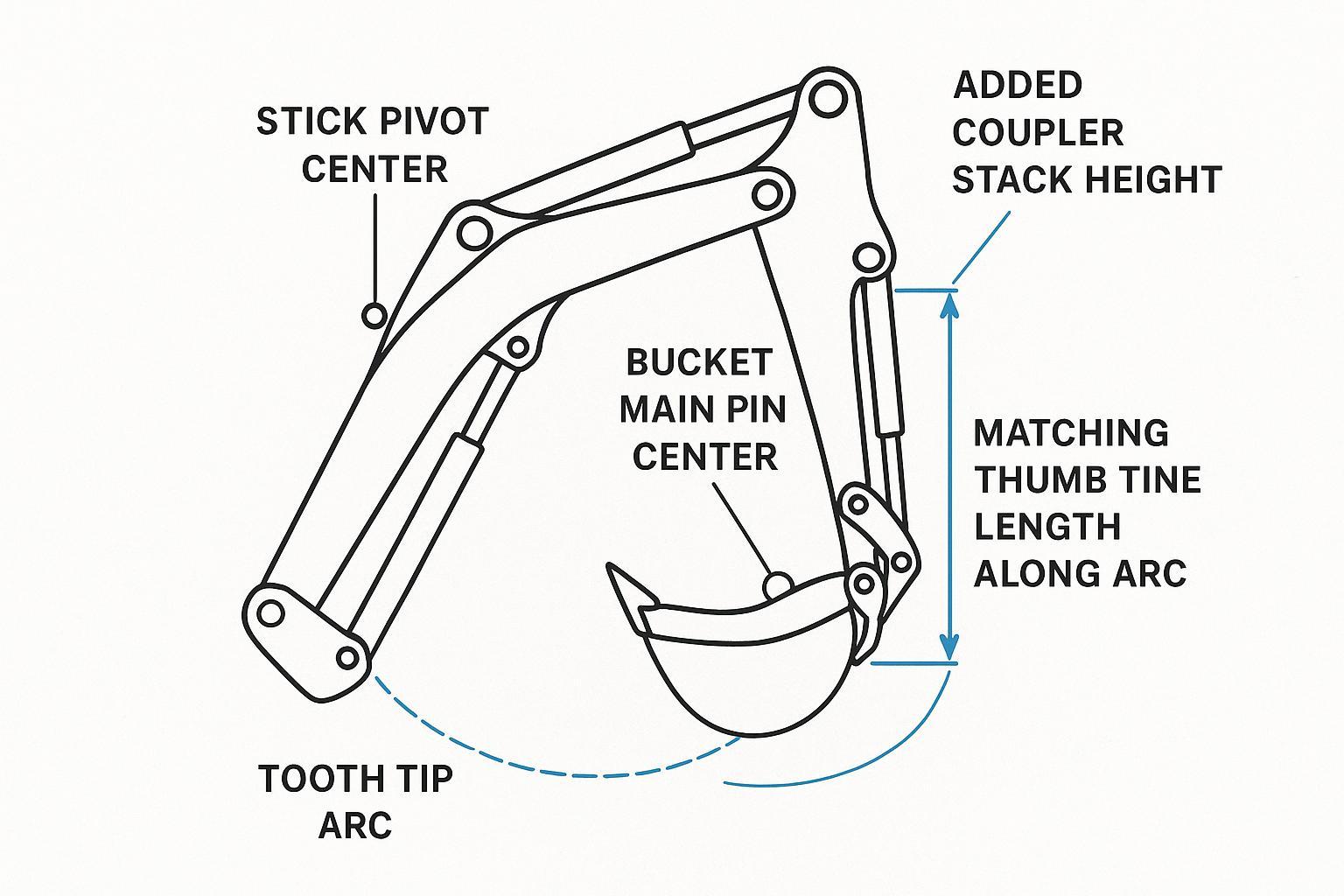
O diagrama acima mostra cinco medidas críticas que você usará no fluxo de trabalho abaixo: centro de pivô do bastão, centro do pino principal do balde, arco da ponta do dente (raio da ponta do balde), altura da pilha do acoplador rápido adicionada e o comprimento do dente do polegar correspondente ao longo desse arco.
Lista de verificação de ajuste rápido e compra (imprimível)
Use esta lista de verificação de página única para coletar os dados que você fornecerá ao seu fornecedor de anexos e para verificar seu ajuste antes de fazer o pedido.
| Item | O que gravar | Por que isso importa |
|---|---|---|
| Classe Máquina/Peso | por exemplo, 2 t de ligação, 2 t, 14 t, 5 t de 6 t | Guias típicos PSI/GPM e faixas de tamanho do polegar |
| Hidráulica Auxiliar | Pressão de operação (psi) e vazão (gpm); simples vs. bidirecional | Garante compatibilidade e velocidade do cilindro/válvula |
| Acoplador Rápido | Sim/Não; modelo/tipo; altura da pilha (mm/in) | Muda o arco do balde; pode exigir corpo do polegar mais longo |
| Raio da ponta do balde | Comprimento do arco centro-ponta (mm/in) | Driver primário de seleção do comprimento do polegar |
| Dentes Balde | Contagem e espaçamento dos dentes; largura do balde | Alinha a contagem/espaçamento dos dentes e a largura do polegar à malha e à tampa |
| Rotação Desejada | Link principal versus link progressivo | Alcance e precisão versus simplicidade e custo |
| Polegar Construir | Perfil de dente (curvo/reto), serrilhados; aço resistente à abrasão; buchas/pinos endurecidos; almofadas de desgaste substituíveis; proteção contra corrosão | Determina aderência, durabilidade e facilidade de manutenção a longo prazo |
| Plano de roteamento da mangueira | Orientação da porta, guardas, pontos de fixação, folga | Evita beliscar, torcer ou abrasão |
Dica: Ao medir o espaçamento dos dentes e os detalhes do balde, você também pode revisar perfis e larguras de dentes compatíveis na página do fornecedor do seu balde, como a categoria Balde da Escavadeira aqui: escavadeira caçamba.
Fluxo de trabalho de dimensionamento para um polegar hidráulico para trabalho de mini escavadeira (rochas, toras, escova)
Siga estas etapas para escolher o polegar hidráulico certo para trabalhos de miniescavadeira onde a precisão e a proteção da superfície são importantes.
1) Meça o raio da ponta do balde e leve em conta o acoplador
- Meça o raio do arco da ponta do dente da caçamba a partir do centro do pino principal da caçamba Se você usar um acoplador rápido, adicione a altura da pilha do acoplador ao seu raio efetivo porque ele altera a geometria do arco da caçamba.
- O comprimento do dente do polegar alvo deve seguir aquele arco maior e corrigido para que as pontas se engrenem de forma limpa com os dentes do balde em toda a faixa de trabalho.
Exemplo de trabalho curto:
- Raio da ponta do balde (R) = 17,5 pol
- Altura da pilha do acoplador rápido (C) = 1,5 pol
- Raio efetivo (Re) = R + C = 19,0 pol
- Comprimento do dente do polegar alvo (em inglês: Target Thumb Tine Longength) (RE), com pequenas permissões para folgas de instalação e ângulo de mordida desejado.
2) Combine a contagem/espaçamento dos dentes e a largura com o balde
- A contagem/espaçamento dos dentes deve corresponder à contagem/espaçamento dos dentes do seu balde para que os dentes e dentes se intercalem sem interferência Isso impede a carga pontual e melhora a aderência em formas irregulares como rochas.
- Orientação da largura: escolha uma largura do polegar que ofereça uma cobertura estável em toda a largura de trabalho do balde Os polegares mais largos e multitinos espalham a carga e estabilizam os troncos/escova; opções mais estreitas podem melhorar a visibilidade e reduzir o peso.
3) Escolha o tipo de rotação para o seu caso de uso
- Polegar do pino principal: geralmente em torno de 12010° de rotação. Eles são mais simples, amplamente compatíveis e adequados para paisagismo geral e manuseio de materiais leves.
- Polegares de ligação progressiva: pode aproximar-se de ~180° de rotação graças a uma ligação entre o cilindro e o polegar O alcance adicionado ajuda a arrancar pedras/logs perto da máquina e colocá-los com precisão, especialmente em pátios apertados.
4) Matriz de decisão: mapear o design para tarefas
| Tarefa | Perfil Tine | Serrilhas | Tipo de rotação | Largura do polegar |
|---|---|---|---|---|
| Rochas (formas irregulares) | Curvo, multitine | Agressivo | Preferido link progressivo; pino principal aceitável | Cobertura média para |
| Registros | Curvo, multitine | Moderado | Quer; progressiva melhora o alcance em torno das pilhas | Estabilidade do meio |
| Escova | Curvo ou reto; multitine | Moderado | Quer; priorizar velocidade/visibilidade | Médio para combinar com a largura do balde |
| Precisão perto de superfícies acabadas | Direto; 23 dentes | Leve | Pin principal muitas vezes suficiente para visibilidade | Narrow para reduzir o excesso |
Anotações de construção e desempenho que você deve confirmar antes da compra:
- Especificação de aço: Procure placa resistente à abrasão nos dentes e quadros reforçados com soldas de qualidade.
- Pinos e buchas: Buchas endurecidas e lubrificáveis e pinos de tamanho apropriado reduzem o jogo e prolongam a vida útil.
- Peças de desgaste: As almofadas de desgaste substituíveis/bordas serrilhadas simplificam a manutenção e ajudam a preservar a mordida ao longo do tempo.
- Proteção contra corrosão: Revestimentos e cobertura adequada da pintura retardam a ferrugem em trabalhos de paisagismo úmido; retoque após a instalação.
Dica profissional: pense em serrilhas como sapato tine mordida mais ajuda com materiais escorregadios irregulares, mas muito pode arranhar ou estragar superfícies delicadas se você não tomar cuidado com o controle.
Hidráulica e canalização para minis (pressão, caudal, valvulação, encaminhamento)
A pressão de operação determina a força de fixação; o fluxo governa a velocidade e a capacidade de resposta Os minis geralmente são executados nessas faixas gerais (sempre confirme no manual do seu operador):
| Classe mini escavadeira | Pressão auxiliar típica | Fluxo auxiliar típico |
|---|---|---|
| 1 t | ~3.000 psi | ~5 gpm |
| 3 t. | ~3,50 4.100 psi | ~7 gpm |
| 5 t. | ~3,60 4.100 psi | até ~22 gpm |
Instantâneo visual simples (ilustrativo):
Aux Pressure (psi) 12 t | 3,3,00) 3 00 t | ████████████████ 3,500,400,500) 5 t 6 t | ████████████████ (3,6004,100) A Fluxo Aux (gpm) 12 t | ███████ (517) 34 t | ████████ (7717) 56 t | (até 22)
Lista de verificação de planejamento hidráulico:
- Modo de circuito: Certifique-se de fluxo bidirecional (dupla ação) para que seu polegar abra e feche sob energia.
- Alívio/sobrepressão: Combine as classificações do cilindro com a pressão da máquina; use proteção de alívio para evitar danos à vedação e desgaste do pino/barra.
- Roteamento da mangueira: Adicione proteções, braçadeiras e folga para o caminho de rotação total; evite pontos de aperto e torção ao redor do bastão.
- Controle de contaminação: Mantenha os acopladores limpos e fechados quando desconectados; detritos no sistema aceleram o desgaste.
Para a física por trás das relações de potência fluida e força/área, consulte hidráulica e cilindro hidráulico. Sempre adie para os manuais de serviço e do seu operador OEM para configurações e procedimentos finais.
Compatibilidade de acoplador rápido e verificações de transporte/reparação
Um acoplador muda de geometria Antes de comprar:
- Declarar que você usa um acoplador e fornecer a sua altura de pilha para o seu fornecedor.
- Ajuste a seco ou simule o caminho de rotação para confirmar que não há contato de lança/vara, interferência no solo ou saliência de transporte além do envelope seguro do seu trailer.
- Centralize o polegar no bastão e verifique os requisitos de lacunas/calços de acordo com o guia de instalação. Pequenos desalinhamentos podem causar malhas e desgaste irregular.
Quando escolher alternativas (grapplers e triagem)
Os polegares são versáteis, mas ferramentas dedicadas às vezes ganham:
- Manuseio pesado de toras o dia todo? Uma garra especialmente construída pode ser mais rápida de encenar e classificar. Explore opções aqui: grabber de toras escavadora.
- Precisa separar os finos da rocha ou do solo superficial antes da colocação? um acessório de triagem reduz o retrabalho e os passes de manuseio de materiais: veja escavadeira triagem caçamba.
Se o seu balde for renovado, certifique-se de que o estilo/espaçamento dos dentes se encaixe nas opções atuais planejadas do thumbreview no escavadeira caçamba página.
Exemplo prático (neutro, não promocional)
Vamos caminhar usando especificações disponíveis publicamente e uma lista de verificação simples Suponha que você execute um 3 t mini escavadeira sourced Qilu Machinery:
- Você confirma a hidráulica auxiliar em torno de 3.700 psi e ~12 gpm no manual do operador.
- Seu raio da ponta do balde mede 18,5 pol; você também executa um acoplador rápido com 1,0 de altura de pilha, portanto, seu raio efetivo é de 19,5 pol.
- Você escolhe um polegar curvo, serrilhado e multitine com um comprimento de dente alvo correspondente a ~ 19,5 pol. ao longo do arco, largura média para alinhar com seu balde e rotação do pino principal para simplificar.
- Você planeja o roteamento da mangueira com braçadeiras ao longo do bastão, uma proteção perto das portas do cilindro e folga suficiente para evitar torcer em extensão total.
- Em um teste funcional seco, você verifica a malha limpa com os dentes da caçamba, nenhum contato da lança na arrumação e dimensões de transporte estáveis.
Isso reflete o processo orientado por lista de verificação que você pode reutilizar em qualquer mini comparável.
Solução de problemas e manutenção (mantenha-o suave e seguro)
| Sintoma | Causa provável | Consertar |
|---|---|---|
| Cogumelos/desgaste em alfinetes ou olhos de cilindro | Sobrepressão, carga lateral, lubrificação deficiente | Verifique as configurações de alívio, melhore a técnica (deixe o polegar ceder ao balde), lubrifique dentro do cronograma |
| O polegar não fechará totalmente ou abrirá lentamente | Restrição de fluxo, ajuste da válvula desviadora, mangueira dobrada | Verifique a orientação da válvula, inspecione as mangueiras quanto a dobras, confirme o modo de fluxo bidirecional |
| Má aderência ou mordida irregular | Desalinhamento dos dentes/dentes, espaçamento errado dos dentes, instalação descentralizada | Recentrar por guia de instalação; selecione o espaçamento dos dentes para combinar com os dentes da caçamba |
| Boom ou contato com o solo durante a rotação | Altura da pilha do acoplador ignorada; comprimento incorreto do polegar | Remedir o raio efetivo; especificar o uso do acoplador; ajustar o comprimento do polegar ou paradas |
| Rachaduras no corpo ou soldas | Carregamento lateral, retroarrastamento, uso indevido como barra de pregueamento | Ajuste a técnica; inspecione e repare; assegure a aplicação dos ternos da especificação/projeto de aço |
Cronograma de cuidados básicos: Limpe os acopladores antes da conexão, unte de acordo com o cronograma do acessório, inspecione mangueiras e proteções diariamente e verifique o jogo de pino/bushing semanalmente Verifique periodicamente o torque do fixador e quaisquer suportes de bloqueio Para segurança geral de elevação e planejamento de trabalho perto de escavações, revise os da OSHA verificações de valas e escavações e recursos de valas/escavação.
Próximos passos e leitura adicional
- Preencha a lista de verificação Quick Fit & Buy deste artigo e verifique as medições duas vezes (raio da ponta e altura da pilha do acoplador são os culpados habituais por trás dos desajustados).
- Decida o link principal versus link progressivo com base na frequência com que você precisa de alcance máximo e sutileza de posicionamento.
- Confirme seu sistema hidráulico auxiliar (psi/gpm) e planeje o roteamento e alívio/válvula da mangueira antes de fazer o pedido, para que a instalação seja plug-and-play.
- Explore ferramentas relacionadas: escavadeira caçamba, grabber de toras escavadora, e escavadeira triagem caçamba.
Para um contexto fundamental sobre como a pressão e o fluxo criam movimento, consulte hidráulica e cilindro hidráulico. Para um planejamento seguro do trabalho, consulte os da OSHA recursos de valas e escavações.
Nota de SEO: Este guia focou em como selecionar um polegar hidráulico para tarefas de miniescavadeira em paisagismo e manuseio de materiais, incluindo geometria, rotação, hidráulica e considerações de segurança para ajudá-lo a tomar uma decisão informada no local.