Эл. адрес: [email protected] Вотсап: +8618266768780

Эл. адрес: [email protected] Вотсап: +8618266768780

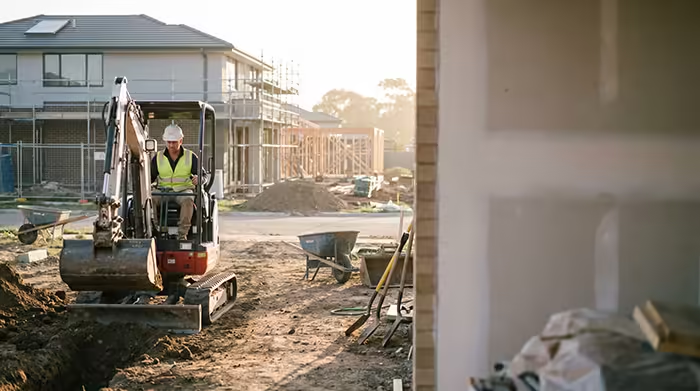
Choosing the right excavator size can make or break a project before the first bucket ever breaks ground. The 2.5-ton excavator — weighing in at roughly 5,500 lbs — occupies a uniquely powerful position in the mini excavator market, and the reasons go far beyond simple preference.
At one end of the spectrum, sub-1-ton machines deliver limited digging depth and breakout force, making them better suited for landscaping touch-ups than serious excavation. At the other end, 5-ton-plus machines require Commercial Driver’s License (CDL) transport, specialized trailers, and site access that most residential lots simply can’t accommodate. The 2.5-ton class threads that needle precisely.
As Typhon Machinery’s expert operator review puts it:
“The 2.5-ton class is the absolute ‘sweet spot’ for 90% of residential and light commercial work, bridging the gap between a toy and a tank.”
In practice, this weight class fits through standard gate openings, hauls on a standard pickup-and-trailer rig without a CDL, and still delivers the digging muscle needed for utility trenches, foundation prep, and tight-quarters demolition work. That rare combination of compact footprint and genuine breakout force is what makes this segment worth understanding in depth — starting with the terminology that defines it.
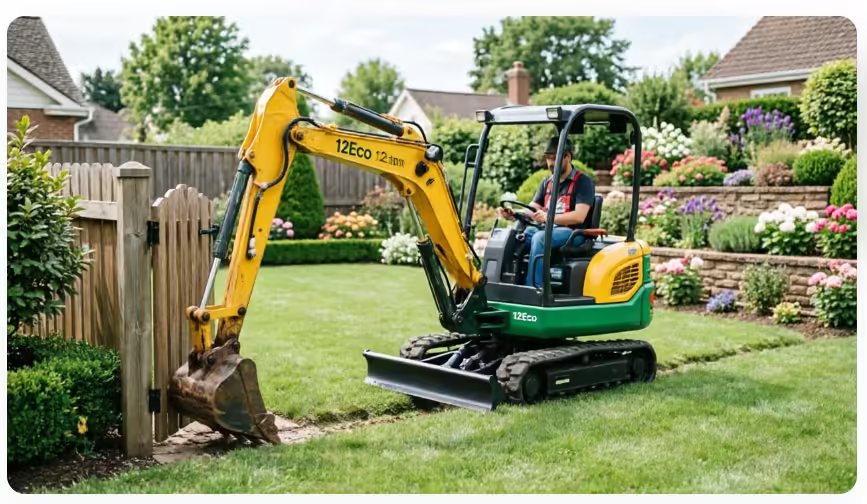
Knowing the right terminology separates confident buyers from costly mistakes — and every reputable mini excavator manufacturer uses these terms consistently across spec sheets and sales conversations.
Before diving into specific model comparisons, here are four definitions every buyer needs to understand:
Zero Tail Swing (ZTS)
A design where the machine’s counterweight stays within the track width during a full 360-degree rotation. According to BigRentz, this feature is critical for working near walls, fences, and parked vehicles — exactly the confined conditions residential jobsites demand.
Breakout Force
The maximum force the excavator can apply when curling the bucket (bucket breakout) or extending the arm (arm breakout). Higher numbers mean tougher digging through clay, compacted soil, or gravel.
Вспомогательная гидравлика
A secondary hydraulic circuit that powers attachments like augers, hydraulic thumbs, and plate compactors. Flow rate — measured in GPM — determines which attachments will perform at full capacity without starving the circuit.
EPA Tier 4 / Euro V Compliance
Engine emission standards that govern exhaust output. Tier 4 Final compliance is federally required for diesel engines sold in the U.S., affecting fuel efficiency, service intervals, and resale value.
With this vocabulary in hand, evaluating real-world specifications — engine choices, hydraulic output, and digging reach — becomes far more straightforward. That’s exactly where the next section heads.
The right spec sheet separates a capable 2.5-ton excavator from one that stalls mid-project — and understanding the core numbers helps buyers evaluate any model with confidence.
| Особенность | Typical Spec | Выгода |
|---|---|---|
| Эксплуатационная масса | 2,400–2,700 kg | Stays under most load limits |
| Давление на грунт | 0.026–0.030 MPa | Safe on turf and soft soil |
| Максимальная глубина копания | 2,500–2,800 mm | Handles utility and footing work |
| Max Reach (ground level) | 4,200–4,500 mm | Covers standard residential lots |
| Скорость гидравлического потока | 40–60 L/min (aux) | Powers breakers and augers reliably |
| Расход топлива | 1–2 gallons/hour | Low operating cost per shift |
Engine choice is one of the most consequential decisions in this class. Kubota and Perkins powerplants carry well-established dealer networks and proven longevity, making them the benchmark for reliability. A China 2.5-ton mini excavator — particularly from manufacturers like TIANLU — increasingly ships with competitive domestic engines that close the performance gap while reducing upfront cost, though parts availability varies by region.
Hydraulic flow rate is the overlooked spec. Many buyers focus on digging depth and ignore auxiliary flow, but powering high-demand attachments like hydraulic breakers requires consistent output above 45 L/min. Models falling short here become limiting bottlenecks on multi-task jobsites. These specs also directly shape the ownership economics — which the next section breaks down in full.
The 2.5-ton class delivers a compelling financial case that larger machines simply can’t match — lower upfront costs, reduced running expenses, and a lifespan that justifies the investment.
For contractors and homeowners evaluating total cost of ownership, the numbers favor this weight class decisively. According to TIANLU Heavy Industry Technology, models in this segment carry a 20–25% lower purchase price than comparable 5-ton machines — a significant saving before the first bucket turn.
ROI Callout: A 2.5-ton excavator delivers a 20–25% reduction in purchase costs and 15% lower maintenance expenses versus 5-ton models, directly improving project margins from day one.
Maintenance overhead follows the same pattern. Lighter machines mean smaller hydraulic systems, less component wear, and lower parts costs — translating to roughly 15% in annual savings on upkeep. Fuel efficiency reinforces this further: ECO mode, standard on machines like the 2.5-ton excavator YFT25, reduces engine load during lighter tasks, cutting fuel consumption meaningfully over a full season.
ROI Callout: With an expected operational lifespan of 8,000 to 10,000 hours, a properly maintained 2.5-ton unit amortizes its cost across years of productive residential and light commercial work.
Pair that durability with the right bucket and tool setup and the value proposition strengthens further. Understanding where these machines are manufactured — and how sourcing decisions affect price — is the logical next step.
Sourcing directly from a Chinese mini excavator factory has become one of the most cost-effective paths to ownership — but only when buyers know how to separate legitimate manufacturers from resellers.
Sourcing
Verification
Настройка
Modern Chinese heavy equipment manufacturing has closed the quality gap considerably, with major brands adopting robotic welding, laser-cut structural components, and third-party inspection protocols. Those verified standards translate directly into real-world performance — exactly what the next section’s practical applications demand.
The 2.5-ton class punches far above its weight, handling three demanding job types that expose the limits of both smaller and larger machines.
The right machine only gets more capable with the right tools attached — which is exactly where the next consideration becomes critical.
A 2.5-ton excavator becomes a genuine multi-tool the moment you match it with the right attachments — and the performance gap between a bare machine and a fully equipped one is substantial.
The attachment lineup that operators consistently recommend on every active excavator forum thread breaks down into four essentials:
Hydraulic compatibility is the deciding factor. The 2.5-ton class typically delivers 15–20 GPM auxiliary flow, which suits breakers and augers comfortably — but always verify your machine’s flow rating against an attachment’s requirements before purchasing. As compact equipment continues expanding into tighter job sites, manufacturers like LTMG increasingly bundle closed cabins and brush cutters for all-weather versatility. Of course, every attachment adds wear to hydraulic lines and couplers — something to factor into your long-term maintenance planning.
A well-maintained 2.5-ton excavator can deliver years of reliable service — and annual upkeep costs typically land between $500 and $1,000, making it one of the most cost-efficient machines in its class according to TIANLU Heavy Industry Technology.
Consistent daily habits protect that investment. Before each shift, focus on these core tasks:
Oil radiator care is non-negotiable on high-duty cycles. When a machine runs multiple buckets per hour through dense clay or compacted aggregate, hydraulic temperatures spike. A clogged or neglected oil radiator accelerates seal failure across the entire hydraulic system — an expensive repair that a simple weekly cleaning prevents.

For Chinese-manufactured units, spare parts sourcing is straightforward when you establish a relationship with your factory-direct supplier upfront. Request a recommended parts list at purchase and keep consumables — filters, track pads, and bucket teeth — on hand. Lead times from overseas suppliers average two to three weeks, so proactive stocking avoids costly downtime.
With the maintenance picture clear, it’s worth stepping back to consolidate everything covered — from site fit to running costs — into the bottom-line guidance every buyer actually needs.
The 2.5-ton excavator earns its “residential sweet spot” reputation by delivering full-size capability in a compact package that fits real-world job sites, budgets, and transport logistics.
Everything covered in this guide — from attachments and sourcing to maintenance schedules — points to the same conclusion: this class of machine simply works harder per dollar than any alternative for residential and light commercial contractors. Here’s the distilled version:
Still have questions before committing? The next section tackles the most common buyer concerns head-on.
The 2.5-ton excavator answers most residential and light commercial needs — but a few practical questions come up repeatedly before buyers commit.
In most cases, no. Machines over 3.5 tons often require a Commercial Driver’s License for transport, which makes the 2.5-ton class a logistical favorite for owner-operators and small contractors. A standard pickup truck and trailer combination typically handles the job without triggering CDL thresholds — though state-specific weight limits always apply, so verify local regulations before hauling.
The gap is significant. A 1-ton machine is best suited for truly confined interior work, while the 2.5-ton delivers roughly double the dig depth, greater breakout force, and compatibility with a wider range of attachments. If your projects involve anything beyond light landscaping, the added capability of a slightly larger class underscores why the 2.5-ton sits at the sweet spot.
Parts availability has improved substantially, with many manufacturers maintaining US-based dealer networks and online inventories. Common wear items — buckets, filters, seals — are generally accessible. Proprietary hydraulic components can take longer; always confirm dealer support before purchasing.
Expect roughly 0.5 to 1.2 gallons per hour depending on workload intensity, according to BigRentz. Light grading sits toward the lower end; sustained trenching in hard soil pushes consumption higher.




-1.png)