Как выбрать оптимальный размер трактора для небольших ферм (компактный или традиционный) — Пятилетнее руководство по общей стоимости владения (TCO) на 2026 год
Как выбрать оптимальный размер трактора для небольших ферм (компактный или традиционный) — Пятилетнее руководство по общей стоимости владения (TCO) на 2026 год
If you run a 5–40 acre operation, the question behind the question is simple: what’s the best tractor size for small farms when you factor in real costs over five years? This guide compares a compact tractor (20–60 HP) to a traditional/utility tractor (60–120+ HP) through a 5‑year total cost of ownership (TCO) lens. Prices and assumptions are noted explicitly and may change by region, dealer incentives, and fuel markets (as of Jan 2026).
The best tractor size for small farms is scenario‑dependent; there’s no universal winner.
For ≤15 acres with frequent loader work in tight spaces, a 35–50 HP compact often minimizes 5‑year TCO while meeting mowing and light tillage needs.
For 20–30 acres with haying (square bales, larger mowers), a 75–110 HP utility tends to win on throughput and safer bale handling despite higher purchase price.
If you’re on the fence, start by listing your top three tasks, acreage, storage/transport limits, and the implements you must run.
TL;DR verdict — best tractor size for small farms: For most mixed‑use 10–20 acre operations with tight maneuvering and frequent loader work, a 35–50 HP compact is the sensible first choice on 5‑year TCO. If haying throughput and round‑bale handling are routine on 20–30 acres, step up to a 75–110 HP utility.
What “best tractor size for small farms” optimizes: the 5‑year TCO
We’ll optimize your decision by modeling 5‑year total cost of ownership. TCO includes:
Optional finance costs (interest varies by buyer/dealer)
Method references you can use yourself:
For fuel and cost math, Mississippi State University’s framework lays out operating‑cost inputs and conversions in detail; see the MSU guide (landing) и current PDF.
Standardized fuel‑efficiency testing such as the DLG PowerMix program describes how tractors are evaluated on mixed duty cycles. We translate that lab logic to small‑farm tasks to produce reasonable gal/hr proxies.
Assumptions used in this article (edit for your farm):
Hours per year: 200–400
Diesel price: $4.00/gal baseline (sensitive)
Compact depreciation over 5 years: ≈40–45% (retain ~55–60%)
Utility depreciation over 5 years: ≈25–40% (retain ~60–75%)
Maintenance: based on extension rules of thumb and repair factors scaled to hours and HP
Compact tractor vs traditional tractor: differences that move TCO
Maneuverability and footprint: Compacts shine in tight barnyards, orchards, and around hoop houses. Smaller turning circles and lower overall weight reduce wasted motion and ground pressure.
PTO and hydraulics: Utilities deliver higher continuous PTO horsepower and hydraulic flow for hay tools, larger cutters, and faster loader cycles. That translates into acres per hour and fewer passes.
Implement compatibility: Compacts typically run Category 1 hitches and 540 PTO, covering 5–6 ft rotary cutters and mid‑width tillers. Utilities commonly support Cat 2/3 and higher PTO loads for balers and wider mowers; plan PTO HP thresholds by implement. For example, Land Pride‑class 5–6 ft rotary cutters often call for ≈20–35 PTO HP; see a representative rotary cutter PTO guidance page. Small square balers can require ~40–50 PTO HP (sometimes more) per pre‑purchase notes from UW Extension.
Fuel per task‑hour: More power means more fuel at comparable load factors; utilities often burn ~3.0–3.8 gal/hr at moderate load vs ~1.7–2.3 for upper compacts, using DLG/NTTL methodology proxies.
Transport and storage: A compact with loader often fits 7k–10k GVWR trailers; utilities push into 10k–14k+ GVWR territory and may trigger additional transport considerations per FMCSA’s USDOT number FAQ.
Compact vs traditional: side‑by‑side table (with 5‑year TCO context)
As of Jan 2026; ranges reflect typical US configurations. Always validate with local dealers and your own hours/implements.
Измерение
Compact (20–60 HP)
Utility/Traditional (60–120+ HP)
Notes & sources
Acquisition (tractor + loader)
≈ $22,000–$45,000
≈ $65,000–$180,000+
Price volatility; verify local quotes and incentives (2026). Market guides and dealer finance pages indicate wide variation by region and options.
Essential implements (typical)
Loader, 5–6 ft rotary cutter, 5–6 ft tiller: ≈ $4,000–$14,000 combined
Loader, 7–10 ft cutter or mower‑conditioner, baler (square or small round): highly variable, often $10,000–$40,000+
Implement choices drive TCO; match PTO HP to minimums (see UW Extension pre‑purchase and Land Pride‑class guidance).
Fuel use (gal/hr, moderate load)
≈ 1.7–2.3
≈ 3.0–3.8
Derived from standardized efficiency methods like DLG PowerMix and university cost calculators; load factor is critical.
Annual maintenance estimate (200–400 hr/yr)
≈ $300–$800
≈ $800–$2,500
Based on extension guidance scaling costs by hours and HP (MSU/UW).
5‑year depreciation (retained value)
~55–60% retained
~60–75% retained (wide variance)
Class‑level tendencies from used‑market analyses (EquipmentWatch exemplars; Iron Solutions for compacts).
PTO usable HP & hitch
~15–50 PTO HP; Cat 1; 540 PTO
~50–100+ PTO HP; Cat 2/3; 540/1000 PTO
Choose by implement minimums (e.g., balers often ≥40–65 PTO HP).
Loader lift (to pivot)
~700–2,500 lb
~3,000–5,000+ lb
Higher hydraulic flow on utilities also shortens loader cycles.
Hydraulics (total flow)
~6–12 gpm
≥16 gpm
More remotes and higher flow support hay tools and faster loaders.
Turning radius & footprint
Very tight; favorable for barns/orchards
Larger; requires space to maneuver
Tight spaces tilt the decision toward compacts.
Transport & storage
3,000–5,000 lb tractor weight; often 7k–10k GVWR trailer
Mini case study A: 12‑acre mixed vegetables, frequent loader work (compact wins on 5‑year TCO)
Scenario assumptions
Tasks: Loader work (compost, pallets), mowing, tilling beds, snow cleanup
Hours: 250 hr/yr; Diesel: $4.00/gal; Time horizon: 5 years
Implements: Loader, 5–6 ft rotary cutter, 5–6 ft tiller (Cat 1)
Math (conservative proxies)
Fuel: 2.0 gal/hr × 250 hr = 500 gal/yr → $2,000/yr → $10,000 over 5 years
Maintenance: ~$400–$600/yr using extension factors → ~$2,500 over 5 years
Depreciation: Purchase $35,000 (tractor+loader) + $8,000 implements = $43,000; retain ~58% → loss ≈ $18,000–$20,000 over 5 years
Interpretation
With tight maneuvering and Cat‑1 implements, a 40–45 HP compact balances loader agility and implement coverage while keeping fuel and depreciation in check. On a mixed‑vegetable farm, fewer ruts and easier access to beds matter as much as raw power.
Related reading: A deeper dive on budget‑friendly choices is available in our internal explainer on best cheap compact tractors for small farms, which discusses how buyers scope features without bloating TCO.
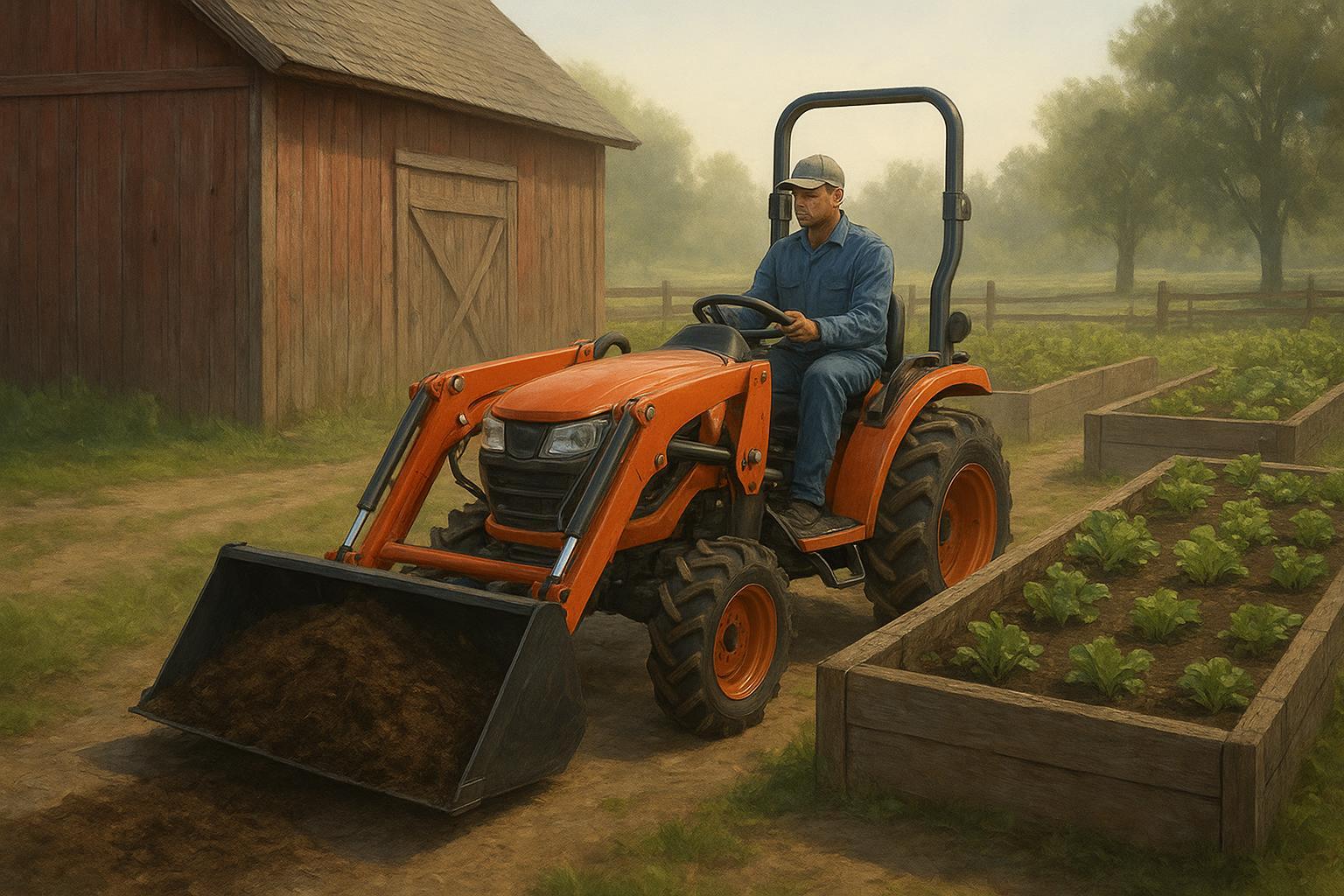
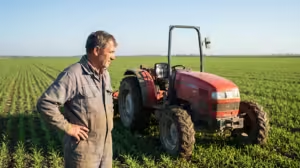
Caption: A compact shows why the best tractor size for small farms isn’t always the biggest—turning inside tight yards saves time and fuel.
Mini case study B: 25‑acre livestock/forage with haying (utility wins on throughput and safety)
Scenario assumptions
Tasks: Mowing pasture, tedding/raking, small square baling, regular bale handling
Hours: 350 hr/yr; Diesel: $4.00/gal; Time horizon: 5 years
Implements: Wider mower/conditioner, small square baler; routine bale handling
Math (conservative proxies)
Fuel: 3.5 gal/hr × 350 hr = 1,225 gal/yr → $4,900/yr → $24,500 over 5 years
Maintenance: ~$1,200–$2,000/yr → ~$7,500 over 5 years (midpoint)
Depreciation: Purchase $95,000 (tractor+loader) + $20,000 implements = $115,000; retain ~65% → loss ≈ $40,000 over 5 years
Interpretation
Higher PTO HP and hydraulic flow let you run wider hay tools and safely handle bales. Even with higher fuel use and purchase price, the productivity gain and safer bale handling often justify a utility on 20–30 acres of forage.
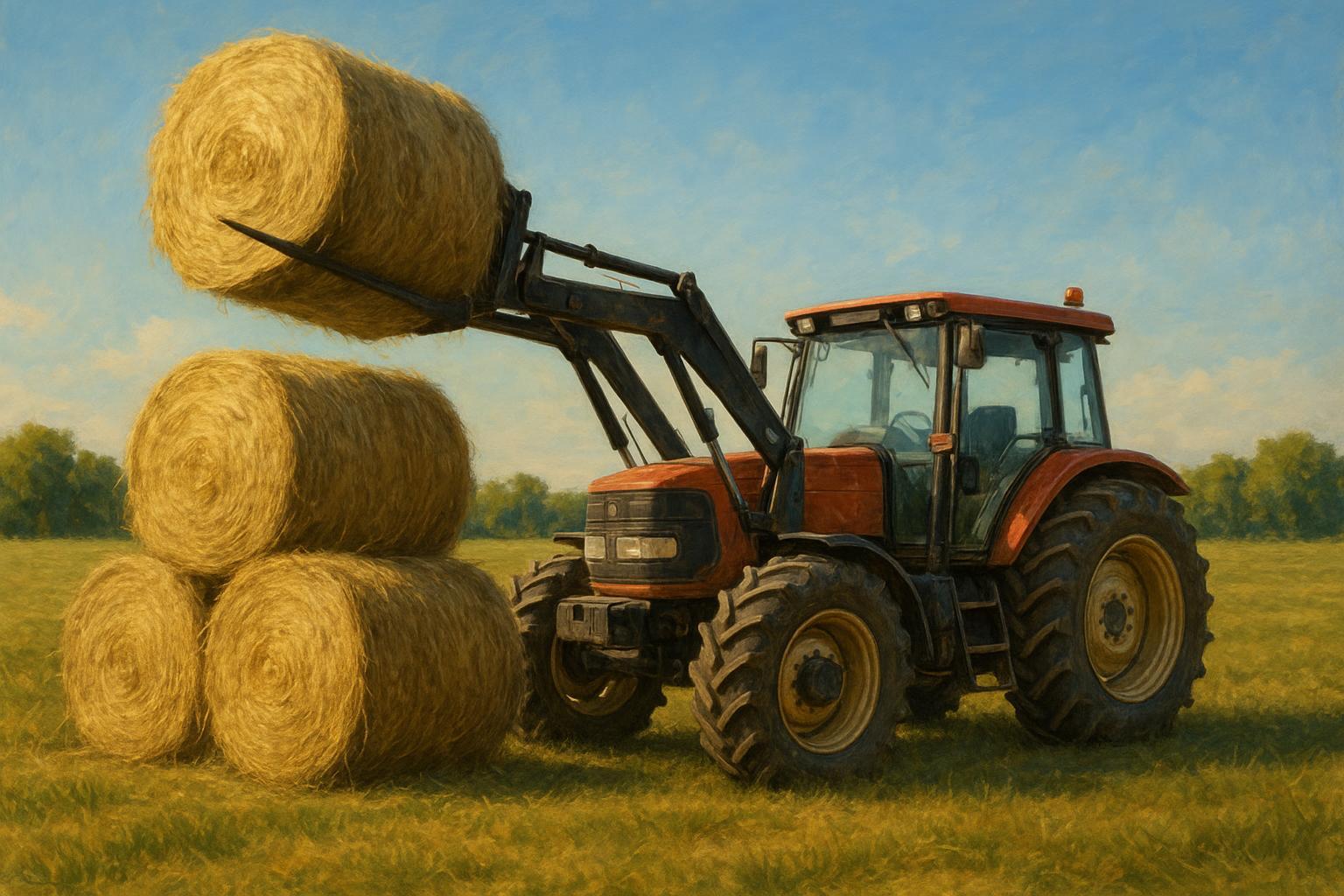
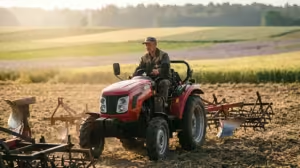
Caption: Round‑bale throughput and hydraulic stability tilt some 20–30 acre operations toward a utility even when TCO is higher.
How to decide your best tractor size for small farms (a quick path)
Think of this like a fork in a farm lane:
If your top three tasks are loader‑heavy (materials, manure, compost), mowing up to 6 ft, and occasional tilling—and you fight tight spaces—start with a 35–50 HP compact.
If you regularly bale hay or need 7–10 ft cutting widths, prioritize a 75–110 HP utility for PTO headroom and loader stability.
If you’re split, estimate your annual hours and run the 5‑year math with your fuel price and implement list; adjust for soil/transport constraints.
Match PTO HP to implement minimums. A 5–6 ft rotary cutter typically requires ~20–35 PTO HP, while many small square balers call for ~40–50 PTO HP (some up to ~65 HP) per extension and manufacturer guidance.
Plan hydraulics for loader speed and bale handling; utilities often deliver ≥16 gpm total hydraulic flow.
Protect soil: heavier tractors demand lower PSI, drier windows, and controlled traffic, especially in wet seasons.
Don’t forget transport: trailer GVWR and towing law thresholds can add cost and complexity; see FMCSA’s USDOT number FAQ for thresholds and definitions.
Also consider (disclosure)
Also consider: QILU compact tractors in the 25–50 HP range if you prioritize tight‑space loader work and Cat‑1 implement compatibility. Disclosure: QILU is our product. Explore a 40 HP option here: best tractor size for small farms — Qilu 40 HP (QL‑404Y).
Suggested video (YouTube)
For a practical visual primer on compact vs utility use cases, this independent overview can help you sense scale and tasks: compact vs utility tractor field discussion on YouTube. Pair the video with the 5‑year TCO math above to ground the advice in your numbers.
Each citation is chosen for methodology or neutral context; your actual quotes and resale values should be checked locally before purchase.
FAQ: best tractor size for small farms
Q1) What is the best tractor size for a 10–20 acre small farm?
For most mixed‑use 10–20 acre farms, a 35–50 HP compact strikes the right balance of maneuverability, implement coverage, and 5‑year TCO. It runs 5–6 ft cutters and mid‑width tillers while staying easy to transport and store.
Q2) Does a compact tractor cost less to own over 5 years than a full‑size tractor?
Often yes for ≤15–20 acre operations dominated by loader work and 5–6 ft mowing. Lower acquisition and fuel use typically outweigh productivity differences. Once haying throughput becomes routine, a utility can flip the math.
Q3) How much fuel does a 40–50 HP compact use per hour vs a 75 HP utility?
Using standardized efficiency methods and moderate loads, compacts often land near ≈1.7–2.3 gal/hr while a ~75 HP utility clusters around ≈3.0–3.8 gal/hr. Your load factor (how hard you’re working the PTO/engine) is the swing variable.
Q4) When should I upgrade from a compact to a utility tractor?
Common thresholds: routine haying (baling weekly in season), implements requiring ≥50 PTO HP, loader tasks needing ≥3,000 lb at height, or annual hours >300–400 with tight field windows.
Q5) How do I calculate 5‑year TCO for my farm?
List acquisition (tractor+loader+implements), estimate annual fuel (gal/hr × hr × $/gal), apply maintenance using extension repair factors, and model depreciation as retained value after five years. Then compare classes under the same hours and tasks. A simple spreadsheet with editable assumptions will get you 90% there.
Q6) Will a compact tractor handle light hay work?
Some compacts near 50 HP can manage small square balers in favorable conditions, but Cat‑2 implements and heavier bales usually justify a utility for power, stability, and safety margins.
Q7) What about soil compaction on market gardens?
Lighter machines, lower tire PSI, and dry‑weather passes help protect structure. If you grow high‑value crops in beds or operate on wet soils, this factor alone may push you toward a compact.
Final word
Choosing the best tractor size for small farms is a math‑plus‑mission decision. Run your 5‑year TCO with your hours, fuel price, and must‑have implements, then test drive both classes on the tightest part of your farm. When in doubt, start with maneuverability and safety; you can always scale up when the work demands it.
Shandong Qilu Industrial Co., Ltd. является профессиональным производителем и экспортером, занимающимся разработкой и производством экскаваторов, погрузчиков и тракторов. Мы предоставляем лучший сервис, абсолютно.




-1.png)