Email: [email protected] Whatsapp: +8618266768780

Email: [email protected] Whatsapp: +8618266768780


In the professional landscaping sector of 2026, the phrase “cutting the grass” has become an obsolete simplification. As urban developers and private estate managers pivot toward Environmental, Social, and Governance (ESG) goals, the mower has been reclassified. It is no longer just a motorized blade; it is a precision biological management tool.
For the modern contractor, the true challenge isn’t just mowing—it’s managing the Soil-Plant-Machinery Interface. If your fleet strategy overlooks the physics of soil compaction or the biology of “turf stress,” you are burning through your ROI before the first frost. This guide dives deep into the lawn mower application solutions that are currently redefining the industry standard.
Most operators believe that blade sharpness is the only factor in a clean cut. In reality, a mower deck is a sophisticated aerodynamic chamber.
To achieve a golf-course finish, the grass must be perfectly vertical at the moment of impact. Modern high-performance decks use “high-lift” blades that act like fan propellers, creating a localized low-pressure zone. This vacuum pulls the grass blades upright. If your deck is clogged with dried debris, the airflow is disrupted, leading to “lay-down” grass and a ragged, uneven finish that requires expensive re-cutting.
In 2026, the industry is moving toward Closed-Chamber Mulching. By eliminating the discharge chute, grass clippings are trapped in a high-velocity vortex. According to the UN Food and Agriculture Organization (FAO), these micro-clippings return vital nitrogen and moisture to the soil, acting as a “living fertilizer.” This eliminates the labor cost of bagging and the environmental footprint of chemical disposal.
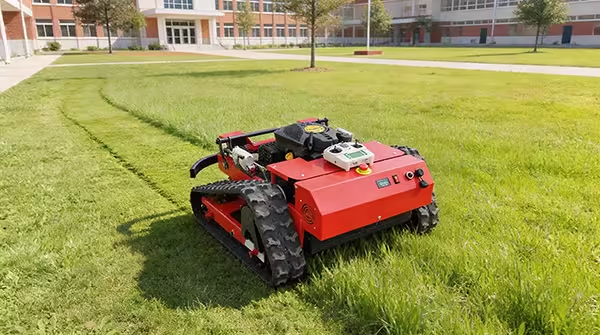
A commercial zero-turn mower can weigh upwards of 1,200 lbs. When that weight is concentrated on four small contact patches, it collapses the soil’s macro-pores—the tiny tunnels that allow oxygen and water to reach the roots.
| Equipment Category | Ground Pressure (PSI) | Impact on Root Depth | Recommended Terrain |
| Heavy Diesel Rider | 15 – 20 PSI | Shallow (3-5 cm) | Level, well-drained industrial parks |
| Stand-on Compact Unit | 8 – 12 PSI | Medium (8-10 cm) | Residential estates, damp turf |
| Robotic/Light Hybrid | 3 – 5 PSI | Deep (15+ cm) | Delicate sports turf, ornamental gardens |
By utilizing low-PSI machines, you reduce the need for mechanical aeration later in the season. This is the same logic we apply to our 1,2-Tonnen-Minibagger -12Eco—achieving industrial output with a “light-footprint” philosophy.
Slope management is no longer just a technical hurdle; it is a legal and insurance frontline. Standard riding mowers are high-risk on inclines above 15 degrees.
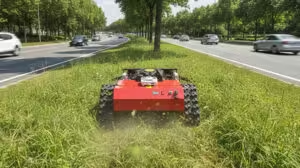
In 2026, we are seeing a massive surge in the use of Remote-Controlled (RC) Tracked Mowers for “High-Risk” zones. These machines keep the operator 50 feet away from the incline, eliminating the risk of rollover injuries.
Pro-Tip: If you’re bidding on municipal contracts, having specialized skid steer loader application solutions for steep-grade clearing will put you in a higher tier of qualified contractors.
Wait-to-fail maintenance is a 20th-century mindset. In 2026, the most successful fleets use Harmonic Diagnostics.
A bent blade—even by a few millimeters—creates a high-frequency vibration that eats through spindle bearings and saps engine power. New telematics systems monitor these “vibration signatures” and alert the technician via smartphone before the heat-seizure occurs.
A common rookie mistake is leveling a mower deck perfectly. Professional installers set a 1/4-inch forward rake. This means the front of the deck is slightly lower than the back. This ensures the grass is cut once and immediately ejected, preventing the “double-cutting” that dulls blades and wastes fuel.
We are seeing a trend where contractors move away from one giant “all-in-one” machine toward a Micro-Fleet Strategy.
This modular approach ensures that each machine is working within its “Peak Efficiency Zone,” significantly extending the lifespan of your entire fleet.
The most significant unique angle of 2026 is Autonomous Path-Planning. We’ve moved beyond simple “random bounce” robots. Modern commercial autonomous mowers use RTK-GPS (Real-Time Kinematic) to achieve sub-centimeter accuracy.
Watch how a modern autonomous unit handles complex perimeter mapping and obstacles without human intervention:
Q: Why does my mower leave “brown tips” on the grass after cutting?
A: This is usually a sign of Blunt Force Trauma, not a cut. A dull blade “tears” the grass cell walls rather than slicing them. The plant loses moisture through the jagged wound, leading to browning and increased disease susceptibility. Sharpen your blades every 10–12 operating hours in commercial settings.
Q: Can I run a mower attachment on my 1.2 Ton Mini Excavator?
A: Technically yes, but it is highly specialized. Using a flail mower on an excavator arm is excellent for clearing high-reach brush or canal banks, but for “finish mowing,” the hydraulic flow must be perfectly matched to avoid “Hydraulic Fade.” Always consult our technical support team for flow-matching.
Q: How do I choose between Tires and Tracks for my mower?
A: Reifen are faster and better for dry, hard-packed surfaces. Spuren are essential for wet, marshy areas or steep slopes where you need “mechanical grip” to prevent sliding. However, tracks can be more aggressive during tight turns, so operator skill is critical to avoid “scuffing.”
Q: What is the most common cause of hydrostatic transmission failure?
A: Heat and Contamination. 90% of zero-turn steering issues stem from clogged cooling fins on the transaxles. Grass clippings act like an insulation blanket, causing the oil to overheat and lose its viscosity. Blow out your transmissions with compressed air daily.
Is your turf management strategy engineered for the future?
The difference between a “landscaper” and an “industry authority” is the quality of the machinery strategy. Don’t settle for iron that just “works”—invest in solutions that thrive. Connect with our engineering consultants today to blueprint your 2026 fleet upgrade and secure your competitive edge.





-1.png)