Email: [email protected] Whatsapp: +8618266768780


The Hydraulic Revolution in Borehole Engineering
Water isn’t just scarce — it’s retreating deeper underground. As surface sources diminish and population demand surges, drilling contractors face a stark reality: reaching viable aquifers now requires penetrating formations that older equipment simply wasn’t built to handle.
Nach den United Nations World Water Development Report, global demand for groundwater is projected to increase by 20% to 30% by 2050. That trajectory isn’t a distant concern — it’s reshaping drilling specifications today.
Traditional mechanical table drives were engineered for a different era. Fixed rotary speeds, limited torque feedback, and rigid power delivery leave them dangerously outmatched against interbedded rock, cobble zones, and alternating hard and soft strata.
The shift toward Hydraulikbohrgerät technology closes that gap decisively. Hydraulic top-head drive systems deliver continuously variable torque and RPM — meaning the operator responds to real-time formation resistance rather than forcing a fixed mechanical output through unpredictable geology. The result is straighter boreholes, reduced bit wear, and meaningful gains in yield per meter drilled.
This adaptability forms what experienced drillers call the “Golden Thread” of borehole efficiency: an unbroken chain of precision decisions — from formation assessment to rig selection to fluid management — that separates productive wells from costly failures. Modern full-hydraulic crawler platforms are purpose-built to anchor that thread across the most demanding strata on site.
Everything starts, however, with reading the ground beneath you — and choosing the right rig to match it.
Step 1: Assessing Geological Strata and Rig Selection
Before a single drill bit touches the ground, the most consequential decision has already been made — selecting the right Bohrgerät für Bohrloch operations based on actual subsurface conditions. Mismatches between rig capability and geology don’t just slow progress; they destroy bits, compromise borehole integrity, and inflate project costs dramatically.
Soil vs. Rock: Choosing Your Platform
Formation type drives platform selection more than almost any other variable. Loose alluvial soils, sandy aquifers, and soft sedimentary layers respond well to truck-mounted rotary rigs, which offer rapid mobilization and high drill-string rotation speeds. However, consolidated rock — granite, basalt, quartzite — demands something fundamentally different.
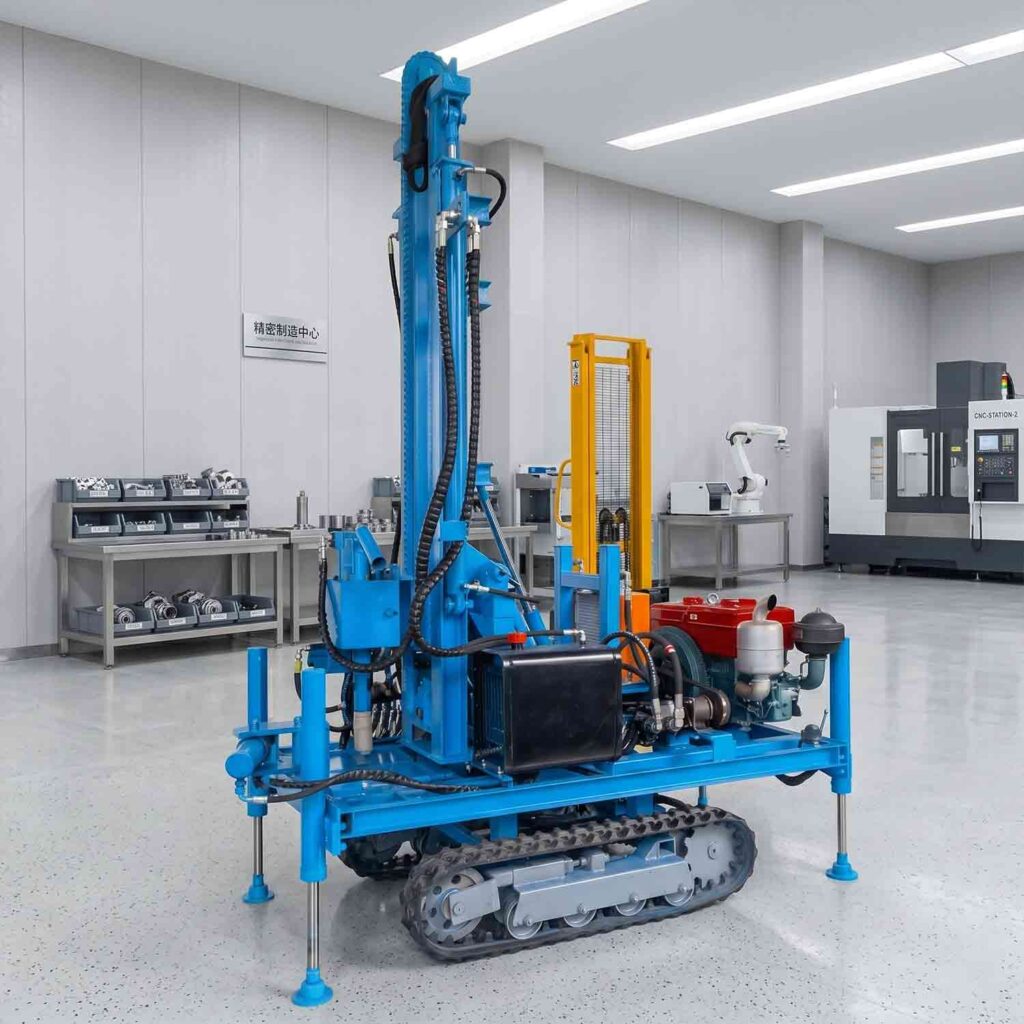
Hard rock penetration requires sustained, high-torque output at controlled RPMs. According to the International Society of Trenchless Technology, hydraulic top-head drive systems deliver superior torque and RPM control compared to traditional mechanical table drives, making them the preferred configuration wherever formation hardness exceeds moderate thresholds.
Selecting the right rig platform from day one is the single most reliable way to protect borehole integrity across unpredictable strata.
Why Crawler Rigs Dominate Unstable Terrain
When ground conditions introduce slope, saturation, or soft load-bearing capacity, crawler-mounted rigs become the practical standard. Their wide track footprint distributes equipment weight across a larger surface area, reducing ground pressure and preventing sinkage that would destabilize a wheeled platform. Much like matching equipment to terrain considerations in other heavy machinery categories, the crawler vs. truck decision hinges on site-specific load and mobility factors rather than personal preference.
Use the table below as a rapid reference guide:
| Strata Type | Recommended Hydraulic Feature |
|---|---|
| Soft alluvial / loose sand | High-speed rotation, variable flow pump |
| Clay-heavy formations | Moderate torque, positive displacement control |
| Fractured limestone | Percussion assist, adjustable WOB control |
| Hard granite / basalt | Maximum torque top-head drive, high pullback capacity |
| Waterlogged / unstable surface | Crawler platform, low ground pressure undercarriage |
Verification Checkpoint: Pullback Capacity vs. Target Depth
Before mobilizing, confirm that the rig’s pullback capacity — the maximum upward force it can apply to extract a stuck or completed drill string — comfortably exceeds the anticipated drill-string weight at target depth. A common rule of practice is to select a rig with pullback rated at a minimum of 20–25% above calculated string weight. Undersizing this figure is one of the leading causes of costly stuck-string events.
With geology mapped and the right platform confirmed, the next critical step involves fine-tuning the hydraulic parameters themselves — pressure, flow, and load-sensing systems — to match the real-time demands of each formation layer.
Step 2: Optimizing Hydraulic Parameters for Maximum Penetration
With the right rig selected and geological data in hand, the critical next challenge is translating that preparation into real-time drilling performance. On a Bohranlage für Rotationswasserbrunnen, hydraulic parameters aren’t set-and-forget values — they demand continuous adjustment as the drill bit encounters shifting strata, from soft alluvial layers to hard fractured rock.
Fine-Tuning Variable Displacement Pumps
Variable displacement pumps are the engine behind adaptive drilling. Unlike fixed-displacement systems, they allow operators to modulate flow and pressure dynamically, matching output precisely to what each formation demands. In practice, when transitioning from consolidated sandstone to a fractured granite layer, an operator should reduce pump displacement incrementally — roughly 10–15% — to prevent sudden pressure spikes that can fracture the borehole wall.
The adjustment sequence typically follows this pattern:
- Monitor formation feedback — Watch the drill string’s torque indicator for resistance changes.
- Reduce or increase pump displacement — Adjust flow rate before altering pressure.
- Stabilize the bit weight — Allow 30–60 seconds for the system to equilibrate before recording new baseline readings.
- Log the parameters — Document pressure (PSI), flow rate (GPM), and depth for later analysis.
Managing Pull-Down and Pull-Back Pressure
Excessive pull-down pressure accelerates bit wear and risks borehole deviation, while insufficient pressure stalls penetration rates. A balanced approach keeps pull-down pressure within 15–20% of the rig’s rated capacity for the given formation hardness. Pull-back pressure should be pre-set before each string addition — typically at 80–90% of pull-down values — to ensure clean extraction without collar binding.
Load-Sensing Systems and Fuel Efficiency
Load-sensing hydraulic systems represent one of the most significant efficiency gains in modern drilling operations. According to Hydraulic and Pneumatics Magazine, hydraulic drilling rigs equipped with load-sensing systems can reduce fuel consumption by up to 15%. This matters on multi-day projects where fuel costs directly erode margins. These systems also reduce heat buildup — a leading cause of hydraulic fluid degradation — making them particularly valuable in extended deep-well operations. Understanding how smart hydraulic monitoring works across heavy equipment is explored further in this overview of real-time hydraulic monitoring.
Profi-Tipp: Enable load-sensing mode during formations with variable resistance. The system automatically reduces pump output when demand drops, cutting fuel waste without sacrificing penetration response time.
Verification Checkpoint: Temperature and Pressure Monitoring
Before advancing each drill string section, confirm:
- Hydraulic fluid temperature remains below 140°F (60°C)
- Systemdruck holds steady within ±5% of the target PSI
- Return-line pressure shows no abnormal spikes indicating blockage
🎬 [Embed YouTube Video: “Hydraulic Rig Operation – Real-Time Parameter Adjustments”]
With hydraulic parameters dialed in, the focus naturally shifts to maintaining the structural integrity of the borehole itself — particularly as depth increases and verticality becomes harder to control.
Step 3: Ensuring Borehole Verticality and Deep-Well Integrity
With hydraulic parameters dialed in, the operational focus shifts to a challenge that quietly undermines many deep-well projects: maintaining borehole verticality and structural integrity as depth increases. Even minor angular deviations accumulate over hundreds of feet, producing a crooked borehole that compromises casing installation, reduces pump efficiency, and — in worst cases — renders the entire well unusable.
Hydraulic Power as a Labor Safety Advantage
Handling heavy drill strings manually introduces significant injury risk, particularly during rod addition and extraction cycles. The National Ground Water Association (NGWA) has noted that the shift toward hydraulic power in water well drilling has significantly reduced manual labor risks and increased the precision of borehole verticality. A modern Bohrmaschine für hydraulische Bohrungen automates pull-down force and rod rotation speed, removing the inconsistency of manual handling while keeping crew members clear of rotating components.
“Hydraulic control systems eliminate the operator variability that has historically been the leading cause of both worksite injuries and off-vertical boreholes.”
Techniques for Maintaining Verticality
In practice, verticality depends on three controllable factors: drill collar weight, rotation speed, and penetration rate. Reducing rotation speed while maintaining steady weight-on-bit prevents the string from “walking” laterally in unconsolidated layers. Stabilizer subs, placed at regular intervals along the drill string, act as centralization guides that keep the bit tracking true. For loose strata projects — clay, sand, or pebble beds — a crawler-mounted rig designed for unstable formations provides the platform stability necessary to hold these parameters consistent.
“In deep boreholes, a deviation of just 1° per 100 feet compounds into significant lateral displacement — enough to prevent standard pump column installation.”
Preventing Collapse and the Alignment Checkpoint
Controlled pressure application is equally critical. Overly aggressive hydraulic thrust in fractured or granular formations strips the borehole wall, triggering collapse and trapping the drill string. Gradually stepping up weight-on-bit — verified against real-time pressure gauges — keeps formation stress manageable.
“Borehole collapse is rarely sudden; it announces itself through rising torque readings and inconsistent penetration rates long before the string becomes stuck.”
Verification Checkpoint — Hydraulic Leveling Jacks: Before drilling commences and after every significant rod change, engage the rig’s hydraulic leveling jacks to confirm the mast is plumb in both planes. A bubble-level tolerance of no more than 0.5° is the industry standard. This two-minute check is among the highest-value actions available on any job site.
Choosing the right equipment supplier is what ultimately determines whether these best practices are even achievable — a point the next section addresses in depth.
Evaluating China Water Well Drilling Rig Manufacturers
With borehole integrity and hydraulic performance addressed, the final operational variable is arguably the most consequential: who built your rig. The Chinese heavy equipment market delivers extraordinary value, but navigating it requires moving well beyond factory price comparisons toward a structured evaluation of engineering standards and long-term support infrastructure.
Engineering Standards Over Sticker Price
EIN Raupenwasserbrunnen Bohrgerät sourced at the lowest quoted price often carries hidden costs—inconsistent torque tolerances, substandard rotary head materials, or hydraulic seals rated below actual operating pressures. In practice, what separates reliable suppliers from budget alternatives is documented adherence to manufacturing standards, not advertised specifications alone.
One practical approach is requesting full material certifications for critical components—specifically the drill string, rotary head, and hydraulic pump assemblies—before committing to any purchase.
Red Flags vs. Green Flags in Suppliers
Red Flags:
- No third-party inspection reports or ISO documentation available
- Reluctance to provide pre-shipment video of the rig under load
- Vague after-sales terms with no guaranteed parts availability window
- Single point of contact with no dedicated technical support team
Green Flags:
- Full certification packages provided proactively alongside performance data
- Video documentation of rig drilling under operational conditions before shipment
- Clearly defined spare parts programs and regional service networks
- Transparent communication about lead times and component sourcing
Reliable Chinese manufacturers now provide full certification and video documentation of rig performance before shipment—a standard Qilu Machinery consistently meets across its hydraulic drilling rig lineup.
After-Sales Support as a Performance Factor
After-sales infrastructure directly determines your total cost of ownership. Component availability, firmware or calibration support, and accessible technical guidance determine whether a six-month project stays on schedule. Experienced buyers prioritize manufacturers who treat post-delivery service as a core product rather than an afterthought.
The questions that matter most—about maintenance schedules, application versatility, and long-term cost—are worth exploring directly, which is exactly what the next section addresses.
Häufig gestellte Fragen
How much does a deep well drilling rig cost, and what drives real value?
Purchase price is only one variable. A hydraulic water well drilling rig capable of reaching 400–500m typically represents a significant capital commitment, but the more relevant metric is cost-per-meter drilled over the machine’s service life. Rigs with variable displacement pumps—which, according to the International Society of Trenchless Technology, allow real-time fine-tuning of drilling parameters—consistently achieve lower operational costs because energy output matches actual formation resistance. A broader overview of available rig configurations helps clarify how capacity tiers align with project budgets.
Why choose a hydraulic rig over a mechanical one at 500m+ depths?
Mechanical rigs lose torque consistency as depth increases, making deviation control und weight-on-bit regulation progressively unreliable. Hydraulic systems maintain programmable torque and rotational speed regardless of depth, which directly supports the borehole verticality standards discussed in Step 3. For complex strata, that precision isn’t optional—it’s operational insurance.
What does a typical maintenance schedule look like for a crawler drilling rig?
In practice, daily checks cover hydraulic fluid levels, track tension, and bit condition. Weekly intervals address pump filter replacement and swivel lubrication. Monthly reviews inspect hose integrity and rotary head bearings. Adhering to this schedule typically extends major component life beyond manufacturer minimums.
Can hydraulic water well rigs handle geothermal or piling applications?
Yes—with appropriate tooling changes. The same rotary-percussion hydraulic drivetrain used for deep aquifer access adapts effectively to geothermal loop installation and foundation piling. However, confirm torque ratings and mast load capacity before switching applications, as formation resistance profiles differ considerably.
Maximizing borehole yield ultimately depends on aligning hydraulic performance, stratigraphic knowledge, directional control, and equipment quality into a single coherent strategy. Every section of this guide has addressed one layer of that system. The next step is matching those insights to a rig specification that fits your specific depth targets and formation conditions—then committing to the maintenance discipline that protects that investment long-term.
Wichtigste Erkenntnisse
- Hydraulic fluid temperature remains below 140°F (60°C)
- Systemdruck holds steady within ±5% of the target PSI
- Return-line pressure shows no abnormal spikes indicating blockage
- No third-party inspection reports or ISO documentation available
- Reluctance to provide pre-shipment video of the rig under load


-1.png)