Email: [email protected] Whatsapp: +8618266768780


Drilling a water well used to mean getting a truck as close as possible and hoping the terrain cooperated. For decades, that compromise defined the industry’s ceiling — and its frustrations.
Traditional truck-mounted rigs were built for speed and road mobility, not versatility. They performed well on flat, accessible ground. But the moment a project moved into hillside terrain, waterlogged soil, or remote rural land, those rigs became liabilities. Setup times stretched. Ground pressure caused instability. Access roads had to be carved out before a single foot of borehole could be drilled.
The global drilling rig market tells the story of what’s at stake: projected to grow from USD $83.58 billion in 2024 to USD $138.61 billion by 2033, the industry isn’t slowing down — it’s demanding smarter equipment to match expanding project scopes.
Then vs. Now: A Clear Shift in Philosophy
| Traditional Approach | Modern Crawler-Hydraulic Approach |
|---|---|
| Road-dependent mobility | All-terrain crawler movement |
| Mechanical drive systems | Full hydraulic power and control |
| High site preparation costs | Minimale Bodenstörung |
| Manual pipe handling | Increasingly automated operations |
| Limited depth capabilities | Deep-well performance as standard |
This shift reflects what operators now call the “Unit Drilling” philosophy — consolidating mobility, power, and precision into a single, self-sufficient machine. Terrain accessibility has quietly become the biggest bottleneck in onshore water well projects, outpacing even equipment cost as a project risk factor.
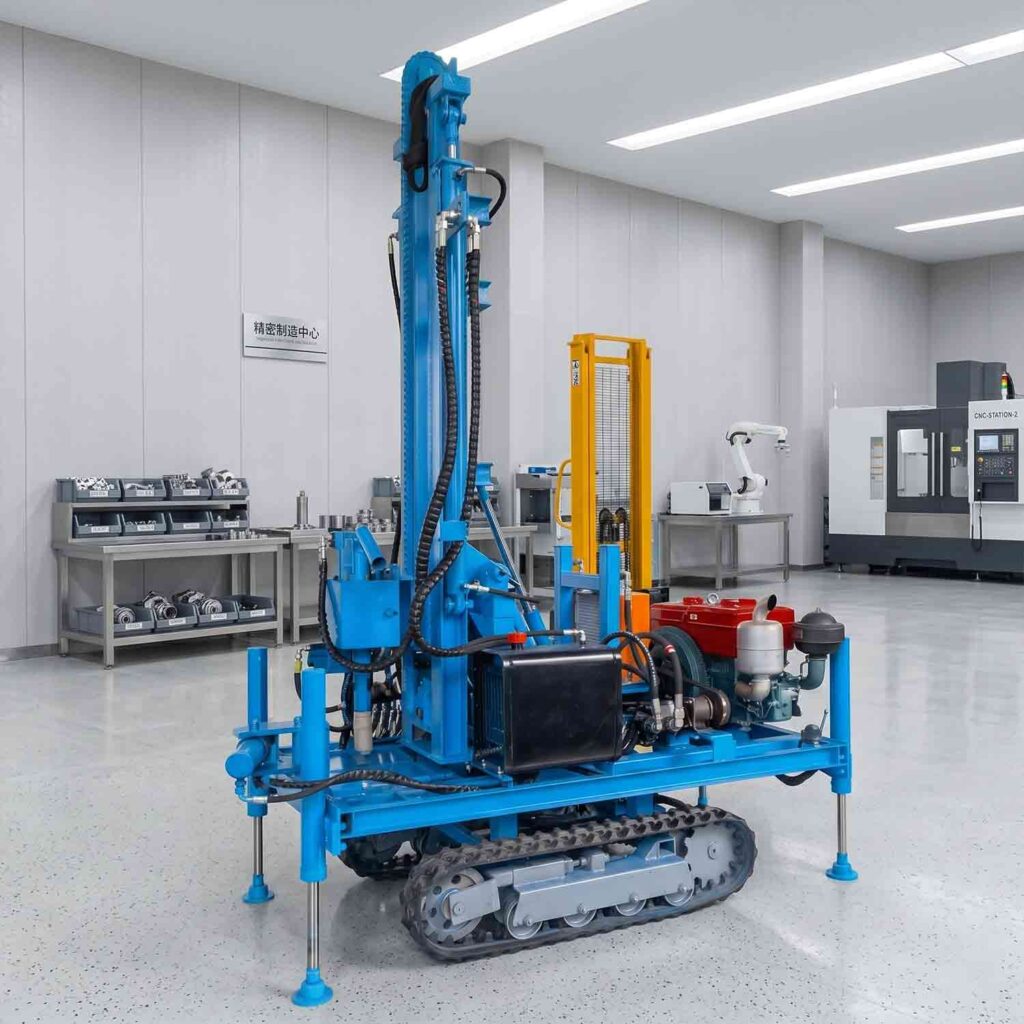
Specialized crawler-mounted rigs built for demanding conditions redefine what’s achievable before a single drill string turns. Das Vertikal montierter Raupen-Hydraulikwasserbrunnenbohrturm represents exactly this convergence — combining hydraulic water well drilling rig efficiency with go-anywhere mobility. Understanding why it works starts with what’s under the hood.
Anatomy of Efficiency: Key Components of Vertical-Mounted Hydraulic Rigs
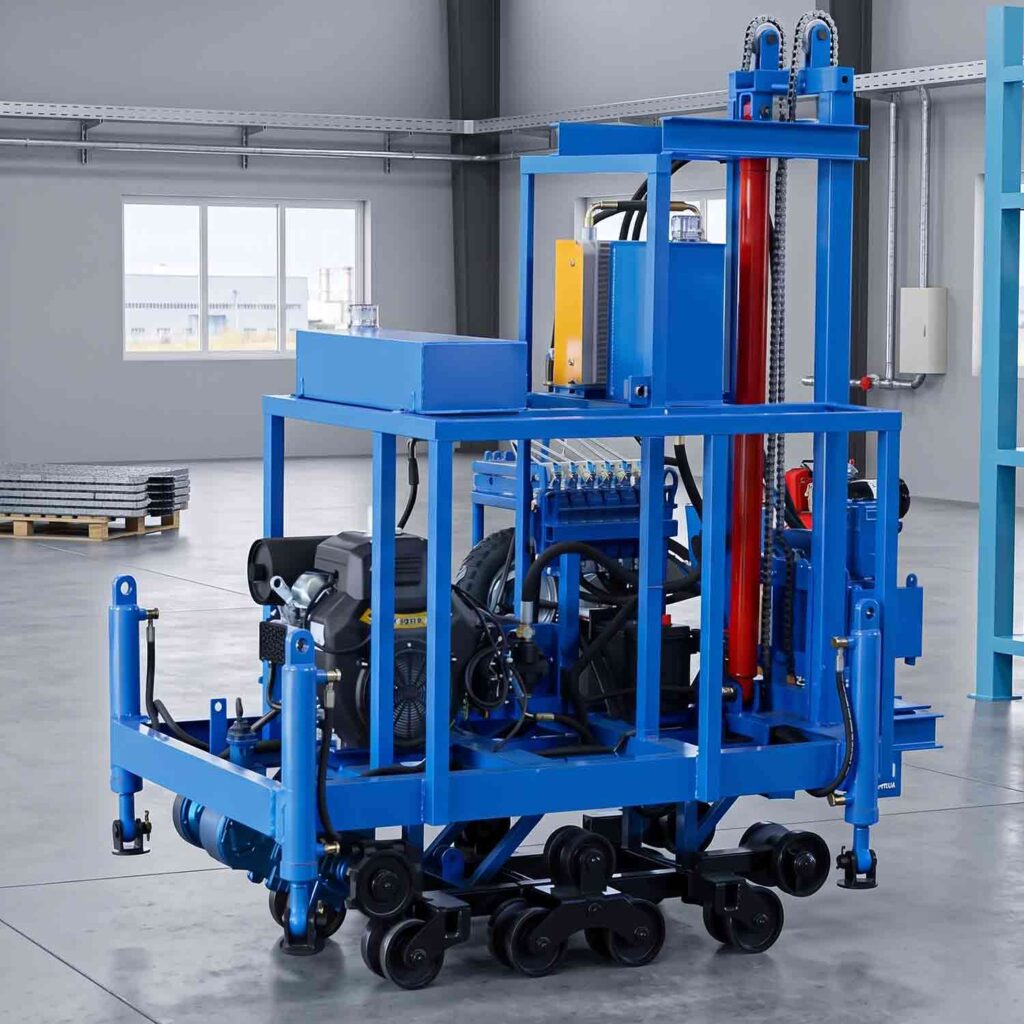
Verständnis Funktionsweise von Bohrinseln at a component level reveals why vertical-mounted crawler hydraulic designs consistently outperform older configurations. Every element — from the mast to the undercarriage — is engineered around a single goal: maximum depth with minimum disruption.
The Vertical-Mounted Mast and Borehole Accuracy
The mast isn’t just a structural frame. On vertical-mounted systems, it functions as a precision guide, holding the drill string in strict alignment throughout the entire depth of penetration. Even minor angular deviation compounds over hundreds of feet, producing crooked boreholes that compromise casing installation and long-term yield. The vertical mast eliminates that risk by keeping the rotary head on a fixed, plumb axis — a critical advantage in deep-well applications where tolerances are tight. You can see how this translates to real-world performance in full-hydraulic deep-well configurations designed for challenging formations.
Hydraulic Power vs. Mechanical Drives: The Torque Advantage
Hydraulic drive systems deliver continuous, variable torque — something mechanical gear-driven systems simply can’t match. In practice, hydraulic systems respond dynamically to formation resistance, automatically adjusting output without stalling or overloading the drivetrain. This responsiveness matters enormously when drilling through alternating soft and hard layers. The result is smoother penetration, less wear on tooling, and fewer costly interruptions.
Crawler Chassis Engineering and Ground Pressure
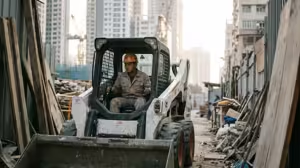
Wide-track crawler undercarriages distribute machine weight across a significantly larger surface area than wheeled alternatives. This low ground pressure design protects fragile terrain, allows access across muddy flats, slopes, and remote sites, and keeps the rig stable under the rotational forces of deep drilling. It’s the same engineering logic applied in compact excavator platforms built for sensitive or restricted ground conditions.
Automated Pipe Handling: Reducing Labor and Downtime
Manual pipe handling has long been one of drilling’s most time-intensive bottlenecks. Automated pipe-feeding systems change that equation dramatically. According to Market Reports World, automation in drilling operations can reduce non-productive time (NPT) by up to 35% — a figure that reflects fewer manual connections, reduced crew fatigue, and more consistent joint makeup quality.
| Komponente | Funktion | Nutzen |
|---|---|---|
| Vertical mast | Maintains plumb drill string alignment | Straighter boreholes, better casing fit |
| Hydraulic power system | Delivers variable torque on demand | Adapts to formation changes without stalling |
| Crawler undercarriage | Distributes load across wide track area | Access to remote and soft-ground sites |
| Automated pipe handler | Mechanizes rod addition and retrieval | Cuts NPT, reduces crew labor and injury risk |
These four systems work in concert — and understanding that integration is key to appreciating why vertical-mounted crawler rigs are increasingly the go-to choice for demanding deep-well projects, including those pushing into geothermal territory.
Solving the Geothermal and Deep-Well Challenge
Not every drilling project involves a straightforward site, cooperative soil, and a predictable depth target. Geothermal exploration pushes rigs to their absolute limits — extreme heat, unpredictable pressure zones, and remote terrain that would stop conventional equipment before the first bit rotation. This is where the engineering philosophy behind modern vertical-mounted crawler hydraulic rigs becomes less of a preference and more of a necessity.
Lessons From High-Stakes Geothermal Projects
Huisman’s LOC 400 rig demonstrated a principle that applies directly to crawler hydraulic design: specialized engineering beats brute-force power when projects involve complex subsurface conditions. The LOC 400’s success on geothermal sites reinforced what experienced drillers already understood — precision control over torque, weight-on-bit, and fluid circulation matters far more than raw horsepower when temperatures climb and formation pressures become unpredictable.
Geothermal drilling doesn’t just test a rig’s strength — it tests every seal, valve, and control system simultaneously, often miles from the nearest service facility.
Vertical hydraulic systems manage this stress well because their closed-loop circuits regulate pressure spikes naturally, reducing wear on components even under sustained thermal load. On the other hand, mechanical drive systems transmit shock directly through the drivetrain, accelerating failure in exactly the conditions geothermal work creates.
Why Crawlers Win at Remote Sites
Geothermal resources rarely sit under convenient locations. In practice, the most productive sites are found on volcanic ridgelines, mountain plateaus, and roadless terrain where a truck-mounted rig simply can’t operate. Crawler mobility solves this directly. Combined with Automatisierte Rohrhandhabungssysteme that reduce manual intervention on steep or unstable ground, these rigs keep crews safer and operations moving without requiring a prepared pad.
For operators exploring remote water and energy resources, the crawler’s self-deployment capability isn’t a convenience feature — it’s a mission-critical requirement.
Precision over pure power ultimately defines success in deep-well scenarios. And as the industry pushes further into automation, that precision is becoming measurably quantifiable.
The ROI of Automation: Reducing NPT and Carbon Footprint
Performance gains on paper only matter when they translate to real dollars saved and real risks eliminated. For contractors running Einheitsbohrung programs across multiple sites, the business case for vertical-mounted crawler hydraulic rigs has never been stronger.
AI-driven drilling tools are delivering measurable efficiency gains of roughly 22%, reducing non-productive time (NPT) that has historically eaten into project margins. Smarter bit weight management, automated rod feeding, and real-time formation analysis keep the drill string moving instead of stalling while crews troubleshoot. Less downtime means fewer standby costs, faster project completion, and more competitive bidding on future contracts.
Business Wins at a Glance
- Reduced NPT: Automated parameter adjustment cuts idle and correction time significantly
- Lower labor costs: Mechanized pipe handling reduces crew dependency on high-risk manual tasks
- Fuel savings: Hydraulic efficiency means the engine works smarter, not harder
- Faster mobilization: Crawler mobility eliminates costly rigging-up delays between drill sites
- Fewer incidents: Automated pipe handling directly reduces the risk of crush injuries and dropped-string accidents that drive up insurance and compliance costs
Safety deserves its own spotlight here. Pipe handling remains one of the most hazardous tasks in any drilling operation. Automating that sequence doesn’t just protect workers — it protects project timelines that a single recordable incident could derail.
The environmental story is equally compelling. Hydraulic systems recover and redirect energy more efficiently than older mechanical drivetrains, resulting in measurably lower fuel burn per meter drilled. According to The Environmental Blog, electrification of drilling platforms can reduce carbon emissions by over 80% — and crawler rigs are increasingly being designed with electrification-ready architecture to capture that upside.
It’s worth noting that Market Reports World found 68% of new rigs commissioned in 2024 featured some level of automation, confirming that this shift isn’t experimental — it’s the new industry standard. You can explore the full range of hydraulic drilling equipment to see how modern platforms are meeting this demand.
The most efficient rig is the one that keeps drilling — safely, cleanly, and with minimal interruption. Achieving that standard consistently, however, depends just as much on what happens between shifts as what happens during them.
Operational Excellence: Best Practices for Crawler Rig Maintenance
Maximizing return on a crawler hydraulic rig isn’t just about what happens downhole — it’s equally about what happens between shifts. Understanding your key Komponenten von Bohrinseln and keeping them in peak condition is what separates a rig that consistently hits targets from one that bleeds budget on avoidable repairs.
Hydraulic Fluid and Climate Management
Extreme temperatures are a hydraulic system’s worst enemy. In cold climates, fluid viscosity thickens and strains pumps during startup. In desert heat, it degrades faster and loses pressure stability. In practice, operators should match fluid grade to seasonal conditions and monitor contamination levels weekly. Dirty fluid accounts for a disproportionate share of component failures across hydraulic equipment.
Crawler Undercarriage and Track Tensioning
The undercarriage takes a beating on rocky terrain, soft soil, and everything in between. Improper track tension accelerates wear on sprockets, rollers, and track links — components that are expensive and time-consuming to replace. Regular tension checks, ideally after every terrain change, extend undercarriage life significantly. Teams working alongside compact earthmoving equipment on multi-phase sites know how quickly neglected undercarriages become costly liabilities.
Predictive Maintenance Through Integrated Sensors
Modern crawler rigs increasingly feature onboard sensor networks that flag anomalies before they escalate. According to Market Reports World, real-time adjustments and predictive maintenance significantly minimize unplanned downtime — a finding that aligns with what forward-thinking drilling contractors are already implementing on-site.
A rig that monitors itself is a rig that rarely surprises you with a shutdown.
Profi-Tipp: Establish a sensor-alert response protocol Vorher mobilization. Knowing exactly who reviews an alert — and how fast — is what turns data into uptime.
Wartungscheckliste
- ✅ Check hydraulic fluid grade and contamination weekly
- ✅ Inspect and adjust crawler track tension after terrain changes
- ✅ Review sensor logs at the start and end of each shift
- ✅ Train operators on automated control panel diagnostics
- ✅ Schedule undercarriage inspections every 250 operating hours
Operator training deserves its own emphasis. Automated controls reduce human error, but only when crews understand how to interpret system feedback and respond correctly. A well-trained team is the final layer of protection any rig has.
If you’re still working through the specifics — maximum depths, fluid vs. pneumatic performance, or transport logistics — the next section tackles the most common questions contractors ask before committing to a vertical-mounted crawler rig.
Frequently Asked Questions About Crawler Hydraulic Rigs
Got questions before committing to a vertical-mounted crawler hydraulic rig? Here are honest answers to what contractors and project managers ask most.
How Deep Can These Rigs Actually Drill?
Maximum drilling depth depends on the specific model and rod configuration, but vertical-mounted crawler rigs are engineered to reach depths that conventional truck-mounted units simply can’t match on difficult terrain. Many commercial-grade models achieve 300–600 meters under standard operating conditions, with specialized configurations pushing deeper for municipal or industrial applications.
Hydraulic vs. Pneumatic: Which Wins in Hard Rock?
In hard rock formations, hydraulic systems deliver consistent rotational torque regardless of depth — a critical advantage that pneumatic rigs struggle to maintain as air pressure dissipates. Hydraulic power transmission doesn’t degrade the same way compressed air does, meaning penetration rates stay predictable even at 200+ meters. For contractors drilling granite or basalt formations, that reliability directly reduces non-productive time.
Water Wells and Geothermal — Can One Rig Do Both?
Absolutely. This is one of the strongest selling points of the crawler platform. The same rig configured for water well completion can be adapted for Geothermieprojektbohrung with appropriate tooling and casing specifications. The vertical mast geometry and stable crawler base make it equally effective for the precise vertical alignment that geothermal loop systems demand. If you’re exploring the broader range of heavy-duty ground-engagement equipment, Qilu’s full crawler lineup offers useful context for comparing platform configurations.
What Are the Transport Requirements?
As noted in Technische Spezifikationen für Qilu-Maschinen, vertical-mounted crawler rigs are specifically designed for stability on uneven terrain where truck-mounted units fail — and that same crawler mobility simplifies on-site repositioning. Standard road transport typically requires a flatbed trailer; no special permits are needed for most regional moves.
Die Quintessenz: Crawler hydraulic rigs aren’t a niche upgrade — they’re becoming the baseline expectation for serious deep-well operations. Evaluate your terrain, depth targets, and dual-use potential, then spec accordingly.
Wichtigste Erkenntnisse
- Reduced NPT: Automated parameter adjustment cuts idle and correction time significantly
- Lower labor costs: Mechanized pipe handling reduces crew dependency on high-risk manual tasks
- Fuel savings: Hydraulic efficiency means the engine works smarter, not harder
- Faster mobilization: Crawler mobility eliminates costly rigging-up delays between drill sites
- Fewer incidents: Automated pipe handling directly reduces the risk of crush injuries and dropped-string accidents that drive up insurance and compliance costs

-1.png)