Email: [email protected] Whatsapp: +8618266768780
Email: [email protected] Whatsapp: +8618266768780


Wenn dein Hof steil ist, helfen die üblichen Mähvergleichschecklisten nicht viel, du versuchst nicht, einen Spec-Sheet-Contest zu gewinnen, du versuchst, einen Mäh zu beenden, ohne zu rutschen, abzuwürgen, das Gras zu skalpieren oder dich in eine riskante Position zu bringen.
Dieser Leitfaden vergleicht Rasenmäher-QL500F und Rasenmäher-QL500Y Aus der Sicht eines Steilhof-Hausbesitzers basiert es auf Entscheidungen, die tatsächlich die Ergebnisse am Hang verändern: Kontrolle, Schnittkonsistenz, Ausdauer, Transport und was “emissionskonform” bedeutet, wenn Sie in den USA kaufen.
Wichtigste Erkenntnisse: Beide Modelle führen a auf 45° Steigfähigkeit und 500 mm Schnittbreite, „, aber sie unterscheiden sich hinsichtlich der Flexibilität, des Gewichts, der Geschwindigkeit und der elektrischen Kapazität an Bord. Diese Unterschiede sind auf Hügeln wichtiger als auf flachen Rasenflächen.
| Kategorie | Rasenmäher-QL500F | Rasenmäher-QL500Y |
|---|---|---|
| Schnittbreite | 500 mm | 500 mm |
| Schnitthöhe | 70 mm | 20 150 mm |
| Fernstart | Ja (Fernbedienung mit Elektrostart) | Ja (Fernbedienung mit Elektrostart) |
| Fernheben | Nicht auf der Produktseite aufgeführt | Ja (Fernsteuerungsheben) |
| Kletterkapazität | 45° | 45° |
| Schrittgeschwindigkeit | 7 km/h | 4 km/h |
| Gesamtgewicht der Maschine | 105 kg | 140 kg |
| Elektrisches System | 24 V 70Ah | 24 V 24Ah |
| Treibstofftank Kapazität | 1,2 L | 1,2 L |
| Kraftstoffverbrauch | 1,2 L/H | 1,2 L/H |
| Emissionsstandard (Seitenanspruch) | Euro 5, EPA | Euro 5, EPA |
Spezifikationen stammen von den offiziellen Produktseiten: Rasenmäher-QL500F und Rasenmäher-QL500Y.
Ein Steilhofmäher hat zwei Aufgaben:
Selbst wenn ein Mäher auf dem Papier fähig ist, hängt die Sicherheit immer noch von den Betriebsgrenzen und der Technik ab. Die US-Arbeitsschutzbehörde legt Wert darauf, die Steigungsgrenzen des Herstellers einzuhalten und hebt die Rollover- und Runover-Gefahren für Mäher im Allgemeinen hervor Sicherheitshinweise für Reitmäher.
Hier ist die einfache Möglichkeit, das auf eine Kaufentscheidung eines Hausbesitzers anzuwenden:
Sowohl QL500 F als auch QL500Y listen a auf 45° Steigfähigkeit und ferngesteuerter Elektrostart auf ihren Produktseiten, dieser Vergleich sollte sich im Klartext weniger auf “kann es klettern” als vielmehr auf Wie ruhig Sie den Schnitt bei gleichzeitiger Gefahrenbewältigung konstant halten können.
QL500Y-Listen Fernbedienung Heben. Auf unebenem Boden kann es Ihnen helfen, den Auftrieb anzupassen, ohne in den Hang zu gehen:
Wenn Ihr Hang Übergänge (flach bis steil, Grabenkanten oder Terrassen) umfasst, kann das Fernheben das Merkmal sein, das Sie bei jedem einzelnen Mähen spüren.
QL500F listet einen höheren Gehgeschwindigkeit (7 km/h vs. 4 km/h) und eine niedrigere Gesamtgewicht der Maschine (105 kg vs. 140 kg). Für einen Hausbesitzer auf einem steilen Hof bedeutet diese Kombination oft:
Nichts davon ersetzt eine sichere Technik. Aber es kann die Zeit, die auf dem Hügel verbracht wird, reduzieren.
️ Warnung: “Kletterkapazität” nicht als Erlaubnis behandeln, jeden Hang mit irgendeiner Geschwindigkeit zu mähen Ihre sichere Grenze ändert sich mit Grasdicke, Nässe, lockerem Boden, Hindernissen, und wie abrupt sich der Grad ändert.
An Pisten ist der häufigste “Schlechtschnitt” nicht das verpasste Gras Es ist Skalpierung. Der Mäher fährt über einen Buckel, das Deck fällt ab, und man hat einen braunen Streifen, dessen Erholung Wochen dauert.
Hier teilten sich die beiden Modelle deutlich:
Ein praktischer Ansatz: Legen Sie Ihre Hangzonen etwas höher als Ihre flachen Zonen fest Es erkauft Ihnen Sicherheitsmarge gegen Skalpierung.
Hausbesitzer unterschätzen meist, wie viel Stop-and-go Passiert auf einem steilen Hof, Sie bremsen nach Hindernissen ab, Sie positionieren sich neu, Sie machen kürzere Pässe.
Zwei aufgeführte Spezifikationen sind hier ungewöhnlich nützlich:
Hier eine kurze visuelle Zusammenfassung, die nur offizielle Seitenparameter verwendet:
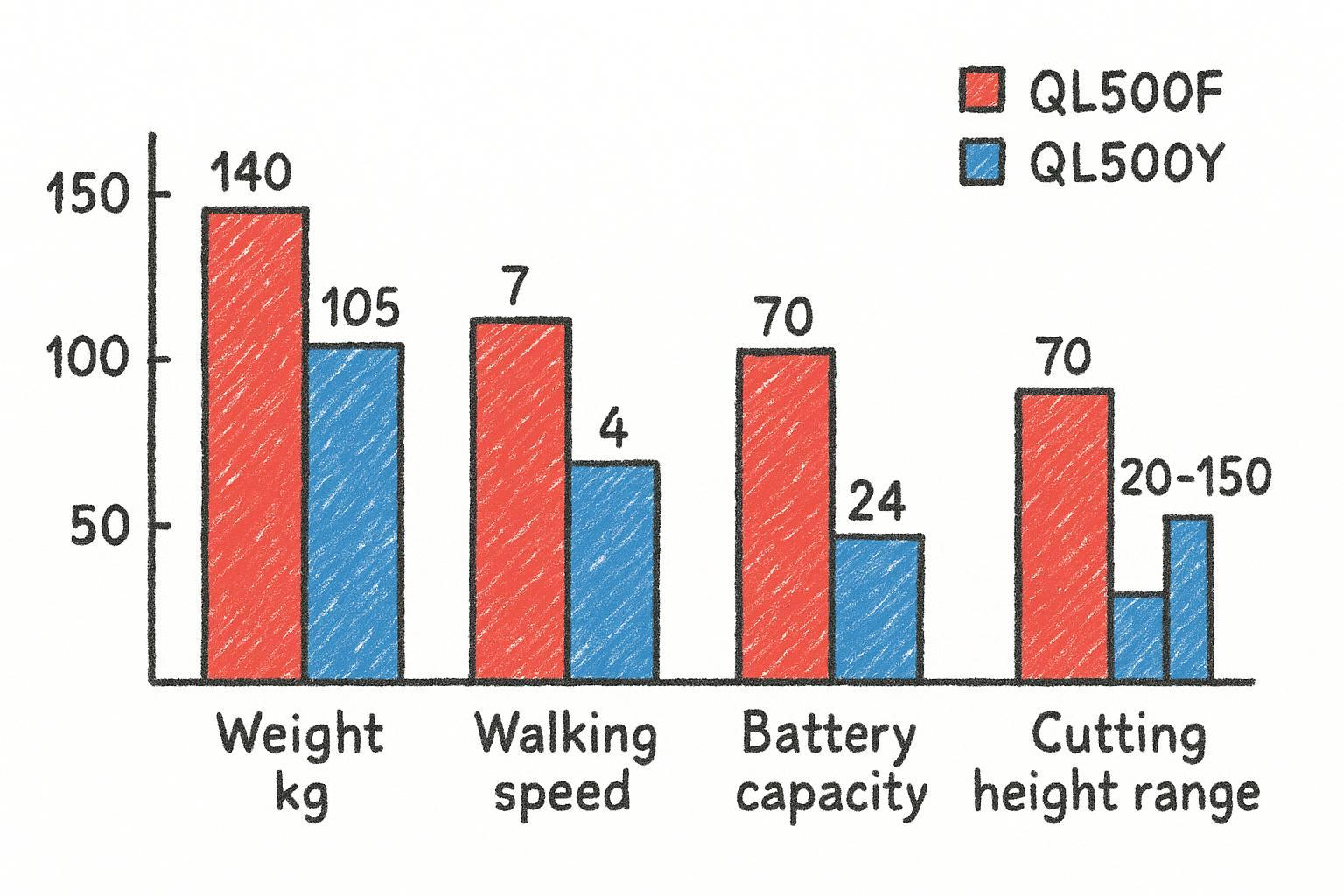
Was man daraus nehmen kann:
Beide Modelle führen dasselbe auf Kraftstofftankinhalt (1,2 l) und Kraftstoffverbrauch (1,2 l/H) Auf ihren Produktseiten sind Ausdauerunterschiede daher eher auf Arbeitsabläufe und Betriebsbedingungen zurückzuführen als auf die Kraftstoffzahlen allein.
Eine schwerere Maschine ist auf einem Hügel nicht automatisch schlechter, aber das Gewicht verändert Ihre tägliche Realität:
QL500F-Listen 105 kg, während QL500Y auflistet 140 kg. Wenn Sie ein Hausbesitzer sind, der den Mäher ohne Besatzung abwickelt, ist diese Lücke wichtig.
Beide Produktseiten erwähnen EPA und Euro 5.
In den USA werden die Emissionsanforderungen für Kleingeräte und Werkzeuge von der US-Umweltschutzbehörde festgelegt und erläutert. Ein guter Ausgangspunkt ist die Übersichtsseite der EPA, Vorschriften für Emissionen aus Kleingeräten und Werkzeugen.
Wenn Sie den rechtlichen Rahmen wünschen, veröffentlicht der eCFR ihn als 40 CFR Teil 1054.
Wie man das in einem Kaufgespräch nutzt (ohne sich in der Rechtssprache zu verlieren):
Euro-Normen sind europäische Abgasnormen für Fahrzeuge Für eine hochstufige Definition siehe Wikipedia's Übersicht über europäische Emissionsnormen. Für die meisten US-Hausbesitzer ist Euro 5 weniger wichtig als EPA, aber es kann für Käufer, die international tätig sind oder weiterverkaufen, von Bedeutung sein.
Nutzen Sie dies als schnelle Selbstsortierung:
Wenn du hin - und hergerissen bist, entscheide dich anhand von Ihr schlechtester Abschnitt, „Nicht Ihr durchschnittlicher Abschnitt.
Die sicherste Mäherwahl braucht noch eine sichere Technik Hier ein kurzer Clip, der einen aufgespürten ferngesteuerten Mäher zeigt, der auf einer steilen Fläche arbeitet:
Einige Höfe haben zwar kurze Abschnitte, die steil sind (Grabenkanten, Böschungen), aber viele Hausbesitzer überschätzen ihre Neigung Messen Sie Ihren steilsten Abschnitt und bauen Sie dann eine Marge auf. Befolgen Sie immer die vom Hersteller bewerteten Grenzwerte.
Nein. Nasses Gras und feuchter Boden verringern die Traktion und erhöhen das Gleitrisiko. Wenn Sie nach Regen mähen müssen, warten Sie, bis die Oberfläche trocken genug ist, um sicher zu gehen, ohne zu rutschen.
Die Schnitthöhe ist in der Regel wichtiger Ein etwas schmaleres Deck ist selten die Ursache für Skalpierung, eine ungeeignete Schnitthöhe auf unebenem Boden jedoch häufig.
Nicht automatisch Gewicht kann unter manchen Bedingungen helfen, aber es kann auch Transport und Erholung erschweren Wichtig ist stabiler Kontakt, kontrollierte Bewegung und das Vermeiden plötzlicher Manöver.
Es bedeutet im Allgemeinen, dass der Motor/die Ausrüstung die EPA-Emissionsanforderungen für seine Kategorie erfüllt, und der Hersteller kann diese Behauptung mit Zertifizierung, Kennzeichnung oder Dokumentation untermauern Die zuvor erwähnte EPA-Seite ist ein guter Ausgangspunkt.
Kann man, aber es ist meistens nicht die Entscheidung, die einen am Hang schützt, bei steilen Höfen priorisieren Sie zuerst Sicherheit, Kontrollmerkmale, und schneiden Sie Konsistenz Dann fordern Sie ein Angebot für die Konfiguration an, die Sie tatsächlich benötigen.
Wenn Sie Ihre steilste Steigung, die Größe der Mähfläche und den Rasentyp teilen, können wir Ihnen die bessere Passform empfehlen und ein Angebot für die richtige Konfiguration unterbreiten.
-1.png)