Bienvenido a Shandong Qilu Industrial Co., Ltd

 Spanish
 English
 Arabic
 Bulgarian
 Bengali
 Czech
Czech
 Danish
 German
 Greek
Greek
 Finnish
 French
 Hindi
Hindi
 Croatian
 Hungarian
 Indonesian
 Italian
 Japanese
 Korean
 Lithuanian
 Dutch
Dutch
 Norwegian
 Polish
 Portuguese
 Romanian
 Russian
 Slovak
 Slovenian
 Swedish
 Thai
Thai
 Turkish
 Ukrainian
 Vietnamese
 Tagalog
 Malay
Malay
 Estonian
 Catalan
 Latvian
 Urdu
Urdu
 Serbian
 Persian
 Swahili
 Albanian
 Armenian
 Icelandic
 Bosnian
 Luxembourgish
 Afrikaans
Spanish English
Arabic
Bulgarian
Bengali
Czech
Danish
German
Greek
Finnish
French
Hindi
Croatian
Hungarian
Indonesian
Italian
Japanese
Korean
Lithuanian
Dutch
Norwegian
Polish
Portuguese
Romanian
Russian
Slovak
Slovenian
Swedish
Thai
Turkish
Ukrainian
Vietnamese
Tagalog
Malay
Estonian
Catalan
Latvian
Urdu
Serbian
Persian
Swahili
Albanian
Armenian
Icelandic
Bosnian
Luxembourgish
Afrikaans
Afrikaans
Spanish English
Arabic
Bulgarian
Bengali
Czech
Danish
German
Greek
Finnish
French
Hindi
Croatian
Hungarian
Indonesian
Italian
Japanese
Korean
Lithuanian
Dutch
Norwegian
Polish
Portuguese
Romanian
Russian
Slovak
Slovenian
Swedish
Thai
Turkish
Ukrainian
Vietnamese
Tagalog
Malay
Estonian
Catalan
Latvian
Urdu
Serbian
Persian
Swahili
Albanian
Armenian
Icelandic
Bosnian
Luxembourgish
Afrikaans
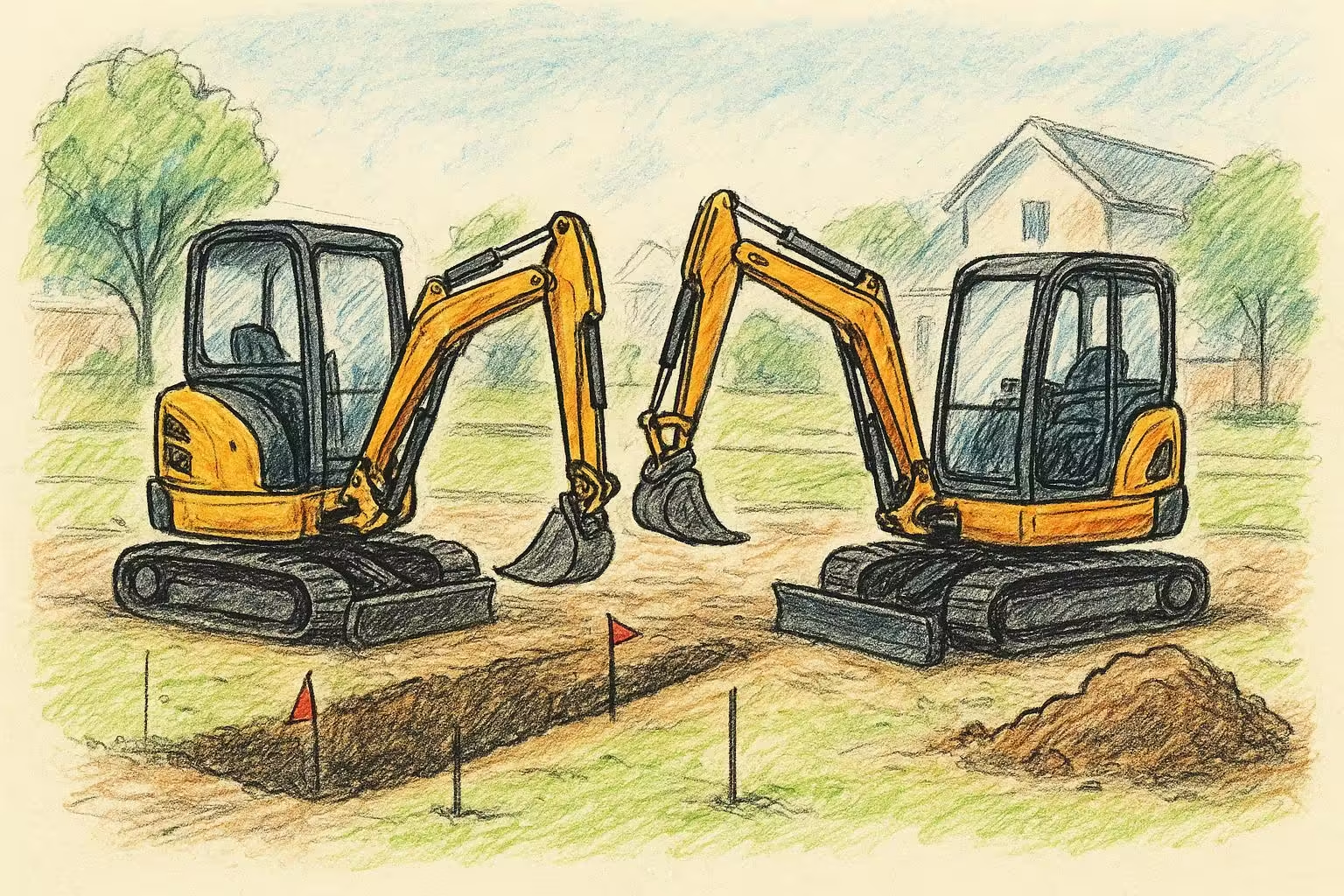
Mini excavadora de 3 toneladas frente a 3,5 toneladas: QL-30Eco frente a QL-35PRO para excavación de zanjas + nivelación
Los equipos de paisajismo y paisajismo no compran excavadoras por “especificaciones”. Los compras por dos tipos de días:
- Días de excavación (servicios públicos, drenaje, manguitos debajo de los pasillos)
- Días de finalización de trabajo (calificar, dar forma, rellenar, minimizar las perturbaciones)
Si tienes un límite presupuestario, la verdadera pregunta no es “¿Qué máquina es más grande?” Es:
¿qué categoría de peso le ofrece los trabajos más terminados por dólar sin que el transporte y el acceso al sitio sean un dolor de cabeza constante?
Conclusiones clave
- Si profundidad/alcance de zanjas es tu cuello de botella (y te reposicionas mucho), el QL-35PRO tiene una clara ventaja en el rango de trabajo basada en cifras publicadas sobre el rango de trabajo.
- Si acceso estrecho y la logística de “entrar, salir” es lo más importante QL-30Eco suele ser la opción más sencilla y de menor coste de propiedad.
- Pentru zăcinări de utilidades, seguridad del sitio y flujo de trabajo ahorrará más tiempo (y riesgo) que perseguir un poco más de especificaciones: siga las instrucciones de excavación de zanjas de OSHA cada vez.
Matriz de comparación de excavadoras compactas rápidas (las cosas que realmente les importan a los equipos)
| Factor de decisión | QL-30Eco (clase de 3,0 toneladas) | QL-35PRO (clase de 3,5 toneladas) | Significado práctico de trabajos reales |
|---|---|---|---|
| Presión presupuestaria | Normalmente es más fácil de mantener dentro de un presupuesto máximo | Puede requerir más gasto inicial | Si el presupuesto es fijo, gastar de más puede obligarlo a omitir los archivos adjuntos que realmente le generan dinero |
| Rango de trabajo (profundidad de excavación/radio/altura)* | Sobre de trabajo más pequeño | Sobre de trabajo más grande | Una envoltura más grande puede significar menos movimientos de reposicionamiento en recorridos largos de trincheras |
| Acceso y maniobras | A menudo es más fácil en diseños residenciales reducidos | Un poco más exigente | Las puertas, los patios laterales estrechos y las zanjas cercanas a la estructura castigan a las máquinas de gran tamaño |
| Perturbación del suelo | A menudo más suave en césped/paisajes terminados | Puede ser mayor según la configuración | El peso y las huellas influyen en cuánto se rompe un área terminada |
| Simplicidad de transporte | Normalmente es más fácil remolcar | Puede empujarte a realizar transportes más pesados | Su configuración de transporte puede convertirse silenciosamente en su mayor “costo oculto” |
| Mejor ajuste | Zanjas de poco a moderado + nivelación final | Carreras de zanjas más largas + excavaciones más exigentes | Elija según lo que le ralentiza hoy, no lo que suena impresionante |
*Números de rango de trabajo a los que se hace referencia más adelante en este artículo.
Qué significa realmente “peso operativo” (y por qué 0,5 toneladas puede cambiarlo todo)
Antes de comparar cualquier excavadora compacta, aclare dos definiciones básicas:
- Un excavadora es un equipo de construcción con pluma, palo, cucharón y cabina sobre una estructura superior giratoria (“casa”). Ver Excavadora (Wikipedia).
- Peso operativo es el peso total de una máquina “en uso”, incluidos los fluidos y el operador. Ver Peso operativo (Wikipedia).
Por eso “3 toneladas frente a 3,5 toneladas” no es sólo una etiqueta de marketing. La categoría de peso cambia tres cosas que afectan duramente a los equipos de paisajismo/paisaje duro:
- Estabilidad y elevación de la confianza en patios irregulares y a lo largo de bordes de zanjas.
- Presión del suelo y perturbaciones en sitios terminados.
- Transporte y logística, lo que puede suponer un coste mayor de lo que esperas cuando intentas mantenerte por debajo del presupuesto máximo.
Rango de trabajo: la verificación de la realidad de la zanja
Para zanjas de utilidad, la “sensación” de una máquina es agradable, pero el trabajo se rige por la geometría:
- ¿Puedes llegar lo suficientemente lejos de tu posición de configuración?
- ¿puedes alcanzar la profundidad que necesitas sin excavar demasiado?
- ¿puedes tirar los desechos donde quieras sin volver a detectarlos constantemente?
Según las cifras de rango de trabajo publicadas en las páginas de productos Qilu, el QL-35PRO muestra valores más altos en profundidad de excavación, radio y altura de descarga que el QL-30Eco.
Gráfico de rango de trabajo (cifras publicadas)
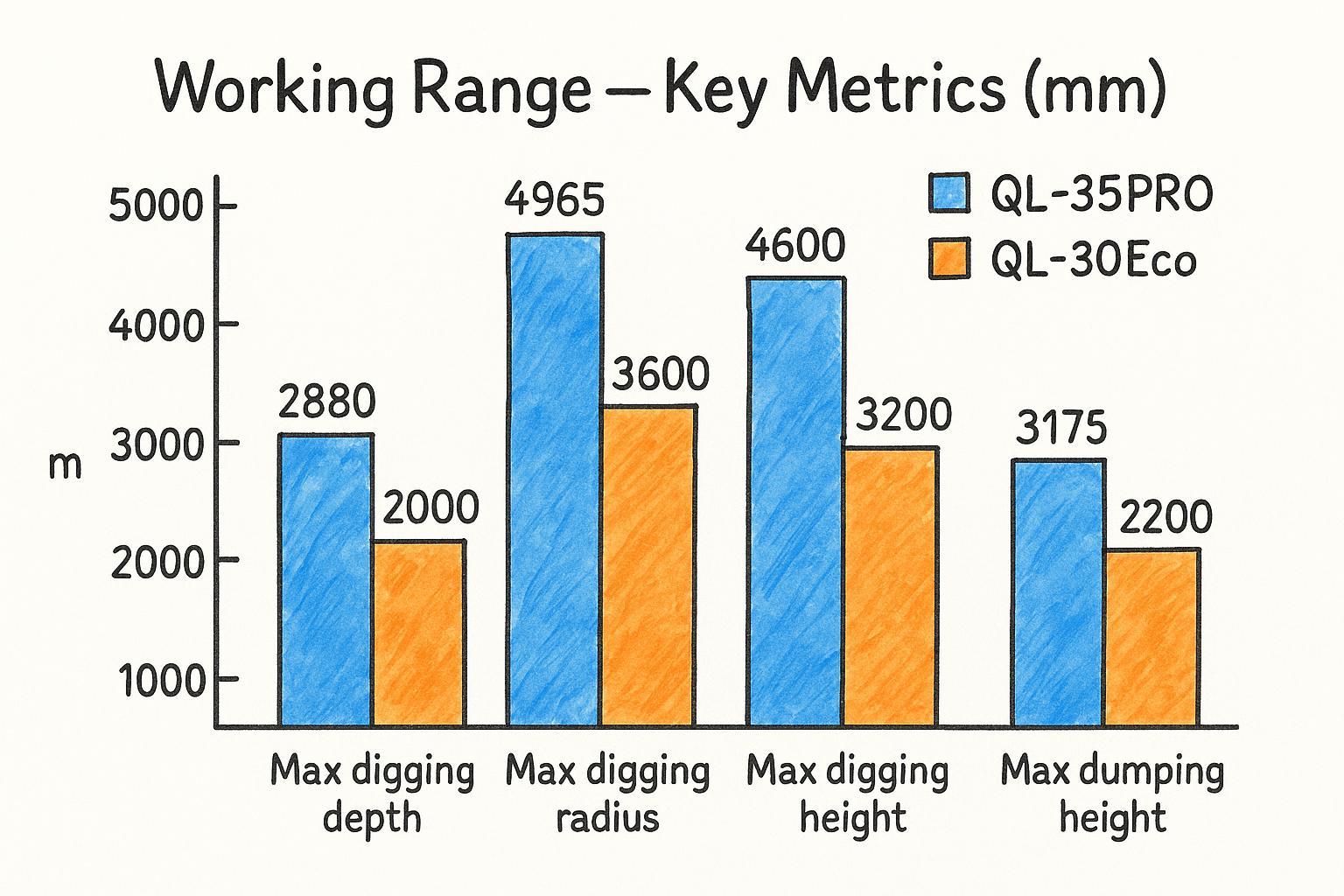
Los números reales (mm)
| Métrica (mm) | QL-35PRO | QL-30Eco |
|---|---|---|
| Profundidad máxima de excavación | 2880 | 2000 |
| Profundidad máxima de excavación vertical | 2305 | 2000 |
| Radio máximo de excavación | 4965 | 3600 |
| Altura máxima de excavación | 4600 | 3200 |
| Altura máxima de descarga/descarga | 3175 | 2200 |
Si desea la hoja de especificaciones completa (opciones de cubo, sistema hidráulico auxiliar, dimensiones y capacidades de fijación), comience con las páginas oficiales: QL-35PRO y QL-30Eco.
(De las cifras del rango de trabajo publicadas en esas páginas:) QL-35PRO enumera la altura máxima de excavación 4600 mm, la altura máxima de descarga 3175 mm, la profundidad máxima de excavación 2880 mm, la profundidad máxima de excavación vertical 2305 mm y el radio máximo de excavación 4965 mm; QL-30Eco enumera la altura máxima de excavación 3200 mm, la altura máxima de descarga 2200 mm, la profundidad máxima de excavación 2000 mm, la profundidad máxima de excavación vertical 2000 mm y el radio máximo de excavación 3600 mm.
Por qué esto es importante para la excavación de zanjas:
- Profundidad: Si habitualmente necesita más profundidad (o desea más margen sin sobrecortar), una profundidad de excavación adicional reduce las soluciones.
- Radio: Más radio puede reducir la frecuencia con la que se reposiciona. Esto se ahorra en tiempo real en líneas de zanja más largas.
- Altura del vertedero: Una altura de vertido más alta facilita la colocación de desechos o cargas en instalaciones de transporte de lados más altos.
Seguridad en zanjas: la forma más rápida de arruinar un trabajo (y cómo evitarlo)
Las zanjas para servicios públicos son el lugar donde los equipos de paisajismo pueden chocar accidentalmente con peligros graves. OSHA es sincera sobre el mayor riesgo: derrumbes.
Utilice los recursos de excavación de zanjas de OSHA como base, no como “agradable tenerlos” Comience con la descripción general de excavación y excavación de zanjas de OSHA y el PDF oficial Publicación de OSHA: Seguridad en excavaciones y excavaciones (OSHA 2226).
⚠¦ Advertencia: OSHA requiere sistemas de protección para muchas condiciones de zanjas y enfatiza las inspecciones diarias realizadas por una persona competente según las reglas de excavación en 29 CFR 1926 Subparte P. Si su flujo de trabajo no incluye la planificación de seguridad de las zanjas, su elección de excavadora no lo salvará.
Marco de decisión de presupuesto primero: lo que le cuesta dinero después de comprar
Un límite presupuestario no significa “comprar lo más barato”. Significa evite los costos que silenciosamente consumen las ganancias de cada trabajo.
Aquí están las palancas de costos que más importan para los equipos de zanjas + nivelación:
1) Transporte: el pago mensual oculto
Las máquinas más pesadas pueden empujarte hacia:
- una clase de remolque diferente
- configuración diferente del camión
- más desgaste, más combustible, más molestias
Si está tratando de mantenerse por debajo del presupuesto máximo, la mejor excavadora suele ser la que mantiene su configuración de transporte simple.
2) Tiempo de reposicionamiento: la lenta fuga en los trabajos de trinchera
Si avanza constantemente para mantener limpio el alcance y la colocación de los escombros, está pagando:
- tiempo del operador
- congestión en el lugar de trabajo
- césped perturbado y más limpieza
Aquí es donde un sobre de trabajo más grande puede devolver el dinero.
3) Daños en el acabado: lo que pagas para “hacer que parezca que no estábamos aquí”
Los equipos de paisajismo y paisajismo viven y mueren con la mirada final.
El tamaño incorrecto puede significar:
- más surcos
- más trabajos de reparación
- propietarios más molestos
¿qué excavadora de paisajismo deberías elegir? (Sin pelusas, solo escenarios)
Elija el QL-30Eco si gana principalmente en logística
Elegir QL-30Eco cuando tus trabajos se ven así:
- propiedades residenciales con estrecho acceso
- recorridos de zanjas más cortos donde el reposicionamiento es manejable
- movilización frecuente (muchos trabajos pequeños por semana)
- presupuesto máximo estricto donde la simplicidad del transporte importa más que el alcance adicional
Estás optimizando para: llegar al sitio fácilmente, terminar limpiamente y controlar los costos de propiedad.
Elija el QL-35PRO si la productividad de la zanja es el cuello de botella
Elegir QL-35PRO cuando tus trabajos se ven así:
- líneas de trincheras más largas donde se acumula el tiempo de reposicionamiento
- se necesita una zanja más profunda donde la profundidad adicional reduce las soluciones alternativas
- restricciones más frecuentes de carga/colocación de desechos donde la altura de descarga ayuda
Estás optimizando para: rango de trabajo, menos remanentes y mayor rendimiento de zanjas.
Accesorios: la forma más económica de hacer que cualquiera de las excavadoras se sienta “más grande”
Si su presupuesto es limitado, los accesorios suelen ser la palanca de retorno de la inversión más alta, especialmente para los equipos de paisajismo que cambian entre zanjas y nivelación.
Para conocer las categorías y configuraciones de archivos adjuntos comunes, consulte la página de descripción general de Qilu en accesorios para miniexcavadoras (pulgar, enganche rápido, sinfín).
Consejo profesional: Si intercambias cubos o herramientas varias veces al día, el tiempo de cambio de su archivo adjunto se convierte en dinero real. Cree su plan de compra en torno a los cambios que realmente realiza en el lugar de trabajo.
Un vídeo que vale la pena ver antes de tu próximo trabajo en la trinchera
Próximos pasos (baja presión)
- Si desea comparar los dos modelos con la hoja de especificaciones completa que tiene a mano, vuelva a visitar las páginas oficiales: QL-35PRO y QL-30Eco.
- Explore la línea más amplia de venta de excavadoras compactas si todavía no estás seguro de la categoría de peso.
- Para conocer los antecedentes de la empresa y las expectativas de soporte, consulte Acerca de Qilu Machinery.
Preguntas frecuentes
¿una miniexcavadora de 3,5 toneladas es siempre “mejor” que una de 3 toneladas?
No. Una máquina de clase de 3,5 toneladas puede brindarle más rango de trabajo y estabilidad, pero “mejor” depende del acceso, el transporte y la frecuencia con la que se reposiciona. Si sus trabajos son sitios residenciales de acceso estrecho, la clase más pequeña puede terminar más rápido simplemente porque es más fácil de mover y colocar.
¿qué profundidad de excavación necesito realmente para la excavación de zanjas de servicios públicos?
Depende de sus requisitos locales y de la utilidad específica. El enfoque práctico es enumerar las profundidades de su zanja más comunes y luego elegir una máquina que pueda alcanzar esas profundidades sin operar al límite todo el día.
¿cuál es la diferencia entre la profundidad máxima de excavación y la profundidad máxima de excavación vertical?
La profundidad máxima de excavación generalmente se mide en ángulo a lo largo de la trayectoria de la pluma/palo. La profundidad máxima de excavación vertical refleja lo que puedes lograr al excavar hacia abajo. Ambos importan, especialmente cuando estás cavando cerca de obstáculos.
¿necesito preocuparme por los derrumbes de trincheras si “sólo” estoy haciendo trabajos de servicios públicos poco profundos?
Sí. Las condiciones cambian rápidamente con el tipo de suelo, la humedad, la vibración y la colocación de escombros. Las pautas y requisitos de OSHA existen porque los derrumbes pueden ocurrir repentinamente. Usar Recursos de excavación y excavación de zanjas de OSHA como base.
¿Cómo debo pensar en un presupuesto máximo al comparar estas dos excavadoras?
Trate el precio de la máquina sólo como parte de la decisión. La configuración del transporte, la limpieza del lugar de trabajo y las opciones de accesorios pueden variar su costo real por trabajo. Si la envolvente de trabajo más grande ahorra un tiempo de mano de obra significativo en sus trabajos típicos en zanjas, puede justificar un costo inicial más alto. De lo contrario, mantenga la configuración simple y asigne presupuesto a los accesorios que mejoran el rendimiento.
¿Debo comprar basándome únicamente en las especificaciones?
No. Las especificaciones te dicen lo que es posible; no le dicen qué es rentable en sus sitios específicos. Utilice las especificaciones para eliminar los desajustes y luego decida en función de los trabajos que realiza cada semana y los costos que no puede cambiar (acceso y transporte). Para obtener el texto reglamentario completo, consulte OSHA 29 CFR 1926 Subparte P (Excavaciones).