Correo electrónico: [email protected] WhatsApp: +8618266768780
Correo electrónico: [email protected] WhatsApp: +8618266768780


Si ha comparado las hojas de especificaciones de la minicargadora durante más de 10 minutos, ha visto cifras que parecen decisivas: caballos de fuerza, carga de vuelco, fuerza de arranque.
Aquí está el problema. El único número que predice de manera más confiable si la máquina se sentirá segura, estable y productiva en un trabajo real suele ser el que los compradores pasan por alto: Capacidad operativa nominal (ROC).
Esta guía está escrita para compradores estadounidenses que evalúan un Cargador de minicargador de China para contratación, paisajismo o trabajo agrícola. No es un artículo genérico de “qué es un minicargador”. Es un marco de la República de China que puede utilizar para preseleccionar una máquina, elegir accesorios y evitar sobrecompras o (peor) sobrecargas.
Conclusión clave: Compre por ROC (y en qué se convierte ROC después de los archivos adjuntos + terreno), no inclinando la carga.
Un minicargador es un cargador compacto diseñado para aceptar una amplia gama de accesorios, convirtiendo una máquina en muchas herramientas. Si desea la definición limpia más notas de diseño como dirección diferencial y tipos de brazos elevadores, comience con Definición de “cargador de dirección deslizante” de Wikipedia.
Para los compradores, la implicación práctica es simple: rara vez se compra “una máquina de cangilones”. Estás comprando una plataforma de fijación. Eso hace que la capacidad y la estabilidad sean el centro de la decisión.
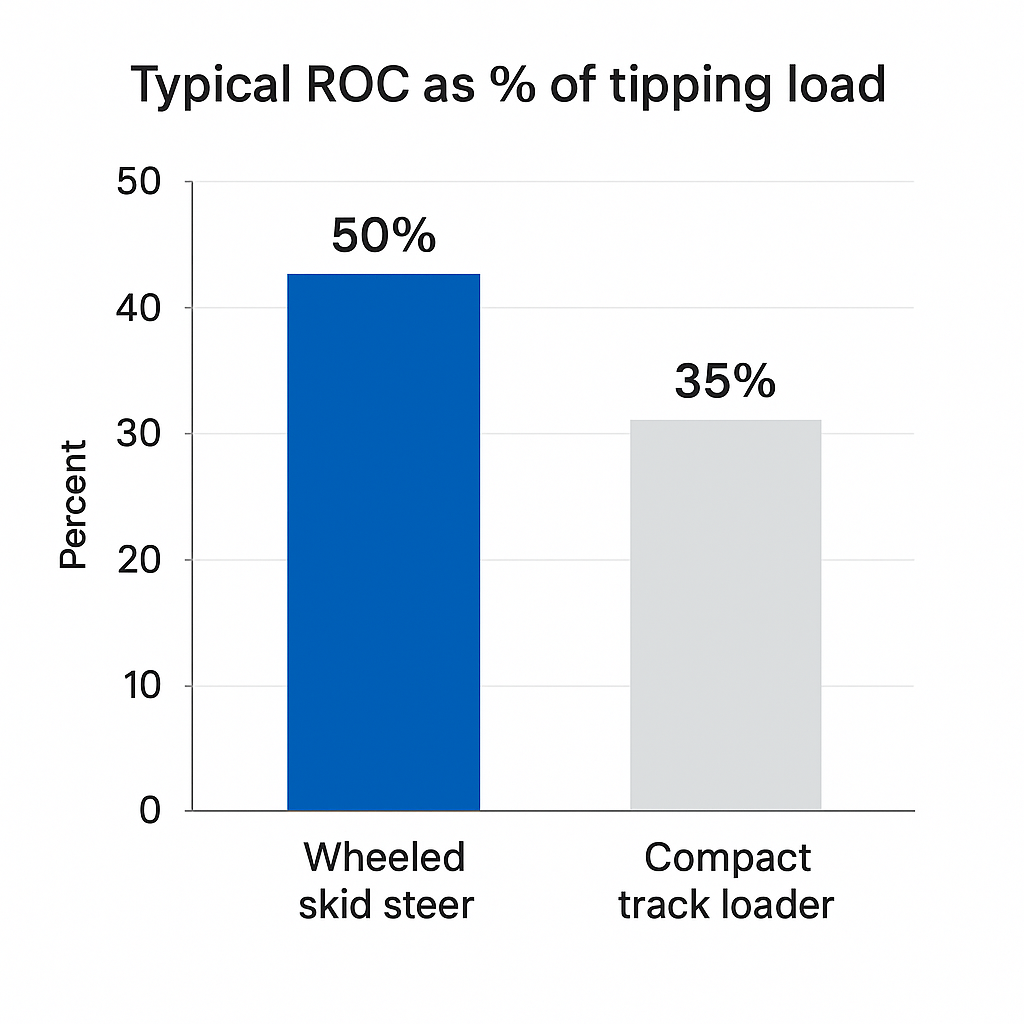
Carga basculante es el umbral donde una máquina comienza a levantar sus ruedas/vías traseras bajo una condición de prueba definida. República de China es la carga segura y de trabajo derivada de esa carga basculante, con un margen de seguridad incorporado.
Una convención industrial común es:
Estas convenciones se explican claramente en Guía de carga ROC vs volcado de Whitestar Machinery (2025).
Si un listado hace que la carga de volcado parezca “capacidad de elevación”, comparará mal las máquinas.
Cree sus cálculos de compra en torno a ROC, luego reste el peso del archivo adjunto y agregue buffers del mundo real.
Responde estas cuatro preguntas. Si no puedes, aún no estás listo para comparar máquinas.
¿Por qué este orden? Porque los accesorios y el terreno cambian cómo se siente la “capacidad segura” en el mundo real.
Aquí hay una forma conservadora de evitar comprar máquinas demasiado pequeñas (o sobrecargar una máquina del tamaño adecuado).
Si desea una única regla general para ese búfer: tratar 80-90% de la República de China restante como su zona segura “diaria”.
Para saber por qué son importantes el terreno y las condiciones reales de trabajo (no solo la prueba del folleto), consulte Guía de Gregory Poole sobre capacidad operativa nominal (2025).
⚠¦ Advertencia: La República de China publicada no es una promesa para pendientes, terrenos blandos o viajes rápidos con una carga elevada.
Utilice esto como cuadrícula de comparación. Está destinado a ser neutral para el proveedor.
| Qué verificar | Por qué es importante | Qué pedir/consultar |
|---|---|---|
| Capacidad operativa nominal (ROC) | Su verdadero “límite de trabajo” para elevación y estabilidad | Definición ROC utilizada (con ruedas versus con orugas), condición de prueba, configuración de la máquina |
| Carga de vuelco (FTSTL) | Se utiliza para derivar ROC, no una calificación de trabajo seguro | Confirme cómo se calcula la ROC a partir de la carga de vuelco |
| Peso operativo | Compensaciones entre estabilidad y presión sobre el suelo | Incluye opciones de cabina, orugas y peso típico de fijación |
| Flujo hidráulico (estándar versus alto flujo) | Determina qué archivos adjuntos alimentados puedes ejecutar bien | Flujo + presión; confirmar los requisitos de fijación |
| Ruta de elevación (radial versus vertical) | Los efectos llegan a toda altura y carga de camiones | Qué diseño de ascensor se utiliza y uso previsto |
| Interfaz de conexión rápida | Compatibilidad de accesorios y flexibilidad de reventa | Confirme el estándar del acoplador + dimensiones |
| Acceso al servicio + consumibles | Tiempo de inactividad y costo de propiedad | Acceso a filtros, puntos de grasa, recorrido de mangueras, disponibilidad de piezas |
A la mayoría de los compradores les importan los accesorios porque generan retorno de la inversión. Eso sólo funciona si los acopladores coinciden.
Dos referencias que vale la pena conocer:
Controles prácticos que evitan sorpresas costosas:
Si desea una explicación rápida del patrón SSQA común, muchos compradores se refieren a él cuando dicen “universal” Notas de conexión rápida SAE J2513 de FarmHack son un punto de partida legible.
No se trata de qué es “mejor”. Se trata de dónde ocurre tu trabajo.
Si desea una guía de selección centrada en las pistas, Qilu tiene una descripción interna útil.
La mayoría de los propietarios no necesitan 20 archivos adjuntos. Necesitan 3-5 que cubran 80% de trabajos.
Un conjunto típico de alto ROI:
Si el trabajo con garfio es una prioridad, utilice esta guía interna para evitar mandíbulas y requisitos hidráulicos que no coincidan: Garfio de minicargadora: características esenciales a buscar.
Si desea hacer coincidir su lista de verificación con configuraciones reales, comience desde el centro del producto y trabaje hacia abajo:
ROC es la capacidad de trabajo segura que debe utilizar para el levantamiento diario. La carga de inclinación es el umbral de prueba utilizado para calcular la ROC, no una clasificación operativa segura.
Muchos fabricantes utilizan un porcentaje más estricto de carga de vuelco para cargadoras de orugas compactas (a menudo alrededor de 35%, a veces 35-40%) que para máquinas con ruedas (a menudo alrededor de 50%). Esa convención es una de las razones por las que se debe comparar directamente la República de China, no la carga de vuelco.
Los accesorios agregan peso y desplazan la carga hacia adelante. Su capacidad utilizable debe restar el peso del accesorio y del acoplador de la República de China y luego incluir un amortiguador para las condiciones reales del suelo y el movimiento.
Muchos minicargadores modernos comparten una interfaz común de conexión rápida, pero “universal” no está garantizado. Verifique las dimensiones del acoplador y el sistema hidráulico por escrito y confirme que cualquier estándar reclamado coincida con el accesorio que planea ejecutar.
Elija según su terreno: orugas para suelo blando/barro/césped y tracción, ruedas para superficies duras, velocidad y mantenimiento más sencillo.
Solicite definición ROC, carga de vuelco, peso operativo, flujo/presión hidráulica, estándar y dimensiones del acoplador y plan de servicio/piezas. Si el proveedor no puede documentarlos, es una señal de alerta.




-1.png)