Welcome to Shandong Qilu Industrial Co., Ltd

 English
 Arabic
 Bulgarian
 Bengali
 Czech
Czech
 Danish
 German
 Greek
Greek
 Spanish
 Finnish
 French
 Hindi
Hindi
 Croatian
 Hungarian
 Indonesian
 Italian
 Japanese
 Korean
 Lithuanian
 Dutch
Dutch
 Norwegian
 Polish
 Portuguese
 Romanian
 Russian
 Slovak
 Slovenian
 Swedish
 Thai
Thai
 Turkish
 Ukrainian
 Vietnamese
 Tagalog
 Malay
Malay
 Estonian
 Catalan
 Latvian
 Urdu
Urdu
 Serbian
 Persian
 Swahili
 Albanian
 Armenian
 Icelandic
 Bosnian
 Luxembourgish
 Afrikaans
English Arabic
Bulgarian
Bengali
Czech
Danish
German
Greek
Spanish
Finnish
French
Hindi
Croatian
Hungarian
Indonesian
Italian
Japanese
Korean
Lithuanian
Dutch
Norwegian
Polish
Portuguese
Romanian
Russian
Slovak
Slovenian
Swedish
Thai
Turkish
Ukrainian
Vietnamese
Tagalog
Malay
Estonian
Catalan
Latvian
Urdu
Serbian
Persian
Swahili
Albanian
Armenian
Icelandic
Bosnian
Luxembourgish
Afrikaans
Afrikaans
English Arabic
Bulgarian
Bengali
Czech
Danish
German
Greek
Spanish
Finnish
French
Hindi
Croatian
Hungarian
Indonesian
Italian
Japanese
Korean
Lithuanian
Dutch
Norwegian
Polish
Portuguese
Romanian
Russian
Slovak
Slovenian
Swedish
Thai
Turkish
Ukrainian
Vietnamese
Tagalog
Malay
Estonian
Catalan
Latvian
Urdu
Serbian
Persian
Swahili
Albanian
Armenian
Icelandic
Bosnian
Luxembourgish
Afrikaans

China Skid Steer Loader Buying Guide: ROC-First Specs That Prevent Costly Mistakes
If you’ve compared skid steer spec sheets for more than 10 minutes, you’ve seen numbers that look decisive: horsepower, tipping load, breakout force.
Here’s the catch. The single number that most reliably predicts whether the machine will feel safe, stable, and productive on a real job is usually the one buyers gloss over: Rated Operating Capacity (ROC).
This guide is written for US buyers evaluating a China Skid Steer Loader for contracting, landscaping, or farm work. It’s not a generic “what is a skid steer” article. It’s a ROC-first framework you can use to shortlist a machine, choose attachments, and avoid overbuying or (worse) overloading.
Key Takeaway: Shop by ROC (and what ROC becomes after attachments + terrain), not by tipping load.
What a skid steer loader is (and why ROC is the spec that matters)
A skid steer loader is a compact loader designed to accept a wide range of attachments, turning one machine into many tools. If you want the clean definition plus design notes like differential steering and lift-arm types, start with Wikipedia’s “Skid-steer loader” definition.
For buyers, the practical implication is simple: you’re rarely buying “a bucket machine.” You’re buying an attachment platform. That makes capacity and stability the center of the decision.
ROC vs tipping load: the 30-second explanation you can actually use
Tipping load is the threshold where a machine starts to lift its rear wheels/tracks under a defined test condition. ROC is the safe, working load derived from that tipping load, with a safety margin built in.
A common industry convention is:
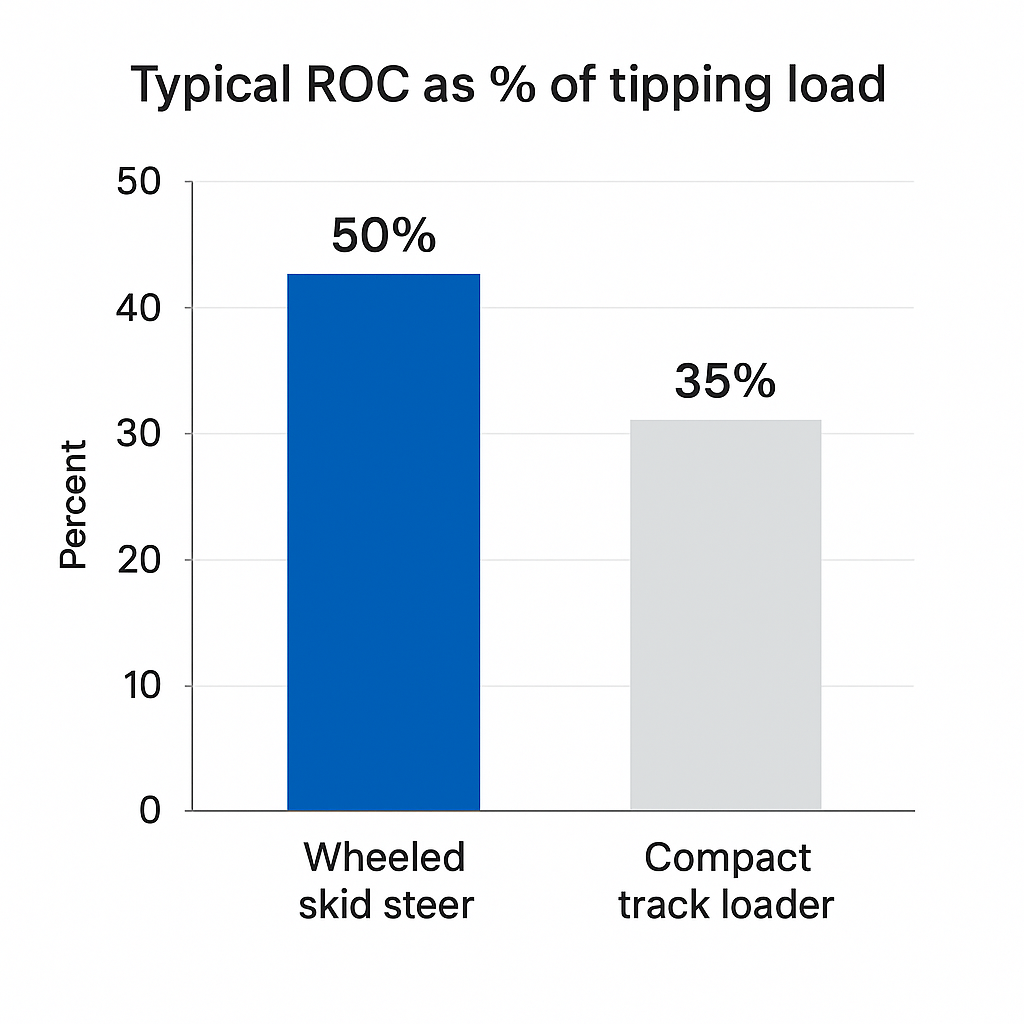
- Wheeled skid steers: ROC is often rated at about 50% of tipping load.
- Compact track loaders: ROC is often rated at about 35% of tipping load (sometimes 35–40%).
These conventions are explained clearly in Whitestar Machinery’s ROC vs tipping load guide (2025).
The mistake
If a listing makes tipping load look like “lift capacity,” you’ll compare machines wrong.
The fix
Build your buying math around ROC, then subtract attachment weight and add real-world buffers.
A ROC-first needs assessment (before you look at models)
Answer these four questions. If you can’t, you’re not ready to compare machines yet.
- Heaviest thing you’ll lift weekly: palletized material, wet soil, round bales, logs, etc.
- Typical lift height and reach: loading a trailer, stacking, feeding into a hopper.
- Ground conditions: flat concrete, rutted dirt, slopes, mud, turf.
- Top 3 attachments you’ll run: bucket + forks + auger, or bucket + grapple, etc.
Why this order? Because attachments and terrain change what “safe capacity” feels like in the real world.
The “usable ROC” calculation (simple, conservative, and practical)
Here’s a conservative way to avoid buying too small (or overloading a right-sized machine).
- Start with the machine’s published ROC.
- Subtract: attachment + coupler weight.
- Subtract: any typical add-ons you’ll keep installed (guards, ballast, etc.).
- Apply a real-world buffer for uneven ground, turning, and stop/start motion.
If you want a single rule of thumb for that buffer: treat 80–90% of the remaining ROC as your “daily” safe zone.
For why terrain and real work conditions matter (not just the brochure test), see Gregory Poole’s guide to rated operating capacity (2025).
⚠️ Warning: Published ROC is not a promise for slopes, soft ground, or fast travel with a raised load.
The buyer’s table: what to check on any China skid steer loader spec sheet
Use this as your comparison grid. It’s meant to be vendor-neutral.
| What to verify | Why it matters | What to ask for / check |
|---|---|---|
| Rated Operating Capacity (ROC) | Your real “work limit” for lifting and stability | ROC definition used (wheeled vs tracked), test condition, machine configuration |
| Tipping load (FTSTL) | Used to derive ROC, not a safe working rating | Confirm how ROC is calculated from tipping load |
| Operating weight | Stability and ground pressure tradeoffs | Include cab options, tracks, and typical attachment weight |
| Hydraulic flow (standard vs high-flow) | Determines which powered attachments you can run well | Flow + pressure; confirm attachment requirements |
| Lift path (radial vs vertical) | Affects reach at full height and truck loading | Which lift design is used and intended use |
| Quick-attach interface | Attachment compatibility and resale flexibility | Confirm the coupler standard + dimensions |
| Service access + consumables | Downtime and cost of ownership | Filter access, grease points, hose routing, parts availability |
Attachment compatibility: don’t assume “universal” without checking
Most buyers care about attachments because they drive ROI. That only works if couplers match.
Two references worth knowing:
- ISO describes interchangeability requirements in ISO 24410:2020 on coupling attachments to skid steer loaders.
Practical checks that prevent expensive surprises:
- Ask for the coupler spec (and photos with a tape measure).
- Confirm your powered attachments match the machine’s hydraulic flow/pressure.
- Treat “adapter plates” as a last resort; they can change geometry and reduce performance.
If you want a quick explainer of the common SSQA pattern many buyers refer to when they say “universal,” FarmHack’s SAE J2513 quick-attach notes are a readable starting point.
Wheels vs tracks (what actually changes for US jobs)
This isn’t about which is “better.” It’s about where your work happens.
- Choose tracks when traction and low ground pressure matter (soft soil, mud, sensitive turf).
- Choose wheels when you value speed on hard surfaces, lower maintenance, and tight turning on finished sites.
If you want a track-focused selection guide, Qilu has a helpful internal overview.
Where a skid steer earns its money: the 80/20 attachment set
Most owners don’t need 20 attachments. They need 3–5 that cover 80% of jobs.
A typical high-ROI set:
- Bucket (general material)
- Pallet forks (moving deliveries, pallets, lumber)
- Auger (posts, small footings)
- Grapple (brush, storm cleanup, demolition debris)
If grapple work is a priority, use this internal guide to avoid mismatched jaws and hydraulic requirements: Skid steer loader grapple: essential features to look for.
YouTube: ROC and tipping load explained (worth 6 minutes)
How to shortlist a China skid steer loader in 7 steps
- Write down your heaviest weekly load and the attachment you’ll use to lift it.
- Convert that into a “usable ROC” target (ROC minus attachment weight, then apply a buffer).
- Choose wheels vs tracks based on ground conditions.
- Match hydraulics to your highest-demand attachment.
- Confirm the quick-attach interface and dimensions.
- Check service access and parts pipeline (filters, hoses, wear items).
- Only then compare price, lead time, and shipping terms.
Next steps: see models and application scenarios
If you want to match your checklist to real configurations, start from the product hub and work down:
FAQ: China skid steer loader buying questions (US-focused)
1) What’s the difference between ROC and tipping load on a skid steer loader?
ROC is the safe working capacity you should use for daily lifting. Tipping load is the test threshold used to calculate ROC, not a safe operating rating.
2) Why do track loaders often have ROC rated differently than wheeled skid steers?
Many manufacturers use a stricter percentage of tipping load for compact track loaders (often around 35%, sometimes 35–40%) versus wheeled machines (often around 50%). That convention is one reason you should compare ROC directly, not tipping load.
3) How do attachments change how much a skid steer loader can safely lift?
Attachments add weight and shift the load forward. Your usable capacity should subtract attachment and coupler weight from ROC, then include a buffer for real ground conditions and motion.
4) Are skid steer attachments universal?
Many modern skid steers share a common quick-attach interface, but “universal” isn’t guaranteed. Verify coupler dimensions and hydraulics in writing, and confirm any claimed standard matches the attachment you plan to run.
5) Should I choose wheels or tracks for a skid steer loader in the US?
Choose based on your ground: tracks for soft soil/mud/turf and traction, wheels for hard surfaces, speed, and simpler maintenance.
6) What should I ask a supplier before buying a China skid steer loader?
Ask for ROC definition, tipping load, operating weight, hydraulic flow/pressure, coupler standard and dimensions, and service/parts plan. If the supplier can’t document these, that’s a red flag.