Correo electrónico: [email protected] WhatsApp: +8618266768780

Correo electrónico: [email protected] WhatsApp: +8618266768780


If you’re a first-time owner, mini excavator maintenance can feel like a mystery: lots of grease points, tracks that wear in weird ways, and hoses you only notice after they fail.
This guide is built to remove the guesswork. It focuses on preventive care you can actually do: short daily checks, a realistic schedule, and the few “stop now” warning signs that save you from expensive downtime.
Maintenance is more than changing parts. For compact equipment, it’s usually three things:
If you’re new to the machine category, it helps to start with a basic definition of what an excavator is and how the major groups work (upper structure, boom/stick/bucket, undercarriage). Wikipedia’s overview of an excavador is a solid starting point.
Even “simple” checks happen around pinch points, hot surfaces, and moving equipment.
OSHA has repeatedly highlighted the importance of protecting workers from hazards related to excavator rotation and swing radius; their standard interpretation on excavator swing radius hazards gives the context.
Pro Tip: Your best maintenance “tool” is consistency. Do the same walk-around in the same order every time so you notice what changed.
Walk the machine clockwise and check in this sequence:
This section doubles as a mini excavator daily inspection routine you can repeat every time you start work.
The goal is not to find every possible issue. The goal is to catch the small stuff before it becomes downtime.
| Daily check | What “good” looks like | Stop and fix if… |
|---|---|---|
| Walk-around for leaks | Dry hoses and fittings; no new wet streaks | You see a steady drip, sprayed mist, or a growing wet area |
| Inspect tracks & undercarriage | No severe cuts/tears; no missing bolts; debris not packed hard | Track is derailing, or you see damaged rollers/idlers |
| Inspect pins & bushings | Grease present; joints move smoothly | Visible metal dust, loud squeaks, or obvious “slop” |
| Check attachment hardware | Fasteners and retainers present; teeth secure | Missing retainer/clip, cracked tooth adapter, loose coupler |
| Clean cooling intake/radiator area | Air can pass; fins not clogged with grass/mud | Overheating, repeated temperature warnings |
| Check safety items | Horn/alarms/lights work; belt intact | Controls stick, warning light persists, belt won’t latch |
If you prefer to print it, treat the weekly table + daily table as your compact excavator maintenance checklist.
These tasks depend on your jobsite. If you work in mud, demo debris, or abrasive sand, shorten the interval.
Greasing is preventative maintenance that directly affects pin and bushing life.
A good routine:
Buscar:
⚠️ Warning: A pinhole leak can inject fluid into skin. Treat any suspected high-pressure leak as a serious hazard and use the right inspection methods and PPE.
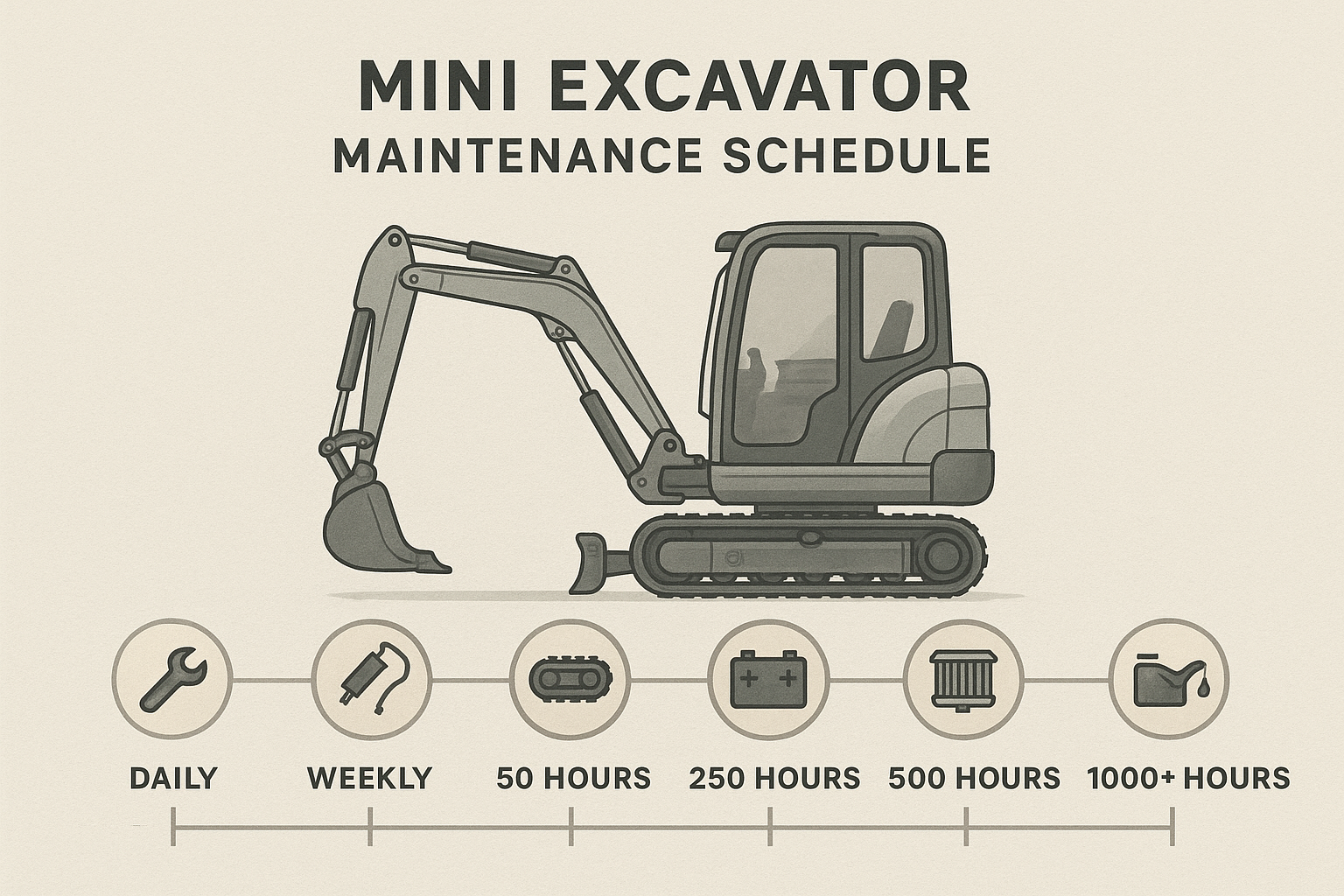
Without your official manual, you should treat these as planning buckets rather than exact intervals.
| Interval bucket | Typical tasks | Why it matters |
|---|---|---|
| 250 hours | Replace routine service filters; inspect belts, clamps, and mounts; check battery terminals | Prevents restrictions and failures from vibration |
| 500 hours | Inspect undercarriage wear more deeply; check for loosened fasteners in high-vibration areas | Undercarriage and hardware are common cost multipliers |
| Annual / seasonal | Full cleaning; inspect hoses end-to-end; check swing area for play/noise; refresh your maintenance log | Seasonal conditions change how machines run |
If you don’t have a schedule yet, request one when you source your machine documentation. If you’re comparing configurations or sizes, start with the broader Mini Excavator Models page so you can match maintenance planning to the right size class.
This is the heart of excavator track maintenance—and it’s where small daily habits have outsized payoff.
For many compact machines, the undercarriage quietly decides your operating cost.
Because you requested that we avoid mentioning specific fluids, this guide won’t describe tension methods that rely on a particular tensioning medium. The correct adjustment method and target values should come from your model’s manual.
If you keep seeing contamination, your best fix is usually improved cleaning and better wiping before greasing—not more greasing.
Hydraulics are reliable when they’re protected. Problems typically come from abrasion, impact, heat, and contamination.
Compact excavators often work around grass, mulch, dust, and demolition debris.
Practical routine:
If the machine will sit:
For broader excavation jobsite safety context (especially when you’re working near trenches), OSHA’s Trenching and Excavation Safety guidance (Publication 2226) and the CDC’s NIOSH trenching and excavation overview are worth reading.
A log turns maintenance from “I think I did it” into a repeatable system.
| Date | Machine hours | Task done | Findings | Action taken | Next due |
|---|---|---|---|---|---|
| Daily walk-around | |||||
| Undercarriage clean | |||||
| Grease points | |||||
| Hose inspection |
Think of this as excavator preventive maintenance in plain math: you’re trading a few minutes of routine checks for fewer hours of lost work.
The exact cost of downtime depends on your work, crew, and schedule. The point is to see how quickly “small delays” add up.
Video: Excavator pre-operation inspection walkthrough.
Some issues are not “keep working and watch it.” Stop and get help if you see:
NIOSH’s Equipment Safety: Maintenance (2022-135) is a good, practical reference for why maintenance procedures matter for injury prevention—not just uptime.
If you want help matching a maintenance plan to your exact configuration, start by reviewing the ECO lineup and then reach out for a spec sheet or service guidance:
Daily walk-around checks should happen every shift. Deeper tasks should be tied to machine hours and job conditions. Dust, mud, and demolition debris usually mean shorter intervals.
If you only do one thing, do a consistent walk-around that looks for leaks, undercarriage packing, and hose rubbing. It catches the failures that most often become downtime.
If tracks derail or ride off-center, tension may be part of the problem—but so can debris packing and alignment. Use your model’s manual for the correct adjustment method and target values.
Yes. A log makes hour-based tasks repeatable and helps you spot patterns (like the same hose rubbing point coming back).
Start with Qilu’s Parts & Service Support resources, then reach out through your supplier’s contact channel if you need documentation or service help.






-1.png)