E-mail: [email protected] WhatsApp: +8618266768780

E-mail: [email protected] WhatsApp: +8618266768780


Si vous vous demandez combien coûte une grande excavatrice en ce moment, vous constaterez que les prix varient beaucoup en 2026 Les nouveaux modèles peuvent vous faire reculer de $300 000 à $2 000 000 pour les machines de la classe minière Les excavatrices usagées vont généralement de $150 000 à $1 200 000, selon la taille et l'état Voici un rapide aperçu des fourchettes de prix typiques :
| Taille Catégorie | Poids opérationnel | Nouvelle gamme de prix | Gamme de prix utilisée |
|---|---|---|---|
| Grandes excavatrices | 25-45 tonnes | $300,000-$600,000 | $150,000-$400,000 |
| Excavatrices minières | 45+ tonnes | $500,000-$2,000,000 | $250,000-$1,200,000 |
Lorsque vous commencez à chercher une grande excavatrice en 2026, vous pourriez vous sentir dépassé par les étiquettes de prix Le marché a beaucoup changé ces dernières années Vous remarquerez que les prix dépendent de beaucoup de choses, comme la taille de la machine, les caractéristiques, et même la dernière technologie Si vous voulez savoir combien coûte une grande excavatrice, vous devez regarder à la fois les options nouvelles et utilisées.
Si vous voulez une toute nouvelle grande excavatrice, vous devriez vous attendre à payer une prime En 2026, la plupart des nouvelles grandes excavatrices coûtent entre $300 000 et $1 500 000 Certains modèles de la classe minière peuvent même atteindre $2 000 000 ou plus Le prix dépend du tonnage, des fonctionnalités que vous choisissez et des dernières mises à niveau technologiques.
Conseil: Les machines dotées d'automatismes avancés ou de moteurs écologiques coûtent généralement plus cher à l'avance, mais elles peuvent vous faire économiser de l'argent sur le carburant et la main-d'œuvre au fil du temps.
Voici un tableau rapide pour vous aider à voir les principaux facteurs qui font monter les prix cette année :
| Tendance clé | La description |
|---|---|
| Priorité au développement durable | Les entreprises veulent des machines vertes et moins polluantes. |
| Progrès technologiques | L'IA et les outils numériques aident les machines à fonctionner mieux et plus rapidement. |
| Demande d'automatisation | De plus en plus d'acheteurs veulent des machines qui fonctionnent seules pour économiser du temps et de l'argent. |
Regardons un exemple réel Imaginez que vous dirigez une entreprise de construction et que vous avez besoin d'une excavatrice de 40 tonnes avec les dernières commandes numériques et un moteur à faibles émissions Vous obtenez des devis de plusieurs concessionnaires Les prix vont de $450 000 pour un modèle de base à $900 000 pour une version entièrement chargée avec toutes les cloches et sifflets Vous vérifiez les sites de l'industrie comme Guide des équipements de construction et voyez des chiffres similaires Sur les réseaux sociaux, les entrepreneurs partagent leurs histoires d'achat, et vous remarquez que ceux qui investissent dans l'automatisation paient souvent plus d'avance mais signalent des coûts d'exploitation inférieurs plus tard.
Si vous avez un budget plus serré, vous vous demandez peut-être combien coûte une grande excavatrice lorsque vous achetez utilisée En 2026, les grandes excavatrices usagées coûtent généralement entre $150 000 et $700 000, mais vous pouvez parfois trouver des machines plus anciennes ou plus hautes heures pour moins cher Le prix dépend de l'âge, de l'état et de la taille de la machine.
Voici un tableau indiquant les fourchettes de prix typiques des excavatrices d'occasion par type :
| Type d'excavatrice | Gamme de prix |
|---|---|
| Mini-pelles | $10 000 à $50 000 |
| Pelles MIDI | $30 000 à $100 000 |
| Pelles standards | $50 000 à $200 000 |
| Grandes excavatrices | $150 000 à $700 000+ |
Disons que vous trouvez une excavatrice de 35 tonnes de 2018 avec 6 000 heures dessus Le vendeur demande $220 000 Vous comparez cela avec les listes sur les marchés d'équipement et voyez des machines similaires dont le prix se situe entre $200 000 et $300 000, selon les dossiers de maintenance et les pièces jointes incluses Certains acheteurs partagent sur les forums qu'ils ont négocié les prix à la baisse en signalant l'usure ou l'historique des services manquants.
Vous pouvez également voir des machines plus anciennes, peut-être de 2012 ou antérieures, répertoriées pour $150 000 ou moins. Cela peut être une bonne affaire si vous vérifiez attentivement l'état. Demandez toujours des journaux de maintenance et essayez d'obtenir une inspection indépendante avant d'acheter.
Note: Les excavatrices d'occasion avec des mises à niveau récentes ou des horaires réduits se vendent souvent rapidement Si vous voyez une bonne affaire, agissez rapidement mais faites vos devoirs.
Alors, combien coûte une grande excavatrice en 2026 ?Pour les nouvelles machines, attendez-vous à $300 000 à $1 500 000 ou plus Pour les d'occasion, prévoyez $150 000 à $700 000+, selon ce dont vous avez besoin Comparez toujours les prix sur les sites Web fiables de l'industrie et vérifiez ce que disent les autres acheteurs sur les réseaux sociaux de cette façon, vous saurez que vous obtenez une offre équitable.
Lorsque vous commencez à comparer les grandes excavatrices, la taille et le poids jouent un rôle énorme dans le prix final Les machines plus grosses peuvent gérer des travaux plus difficiles, mais elles sont également livrées avec un prix plus élevé Si vous regardez les excavatrices dans la gamme de 30-50 tonnes, vous verrez des prix qui atterrissent souvent entre $500 000 et $800 000. Voici un tableau rapide pour vous aider à visualiser comment la taille impacte le coût :
| Taille de l'excavatrice | Gamme de prix |
|---|---|
| Grandes excavatrices (30-50 tonnes) | $500 000$800 000 |
Disons que vous dirigez une entreprise de démolition et que vous avez besoin d'une excavatrice de 45 tonnes pour les travaux lourds Vous vérifiez les listes sur les sites de l'industrie et voyez que les modèles plus récents dans cette catégorie de poids coûtent habituellement environ $750 000 Sur les réseaux sociaux, les entrepreneurs partagent souvent que le fait de monter de quelques tonnes seulement peut ajouter des centaines de milliers au prix Si vous n'avez besoin que d'une machine de 30 tonnes, vous pourriez économiser $200 000 ou plus Toujours correspondre à la taille aux besoins de votre projet afin de ne pas dépenser trop.
Les excavatrices modernes sont remplies de fonctionnalités avancées cela peut rendre votre travail plus facile et plus sûr, mais ces extras font également grimper le prix Voici quelques-unes des mises à niveau les plus courantes que vous trouverez en 2026 :
Si vous voulez une machine avec GPS et télématique, attendez-vous à payer une prime Par exemple, un entrepreneur a partagé sur un forum d'équipement que l'ajout de commandes automatisées et d'hydraulique améliorée a fait grimper le prix de leur pelle de près de $100 000. sites d'actualités de l'industrie comme Le monde de l'équipement mettez souvent en évidence la façon dont ces technologies améliorent l'efficacité, mais vous devrez peser le coût initial par rapport aux économies à long terme Les machines avec plus de fonctionnalités conservent généralement leur valeur, aussi.
La marque que vous choisissez et les conditions actuelles du marché affectent également le montant que vous paierez Certaines marques ont une réputation de durabilité et de valeur de revente plus élevée, ce qui peut pousser les prix à la hausse Dans un marché chaud, les prix augmentent parce que la demande dépasse l'offre Pendant les périodes plus lentes, vous pourriez trouver de meilleures offres alors que les vendeurs se disputent les acheteurs.
Par exemple, début 2026, plusieurs marchés d'équipement ont signalé une flambée des prix en raison des retards de la chaîne d'approvisionnement Sur LinkedIn, les experts du secteur ont discuté de la façon dont les acheteurs payaient 10-151TP3 T de plus pour les grandes excavatrices par rapport à l'année précédente Si vous êtes flexible avec le timing, vous pouvez parfois économiser en attendant que le marché se refroidisse Vérifiez toujours plusieurs sources et parlez à d'autres acheteurs en ligne pour avoir une idée des tendances actuelles.
Ainsi, lorsque vous demandez combien coûte une grande excavatrice, n’oubliez pas que la taille, les caractéristiques et le calendrier du marché jouent tous un rôle. En comprenant ces facteurs, vous pouvez faire des choix plus intelligents et éviter de payer plus que nécessaire.
Quand vous regardez les grandes excavatrices, l'état et l'âge peuvent faire une énorme différence de prix Vous pourriez voir deux machines avec les mêmes spécifications, mais une coûte beaucoup moins. Pourquoi ? la réponse se résume souvent à la façon dont le propriétaire précédent s'est occupé de l'équipement et combien d'années il a fonctionné.
Les excavatrices plus anciennes sont généralement livrées avec un prix inférieur Vous pourriez trouver un modèle 2015 pour $180 000, tandis qu'une version 2022 avec des horaires similaires se vend pour $350 000 L'âge compte, mais ce n'est pas la seule chose que les acheteurs vérifient La véritable histoire se cache dans l'état de la machine Si vous voyez une excavatrice bien entretenue, vous savez qu'elle durera plus longtemps et fonctionnera mieux C'est pourquoi certaines machines plus anciennes atteignent encore des prix élevés.
Décomposons ce que les acheteurs recherchent lorsqu'ils jugent la condition :
Voici un tableau rapide montrant comment l'âge et la condition peuvent affecter la valeur de revente en 2026 :
| Âge des excavatrices | Condition | Gamme de prix typique |
|---|---|---|
| 2-4 ans | Excellent | $500 000$900 000 |
| 5-8 ans | Bien | $300 000$600 000 |
| 9+ ans | Juste/Pauvre | $150 000$350 000 |
Imaginez que vous magasinez pour une excavatrice de 40 tonnes Vous trouvez deux options : une de 2018 avec 7 000 heures et un record de service impeccable, et une autre de 2020 avec 5 000 heures mais des signes de négligence L'ancienne machine pourrait en fait coûter plus cher parce qu'elle est en meilleure forme Les acheteurs paient souvent un supplément pour un équipement propre, bien entretenu et prêt à travailler.
Conseil: Demandez toujours des journaux de maintenance et inspectez la cabine et l'hydraulique avant d'acheter Un petit effort supplémentaire peut vous faire économiser des milliers.
Si vous prévoyez vendre votre excavatrice plus tard, gardez-la en pleine forme Le service régulier, les intérieurs propres et les réparations rapides aident à protéger votre investissement Vous obtiendrez un meilleur prix et attirerez plus d'acheteurs le moment venu.
Condition et âge n'affectent pas seulement le prix, ils ont également un impact sur la fiabilité et les coûts futurs. Choisissez judicieusement et vous éviterez les maux de tête sur la route.
Si vous voulez éviter le gros coût initial de l'achat, louer une grande excavatrice peut avoir beaucoup de sens Vous obtenez la machine dont vous avez besoin pour votre projet, et vous ne payez que pour le temps que vous l'utilisez Décomposons ce que vous pouvez vous attendre à payer et ce que vous devriez chercher dans un contrat de location.
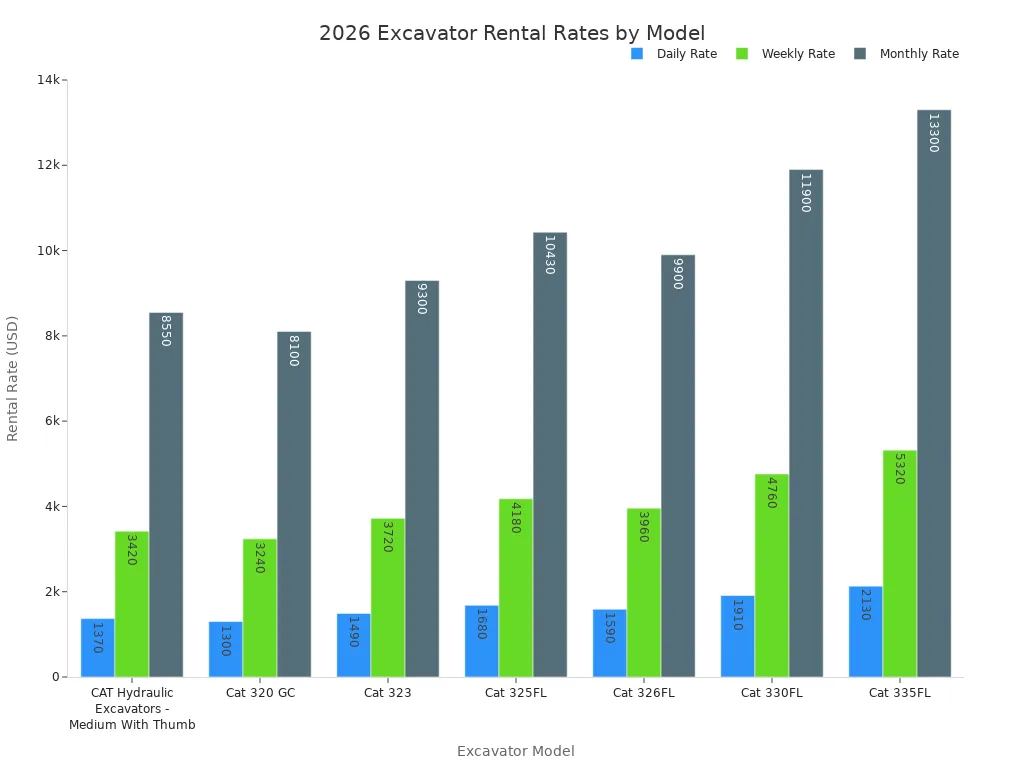
Les tarifs de location des grandes excavatrices en 2026 dépendent de la taille et des caractéristiques de la machine La plupart des sociétés de location offrent des options flexibles, afin que vous puissiez choisir des conditions quotidiennes, hebdomadaires ou mensuelles Voici un aperçu rapide des tarifs typiques :
| Taille du modèle (exemple) | Tarif Quotidien | Tarif Hebdomadaire | Taux Mensuel |
|---|---|---|---|
| Moyen (avec pouce) | $1,370 | $3,420 | $8,550 |
| Standard | $1,300 | $3,240 | $8,100 |
| Usage intensif | $1,910 | $4,760 | $11,900 |
| Extra-large | $2,130 | $5,320 | $13,300 |
Vous pouvez voir que louer pour un mois vous donne habituellement le meilleur rapport qualité-prix par jour Par exemple, si vous avez besoin d'une excavatrice robuste pour un travail de démolition de deux semaines, vous pourriez payer environ $4,760. si votre projet s'étend à un mois, le tarif tombe à environ $11,900. de nombreux entrepreneurs partagent leurs expériences de location sur Les forums de construction de Reddit et Forums Équipements Lourds, (en), où vous pouvez comparer les tarifs et les conseils du monde réel.
Avant de signer un contrat de location, vous devez savoir ce qui est inclus La plupart des accords couvrent plus que le seul prix Voici ce que vous trouverez habituellement :
| Élément d'accord | Ce que cela signifie |
|---|---|
| Durée du bail | Dates de début et de fin de votre location |
| Termes financiers | Coût total, calendrier de paiement et dates d'échéance |
| Dépôt de garantie | Montant que vous payez à l'avance, remboursé si vous retournez la machine en bon état |
| Responsabilité d'entretien | Qui gère les réparations et le service de routine pendant la location |
| Dispositions d'annulation | Règles pour mettre fin à la location anticipée et éventuelles pénalités |
| Option d'achat | Parfois, vous pouvez acheter la machine à la fin de votre location |
| Processus de retour | Étapes de retour de la pelle et dans quel état elle doit être |
Disons que vous louez une excavatrice de 35 tonnes pour un mois Votre accord pourrait exiger un dépôt de $2 000, des inspections hebdomadaires et une liste de contrôle de retour claire Si vous terminez tôt, vous pouvez payer une petite pénalité, mais vous évitez les engagements à long terme Vous pouvez trouver des exemples de contrats et des conseils sur Section location d'Equipment World.
Conseil: Lisez toujours les petits caractères Renseignez-vous sur l'entretien, l'assurance et ce qui se passe en cas de panne de la machine.
Faut-il louer ou acheter ? la réponse dépend des besoins de votre entreprise Voici une comparaison rapide :
| Location : Avantages | Location : Inconvénients |
|---|---|
| Coût initial inférieur | Coût à long terme plus élevé |
| Aucun stockage nécessaire | Disponibilité limitée |
| Dernière technologie | Pas de propriété |
| Flexibilité pour les emplois de courte durée | Plus de paperasse |
| Pas d'amortissement | |
| Moins de tracas d'assurance |
| Achat : Avantages | Achat : Inconvénients |
|---|---|
| Épargne à long terme | Coût initial élevé |
| Toujours disponible | Responsabilité d'entretien |
| Propriété d'actifs | Dépréciation |
| Personnalisation possible | Stockage nécessaire |
| Avantages fiscaux | Moins de flexibilité |
Si vous n'avez besoin d'une excavatrice que quelques mois chaque année, la location vous permet d'économiser de l'argent et des maux de tête Si vous en utilisez une tous les jours, l'achat pourrait avoir plus de sens De nombreux entrepreneurs partagent leurs histoires sur LinkedIn et sites d'actualités de l'industrie, 1, pour que vous puissiez voir ce qui fonctionne pour les autres.
La location vous donne de la flexibilité et maintient votre flux de trésorerie fort L'achat vous donne le contrôle et la valeur à long terme Pesez vos options avant de décider.
Lorsque vous possédez une grande excavatrice, l'entretien et les réparations deviennent une grande partie de votre budget annuel Vous ne pouvez pas sauter ces coûts si vous voulez que votre machine dure et fonctionne bien En 2026, vous verrez deux stratégies principales : l'entretien préventif traditionnel et l'entretien prédictif plus récent alimenté par l'IA Si vous vous en tenez à l'approche old-school, vous pourriez dépenser environ $127 000 par an sur la maintenance pour chaque pelle Si vous passez à la maintenance prédictive, vous pourriez réduisez cela à $84 000341TP3 économies C'est une grande différence !
Voici une ventilation des coûts annuels types :
| Type de coût | Fourchette estimée |
|---|---|
| Entretien de routine | $3 000 $5 000 |
| Entretien du train d'atterrissage | $2 000 $8 000 |
| Réparations Majeures | $1 000 $5 000 |
| Coûts annuels totaux | $5 000 $18 000 |
Disons que vous dirigez une entreprise d'excavation très occupée Vous utilisez un logiciel de maintenance prédictive qui vous alerte avant la défaillance des pièces Sur un an, vous économisez plus de $40 000 par rapport à votre ancienne routine Vous évitez également les pannes coûteuses lors de grands projets De nombreux entrepreneurs partagent leurs expériences sur Forums Équipements Lourds et dire qu'investir dans la maintenance intelligente est payant à long terme.
Conseil: Conservez des registres de service détaillés Les acheteurs paieront plus cher pour une machine bien documentée lorsque vous déciderez de vendre.
L'assurance et les garanties vous protègent des coûts imprévus Vous aurez besoin de plusieurs types de couverture pour votre excavatrice Une Politique du propriétaire d'entreprise (BOP) coûte habituellement environ $1 687 par an, 1, ou $141 par mois L'assurance responsabilité civile générale s'élève en moyenne à $810 par an, et l'indemnisation des accidents du travail ajoute $1 032 supplémentaires par an. Ces polices couvrent les dommages, le vol et les accidents du travail.
Vous pouvez également acheter des plans de garantie Les garanties de base sont livrées avec de nouvelles machines, mais vous voudrez peut-être ajouter une couverture étendue Les garanties étendues coûtent un supplément mais peuvent vous faire économiser des milliers si un composant majeur échoue De nombreux propriétaires discutent des options d'assurance sur Les forums de construction de Reddit et recommandez de magasiner pour les meilleurs tarifs.
Voici une liste rapide des coûts d'assurance typiques :
N'oubliez pas de consulter les détails de votre politique Certains plans ne couvrent que certains types de dommages ou nécessitent des inspections régulières.
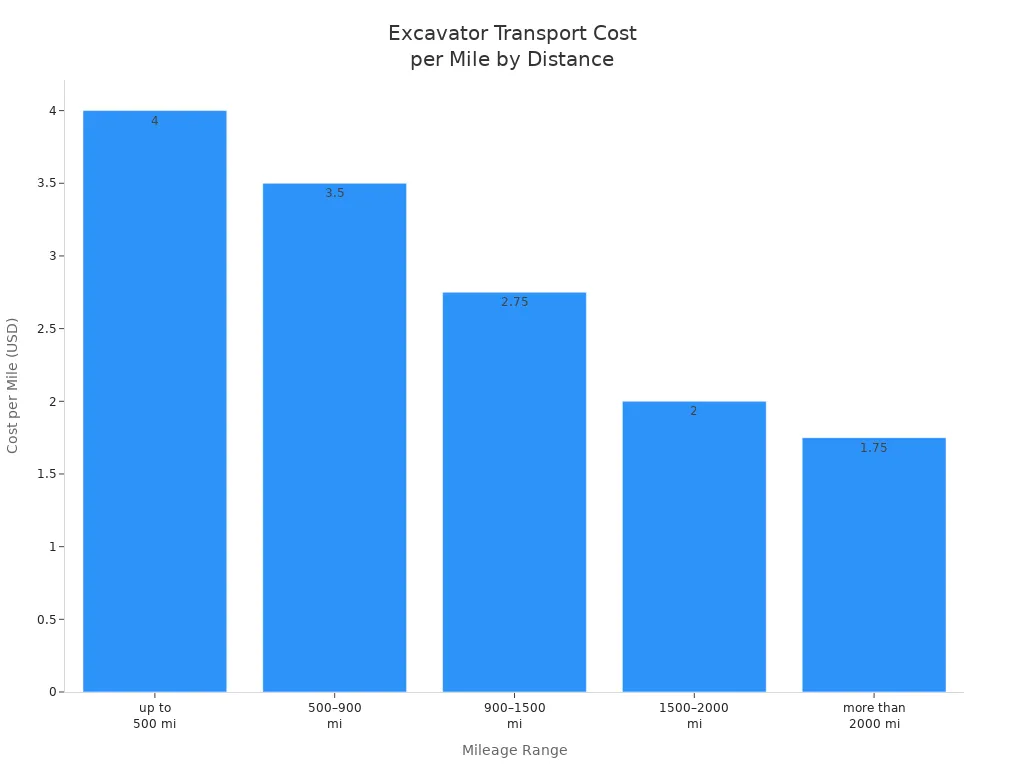
Déplacer une grande excavatrice n'est pas bon marché Vous paierez au kilomètre, et les coûts changent en fonction de la distance Pour les trajets courts jusqu'à 500 milles, attendez-vous à payer environ $4 au kilomètre Pour les trajets plus longs sur 2 000 milles, le tarif tombe à $1,75 au kilomètre Voici un tableau pour vous aider à estimer les coûts de transport :
| Kilométrage | Temps de transit | Coût par Mile |
|---|---|---|
| jusqu'à 500 mi | 1-2 jours | $4 |
| 500 mi 900 mi | 3-4 jours | $3.5 |
| 900 mi 1500 mi | 4-5 jours | $2.5$3 |
| 1500 mi 2000 mi | 6-8 jours | $2 |
| 2000+ mi | 8-12 jours | $1.75 |
Le stockage ajoute une autre couche de coût Si vous n'avez pas votre propre cour sécurisée, vous pourriez payer pour le stockage commercial, qui peut aller de quelques centaines à plusieurs milliers de dollars par mois, selon l'emplacement et la sécurité Par exemple, un entrepreneur au Texas partagé sur LinkedIn qu'il paie $600 par mois pour un terrain clôturé à proximité de son chantier principal.
Toujours prendre en compte le transport et le stockage lorsque vous budgétisez une nouvelle excavatrice Ces coûts peuvent vous surprendre si vous n'êtes pas préparé.
Lorsque vous achetez une grande excavatrice, vous devez réfléchir à la façon dont sa valeur va changer avec le temps L'amortissement est le processus où votre machine perd de la valeur chaque année Cela se produit à cause de l'usure, de la nouvelle technologie et de l'évolution de la demande du marché Si vous prévoyez de garder votre excavatrice pendant plusieurs années, comprendre l'amortissement vous aide à prendre des décisions financières plus intelligentes.
En 2026, vous pouvez profiter de amortissement bonifié règles. Ces règles vous permettent de déduire le coût total de votre excavatrice l'année où vous l'avez mise en service Cela stimule votre trésorerie et peut donner à votre entreprise une apparence plus forte pour les banques et les investisseurs De nombreux entrepreneurs utilisent cette stratégie pour améliorer leurs bilans et libérer de l'argent pour d'autres projets.
Voici un tableau rapide pour montrer comment l'amortissement peut avoir un impact sur votre entreprise :
| Aspect | La description |
|---|---|
| Amortissement bonus | Déduisez le coût total la première année, ce qui contribue à votre trésorerie. |
| Force financière | Des bilans plus solides attirent les prêteurs et les investisseurs. |
| Rentabilité après impôt | Les dépenses immédiates peuvent améliorer les bénéfices et la valeur des actifs à long terme. |
Regardons un exemple concret Imaginez que vous achetez une pelle $600 000 pour votre entreprise de construction Vous utilisez l'amortissement bonus et que vous annulez la totalité du montant la première année Ce déménagement abaisse votre revenu imposable et vous donne plus d'argent pour investir dans votre entreprise Au cours des cinq prochaines années, votre pelle perdra de la valeur, mais vous avez déjà obtenu l'avantage fiscal à l'avance.
Les taux d'amortissement des grandes excavatrices suivent habituellement un calendrier en ligne droite ou accéléré La plupart des machines perdent environ 201TP3 T de leur valeur la première année Après cela, vous pouvez vous attendre à une baisse de 10-151TP3 T chaque année Si vous gardez votre excavatrice en pleine forme et enregistrez tout l'entretien, vous pouvez ralentir cette perte Les machines bien entretenues conservent mieux leur valeur et se vendent à des prix plus élevés lorsque vous êtes prêt à effectuer une mise à niveau.
Voici une simple ventilation de la façon dont une excavatrice $600 000 pourrait se déprécier :
Conseil: Conservez des registres de service détaillés et planifiez une maintenance régulière Les acheteurs paieront plus pour une machine avec un historique propre.
L'amortissement n'est pas seulement un chiffre sur papier Il affecte votre valeur de revente, vos impôts et votre capacité à emprunter de l'argent Si vous planifiez à l'avance et utilisez l'amortissement bonus, vous pouvez tirer le meilleur parti de votre investissement Toujours prendre en compte l'amortissement lorsque vous comparez le coût réel de possession par rapport à la location d'une grande excavatrice.
Vous voulez obtenir le plus de valeur pour votre argent lorsque vous achetez ou louez une grande excavatrice Voici quelques façons intelligentes d'économiser :
Vous pouvez également suivre ces étapes pour étirer votre budget :
Un entrepreneur partagé Forums Équipements Lourds le passage aux modèles hybrides et la vente de machines plus anciennes ont aidé son entreprise à économiser plus de $50 000 en un an.
Acheter une excavatrice d'occasion peut être une bonne affaire, mais vous devez d'abord vérifier quelques choses Voici une liste de contrôle pour vous guider :
Vous pouvez trouver plus de conseils et de véritables histoires d'inspection sur Les forums de construction de Reddit et Forums Équipements Lourds.
Conseil: Amenez toujours avec vous un mécanicien ou un inspecteur de confiance Ils peuvent repérer les problèmes que vous pourriez manquer.
Négocier le prix d'une grande excavatrice peut sembler difficile, mais vous avez plus de pouvoir que vous ne le pensez Voici comment vous pouvez obtenir la meilleure offre :
Un acheteur sur Les discussions de LinkedIn sur les équipements de construction a partagé que la comparaison des devis de trois régions l'a aidé à économiser $20 000 sur son dernier achat.
N'oubliez pas que la connaissance est votre meilleur outil Plus vous en savez, meilleure sera votre offre.
Quand vous regardez les grandes excavatrices, le prix de la vignette n'est que le début, Vous devez penser au coût total avant de prendre une décision Beaucoup d'acheteurs se concentrent sur le coût initial, mais la dépense réelle provient de tout ce qui suit.
Voici comment vous pouvez décomposer le coût total :
| Taille de l'excavatrice | Taux de location mensuel |
|---|---|
| Taille moyenne (13-20 t) | $5 700 $8 500 |
| Grand (21-30 t) | $7 500 $14 000 |
| Extra-grand (30+ t) | $10 000 $22 000 |
Regardons un exemple réel Imaginez que vous dirigiez une entreprise de construction Vous avez besoin d'une excavatrice de 25 tonnes pour un projet de six mois Vous comparez l'achat de neuf, l'achat d'occasion et la location :
Vous voyez que louer coûte moins cher pour ce court projet Si vous prévoyez d'utiliser la machine pendant des années, acheter a plus de sens.
Conseil: Toujours additionner chaque coût avant de décider Le prix de la vignette le plus bas ne signifie pas toujours la meilleure offre.
En regardant la situation complète, vous pouvez choisir l'option qui correspond à vos besoins et à votre budget.
Vous avez vu ça prix des grandes excavatrices en 2026 gamme largement basée sur la taille, l'âge et les fonctionnalités Voici un récapitulatif rapide :
| Catégorie | Gamme de prix |
|---|---|
| Nouvelles Grandes Excavatrices | $300 000$600 000 |
| Grandes pelles d'occasion | $80 000 $450 000 |
Pour faire un choix intelligent, rappelez-vous ces conseils :
Prêt pour votre prochaine étape ? déterminez ce dont vous avez besoin, définissez votre budget et contactez les concessionnaires pour obtenir des devis.
Vous pouvez vous attendre à ce qu'une grande excavatrice dure de 8 000 à 12 000 heures avec un entretien régulier Certains propriétaires signalent que les machines fonctionnent plus de 15 000 heures Si vous suivez le service et les réparations, vous bénéficierez de plus d'années de votre investissement.
Vous trouverez souvent de meilleures offres à la fin de l'année Les concessionnaires veulent effacer les stocks avant l'arrivée de nouveaux modèles Par exemple, un entrepreneur a économisé 101TP3 T en achetant en décembre au lieu du printemps.
Oui, vous pouvez financer des machines d'occasion De nombreux prêteurs proposent des conditions de 24 à 60 mois Voici un aperçu rapide des options de financement typiques :
| Durée du terme | Tarif Typique |
|---|---|
| 24 mois | 5% – 7% |
| 36 mois | 6% – 8% |
| 60 mois | 7% – 10% |
Vous obtenez le plus de valeur des seaux, des pouces hydrauliques et des attelages rapides Ces accessoires vous permettent de gérer plus de travaux Par exemple, un entrepreneur en démolition a ajouté un brise-hydraulique et augmenté les offres de projet d'ici 20%.
Commencez par une inspection complète Examinez les dossiers de service et testez toutes les fonctions Comparez le prix à des annonces similaires Si vous voyez une machine de 35 tonnes avec de faibles heures et un historique propre pour $200,000, c'est généralement une affaire solide.
Vous devez prévoir un budget pour l'entretien, l'assurance, le transport et le stockage Par exemple, l'entretien annuel peut fonctionner de $5 000 à $18 000. Le transport peut coûter $4 par mile pour les trajets courts. L'assurance ajoute $1 500 à $3 000 par an.
Pour un projet de six mois, la location coûte souvent moins cher Si vous louez une excavatrice de 30 tonnes à $12 000 par mois, vous dépenserez $72 000 au total L'achat de neuf pourrait coûter $600 000 plus l'entretien La location évite les engagements à long terme et les gros coûts initiaux.





-1.png)