Bienvenue sur Shandong Qilu Industrial Co., Ltd

 French
 English
 Arabic
 Bulgarian
 Bengali
 Czech
Czech
 Danish
 German
 Greek
Greek
 Spanish
 Finnish
 Hindi
Hindi
 Croatian
 Hungarian
 Indonesian
 Italian
 Japanese
 Korean
 Lithuanian
 Dutch
Dutch
 Norwegian
 Polish
 Portuguese
 Romanian
 Russian
 Slovak
 Slovenian
 Swedish
 Thai
Thai
 Turkish
 Ukrainian
 Vietnamese
 Tagalog
 Malay
Malay
 Estonian
 Catalan
 Latvian
 Urdu
Urdu
 Serbian
 Persian
 Swahili
 Albanian
 Armenian
 Icelandic
 Bosnian
 Luxembourgish
 Afrikaans
French English
Arabic
Bulgarian
Bengali
Czech
Danish
German
Greek
Spanish
Finnish
Hindi
Croatian
Hungarian
Indonesian
Italian
Japanese
Korean
Lithuanian
Dutch
Norwegian
Polish
Portuguese
Romanian
Russian
Slovak
Slovenian
Swedish
Thai
Turkish
Ukrainian
Vietnamese
Tagalog
Malay
Estonian
Catalan
Latvian
Urdu
Serbian
Persian
Swahili
Albanian
Armenian
Icelandic
Bosnian
Luxembourgish
Afrikaans
Afrikaans
French English
Arabic
Bulgarian
Bengali
Czech
Danish
German
Greek
Spanish
Finnish
Hindi
Croatian
Hungarian
Indonesian
Italian
Japanese
Korean
Lithuanian
Dutch
Norwegian
Polish
Portuguese
Romanian
Russian
Slovak
Slovenian
Swedish
Thai
Turkish
Ukrainian
Vietnamese
Tagalog
Malay
Estonian
Catalan
Latvian
Urdu
Serbian
Persian
Swahili
Albanian
Armenian
Icelandic
Bosnian
Luxembourgish
Afrikaans

Comment choisir et utiliser un tracteur agricole diesel dans une petite ferme
Si vous achetez votre premier tracteur agricole diesel pour une opération de 110 acres, les choix peuvent sembler écrasants La bonne correspondance se résume à une poignée de décisions pratiques : le travail que vous ferez, la puissance dont vous avez réellement besoin, 2 RM vs 4 RM, la prise de force et l'hydraulique pour vos outils, la maintenance que vous pouvez suivre et le coût total de possession Ce guide vous guide à travers une approche claire, étape par étape, plus un exemple réaliste et de la taille d'un petit exploitant que vous pouvez copier.
Principaux points à retenir
- Définissez d'abord les tâches, puis taillez votre tracteur de ferme diesel en fonction de la puissance de la prise de force et mettez en œuvre les besoins en matière de puissance du moteur par brochure.
- Pour la plupart des petites exploitations, tracteurs diesel compacts de 25 CV avec attelages de catégorie I et cache prise de force de 540 tr/min, travail de labourage, de chargement et de transport.
- La 4 RM est souvent payante sur les pentes, les sols meubles et les travaux de chargeuse grâce aux avantages en termes de traction et de stabilité.
- Planifiez la maintenance avant d'acheter : des chèques quotidiens, des services basés sur les heures et un stockage saisonnier protégeront votre investissement.
- Suivez les heures, le carburant et les coûts dès le premier jour pour affiner votre coût total de possession et éviter de dépenser trop de capacité que vous n'utiliserez pas.
Ce qu'un tracteur agricole diesel peut faire sur 1 10 acres
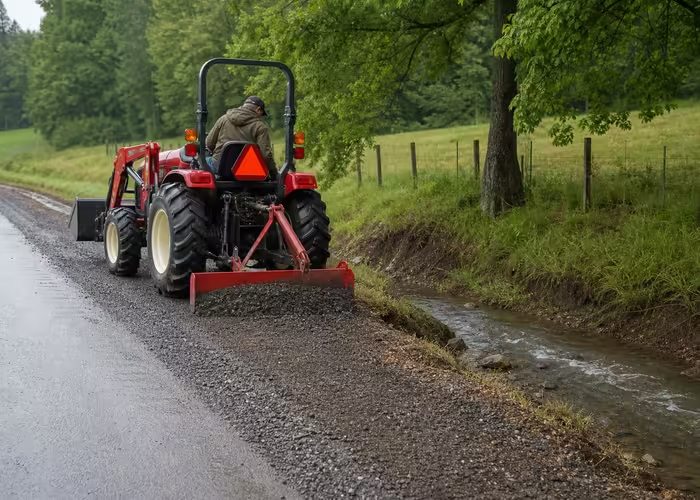
Un tracteur de ferme diesel dans la gamme compacte à compacte-utilitaire peut alimenter les motoculteurs rotatifs, les tondeuses de finition, les débroussailleuses, les vis de post-trou et les petites chargeuses Les moteurs diesel fournissent un couple constant à bas régime, ce qui est idéal pour le travail sur le terrain entraîné par prise de force Lorsque vous comparez les spécifications, n'oubliez pas que vous verrez trois chiffres de puissance discutés dans les cercles de la ferme : la puissance du moteur (le plus grand nombre dans les annonces), la puissance de prise de force (ce qui entraîne réellement les outils) et la puissance de barre d'attelage (ce qui tire). Les extensions universitaires notent la puissance des machines sont généralement inférieures à la vitesse de moteur ; vérifiez la taille des machines est mesurée et le contexte. Penn State Extension sur la gestion des machines.
7 étapes pour choisir le bon tracteur de ferme diesel
- Listez les tâches et les demandes de pointe
- Notez vos meilleurs travaux par fréquence et difficulté : fauchage, labourage, pelles de chargeuse, palettes mobiles, creusement de post-trou, déneigement, travaux de verger entre les rangées, etc.
- Notez votre terrain (plat, vallonné, en terrasses), votre sol (sableux, limoneux, argileux) et votre humidité (souvent humide ou principalement sèche).Ces facteurs déterminent les décisions de traction et de ballast.
- Puissance de taille (moteur vs prise de force)
- Identifiez votre implémentation la plus exigeante et recherchez ses besoins en puissance de prise de force. Les motoculteurs et débroussailleuses rotatifs indiquent souvent une plage HP de prise de force ; visez à y être confortablement intégré.
- En règle générale, la puissance de la prise de force est généralement inférieure de 15 chevaux à celle du moteur 51TP11 T en fonction de la transmission. Concentrez vos achats sur PTO HP qui répond aux besoins de votre outil.
- Si vous êtes entre deux tailles, choisissez l'option la plus petite si vos champs sont petits et que les outils sont modestes ; choisissez la plus grande si vous prévoyez d'ajouter bientôt des pièces jointes plus lourdes.
- Choisissez 2 RM ou 4 RM
- 4 WD augmente la traction et la charge sur l'essieu avant, ce qui aide au travail de la chargeuse, aux pentes et au sol meuble Il peut améliorer les caractéristiques de stabilité en déplaçant le poids vers l'avant et en délivrant un couple aux deux essieux, que de nombreux petits exploitants apprécient pour la sécurité et la productivité sur terrain mixte Pour les principes de stabilité pertinents pour le travail de la chargeuse, voir Le guidage de stabilité du tracteur de Penn State.
- 2 RM peut être adéquat sur des champs plats et secs avec des instruments légers et c'est généralement moins cher Si le travail de chargeur et les collines sont courants, 4 RM est souvent le meilleur choix à long terme.
- Catégorie de prise de force, hydraulique et attelage
- PTO : La plupart des outils pour petits exploitants utilisent une prise de force de 540 tr/min avec un arbre de 1-3/8 pouce à 6 cannelures Certains tracteurs offrent un mode 540 E (économie) pour les charges légères à un régime moteur inférieur afin d'économiser du carburant.
- Hydraulique : Le travail de la chargeuse bénéficie d'un débit hydraulique plus élevé ; vérifiez les litres/minute ou gallons/minute de votre tracteur et faites correspondre votre chargeur et tout outil hydraulique.
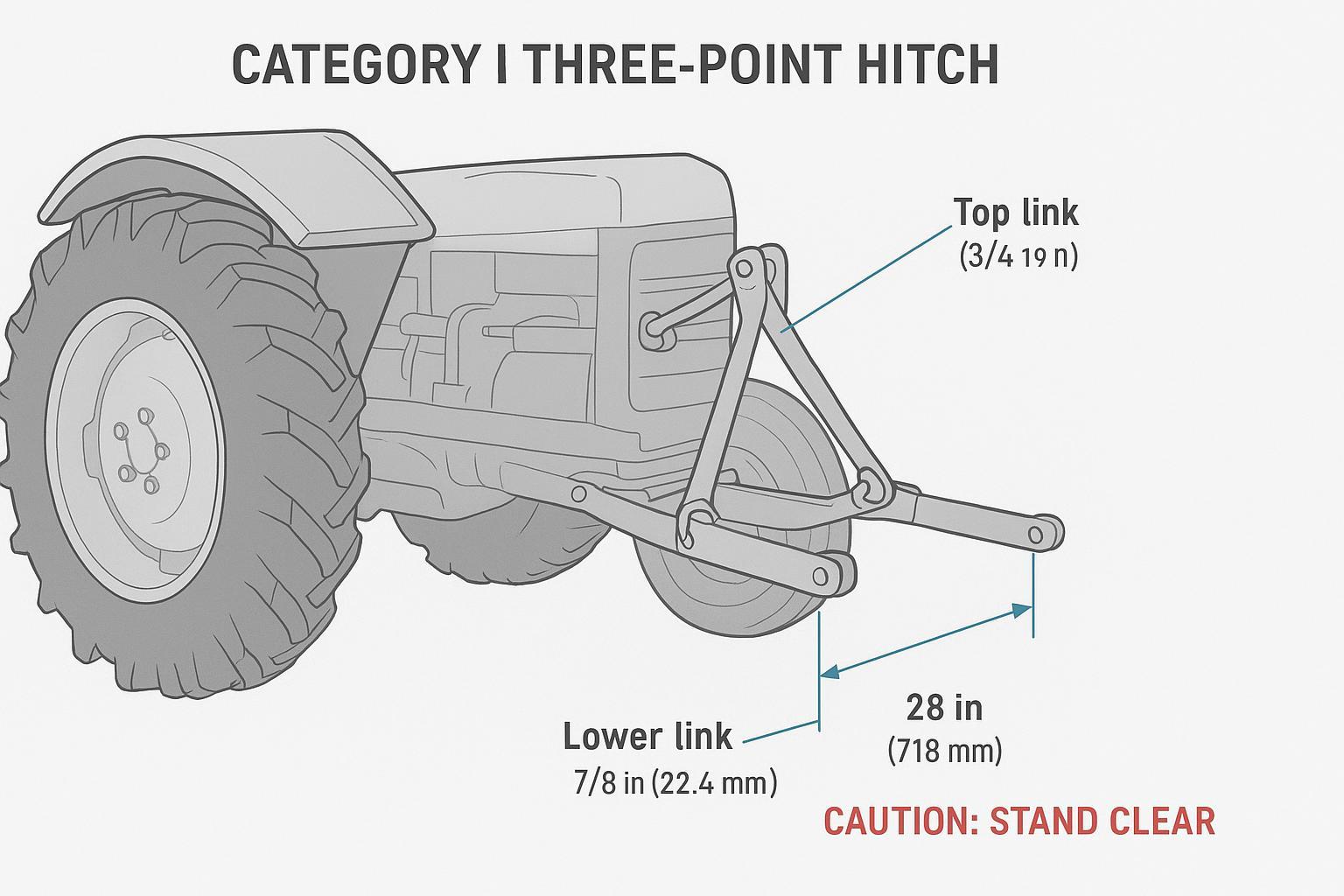
- Attelage : L'attelage à trois points de catégorie I est standard pour les tracteurs compacts et les outils de petite ferme Assurez-vous que vos outils correspondent aux dimensions et aux tailles de broches de catégorie I, et envisagez un attelage rapide si vous changez souvent d'outils.
- Implémenter des bases correspondantes
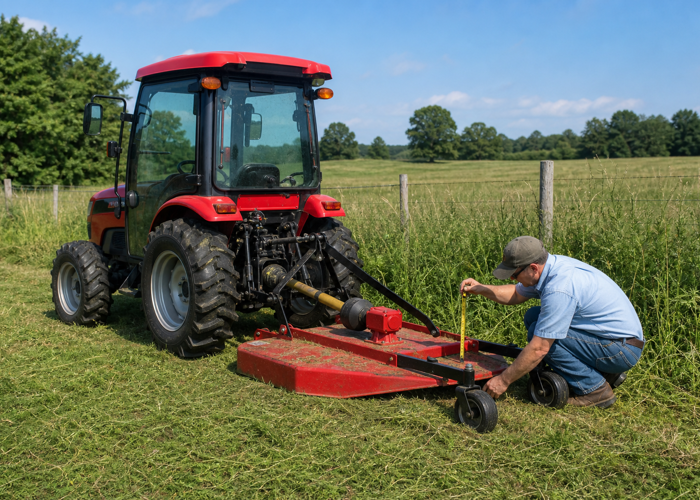
- Taille mettre en œuvre la largeur à la puissance de prise de force et à la largeur du tracteur de votre tracteur Par exemple, une tondeuse de finition doit généralement couvrir vos traces de pneus, tandis qu'une barre franche ne doit pas surcharger la prise de force.
- Vérifiez les valeurs nominales de la boîte de vitesses, la longueur de la transmission et toute exigence relative au boulon de cisaillement ou à l'embrayage à glissement pour éviter tout dommage.
- Planifier le ballast pour les travaux de chargeuse (boîte de ballast arrière ou outil plus ballast de roue) pour maintenir la direction et la stabilité.
- Inspectez et testez-drive checklist
- Démarrage à froid : Commence-t-il proprement et tourne-t-il au ralenti en douceur ? Vérifiez la fumée et les lampes d'avertissement.
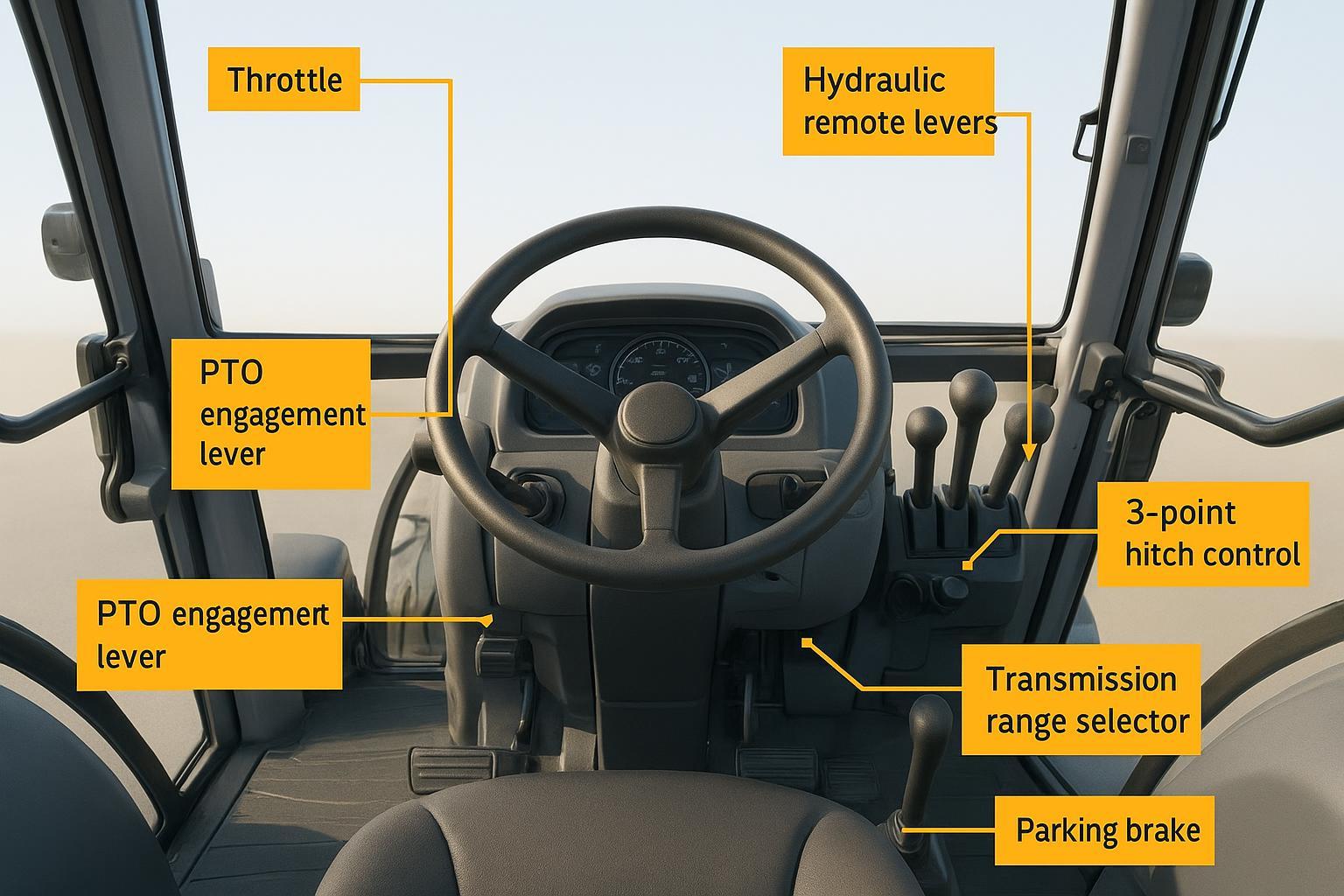
- Commandes : vérifiez l'engagement/désengagement de la prise de force, la portance à 3 points, les télécommandes hydrauliques et les plages de transmission.
- Sécurité : Confirmez que ROPS est installé et se verrouille correctement ; confirmer l'état de la ceinture de sécurité et les protections de prise de force.
- Fuites et usure : Regardez sous la machine les gouttes, inspectez les tuyaux, les goupilles et les pneus. Conduisez sur un sol inégal pour écouter les bruits inhabituels.
- Planifiez le service, le support et le TCO
- Identifiez où vous obtiendrez des filtres, des fluides et un service Renseignez-vous sur la disponibilité des pièces et les délais de livraison.
- Construire un plan simple de coût total de possession (TCO) avec le coût d'achat, le carburant, le service de routine, la réserve de réparation, les outils et l'abri/assurance. Commencez à enregistrer les heures et le carburant dès le premier jour pour remplacer les estimations par des chiffres réels.
Bandes de puissance et tâches pour un tracteur de ferme diesel
| Bande HP | Tâches typiques | Outils communs | Remarques |
|---|---|---|---|
| 250 CV | Tondre les pelouses et les vergers, labourer léger, transporter de petites remorques | Faucheuse de finition 4 ft, barre franche 4 ft, godet de chargeuse légère | Taille compacte s'adapte aux espaces restreints ; considérez 4 RM pour les pentes/travaux de chargeur |
| 40 HP50 | Coupe à brosses, labourage rotatif, travaux de chargeuse fréquente, creusement de post-trous | Coupeuse rotative 5 ft, barre franche 5 ft, palette pour | Polyvalent pour les jardins maraîchers et les tâches mixtes ; toujours de catégorie I sur de nombreux modèles |
| 60+ CV | Coupeuses/bûches plus grandes, chargeuses plus lourdes, préparation au champ pour une superficie plus grande | 6 instruments, chargeuses plus lourdes, presses à balles | Considérez si vous vous étendez au-delà d'environ 100 acres ; peut emménager dans Cat II sur certains modèles |
Remarque : Ces bandes sont illustratives ; confirmez toujours les exigences d'implémentation spécifiques par rapport à la puissance de prise de force et à la catégorie d'attelage dans les manuels de l'opérateur.
Exemple pratique : mettre un tracteur de ferme diesel au travail
Divulgation : 1TP2 T est notre partenaire produit.
Scénario : Un jardin maraîcher de 5 acres a besoin de travaux de préparation du sol, de tonte et de chargeuse régulière pour le compost et les palettes Le propriétaire considère un tracteur de ferme diesel de 400 CV avec prise de force 4 RM, prise de force 540 tr/min, attelage de catégorie I et chargeur frontal.
Logique de sélection que vous pouvez copier :
- Tâches : Labourage rotatif 4 temps rotatifs par saison, fauchage hebdomadaire, travail hebdomadaire de chargeur, trous de poteaux occasionnels.
- Dimensionnement de la prise de force : Un motoculteur de 5 ft appelle généralement des HP de prise de force de milieu de 30 à bas de 40 s, ce qui pointe vers une puissance nominale de moteur de 400 HP dans de nombreux modèles.
- Entraînement : 4 RM choisis pour la traction sur les pentes et une manutention plus sûre des chargeurs.
- Hydraulique : Spécification du chargeur vérifiée pour la capacité de levage et le débit hydraulique afin de répondre aux besoins de manipulation des palettes.
Méthode de suivi des résultats (illustrative et non universelle) :
- Consommation de carburant : enregistrez les gallons par heure à partir du compteur horaire et des recettes de carburant avant/après chaque tâche.
- Temps de préparation sur le terrain : Temps de début/arrêt des grumes pour les passes de travail du sol et les acres de tonte/heure.
- Ventilations : comptez les arrêts imprévus par mois et enregistrez les causes.
Résultats illustratifs d'une saison de croissance utilisant cette méthode :
- Consommation de carburant : -18%
- Temps de préparation du champ : -32%
- Ventilations/mois: -50%
Ces chiffres sont un exemple pour montrer comment un petit exploitant peut mesurer les améliorations ; vos résultats varieront en fonction des outils, du sol, du terrain et de l'entretien. Pour un aperçu des considérations d'achat de tracteurs diesel avec des spécifications à examiner, consultez le guide des tracteurs diesel sur Qilu Machinery.
Configuration du premier jour et fonctionnement sûr
Avant votre première journée complète, préparez-vous au succès avec une routine courte et reproductible.
- Fluides et filtres (1015 min)
- Vérifiez l'huile moteur, le liquide de refroidissement, le liquide hydraulique/de transmission et le niveau de carburant. Rechargez jusqu'à la spécification.
- Inspectez le filtre à air ; retirez la poussière si votre manuel le permet ou le remplace lorsqu'il est restreint.
- Pneus et ballast (510 min)
- Réglez les pressions des pneus sur le manuel de l'opérateur Ajoutez le lest de roue si recommandé pour les travaux de chargeuse.
- Monter un boîtier de lestage arrière ou un outil lourd lors de l'utilisation du chargeur avant.
- ROPS, ceinture de sécurité et protections (2 min)
- Verrouillez le ROPS en position verticale Portez la ceinture de sécurité chaque fois que le ROPS est levé.
- Confirmez la protection de la prise de force et les boucliers sont en place.
- Contrôle la familiarisation (510 min)
- Pratiquez l'engagement de la prise de force au ralenti, ajustez l'attelage à 3 points et passez dans les plages de transmission.
- Réchauffez le moteur avant le chargement ; évitez les régimes élevés jusqu'à ce que les températures se stabilisent.
Dépannage et maintenance de routine
Lorsque quelque chose se sent éteint, faites une pause et travaillez d'abord grâce à des contrôles simples et sûrs, puis consultez le manuel ou un revendeur.
Problèmes courants et premiers contrôles :
- Démarrages à froid dur : vérifiez l'état de la batterie et le fonctionnement de la bougie de préchauffage ; utilisez du diesel de qualité hivernale dans les climats froids.
- Faible puissance de prise de force : vérifiez les filtres à air et à carburant pour vérifier les restrictions ; confirmer que le levier de prise de force est complètement engagé ; éviter de surcharger les outils.
- Excès de fumée : Inspectez l'admission d'air et la qualité du carburant ; la fumée blanche au démarrage à froid peut être normale, mais la fumée persistante nécessite un diagnostic.
- Lenteur hydraulique : Vérifiez le niveau et la viscosité du liquide ; nettoyer ou remplacer les filtres ; réchauffer le système avant de travailler lourdement par temps froid.
- Surchauffe : ailettes et écrans de radiateur transparents ; s'assurer que la concentration du liquide de refroidissement est correcte ; nettoyer fréquemment les débris de la calandre lors de la tonte.
- Vibrations inhabituelles : arrêtez immédiatement la prise de force et inspectez l'alignement de la transmission et les boucliers de sécurité avant de redémarrer.
Modèle de maintenance (suivez d'abord le manuel de votre opérateur) :
- Quotidien/10 heures : Contrôle des fuites de contournement ; niveau d'huile moteur ; niveau de liquide de refroidissement ; écran de radiateur ; pression des pneus ; points de graisse rapides comme spécifié.
- 50 heures (service précoce de la nouvelle machine) : Huile moteur et filtre ; contrôles généraux de la rétorque des boulons/attaches.
- 200250 heures : Huile moteur et filtre ; filtre (s) à carburant par manuel ; filtre hydraulique/de transmission par intervalle ; service de filtre à air comme indiqué.
- Stockage saisonnier : Nettoyez soigneusement, stabilisez le carburant s'il est stocké, chargez ou débranchez la batterie et protégez le tracteur des intempéries.
Coût de possession : un exemple simple
Utilisez ce tableau pour esquisser votre budget Remplacez les numéros par vos prix locaux et vos journaux d'heures réels au fur et à mesure que la saison avance.
| Article TCO | Assomption | Estimation annuelle |
|---|---|---|
| Amortissement d'achat | Tracteur $28 000 sur 10 ans | $2,800 |
| Carburant | 1,1 gal/h × 150 heures × $4,25/gal | $701 |
| Service de routine | Filtres, huile, liquide de refroidissement, graisse | $350 |
| Réserver réparations | Petites pièces, tuyaux, pneus (mis de côté) | $400 |
| Implémente | Tilleul amorti + faucheuse + fourches | $900 |
| Assurance/refuge | Espace de grange ou politique appentis + | $300 |
| Total estimé par an | $5,451 |
Conseil : Suivez les heures et le carburant dès le premier jour Après votre première saison, échangez ces estimations contre vos réels pour améliorer la précision Certains petits exploitants comparent également cela à la location personnalisée pour les emplois de pointe afin de voir quel mix économise le plus.
Chargeur travailler et mettre en œuvre les changements au cours de la saison
Le fonctionnement sûr du chargeur repose sur le ballast, des commandes lisses et une connaissance du terrain. Gardez les charges faibles pendant le voyage, évitez les pentes latérales et ne dépassez jamais la portance nominale. Lors d'un changement fréquent d'outils, un attelage rapide peut économiser du temps, mais vérifiez toujours la compatibilité et la taille des broches.
Si vous planifiez beaucoup de journées de travail chargeur-plus-implément, le guidage d'appariement comme l'aperçu du tracteur et du chargeur sur le site de 1TP7 T peut vous aider à réfléchir au débit hydraulique, au contrepoids et aux choix d'attachement sans battage médiatique de vente : voir cette ressource sur appariement tracteur et chargeur.
Vidéo : bases du tracteur de ferme diesel en 7 minutes
Une introduction concise qui vaut la peine d'être regardée avant votre premier jour de terrain : Bases de tracteur compact (vidéo).
FAQ
- De quelle hp ferme de tracteurs diesel ai-je besoin pour 5 acres ? pour les tâches mixtes de tonte, de labourage et de chargeuse, de nombreux petits exploitants se situent dans la gamme 2540 HP. Si vos outils nécessitent une PTO HP plus élevée (par exemple, un tracteur de 6 pi jusqu'à), un tracteur de 4050 HP peut être plus confortable Vérifiez toujours d'abord l'exigence de PTO de l'outil.
- Est-ce que 4 WD en vaut la peine sur un tracteur agricole diesel compact ? souvent, oui surtout pour les travaux de chargeuse, les pentes et les sols meubles. 4 WD améliore la traction et aide à garder la direction lorsque la chargeuse est chargée Si votre terrain est plat et sec et que le travail de chargeuse est rare, 2 WD peut suffire.
- Quelle est la différence entre la puissance du moteur et la puissance de prise de force hp ? la puissance du moteur (brute) est mesurée au niveau du moteur ; la puissance de prise de force hp reflète la puissance disponible au niveau de l'arbre de prise de force après les pertes de la puissance de transmission. La puissance de prise de force est ce qui compte pour les outils correspondants.
- À quelle fréquence dois-je entretenir un tracteur de ferme diesel Suivre le manuel de l'opérateur Un modèle courant est celui des contrôles quotidiens, d'un service précoce de 50 heures sur les nouvelles machines, puis d'intervalles de 200 à 50 heures pour les filtres à huile/à carburant, avec des filtres à air et à carburant entretenus comme indiqué.
- Qu'est-ce qu'un attelage de catégorie I et pourquoi est-ce important ? la catégorie I est la taille standard d'attelage à trois points pour les tracteurs compacts et les outils de petite ferme La correspondance de la catégorie garantit l'ajustement des broches et de l'espacement et que la capacité de levage s'aligne avec vos outils.
- Quelles normes d'émissions dois-je rechercher ? sur de nombreux marchés, recherchez des moteurs répondant aux normes américaines EPA Tier 4 Final ou aux normes de l'UE Stage V. Ceux-ci utilisent généralement un post-traitement comme les filtres à particules diesel Pour obtenir des informations générales sur les normes diesel non routières et leur effet sur les PM/NOx, voir Aperçu du niveau 4 de DieselNet.
Notes de sécurité et de conformité
- L'utilisation des ROPS et de la ceinture de sécurité sauve des vies Lorsque le ROPS est en place, portez la ceinture Pour les principes fondamentaux de la sécurité des tracteurs agricoles et les contrôles des dangers, consultez Les orientations de l'OSHA en matière de sécurité agricole.
- Les principes de puissance et de stabilité pour les travaux de chargeuse et les pentes sont bien résumés par Penn State Extension ; revoir leurs conseils liés plus tôt dans cet article avant d'opérer sur un terrain accidenté.
Si vous voulez une plongée plus profonde dans les listes de contrôle de sélection de tracteurs diesel et les considérations de modèle, l'article de base de connaissances de Qilu sur les tracteurs diesel est un bon point de départ neutre lié ci-dessus Sauvegarder ce guide, imprimer les listes de contrôle, commencer à enregistrer les heures et le carburantvous' fera des décisions plus rapides, et plus économiques avec chaque saison.