E-mail: [email protected] WhatsApp: +8618266768780
E-mail: [email protected] WhatsApp: +8618266768780


There’s a reason the most successful agribusinesses on the planet aren’t betting on the biggest tractor they can buy — they’re betting on the smartest one. And right now, that conversation begins and ends at the 70-horsepower utility class.
“The utility tractor is the Swiss Army knife of the modern farm. At the 70-horsepower mark, these machines are heavy enough for serious field work but agile enough for confined landscaping and construction site tasks.” — Agriculture réussie
That analogy cuts to the core of a global trend reshaping procurement decisions from the American Midwest to Southeast Asian rice paddies. Operations of every scale are stepping away from fleets of highly specialized, single-purpose machines and moving toward versatile 70HP platforms that handle everything from loader work and mowing to tilling and light grading — often within the same workday.
The data backs this up decisively. According to Fortune Business Insights, le 40-100HP tractor segment — the exact range where the QL-704B lives — is currently the fastest-growing category in the global agricultural machinery market. That’s not coincidence; it’s the market responding to real operational pressure.
Key Insight: The 40-100HP utility segment is experiencing faster growth than both compact and high-horsepower categories, driven by demand for multi-purpose capability, lower operating costs, and compatibility with a wider range of implements.
Any thorough QL-704B Qilu Machinery review must start here — not with spec sheets, but with context. Understanding why this segment is surging is what separates a smart equipment decision from an expensive one. And as the gap between 60HP and 70HP platforms reveals, not all horsepower is created equal.
Not every operation needs more power — but knowing exactly when you do is what separates efficient farm management from chronic underperformance. The 10HP difference between a 60HP compact tractor and a 70HP utility machine like the QL-704B might look modest on paper. In practice, it reshapes what’s possible across your entire equipment lineup.
UN finish mower or light tiller places relatively modest torque demands on a tractor’s PTO. But swap that out for a backhoe attachment, subsoiler, or heavy rotary tiller working through clay-heavy ground, and the load profile changes dramatically. These implements require sustained torque delivery — not just peak output — to operate consistently without bogging down or stalling mid-pass.
Here’s where the efficiency math gets compelling. According to ASAE machinery management standards, operating a tractor at or near its maximum power limit for extended periods increases both fuel consumption and engine wear compared to running a higher-HP machine at partial load. A 60HP tractor pushed to 95–100% capacity to manage a heavy subsoiler is burning fuel inefficiently and accelerating component fatigue. That same task handled by a 70HP machine running at roughly 80% load runs cooler, consumes less fuel per hour, and extends service life considerably.
Reserve power isn’t a luxury — it’s an efficiency multiplier.

This ratio also directly affects soil compaction and traction. A heavier machine with proportionally higher power distributes torque more effectively, reducing wheel slip — which is both a traction problem and a soil degradation issue.
| Tâche | 60HP Efficiency | 70HP Efficiency | Recommendation |
|---|---|---|---|
| Light tilling / mowing | Haut | Très élevé | Either works |
| Heavy rotary tilling | Moderate (strained) | High (reserve) | 70HP preferred |
| Backhoe operation | Low (near limit) | High (comfortable) | 70HP strongly preferred |
| Loader work on grade | Modéré | Haut | 70HP preferred |
For operations that have already maximized what a compact tractor can deliver, partnering with a reliable China tractor supplier offering proven 70HP utility platforms represents a logical — and cost-effective — step up. The QL-704B is built precisely for this transition, and understanding its engineering reveals exactly why it handles demanding loads so confidently.
Now that we’ve established when a 70HP utility tractor makes strategic sense, the next question is what separates a well-engineered machine from one that simply meets the spec sheet on paper. For anyone seriously researching where to Qilu Machinery QL-704B buy, the deeper story is in the engineering — specifically, how the QL-704B’s drivetrain translates rated horsepower into real-world productivity across variable terrain.
Traction is where most utility tractors reveal their limitations, and the QL-704B is engineered to hold its ground. In wet fields, compacted clay, or loose sandy soils, wheel slippage quietly destroys fuel efficiency and task completion rates. According to Penn State Extension, in 70HP configurations, a 4WD system can increase pulling power by up to 25% in wet or loose soil conditions — a meaningful difference when you’re mid-operation and losing daylight.
A tractor’s hydraulic system is essentially its nervous system — and the QL-704B’s open-center hydraulic circuit delivers consistent flow rates that support simultaneous implement operation without pressure drop. This matters most when running a loader and rear attachment concurrently, which is a common scenario in mixed-use agribusiness environments.
In practice, operator fatigue compounds mechanical inefficiency — tired operators make slower decisions and cut corners on precision tasks. The QL-704B addresses this with a purpose-designed operator station that reduces cumulative physical strain across multi-hour work cycles.
Of course, even the best-engineered machine is only as valuable as its uptime — which raises an equally important question about what happens when something goes wrong.
When a tractor goes down during peak harvest or a critical construction deadline, the financial bleeding starts immediately. Equipment downtime isn’t just an inconvenience — it’s a quantifiable threat to your bottom line. According to Farm Journal (AgWeb), medium to large agricultural and construction firms face average losses of $400 to $1,200 per hour during peak operational windows when equipment goes offline. Multiply that by even a two-day repair wait, and a single breakdown can erase weeks of margin.
“The difference between a profitable season and a break-even one often comes down to whether your equipment is running on day 14 of harvest — not day one.”
This is exactly why any serious top 70HP tractors comparison has to go beyond rated power and dig into serviceability architecture — the design choices that determine how fast you can get back in the field.
The QL-704B addresses this head-on with a serviceability-first design philosophy. Filters, fluid check points, and service panels are positioned for quick, tool-minimal access — reducing routine maintenance time and eliminating the need for specialized technicians on basic service calls. In practice, operators can complete standard fluid checks and filter changes without disassembling surrounding components, a small detail that compounds into significant saved hours over a season.
“Parts availability from our supplier was the deciding factor. We can’t afford to wait three weeks for a filter — and with Qilu, we haven’t had to.”
Choisir un reliable China tractor supplier means more than a competitive purchase price. Qilu Machinery maintains a structured global parts distribution network, meaning critical components aren’t stuck in a fulfillment backlog when you need them most. The QL-704B also comes backed by a comprehensive warranty and dedicated after-sales support — providing documented protection on major drivetrain and hydraulic components.
That kind of operational insurance matters most when the machine is working hardest — which is precisely where the QL-704B’s versatility gets put to the test across industries.

The QL-704B’s engineering strengths don’t live in a single industry — they translate across sectors in ways that make a compelling case for standardizing around one capable platform.
A versatile machine that performs across industries isn’t a luxury; it’s a multiplier on every dollar invested in equipment.
| Industrie | Primary Task | QL-704B Advantage |
|---|---|---|
| Construction | Site preparation, material hauling | Compact footprint with high hydraulic lift capacity |
| Landscaping & Municipal | Grading, debris clearing, grounds maintenance | Precise 4WD control in irregular terrain |
| Agriculture | Heavy tillage, implement management | Consistent PTO output and robust draft capacity |
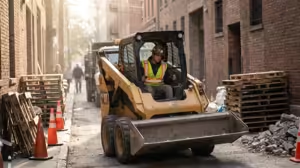
As Construction Equipment Magazine notes, the 70HP class is increasingly deployed in urban construction precisely because it can operate in tighter spaces than 100HP+ machines while maintaining strong hydraulic lift performance. Example scenario: a contractor using the QL-704B for site grading and material hauling on a mid-density residential development gains the muscle needed without sacrificing maneuverability on constrained lots.
Municipal fleets face pressure to do more with less. The QL-704B handles grading, mowing attachments, and debris removal across parks, roadsides, and public grounds — all without requiring specialized operator training for each task.
In tillage and implement-intensive operations, the QL-704B’s draft control and PTO consistency keep productivity steady across demanding field conditions. It’s the kind of reliable performance that makes the Qilu Machinery tractor warranty particularly meaningful — protecting operators across diverse, high-demand use cycles rather than a narrow set of conditions.
Standardizing around a single machine type reduces parts inventory, simplifies technician training, and streamlines service scheduling. That operational consistency compounds over time into real cost savings — a point worth keeping in mind as you consider seeing all of this capability in motion.
Seeing this machine move through real-world conditions tells a story that specs alone can’t fully capture. The video below features the QL-704B in action — a practical demonstration sourced from Qilu Machinery, one of the leading China 70HP tractor supplier names in global agricultural equipment.
A tractor’s true capability reveals itself under load, not on a spec sheet. Subscribe to Qilu Machinery’s channel for ongoing walkthroughs covering additional configurations, seasonal applications, and attachment compatibility — topics we’ll also address directly in the FAQ section coming up next.
Before committing to a machine at this capability level, buyers naturally have questions. Here are the answers to the most common ones.
The QL-704B supports a broad range of three-point hitch implements, including rotary tillers, plows, disc harrows, seeders, hay balers, and front loaders. Its hydraulic output and PTO specifications make it compatible with both Category I and Category II implements, giving operators significant flexibility across farming and light construction tasks without needing custom adapters.
In practice, the QL-704B’s turbocharged diesel engine is engineered for efficiency relative to output, not just raw economy. While it naturally consumes more fuel than a 40–50HP tractor at peak load, the trade-off is that it completes tasks faster and with fewer passes — which often results in lower per-acre fuel costs overall. For operations scaling up from smaller machines, that efficiency gap tends to close quickly.
Consistency, certification, and export track record are the three pillars buyers most often cite. Qilu Machinery holds recognized manufacturing certifications and has established supply channels across multiple continents. For global agribusiness buyers, that combination of documentation and demonstrated delivery history is what separates credible partners from uncertain ones.
The QL-704B typically comes with a 12-month or 1,000-hour warranty covering major mechanical components, though terms can vary by distributor and region. Buyers should confirm warranty service logistics — including parts availability and authorized service centers — before finalizing purchase agreements.
As explored in earlier sections, the QL-704B performs well on light-to-medium construction applications — land clearing, grading, and loader work. However, for sustained heavy-duty construction requiring dedicated machinery, it’s worth evaluating whether a purpose-built construction unit better fits the workload.
The QL-704B isn’t just a tractor — it’s a strategic investment in operational range, proving that utility and performance are no longer a trade-off in modern agribusiness. Whether you’re managing row crops, diversified land, or cross-sector projects, the right 70HP platform changes what’s possible. Now’s the time to put that capability to work.




-1.png)