Getting orchard tractor implement matching right is the difference between clean passes, consistent coverage, and quiet uptime—or a season of scuffed trunks, missed canopies, and downtime. In narrow rows, the margins are thin: centimeters of clearance, tight headlands, variable slopes, and heavy rear loads. This guide translates those constraints into repeatable decision rules you can apply on any specialty block.
Start with row spacing and canopy geometry, then back into tractor width, adjustable track, and turning radius. Don’t size the tractor first and force the fit later.
Match PTO horsepower and hydraulic flow to each implement’s spec with a 10–20% margin; verify PTO hp for airblast sprayers and flow/pressure for hydraulic hedgers or pruners.
Size inter-row mower decks to actual clearances, not nominal row spacing; use modest safety margins at the trunks and trellis.
Stabilize the platform before you scale speed: ballast, tire pressure, and weight distribution are non-negotiable when spraying on slopes.
Adhere to lighting/marking and ROPS requirements and follow airblast calibration guidance from extension programs to ensure coverage and reduce drift.
Quick selection checklist for orchard tractor implement matching
Map the tightest row spacing and canopy/trunk clearances across the block; note slope and soil firmness.
Define your implement set and duty cycle for the season: airblast spraying, inter-row mowing, hedging/pruning, cultivation.
Set tractor envelope targets: overall width, adjustable track width range, and turning radius that fit your headlands.
Confirm power and hydraulics: required PTO horsepower and continuous hydraulic flow/pressure for the implements you’ll use most.
Check hitch category, weight, wheelbase, and tire options; plan ballast for the heaviest rear-mounted load.
Cross-check against safety and standards: ROPS in place, lighting/marking for public roads, PTO interface compatibility.
Pilot test with water and a light pass before committing to full-rate spraying or high-speed mowing.
The specs that actually matter in narrow rows
Tractor specs only matter insofar as they protect the crop, keep you stable, and power the implement efficiently. Here’s how to read them with narrow-row constraints in mind.
Overall width, track width, turning radius
Overall width dictates whether you physically fit without contacting trunks or posts. In narrow orchards, many operators target overall widths in the 1.3–1.7 m band depending on 2.0–3.0 m row spacings. Use adjustable rims or track settings to fine-tune.
Track width affects stability and clearance. Wider tracks improve stability on slopes but reduce clearance to trunks; adjust to the narrowest safe setting for your steepest blocks.
Turning radius governs headland efficiency and fatigue. Narrow specialty tractors can achieve tight radii around 3.3–3.5 m with the right steering geometry. Confirm your headland length supports a smooth U-turn without shunting.
PTO horsepower and torque reserve
The implement, not the tractor, sets the minimum PTO requirement. For small three-point airblast sprayers common in orchards and vineyards, typical requirements fall in the roughly 20–45 PTO hp range depending on fan size and target canopy density. Calibrate with water and maintain a modest power margin so the fan speed stays consistent under load. See university guidance on airblast calibration and selection to set realistic expectations and operating speeds, including Ohio State’s sprayer selection series (2016–2021) and Washington State’s six-step calibration framework (2016; updated 2025).
Reference: Washington State University explains practical calibration steps such as verifying ground speed and adjusting air direction to canopy density in the Six Steps guide, an enduring resource for orchard and vineyard operators. See the discussion in the 2016 article, updated in 2025, under step-by-step airblast optimization.
Hydraulic flow and pressure for attachments
Hedgers and pruners often run off tractor remotes and may require sustained flow at elevated pressure. Industry-typical ranges you’ll encounter are roughly 10–25 gpm at about 2,000–3,000 psi for many orchard pruners and hedgers, with heavier assemblies drawing more. Because specifications vary, confirm flow, pressure, and continuous-duty heat rejection with the implement datasheet and your tractor’s hydraulic system rating. If the numbers don’t match, plan for an auxiliary power pack.
Hitch category, wheelbase, and weight distribution
Hitch category must match implement pins and geometry to avoid unsafe lash-ups. Most orchard-size implements use Category I or II three-point hitches.
Wheelbase and base weight influence ride, traction, and stability with heavy rear loads like sprayers. A longer wheelbase can smooth the ride; total mass helps resist sway but increases soil compaction. Plan ballast to maintain balance when the tank is full and when it is nearly empty.
Implement-specific guidance with practical ranges
Airblast sprayers in orchards and vineyards
Small to mid-size three-point airblast units require careful matching of PTO horsepower, gear ratios, and desired ground speed. Extension sources emphasize establishing a verified operating speed, then calibrating output to target gallons per acre and canopy density.
Power guidance and calibration: Airblast selection and calibration topics are covered in Ohio State’s sprayer series (2016–2021) and in Washington State’s Six Steps to Calibrate and Optimize Airblast Sprayers, which details ground speed checks, fan air direction, and nozzle selection for tree fruit and vines. These resources emphasize operating within a realistic 2.5–4 mph band and adjusting air to minimize drift while maintaining coverage.
Practical note: Size the PTO requirement with a 10–20% margin above the sprayer’s rated need so the fan maintains rpm on hills and during acceleration. Conduct initial calibrations with water and record nozzle pressure, tractor gear, and engine rpm for repeatability.
Authoritative resources:
According to the Six Steps article from Washington State University Tree Fruit (2016; updated 2025), accurate speed verification and airflow adjustment are key steps before finalizing rates and nozzles, which materially reduce over-application and drift. Six Steps to Calibrate and Optimize Airblast Sprayers
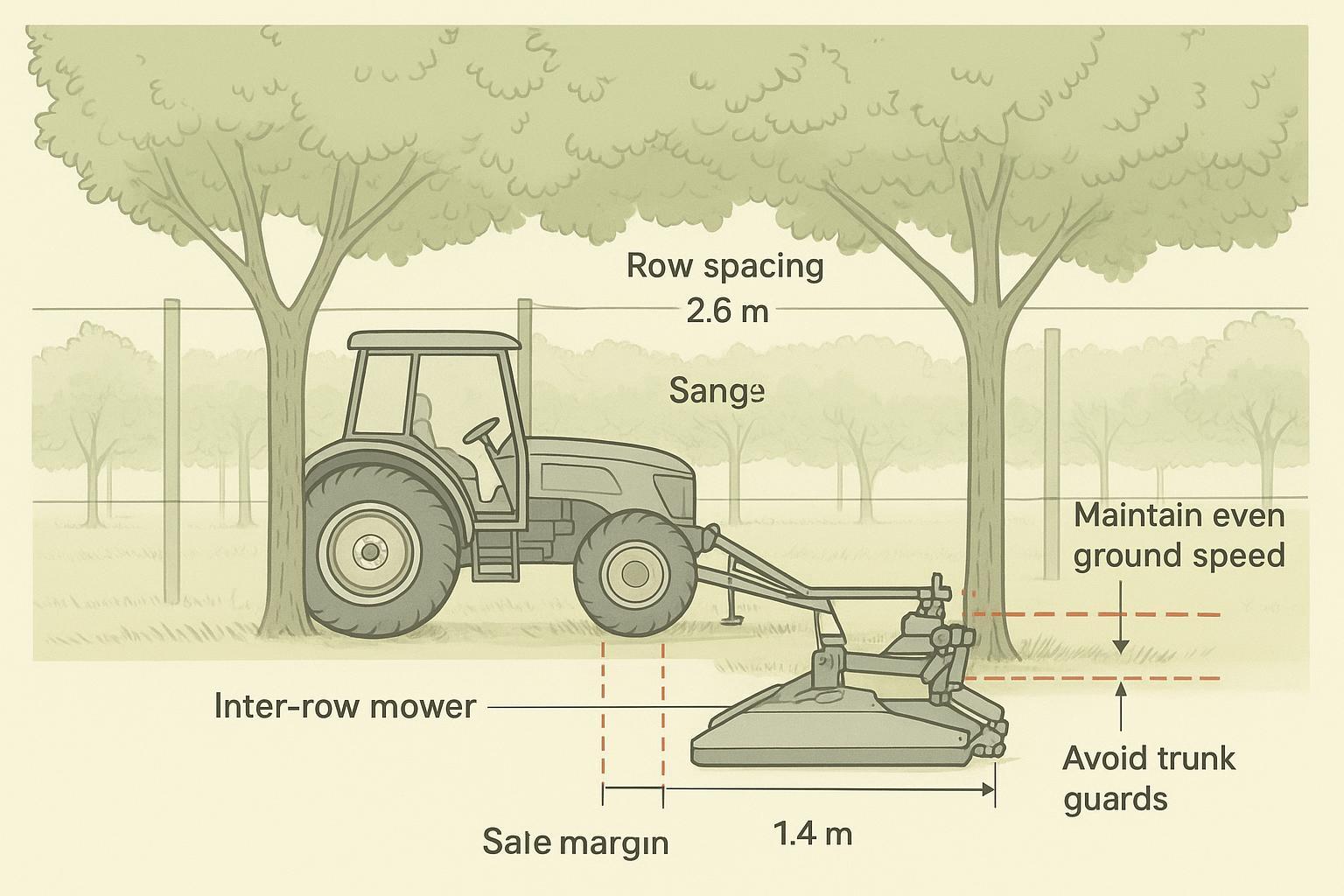
Unlike spraying, there isn’t a universal extension formula for deck width. A conservative operational approach is to size the mower deck to the tightest sustained clearance you measure under the canopy, leaving a small safety margin per side to avoid trunk scuffs and trellis contact. In narrow orchards or vineyards (≈2.0–2.6 m rows), consider offset or wing mowers to reach the dripline while keeping the tractor centered.
Field rule: Measure the narrowest distance between opposing trunks or posts where you’ll mow consistently; set deck width slightly narrower than that number. Validate with a slow pass before raising speed.
Hedgers and pruners
Hydraulic implements are limited by your tractor’s continuous flow and pressure, not just peak specs. Confirm that hydraulic remotes supply the stated gpm at working rpm, and that return-line configuration and oil cooling support continuous duty. If not, an auxiliary hydraulic pack on the implement can decouple the load from the tractor system.
Implement–tractor compatibility matrix
Implement
Typical PTO hp requirement
Hydraulic flow and pressure
Hitch category
Width and clearance notes
Airblast sprayer, 200 L class
~20–45 PTO hp depending on fan and canopy
N / D
Cat I/II
Verify overall width and turning radius; keep fan rpm stable; calibrate to canopy density
Inter-row mower, 1.2–1.6 m
PTO hp varies with deck width and grass load
N / D
Cat I/II
Size deck to measured clearance; consider offset heads for dripline coverage
Hedger/pruner mast
PTO hp not primary
~10–25 gpm at ~2,000–3,000 psi typical ranges; verify per model
Cat II or loader mount
Ensure continuous-duty hydraulics; check weight and lateral balance
In-row cultivator
Low–moderate PTO hp
Occasional hydraulic actuation
Cat I/II
Confirm tine clearances and stone protection; respect trunk guards
Ballast, stability, and slope operations in orchards
Rear-mounted sprayers shift the center of gravity aft and high as the tank fills, which can reduce steering authority and increase rollover risk on slopes. Stabilize first, then increase speed.
Ballast: Add liquid ballast or wheel weights to maintain traction and a low center of gravity. Extension guidance on ballasting notes that targeted wheel slip around 10–15% can improve traction and fuel efficiency when set correctly. See the overview from Farm Energy Extension on tractor ballasting for operating principles and trade-offs. Ballasting Tractors for Optimal Fuel Efficiency
Tire pressure and contact: Under-inflation harms stability and fuel efficiency; over-inflation reduces traction on uneven orchard floors. Set pressures to the tire’s load table for the heaviest implement you’ll carry.
Tank management: Calibrate with water and avoid overfilling on significant slopes to reduce slosh and high center of gravity. Many operators prefer partial fills for steep blocks, verified with pre-work test passes. See OSU Ohioline calibration and preparation guidance for orchard and vineyard sprayers (2016–2021). Calibration of Orchard and Vineyard Sprayers
Travel patterns and visibility: Favor uphill or level travel where feasible and minimize cross-slope passes with rear-heavy loads. When moving on public roads or in low light, follow agricultural lighting and marking practices consistent with ASABE S279. The Association of Equipment Manufacturers provides a practical, illustrated guide to these practices. AEM Illustrative Guide to Lighting and Marking
Safety and standards every operator should know
You don’t need to be a standards engineer to match implements responsibly, but you should know what you’re aligning to:
ROPS and seatbelt: Maintain ROPS in good condition and wear the seatbelt. ROPS testing is governed internationally through OECD and ISO codes; many national guidance documents summarize requirements for farm use.
Lighting and marking: Follow agricultural lighting/marking guidance consistent with ASABE S279 practices; land-grant extensions like UF/IFAS summarize practical placements and conspicuity measures that reduce roadway incidents. See UF/IFAS’s overview for diagrams and recommendations (2006). Lighting and Marking of Agricultural Equipment
PTO interface: Ensure PTO shaft dimensions and speeds align with ISO 500-series conventions used across agricultural implements.
Sprayer safety: Guard moving parts, confirm hose pressures, and follow sprayer safety practices summarized in ISO-type guidance and extension bulletins.
Practical example and workflow in a narrow-row block
Disclosure: Qilu Machinery is our product.
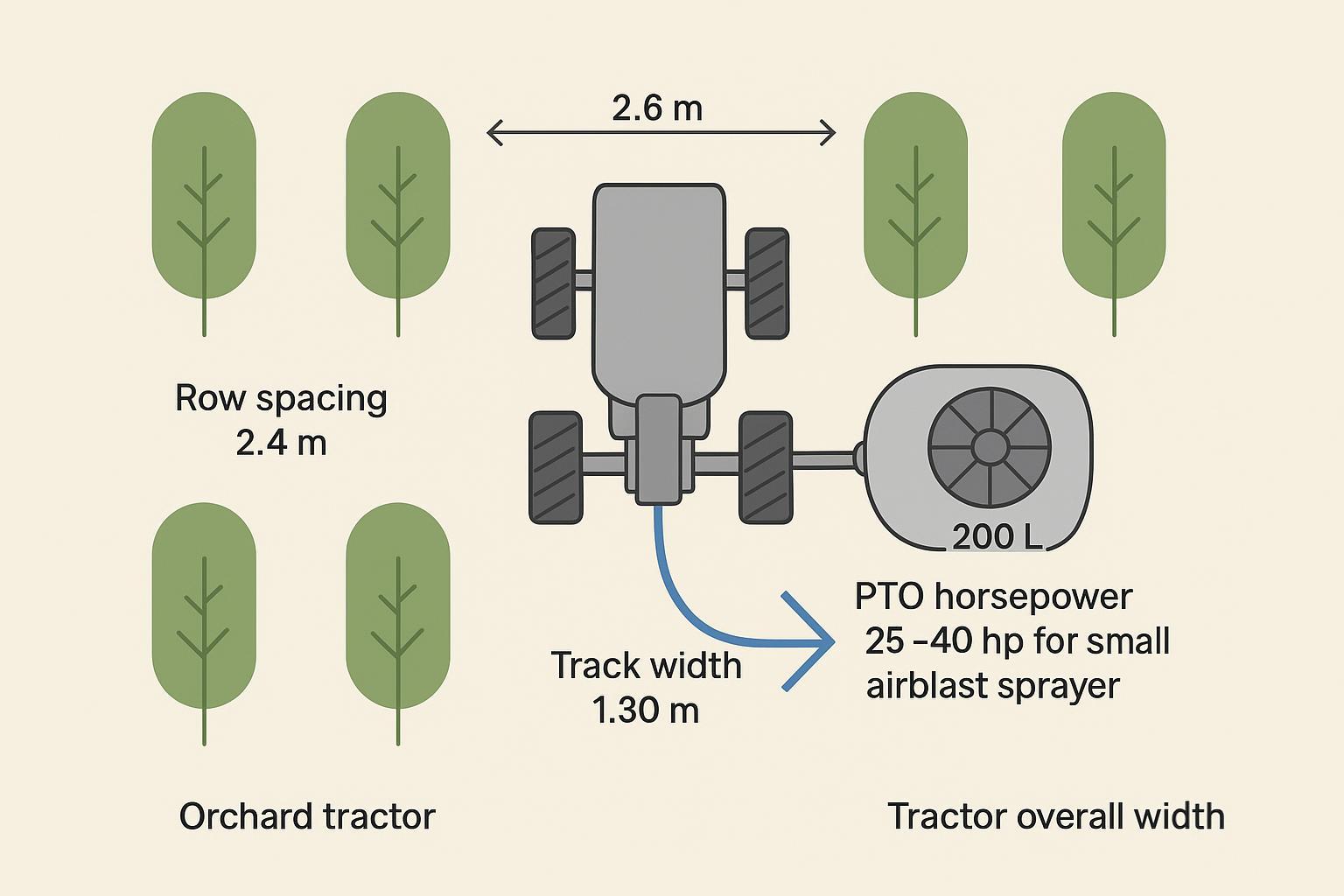
Let’s apply these steps to a 50 hp compact orchard tractor as an orchard tractor implement matching example. For illustration, see this 50 hp orchard tractor example on the Qilu Machinery site: the QL-504Y-E model, listed for orchard and small-plot work. We’ll walk through matching it to a 200 L three-point airblast sprayer and a 1.4 m inter-row mower.
Site constraints: Row spacing averages 2.6 m with occasional tighter bends near headlands; moderate slopes up to 8%.
Tractor envelope: Target overall width near 1.45 m with track set around 1.30 m to leave comfortable clearance. Confirm turning radius suitable for the headlands.
Sprayer match: A 200 L sprayer typically calls for roughly 20–45 PTO hp. With a 50 hp engine class tractor, verify PTO horsepower output (not just engine rating) and maintain a 10–20% margin above the sprayer’s PTO requirement. Start with ground speed in the 2.5–3.5 mph range using water, record nozzle pressure and fan rpm, and adjust air vanes to push through but not beyond the canopy per calibration guidance.
Mower match: Measure the tightest recurring under-canopy clearance; choose a 1.4 m deck if it leaves about 0.1 m margin per side. Use an offset mower head to reach near the dripline without trunk contact. Make an initial low-speed pass to validate clearance before increasing speed.
Ballast and tires: Add rear wheel ballast and set tire pressures to load tables for the sprayer’s full tank. In sloped sections, avoid completely full tanks; aim for partial fills and confirm steering authority in test passes.
Pilot test: With water in the tank, run two calibration passes on a representative alley. Confirm coverage on water-sensitive cards and verify no trunk scuffs during the mowing pass.
In a 2.2 m vineyard block, the tractor envelope is tightened further. Set overall width near 1.30–1.40 m and reduce track width while preserving slope stability for the steepest row. An in-row or tunnel sprayer can reduce drift and improve coverage at lower air settings. Calibrate speed carefully; use ribbons or flags to validate that the airstream just envelops the canopy.
Sloped orchard with heavy rear load
On 10–12% slopes, prioritize stability: a wider track within the trunk clearance limit, diligent ballast, and reduced tank fill volume on steep sections. Travel patterns should bias uphill passes under load and minimize cross-slope operation. Keep speed on the low end of your calibrated band to maintain control and coverage.
Tools you can use right now
University calibration video: For a concise demonstration of airblast calibration concepts relevant to orchards and vineyards, see the 7:54-minute session from Penn State Extension and University of New Hampshire, published in 2014 and frequently referenced by extension educators: Air-blast Sprayer Calibration: Educator Perspective.
Reference guides for calibration and safety: Washington State University’s Six Steps resource (2016; updated 2025) and Ohio State University’s Ohioline sprayer series (2016–2021) provide step-by-step checklists you can apply on-farm. For roadway safety and farm visibility, consult UF/IFAS’s lighting and marking overview (2006) and the AEM illustrative guide summarizing ASABE S279 practices.
Tip: Before every spray window, run a short water-only calibration pass at the day’s intended speed and wind conditions, then lock those rpm and pressure settings in your logbook. It pays for itself.
Perguntas frequentes
What’s the simplest way to start orchard tractor implement matching in a new block?
Begin with a detailed measurement walk: row spacing, under-canopy clearance, slope changes, and headland lengths. List your implements and duty cycle. From those constraints, set target tractor width, track, turning radius, PTO hp, and hydraulics. Then validate with a water-only pilot.
How much PTO horsepower do I need for a 200 L airblast sprayer?
Most small three-point airblast sprayers fall in the roughly 20–45 PTO hp band. Use the implement’s stated PTO requirement, add a 10–20% margin, and verify you can hold fan rpm at your calibrated speed on your terrain.
How do I size an inter-row mower for narrow rows?
Measure the tightest recurring under-canopy clearance where you’ll mow and pick a deck slightly narrower than that, maintaining a small margin per side. If you need to reach the dripline, consider an offset head. Validate at low speed before increasing.
My hedger/pruner spec calls for 18 gpm at 2,500 psi. What if my tractor remotes are lower?
You can’t safely “wish” more flow or pressure from the system. Consider an auxiliary hydraulic power pack designed for continuous duty at the required flow and pressure, and confirm return-line plumbing and oil cooling.
What ballast should I add for a rear sprayer on slopes?
Combine liquid ballast or wheel weights with tire pressures set to load tables for the heaviest configuration. Aim for controlled wheel slip near 10–15% and confirm steering authority during a test pass with a partial tank.
Which standards matter for orchard tractor implement matching?
Keep ROPS in place and use seatbelts. Follow lighting and marking practices summarized from ASABE S279 for public-road travel, and ensure PTO interface compatibility in line with ISO conventions. For sprayers, follow guarding and pressure safety practices summarized by extension resources.
Sources and further reading
Washington State University Tree Fruit, Six Steps to Calibrate and Optimize Airblast Sprayers for Orchards and Vineyards (2016; updated 2025): step-by-step speed checks, airflow adjustment, and nozzle setup for tree fruit and vines. Six Steps to Calibrate and Optimize Airblast Sprayers
Association of Equipment Manufacturers, Illustrative Guide to Agricultural Equipment Lighting and Marking: visual interpretations of ASABE S279 practices used by farms and manufacturers. AEM Illustrative Guide to Lighting and Marking
Shandong Qilu Industrial Co., Ltd. é um fabricante e exportador profissional que integra o desenvolvimento e produção de escavadeiras, carregadeiras e tratores. Nós fornecemos o melhor serviço, absolutamente.






-1.png)