Bienvenue sur Shandong Qilu Industrial Co., Ltd

 French
 English
 Arabic
 Bulgarian
 Bengali
 Czech
Czech
 Danish
 German
 Greek
Greek
 Spanish
 Finnish
 Hindi
Hindi
 Croatian
 Hungarian
 Indonesian
 Italian
 Japanese
 Korean
 Lithuanian
 Dutch
Dutch
 Norwegian
 Polish
 Portuguese
 Romanian
 Russian
 Slovak
 Slovenian
 Swedish
 Thai
Thai
 Turkish
 Ukrainian
 Vietnamese
 Tagalog
 Malay
Malay
 Estonian
 Catalan
 Latvian
 Urdu
Urdu
 Serbian
 Persian
 Swahili
 Albanian
 Armenian
 Icelandic
 Bosnian
 Luxembourgish
 Afrikaans
French English
Arabic
Bulgarian
Bengali
Czech
Danish
German
Greek
Spanish
Finnish
Hindi
Croatian
Hungarian
Indonesian
Italian
Japanese
Korean
Lithuanian
Dutch
Norwegian
Polish
Portuguese
Romanian
Russian
Slovak
Slovenian
Swedish
Thai
Turkish
Ukrainian
Vietnamese
Tagalog
Malay
Estonian
Catalan
Latvian
Urdu
Serbian
Persian
Swahili
Albanian
Armenian
Icelandic
Bosnian
Luxembourgish
Afrikaans
Afrikaans
French English
Arabic
Bulgarian
Bengali
Czech
Danish
German
Greek
Spanish
Finnish
Hindi
Croatian
Hungarian
Indonesian
Italian
Japanese
Korean
Lithuanian
Dutch
Norwegian
Polish
Portuguese
Romanian
Russian
Slovak
Slovenian
Swedish
Thai
Turkish
Ukrainian
Vietnamese
Tagalog
Malay
Estonian
Catalan
Latvian
Urdu
Serbian
Persian
Swahili
Albanian
Armenian
Icelandic
Bosnian
Luxembourgish
Afrikaans

Comment tirer le meilleur parti de votre tracteur
Vous voulez garder votre tracteur en marche fort pendant des années Les soins réguliers et les contrôles quotidiens font une grande différence Des habitudes intelligentes comme inspecter les liquides, surveiller les fuites et nettoyer les pièces mobiles vous aident à éviter les réparations coûteuses N'importe qui peut suivre Prolonger la durée de vie de votre tracteur : un guide de soins en utilisant des étapes simples Vous améliorez la fiabilité et économisez de l'argent lorsque vous faites attention aux détails tous les jours.
Principaux points à retenir
- Effectuer inspections quotidiennes pour attraper les petits problèmes avant qu'ils ne deviennent des réparations coûteuses.
- Surveiller régulièrement les niveaux de liquide pour éviter la surchauffe et les pannes mécaniques.
- Suivez un programme d'entretien de routine pour que votre tracteur fonctionne correctement.
- Utilisation huile de haute qualité et des filtres pour améliorer les performances et la longévité du moteur.
- Gardez votre tracteur propre, en particulier le train de roulement, pour éviter la rouille et les dommages.
- Rangez correctement votre tracteur pour le protéger des dommages causés par les intempéries et des parasites.
- Conservez des dossiers de maintenance détaillés pour augmenter la valeur de revente et la fiabilité.
- Résolvez rapidement les petits problèmes pour éviter les pannes majeures et économiser de l’argent.
Prolonger la durée de vie de votre tracteur : un guide de soins
Inspections Quotidiennes
Vérification des fuites et des dommages
Vous protégez votre investissement lorsque vous inspectez votre tracteur tous les jours Commencez par chercher les fuites sous le moteur et le système hydraulique Examinez les essieux avant et la direction pour vérifier le relâchement Graissez les roulements si vous remarquez une résistance Vérifiez la présence de débris dans le radiateur et assurez-vous que le système de refroidissement reste dégagé Inspectez les courroies pour déceler les fissures et la tension Gardez une courroie de rechange dans votre boîte à outils Regardez le filtre à air pour confirmer qu'il n'est pas obstrué Examinez les câbles de la batterie pour déceler la corrosion et vérifiez les liaisons d'embrayage et de frein si nécessaire Vérifiez les connexions des tuyaux hydrauliques et gardez l'arrière du tracteur propre Assurez-vous que les pneus restent correctement gonflés.
Conseil : Une remise des gaz rapide avant de démarrer votre tracteur peut détecter de petits problèmes avant qu'ils ne deviennent des réparations coûteuses.
Liste de contrôle d'inspection quotidienne:
- Inspectez les essieux avant et la direction pour plus de relâchement.
- Roulements graisseux si nécessaire.
- Vérifiez le système de refroidissement et le radiateur pour détecter les débris.
- Examinez les courroies pour détecter les tensions et les fissures.
- Confirmez que le filtre à air est clair.
- Vérifiez l'huile moteur pour détecter tout contaminant ou eau.
- Inspectez les niveaux de liquide de la batterie et les câbles.
- Régler les timoneries d'embrayage et de frein.
- Vérifiez les niveaux de liquide du réservoir hydraulique.
- Assurez-vous que les pneus sont correctement gonflés.
- Nettoyez l'arrière du tracteur et vérifiez les raccords des tuyaux hydrauliques.
Surveillance des niveaux de fluide
Vous prolongez la durée de vie de votre tracteur en surveillant les niveaux de liquide tous les jours Vérifiez l'huile moteur, le liquide de refroidissement et le liquide hydraulique avant chaque utilisation Recherchez des signes de contamination, comme de l'eau dans l'huile ou du liquide de refroidissement trouble Retirez les liquides au besoin Nettoyez les réservoirs et les bouchons pour empêcher la saleté de pénétrer dans le système Des contrôles de liquide cohérents vous aident à éviter la surchauffe et la défaillance mécanique.
Calendrier de maintenance de routine
Inspections de 100 heures (ceintures, tuyaux, lignes)
Vous devez suivre un programme d'entretien de routine pour que votre tracteur fonctionne correctement À toutes les 100 heures de fonctionnement, inspectez les courroies, les tuyaux et les conduites hydrauliques Recherchez les fissures, les fuites et les signes d'usure Remplacez toutes les pièces qui présentent des dommages Resserrez les connexions desserrées et vérifiez l'alignement correct Cette habitude vous aide à prévenir les pannes et les réparations coûteuses.
Service 200/500 heures (filtres, contrôles complets)
Planifiez un entretien complet toutes les 200 à 500 heures Changez l'huile moteur et remplacez les filtres à huile Inspectez la tringlerie de direction et l'alignement des roues avant Remplacez les filtres à air et vérifiez les niveaux de liquide hydraulique Examinez l'usure des courroies et des tuyaux Ces étapes maintiennent votre tracteur en parfait état et prolongent sa durée de vie.
| Tâche d'entretien | Fréquence |
|---|---|
| Contrôles quotidiens | Inspectez les niveaux de liquide, la pression des pneus et les dommages visibles |
| Changez l'huile moteur et le filtre | Toutes les 100 heures ou annuellement |
| Transmission de service et systèmes hydrauliques | Toutes les 200 à 300 heures ou chaque année |
| Tâches de maintenance complètes | Toutes les 400 à 600 heures |
Remarque : Le respect du calendrier de maintenance du fabricant vous aide à résoudre les problèmes mineurs plus tôt et à éviter des réparations coûteuses.
- Un entretien régulier permet aux tracteurs de fonctionner efficacement et prolonge leur durée de vie.
- Un bon entretien peut retarder le besoin de remplacement, maximisant ainsi votre investissement.
- Attraper les problèmes mineurs tôt empêche les réparations coûteuses et minimise les temps d'arrêt.
Modifications de l'huile et du filtre
Intervalles Recommandés
Vous devez vérifier les niveaux d'huile toutes les 10 heures et changer les filtres à huile et à huile du moteur toutes les 50 à 200 heures, en fonction de la charge de travail de votre tracteur Remplacez les filtres à air et inspectez annuellement les courroies et les tuyaux Ces intervalles vous aident à maintenir les performances et la fiabilité du moteur.
| Intervalle | Tâche d'entretien |
|---|---|
| Toutes les 10 heures | Vérifiez le niveau d'huile, le niveau de liquide de refroidissement, inspectez le filtre à air, vérifiez la pression des pneus, inspectez pour déceler tout dommage. |
| Toutes les 50 heures | Changez le filtre à huile et à huile du moteur, vérifiez le niveau de liquide hydraulique, inspectez le filtre à carburant, inspectez pour déceler tout dommage. |
| Toutes les 100 heures | Entretenir le moteur. |
| Toutes les 200 heures | Changez l'huile moteur et remplacez le filtre à huile, vérifiez la tringlerie de direction et l'alignement des roues avant, inspectez les dommages, vérifiez les ceintures et les tuyaux, les conduites hydrauliques, remplacez le filtre à air. |
| Annuellement | Ceintures et tuyaux de contrôle, conduites hydrauliques, remplacer le filtre à air. |
Choisir de l'huile et des filtres de qualité
Vous améliorez les performances du moteur et prolongez la durée de vie de votre tracteur en utilisant de l'huile et des filtres de haute qualité Les lubrifiants haut de gamme réduisent l'usure des composants du moteur Des filtres fiables empêchent les contaminants d'entrer dans le moteur Les vidanges régulières d'huile et les remplacements de filtres garantissent un fonctionnement efficace de votre tracteur et dure plus longtemps.
Conseil : choisissez toujours l'huile et les filtres qui répondent ou dépassent les spécifications de votre fabricant de tracteurs.
Prolonger la durée de vie de votre tracteur: Un Guide de soins vous donne les outils pour maintenir votre équipement en marche fort Les inspections quotidiennes, l'entretien de routine, et l'huile et les filtres de qualité vous aident à éviter les pannes et à maximiser votre investissement Lorsque vous suivez ces étapes, vous vous assurez que votre tracteur reste fiable pendant des années.
Filtre à air et système de carburant
Nettoyage et remplacement du filtre à air
Vous gardez votre tracteur en marche efficace lorsque vous faites attention au filtre à air La poussière et les débris peuvent obstruer le filtre, réduisant ainsi les performances du moteur et augmentant la consommation de carburant Vous devez inspecter le filtre à air régulièrement, surtout si vous opérez dans des environnements poussiéreux Les contrôles mensuels fonctionnent bien pour la plupart des utilisateurs, mais vous devrez peut-être nettoyer ou remplacer le filtre plus souvent si vous remarquez une réduction du débit d'air ou des saletés visibles.
- Vérifiez le filtre à air tous les mois ou après avoir travaillé dans des conditions poussiéreuses.
- Nettoyez le filtre avec de l'air comprimé s'il n'est que légèrement sale Remplacez-le si vous constatez une forte accumulation ou des dommages.
- Respectez toujours les instructions du fabricant pour le nettoyage et le remplacement.
Un agriculteur du Kansas a partagé que le nettoyage du filtre à air après chaque semaine de travail sur le terrain réduisait les problèmes de moteur et améliorait le rendement énergétique Vous pouvez utiliser une routine d'inspection simple pour détecter les problèmes tôt Si vous voyez de la poussière à l'intérieur du boîtier du filtre, nettoyez la zone avant d'installer un nouveau filtre. Cette habitude prend en charge l'extension de la durée de vie de votre tracteur : un guide de soins et vous aide à éviter des réparations coûteuses.
| Tâche de maintenance du filtre à air | Fréquence | Action |
|---|---|---|
| Inspectez le filtre à air | Mensuel ou selon les besoins | Contrôle visuel |
| Filtre à air pur | Mensuel ou après utilisation lourde | Utiliser de l'air comprimé |
| Remplacer le filtre à air | Lorsqu'il est sale ou endommagé | Installer un nouveau filtre |
Conseil : Un filtre à air propre permet à votre moteur de respirer facilement et empêche la saleté de pénétrer dans les composants sensibles.
Garder le réservoir de carburant plein et utiliser un stabilisateur
Vous protégez le système de carburant de votre tracteur en gardant le réservoir plein et en utilisant un stabilisateur de carburant L'éthanol dans le carburant peut causer de l'instabilité et des dommages s'il n'est pas traité Les stabilisateurs de carburant aident à prévenir ces problèmes, protégeant les conduites de carburant et les carburateurs de la corrosion et de l'accumulation Vous prolongez la durée de vie du système de carburant de votre tracteur lorsque vous ajoutez un stabilisateur avant de longues périodes de stockage ou pendant les temps d'arrêt saisonniers.
- Remplissez le réservoir de carburant après chaque utilisation pour réduire la condensation et éviter la rouille.
- Ajoutez un stabilisateur de carburant avant de ranger votre tracteur pendant plus d'un mois.
- Faites tourner le moteur pendant quelques minutes pour faire circuler le stabilisateur dans le système.
Un propriétaire de tracteur au Texas a signalé moins de problèmes de conduite de carburant après avoir utilisé un stabilisateur pendant le stockage hivernal. Des recherches sur les extensions agricoles montrent que les stabilisateurs de carburant peuvent conduire à un durée de vie plus longue pour le système d'alimentation en carburant du tracteur. Vous soutenez l'extension de la durée de vie de votre tracteur : un guide de soins lorsque vous intégrez les soins du système de carburant à votre routine.
| Tâche de maintenance du système de carburant | Bénéfice | Action recommandée |
|---|---|---|
| Gardez le réservoir plein | Empêche la condensation et la rouille | Remplir après chaque utilisation |
| Utilisez un stabilisateur de carburant | Protège les conduites de carburant et le carburateur | Ajouter avant stockage |
| Exécuter le moteur après avoir ajouté le stabilisateur | Circule stabilisateur | Courir pendant plusieurs minutes |
Remarque : L'entretien régulier du système de carburant vous aide à éviter des réparations coûteuses et maintient votre tracteur prêt pour le travail.
Vous améliorez la fiabilité et les performances lorsque vous vous concentrez sur la maintenance du filtre à air et du système de carburant. Prolonger la durée de vie de votre tracteur : un guide de soins vous donne des mesures pratiques pour que votre équipement fonctionne bien.
Pièces de lubrification et de déplacement
Garder les pièces mobiles de votre tracteur bien lubrifié est l'un des moyens les plus efficaces pour prévenir les pannes et prolonger sa durée de vie Vous réduisez la friction, protégez les composants et gardez votre machine en bon état lorsque vous faites attention aux points de graissage et aux systèmes hydrauliques.
Points de Graissage
À quelle fréquence graisser
Vous devez graisser régulièrement les pièces mobiles de votre tracteur La plupart des experts recommandent de graisser tous les points critiques toutes les 10 heures de fonctionnement ou au moins une fois par semaine si vous utilisez votre tracteur moins fréquemment Si vous travaillez dans des conditions boueuses ou humides, vous devrez peut-être graisser plus souvent Vérifiez toujours le manuel de votre opérateur pour des intervalles spécifiques.
Conseil : Faites en sorte que le graissage fasse partie de votre routine après quelques utilisations. Cette habitude vous aide à détecter l'usure tôt et maintient votre tracteur en pleine forme.
Domaines clés à lubrifier
Vous devez savoir où appliquer la graisse pour obtenir les meilleurs résultats Concentrez-vous sur les bras de chargeuse, les composants de direction, les arbres de transmission et les joints de faucheuse L'absence d'un point de graisse peut entraîner une usure prématurée et des réparations coûteuses Le tableau ci-dessous met en évidence les points de graissage les plus critiques identifiés par les experts en maintenance :
| Catégorie de point de graissage | Nombre de Points | Localisation Description |
|---|---|---|
| Points de graisse du chargeur | 6 (chaque côté) | Deux à l'avant, deux au milieu, deux à l'arrière |
| Points de direction assistée et de conduite | 6 | Deux sur l'arbre de transmission intégrale, deux sur l'arbre de transmission principal |
| Points supplémentaires pour les modèles de tondeuses à ventre | 3 | Un à chaque joint en U et un au milieu de l'arbre |
Une lubrification régulière en ces points réduit considérablement la friction entre les pièces mobiles Cette réduction entraîne un fonctionnement plus fluide et moins de réparations Vous évitez également l'usure inutile et prolongez la durée de vie de votre tracteur, ce qui réduit le risque de pannes inattendues.
Entretien du système hydraulique
Vérification des niveaux de fluide
Vous devriez vérifier le liquide hydraulique de votre tracteur à intervalles réguliers Pour de nombreux modèles populaires, tels que Jinma, l'intervalle recommandé est chaque année ou toutes les 100 heures d'utilisation, selon la première éventualité Utilisez la jauge ou le voyant pour confirmer que le liquide est au bon niveau Un faible niveau de fluide peut causer des performances lentes et endommager la pompe hydraulique.
| Modèle Tracteur | Intervalle de contrôle du fluide hydraulique |
|---|---|
| Jinma | Tous les 1 an ou 100 heures |
Remarque : Utilisez toujours le type de liquide hydraulique spécifié dans votre manuel pour éviter les problèmes du système.
Inspection des fuites
Vous protégez les performances de votre tracteur lorsque vous inspectez le système hydraulique pour déceler des fuites Recherchez des points humides autour des tuyaux, des raccords et des vérins Les fuites hydrauliques diminuent la pression, ce qui peut ralentir votre tracteur ou même provoquer une défaillance du système Un fluide insuffisant peut entraîner une surchauffe et des dommages aux composants coûteux Les fuites augmentent également les coûts de maintenance car la perte de liquide entraîne une usure plus importante de l'équipement.
- Vérifiez sous le tracteur et autour des conduites hydrauliques les gouttes ou les flaques d'eau.
- Serrez les raccords desserrés et remplacez immédiatement les tuyaux endommagés.
- Nettoyez tout fluide déversé pour éviter que la saleté ne colle aux composants.
En faisant de la lubrification et des soins hydrauliques une partie de votre routine habituelle, vous gardez votre tracteur en marche efficacement et évitez les réparations coûteuses Ces habitudes simples vous aident à tirer le meilleur parti de votre équipement.
Batterie et système électrique
Une batterie et un système électrique fiables maintiennent votre tracteur prêt à travailler tous les jours Vous pouvez éviter les pannes frustrantes et les réparations coûteuses en suivant quelques étapes simples de maintenance. Faire attention à votre batterie et à vos connexions électriques vous aide à tirer le meilleur parti de la vie votre équipement.
Entretien de batterie
Terminaux de nettoyage
La corrosion sur les bornes de la batterie peut entraîner une perte de puissance et des problèmes de démarrage Vous devez inspecter les bornes de votre batterie tous les mois Si vous voyez une accumulation blanche ou verte, nettoyez les bornes avec une solution de bicarbonate de soude et une brosse métallique Après le nettoyage, appliquez une fine couche de vaseline ou un protecteur pour éviter une corrosion future Les couvercles résistants à la corrosion peuvent également aider à réduire la fréquence à laquelle vous devez nettoyer les bornes.
Conseil : portez toujours des gants et des lunettes de sécurité lorsque vous travaillez avec des piles.
Voici un résumé des pratiques efficaces de maintenance des batteries :
| Pratique d'entretien | Description |
|---|---|
| Inspections régulières (mensuelles) | Inspectez les bornes de la batterie pour détecter toute corrosion et nettoyez-les pour éviter toute perte de puissance. |
| Pratiques de charge optimisées | Évitez les décharges profondes et utilisez des chargeurs appropriés pour maintenir les performances de la batterie. |
| Protection de l'environnement | Gardez la batterie propre et sèche, et conservez-la dans un endroit frais et sec pendant un stockage prolongé. |
| Remplacements préventifs | Remplacer la batterie avant défaillance complète afin d'éviter d'endommager le système électrique du tracteur. |
Un agriculteur de l'Iowa a partagé que le nettoyage mensuel des terminaux réduisait les problèmes de démarrage par temps froid. Cette simple habitude peut ajouter des années à la durée de vie de votre batterie.
Utilisation d'un appel d'offres de batterie
Vous pouvez prolonger la durée de vie de la batterie de votre tracteur en utilisant un appel d'offres pour batterie intelligent, en particulier pendant le stockage hors saison Les chargeurs intelligents maintiennent la batterie à la tension idéale, empêchant ainsi la surcharge et la sulfatation Les recherches montrent que les batteries AGM durent plus longtemps lorsqu'elles sont chargées à une tension de pointe de 14,7 volts et maintenues à 13,6 volts La plupart des fabricants recommandent des mainteneurs intelligents par rapport aux chargeurs à ruissellement traditionnels car ils offrent un meilleur contrôle et protègent la santé de votre batterie.
Si vous stockez votre tracteur pendant de longues périodes, connectez un appel d'offres de batterie pour maintenir la charge stable Cette pratique garantit que votre tracteur démarre facilement lorsque vous en avez besoin De nombreux experts agricoles discutent des avantages des appels d'offres de batterie dans des forums et des articles, tels que ce guide de l'Université du Nebraska Extension.
Vérifications électriques
Connexions d'inspection
Les connexions électriques desserrées ou sales peuvent causer de nombreux problèmes courants de tracteur Vous devriez vérifier toutes les connexions de câblage, fusibles et interrupteurs tous les quelques mois Recherchez les fils effilochés, les bornes desserrées ou les signes de dommages causés par la chaleur Resserrez toutes les connexions desserrées et remplacez les fils endommagés tout de suite.
- Inspectez les faisceaux de câbles pour détecter toute usure ou tout dommage causé aux rongeurs.
- Feux de test, jauges et signaux d'avertissement avant chaque utilisation.
- Remplacez les fusibles soufflés par le type correct pour éviter les défauts électriques.
Un propriétaire de tracteur en Géorgie a constaté que des contrôles électriques réguliers empêchaient des arrêts inattendus pendant le travail sur le terrain En intégrant ces inspections à votre routine, vous gardez le système électrique de votre tracteur fiable et sûr.
Remarque : Les problèmes électriques sont l'une des principales causes d'arrêt du tracteur. Des contrôles réguliers vous aident à éviter les pertes de temps et les réparations coûteuses.
Vous trouverez plus de conseils et de discussions communautaires sur l'entretien des batteries de tracteurs sur le forum électrique de TractorByNet.
Pneus et train de roulement
Soins des pneus
Vérification de la pression et de la bande de roulement
Vous gardez votre tracteur sûr et efficace lorsque vous faites très attention à la pression des pneus et à la bande de roulement Des pneus correctement gonflés aident votre tracteur à saisir le sol et à transporter de lourdes charges sans glisser Les pneus sous-gonflés ou surgonflés s'usent plus rapidement et peuvent provoquer des éruptions dangereuses Vous devez vérifier la pression des pneus au moins une fois par mois, à l'aide d'un manomètre fiable Comparez toujours vos relevés aux niveaux recommandés dans votre manuel d'utilisation.
Il faut aussi inspecter la profondeur de la bande de roulement La bande de roulement usée réduit la traction et augmente le risque de coincer ou de perdre le contrôle Utilisez le test du sou pour vérifier la profondeur de la bande de roulement : insérez un sou dans la bande de roulement avec la tête de Lincoln tournée vers le bas Si vous voyez le haut de sa tête, il est temps de remplacer le pneu La rotation régulière de vos pneus tous les 5 000 à 8 000 milles les aide à porter uniformément et à durer plus longtemps.
- Vérifiez la pression des pneus mensuellement pour garantir un gonflage correct.
- Faites pivoter les pneus tous les 5 000 milles pour une usure uniforme.
- Maintenir un alignement correct des roues pour éviter une usure inégale de la bande de roulement.
- Équilibrer les pneus pour éviter les vibrations et l'usure inégale.
- Conduisez en douceur pour minimiser les impacts difficiles.
- Utilisez le test du centime pour surveiller la profondeur de la bande de roulement.
Les programmes systématiques de pneus peuvent réduire les coûts de 651TP11 T, prolonger la durée de vie des pneus de 501TP11 T et prévenir 951TP11 T de pannes grâce à des soins proactifs.
Protéger des UV et de la pourriture sèche
La lumière du soleil et le temps peuvent endommager votre tracteur’Les pneus de 's au fil du temps Les rayons UV décomposent le caoutchouc, provoquant des fissures et de la pourriture sèche Vous pouvez protéger vos pneus en garant votre tracteur dans une zone ombragée ou à l'intérieur d'un hangar Si vous devez ranger votre tracteur à l'extérieur, utilisez des couvre-pneus pour bloquer la lumière du soleil Nettoyez régulièrement vos pneus afin d'éliminer la saleté et les produits chimiques qui accélèrent le vieillissement Évitez de laisser votre tracteur s'asseoir à un endroit pendant de longues périodes, car cela peut provoquer des points plats et augmenter le risque de pourriture sèche.
- Garez-vous à l'ombre ou à l'intérieur lorsque cela est possible.
- Utilisez des couvre-pneus pour le stockage extérieur.
- Nettoyer les pneus pour éliminer les débris et les produits chimiques.
- Déplacez votre tracteur de temps en temps pour éviter les taches plates.
Nettoyage du train d'atterrissage
Enlever la saleté et les débris
Vous prolongez la vie de votre tracteur lorsque vous gardez le train de roulement propre La saleté, la boue et les résidus de récolte peuvent s'accumuler sous votre tracteur, emprisonnant l'humidité et provoquant de la rouille Les débris peuvent également cacher les dommages ou les fuites, ce qui rend plus difficile la détection précoce des problèmes. Après chaque utilisation, inspectez le train de roulement et retirez toute accumulation avec une brosse rigide ou un tuyau d'eau à basse pression. Portez une attention particulière aux zones autour des essieux, des joints et des conduites hydrauliques.
- Inspectez le train de roulement après chaque utilisation.
- Enlevez la boue, l'herbe et les débris avec une brosse ou un tuyau.
- Laissez sécher le train de roulement avant de ranger votre tracteur.
- Vérifiez les signes de rouille ou de dommages pendant le nettoyage.
Un train d'atterrissage propre vous aide à repérer les problèmes tôt et à maintenir votre tracteur en marche sans problème Vous économisez de l'argent et évitez les temps d'arrêt en faisant de cette étape simple une partie de votre routine.
Nettoyage et stockage
Nettoyage Régulier
Lavage extérieur et pièces jointes
Vous prolongez la durée de vie de votre tracteur lorsque vous le nettoyez après chaque utilisation La saleté, la boue, les résidus de récolte et le sel peuvent s'accumuler à l'extérieur et sur les accessoires Ces matériaux emprisonnent l'humidité et provoquent la corrosion Vous devez accorder une attention particulière au train de roulement et aux zones cachées, où la rouille commence souvent Utilisez une brosse ou un grattoir pour éliminer les gros débris Pulvérisez de l'eau ou utilisez un compresseur d'air pour éliminer la poussière et la boue, mais évitez l'eau à haute pression près des composants électriques En hiver, inspectez l'accumulation de sel et rincez-le pour éviter la rouille Un nettoyage régulier peut augmenter la durée de vie de votre tracteur jusqu'à 301TP111 T.
- Enlevez la boue et la saleté avec une brosse ou un grattoir.
- Pulvériser de l'eau ou utiliser de l'air comprimé pour nettoyer les zones difficiles d'accès.
- Rincer abondamment et laisser sécher toutes les pièces à l'air libre.
- Évitez les pulvérisations directes à haute pression sur l'électronique.
Conseil : Nettoyez votre tracteur à la fin de chaque saison pour éviter la corrosion et l'usure.
| Étape | Action |
|---|---|
| Préparation | Retirez les gros débris avec une brosse ou un grattoir |
| Application | Vaporisez ou submergez des pièces pour une couverture complète |
| Temps de séjour | Laissez la solution de nettoyage reposer comme recommandé |
| Rinçage | Rincer à l'eau propre |
| Séchage | Pièces sèches à l'air complètement |
Stockage approprié
Stockage intérieur et extérieur
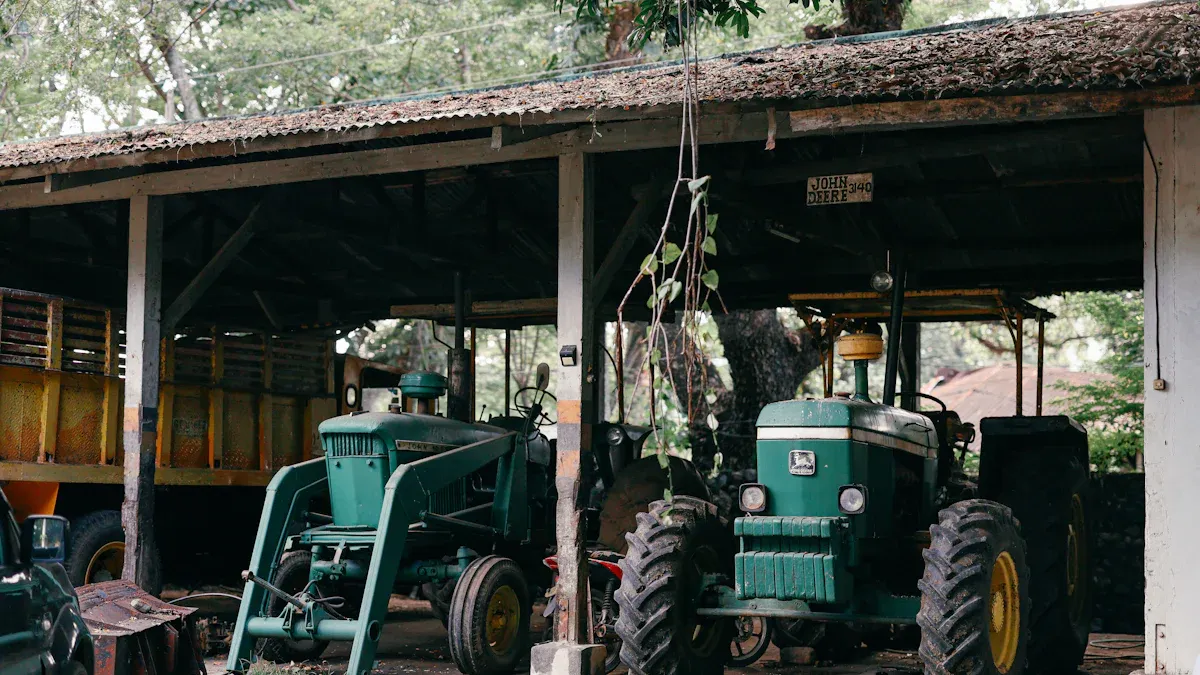
Vous protégez votre tracteur de la rouille et des dommages causés par les intempéries lorsque vous le stockez correctement Le temps froid et l'humidité peuvent corroder les pièces métalliques et geler les liquides Si vous avez accès à un garage ou une grange, rangez votre tracteur à l'intérieur Cela le protège de la pluie, de la neige et du soleil Si le stockage intérieur n'est pas disponible, utilisez un couvercle de haute qualité pour protéger votre tracteur des éléments Un bon rangement empêche la rouille et maintient votre tracteur prêt pour le travail.
- Conserver à l'intérieur lorsque cela est possible.
- Utilisez une housse durable pour le stockage extérieur.
- Protégez votre tracteur de la neige, de la glace et de la lumière directe du soleil.
Couverture et prévention des rongeurs
Vous réduisez le risque de dommages lorsque vous couvrez votre tracteur et empêchez les rongeurs de nicher Les rongeurs peuvent mâcher des fils et construire des nids dans les compartiments moteurs Utilisez des housses qui s'ajustent étroitement et bloquent les points d'entrée Inspectez régulièrement votre tracteur pour déceler tout signe de ravageur Retirez les sources de nourriture et gardez la zone de stockage propre.
Remarque : La prévention des rongeurs vous aide à éviter les problèmes électriques et les réparations coûteuses.
Préparation hors saison
Stabilisateur de carburant et retrait de batterie
Vous préparez votre tracteur pour de longues périodes d'inactivité en suivant les étapes clés Ajoutez un stabilisateur de carburant au réservoir si vous n'utiliserez pas votre tracteur pendant plus d'une semaine Cela empêche l'eau de s'accumuler dans le carburant et protège le moteur de faire fonctionner le moteur pendant quelques minutes pour faire circuler la batterie et la stocker dans un endroit frais et sec. Nettoyez les bornes et vérifiez la corrosion Ces étapes vous aident à éviter les pannes de batterie et les dommages au système de carburant.
- Ajouter le stabilisateur de carburant avant le stockage.
- Faites tourner le moteur pour distribuer le stabilisateur.
- Retirez et stockez la batterie dans un endroit sûr.
- Nettoyez les bornes de la batterie et vérifiez les niveaux de liquide.
| Liste de contrôle hors saison | Action |
|---|---|
| Système de carburant | Ajoutez un stabilisateur, exécutez le moteur |
| Batterie | Retirer, nettoyer, conserver en toute sécurité |
| Extérieur et pièces jointes | Laver et sécher soigneusement |
| Zone de stockage | Inspectez les rongeurs |
Vous gardez votre tracteur en parfait état lorsque vous le nettoyez régulièrement, rangez-le correctement et préparez-vous pour l'intersaison Ces habitudes vous aident à éviter la corrosion, la rouille et les réparations coûteuses.
Opération et formation intelligentes

Opération intelligente et une formation continue vous aide à tirer le meilleur parti de votre tracteur Lorsque vous comprenez votre équipement et suivez des habitudes sûres, vous réduisez l'usure, prévenez les accidents et économisez de l'argent sur les réparations.
Manuel de l'opérateur
Sections clés à examiner
Vous acquérez des connaissances précieuses lorsque vous lisez le manuel de l'opérateur de votre tracteur De nombreux propriétaires sautent cette étape, mais le manuel contient des informations essentielles qui vous aident à entretenir et à faire fonctionner correctement votre tracteur.
- Les listes de contrôle de maintenance vous guident dans les tâches quotidiennes, hebdomadaires et saisonnières.
- Les instructions d'étalonnage vous aident à ajuster les paramètres pour différentes tâches.
- Les sections de dépannage vous apprennent à résoudre des problèmes courants par vous-même.
En comprenant ces sections, vous résolvez les problèmes rapidement et réduisez les temps d'arrêt Vous évitez également les coûts de réparation inutiles Un agriculteur de l'Ohio a partagé que l'examen du manuel l'aidait à réparer une fuite hydraulique sans appeler un mécanicien Vous pouvez trouver manuels d'opérateur et guides de sécurité à Extension de l'État de Penn et Page Sécurité Agricole de l'OSHA.
Habitudes d'utilisation sûres
Échauffement et refroidissement
Vous protégez le moteur et les systèmes hydrauliques de votre tracteur lorsque vous réchauffez la machine avant un travail pénible Laissez le moteur tourner au ralenti pendant quelques minutes pour faire circuler l'huile et atteindre la température de fonctionnement Après la finition, laissez le tracteur refroidir avant de l'éteindre Cette habitude empêche les chocs thermiques et prolonge la durée de vie des composants.
Éviter la surcharge
Vous évitez les dommages coûteux en ne dépassant jamais les limites de charge recommandées par votre tracteur La surcharge met à rude épreuve le moteur, la transmission et le système hydraulique Toujours atteler l'équipement aux points recommandés par le constructeur et vérifiez que les attelages sont robustes et correctement montés Avant de remorquer ou d'utiliser des wagons, inspectez les connexions et confirmez qu'elles sont sécurisées.
Les organismes de sécurité recommandent ces habitudes pour chaque opérateur :
- Attachez votre ceinture de sécurité solidement.
- Évitez les fossés, les remblais et les trous.
- Réduire la vitesse lors du virage ou du franchissement des pentes.
- Restez en dehors des pentes raides.
- Ne pas autoriser les passagers.
- Confirmez que tout le monde est clair avant de bouger.
- Fonctionne en douceur.
- Attelage uniquement aux points approuvés.
- Réglez les freins en toute sécurité à l'arrêt.
Conseil : toujours désengager la prise de force, arrêter le moteur, et retirer les clés avant de quitter le siège.
Vous pouvez en savoir plus sur le fonctionnement sûr des tracteurs dans la base de données nationale sur la sécurité des produits agricoles et suivre #TractorSafety sur les réseaux sociaux pour obtenir des conseils communautaires.
Dossiers d'entretien
Avantages du service de suivi
Vous augmentez la valeur de revente et la fiabilité de votre tracteur en tenant des registres d'entretien détaillés Les acheteurs recherchent des tracteurs avec un historique de service complet, qui montre un bon entretien et un entretien régulier L'état général et les soins documentés comptent plus que les heures d'utilisation.
| Bénéfice des registres de maintenance | Impact sur la longévité des tracteurs |
|---|---|
| Respect du calendrier de service | Moins de pannes, durée de vie plus longue |
| Historique complet des services | Valeur de revente plus élevée |
| Preuve d'entretien régulier | Une plus grande confiance des acheteurs |
Une étude récente a révélé que les tracteurs ayant des antécédents de service documentés se vendaient jusqu'à 201TP11 T plus que ceux sans dossier Vous pouvez utiliser un carnet, une feuille de calcul ou une application mobile pour suivre les changements d'huile, les inspections et les réparations.
Remarque : Une tenue de registres cohérente vous aide à repérer les modèles, à planifier la maintenance préventive et à faire preuve de prudence envers les futurs acheteurs.
Vous construisez un tracteur plus sûr et plus fiable lorsque vous combinez un fonctionnement intelligent, une formation continue et une tenue de registres minutieuse. Ces habitudes s'avèrent payantes avec moins de réparations, une durée de vie plus longue de l'équipement et une meilleure valeur de revente.
Erreurs courantes à éviter
Sauter l'entretien
Vous risquez la fiabilité de votre tracteur lorsque vous sautez l'entretien régulier De nombreux propriétaires pensent que leur équipement peut gérer de longues heures sans attention, mais cette habitude entraîne des pannes et des réparations coûteuses Vous devez toujours suivre le calendrier d'entretien dans le manuel de votre opérateur La négligence de la lubrification provoque une usure rapide des pièces mobiles Oublier de vérifier les niveaux de liquide peut entraîner une surchauffe ou une défaillance hydraulique Si vous ignorez les dossiers de service, vous risquez de manquer des inspections et des remplacements importants.
Conseil : Réglez des rappels pour les changements d'huile, les remplacements de filtres et les inspections. Un soin constant permet à votre tracteur de fonctionner correctement.
Les professionnels des services de tracteurs signalent souvent ces erreurs courantes :
- Pousser les machines à leurs limites, risquant des dysfonctionnements et des réparations coûteuses.
- La négligence de la lubrification régulière, qui est essentielle pour le bon fonctionnement et la longévité.
- Oublier de garder une trace des dossiers de service, ce qui entraîne des calendriers de maintenance manqués.
- Ne pas adapter l'utilisation des équipements aux conditions saisonnières, ce qui peut compliquer les opérations.
- Ne pas nettoyer régulièrement les outils, ce qui entraîne une diminution de l'efficacité et une rouille potentielle.
Vous évitez la plupart des problèmes en vous en tenant à une routine et en gardant votre tracteur propre et bien lubrifié.
Utilisation de mauvaises pièces ou fluides
Vous pensez peut-être que n'importe quelle huile ou filtre fonctionnera, mais l'utilisation de pièces ou de fluides incorrects peut endommager votre tracteur Les fabricants conçoivent des moteurs et des systèmes hydrauliques pour des produits spécifiques Si vous utilisez une mauvaise viscosité, votre tracteur peut surchauffer Les liquides épais peuvent provoquer la famine et la défaillance de la pompe Des additifs incompatibles affaiblissent les performances hydrauliques et endommagent les joints ou les tuyaux Les clapets et défaillances des freins humides résultent souvent de l'utilisation de fluides non approuvés.
- Surchauffe du système due à une viscosité incorrecte.
- Cavitation et défaillance de la pompe dues à un écoulement inapproprié du fluide.
- Mauvaises performances hydrauliques dues à des additifs erronés.
- Dommages au joint et au tuyau dus à des fluides incompatibles.
- Bavardage des freins mouillés et défaillance due à des fluides incorrects.
- Garantie annulée si vous utilisez des fluides non conformes.
Remarque : Vérifiez toujours votre manuel pour connaître les liquides et pièces recommandés. Utilisation de produits approuvés protège votre tracteur et maintient votre garantie valide.
Pratiques de stockage médiocres
Vous raccourcissez la durée de vie de votre tracteur lorsque vous le stockez de manière inappropriée L'exposition à la pluie, à la neige et à la lumière du soleil provoque de la rouille et affaiblit les pneus Les rongeurs peuvent nicher dans le compartiment moteur et mâcher des fils Si vous laissez votre tracteur à l'extérieur sans couvercle, l'humidité s'accumule et endommage les systèmes électriques Vous devez ranger votre tracteur à l'intérieur ou utiliser une housse de haute qualité Nettoyez la zone de stockage et bloquez les points d'entrée pour prévenir les parasites.
- Rangez votre tracteur dans un endroit sec et abrité.
- Utilisez des housses pour vous protéger des intempéries et des rayons UV.
- Inspectez les rongeurs et retirez les sources de nourriture.
- Nettoyez votre tracteur avant le stockage pour éviter la corrosion.
Callout : De bonnes habitudes de stockage empêchent la rouille, les problèmes électriques et les réparations coûteuses Vous gardez votre tracteur prêt pour le travail lorsque vous le protégez des éléments.
Vous évitez ces erreurs courantes en suivant un calendrier de maintenance, les, utiliser les bons produits, ´, et rangeant correctement votre tracteur Ces habitudes vous aident a tirer le meilleur parti de votre equipement.
Ignorer les petits problèmes
Vous pourriez remarquer un petit goutte-à-goutte sous votre tracteur ou entendre un léger grincement lorsque vous tournez le volant De nombreux propriétaires ignorent ces problèmes mineurs, pensant qu'ils n'affecteront pas les performances Les petits problèmes signalent souvent des problèmes plus importants en attente de se produire Si vous les traitez tôt, vous économisez du temps et de l'argent.
Un boulon desserré ou une fuite minuscule peut se transformer en une panne majeure Par exemple, une petite fuite hydraulique peut abaisser les niveaux de liquide et endommager la pompe Une ceinture usée peut se casser pendant un travail pénible, arrêtant votre tracteur sur le terrain Vous évitez ces situations en agissant rapidement.
Conseil : Toujours rechercher de nouveaux sons, odeurs ou changements dans le fonctionnement de votre tracteur Une attention précoce maintient votre équipement fiable.
Les petits problèmes courants que vous ne devriez jamais ignorer comprennent :
- Fuites mineures de liquide sous le moteur ou le système hydraulique
- Bruits inhabituels de la transmission ou de la direction
- Légers changements dans la réponse des freins ou des embrayages
- Fissures dans les tuyaux ou les ceintures
- Feux de tableau de bord scintillants
- Petites taches de rouille sur les surfaces métalliques
- Boulons et attaches desserrés ou manquants
Vous pouvez utiliser une simple liste de contrôle pour détecter ces problèmes avant qu'ils ne s'aggravent :
| Petit problème | Cause possible | Action recommandée |
|---|---|---|
| Goutte fluide | Joint ou joint usé | Inspecter et remplacer la pièce |
| Direction grinçante | Joint sec ou douille | Lubrifier les pièces mobiles |
| Lumières tamisées | Batterie ou câblage faible | Nettoyer les terminaux, vérifier les fils |
| Tuyau fissuré | Dommages liés à l'âge ou à la chaleur | Remplacez le tuyau immédiatement |
| Tache de rouille | Exposition à l'humidité | Nettoyer et appliquer un protecteur |
Si vous remarquez l'un de ces signes, n'attendez pas Vous devez inspecter la zone touchée et effectuer des réparations dès que possible Les petites réparations coûtent moins cher et prennent moins de temps que la réparation d'une panne majeure.
Appel: Ignorer les petits problèmes peut entraîner des réparations coûteuses et des temps d'arrêt inattendus Vous protégez votre investissement en restant alerte et en agissant rapidement.
Vous pouvez trouver plus de conseils sur la détection précoce des problèmes à l'adresse Extension Penn State : Entretien des tracteurs et joignez-vous aux discussions avec d'autres propriétaires sur les forums TractorByNet.
Vous prenez l'habitude d'une inspection régulière et d'une réponse rapide Cette habitude vous aide à éviter les pannes coûteuses et maintient votre tracteur en état de fonctionner quand vous en avez le plus besoin Les petits problèmes sont plus faciles à résoudre aujourd'hui que les gros demain.
Vous prolongez la durée de vie de votre tracteur lorsque vous suivez des inspections quotidiennes, un entretien de routine et des habitudes de fonctionnement intelligentes Les soins réguliers vous aident à détecter les petits problèmes tôt et à éviter les réparations coûteuses Utilisez des pièces et des liquides de qualité, gardez votre tracteur propre et conservez-le correctement Suivez vos dossiers de maintenance pour une meilleure fiabilité.
Commencez ces habitudes dès aujourd'hui Vous économisez de l'argent, réduisez les temps d'arrêt et profitez d'un tracteur fiable pendant des années. 🚜 Prendre soin de votre équipement vous récompense chaque saison.
FAQ
À quelle fréquence devez-vous vérifier les niveaux de liquide de votre tracteur ?
Vous devez vérifier l'huile moteur, le liquide de refroidissement et le liquide hydraulique avant chaque utilisation Cette habitude vous aide à détecter les fuites et à éviter la surchauffe. Les contrôles quotidiens maintiennent votre tracteur en bon état de fonctionnement et réduisent le risque de réparations coûteuses.
Quelle est la meilleure façon de ranger votre tracteur pendant l'hiver ?
Rangez votre tracteur à l'intérieur si possible Utilisez un couvercle de haute qualité pour le protéger de l'humidité et de la lumière du soleil Retirez la batterie et ajoutez le stabilisateur de carburant Nettoyez soigneusement le tracteur pour éviter les dommages causés par la rouille et les rongeurs.
Comment savoir quand remplacer le filtre à air de votre tracteur ?
Inspectez le filtre à air mensuellement ou après avoir travaillé dans des conditions poussiéreuses Remplacez-le si vous voyez de fortes saletés, des dommages ou une réduction du débit d'air Un filtre à air propre améliore les performances du moteur et le rendement énergétique.
Pourquoi le graissage des pièces mobiles est-il important ?
Le graissage des pièces mobiles réduit la friction et prévient l'usure Vous devez graisser les bras de chargeuse, les composants de direction et les arbres de transmission toutes les 10 heures de fonctionnement La lubrification régulière prolonge la durée de vie de votre tracteur et réduit les coûts de réparation.
Que faire si vous remarquez une petite fuite ?
Enquêtez immédiatement sur la source Vérifiez les joints, les tuyaux et les raccords pour déceler tout dommage Remplacez les pièces usées et nettoyez la zone De petites fuites peuvent entraîner des problèmes plus importants si elles sont ignorées, donc une action rapide permet d'économiser du temps et de l'argent.
Comment pouvez-vous prévenir la pourriture sèche des pneus et les dommages causés par les UV ?
Garez votre tracteur à l'ombre ou à l'intérieur Utilisez des couvre-pneus pour le stockage extérieur Nettoyez régulièrement les pneus et déplacez votre tracteur de temps en temps pour éviter les points plats Ces étapes protègent les pneus des fissures et prolongent leur durée de vie.
Est-il nécessaire de tenir des registres d'entretien ?
Oui. Les dossiers de maintenance vous aident à suivre les intervalles de service et les modèles de points. Les dossiers détaillés augmentent la valeur de revente et montrent aux acheteurs que votre tracteur a reçu les soins appropriés. Utilisez un cahier, une feuille de calcul ou une application pour un suivi facile.
Quels sont les signes de problèmes de batterie ?
Recherchez les démarrages lents du moteur, les lumières tamisées ou la corrosion sur les bornes Testez régulièrement la tension de la batterie Nettoyez les bornes et utilisez un appel d'offres de batterie pendant le stockage. Une détection précoce évite les pannes inattendues.