Mirë se vini në Shandong Qilu Industrial Co., Ltd

 Albanian
 English
 Arabic
 Bulgarian
 Bengali
 Czech
Czech
 Danish
 German
 Greek
Greek
 Spanish
 Finnish
 French
 Hindi
Hindi
 Croatian
 Hungarian
 Indonesian
 Italian
 Japanese
 Korean
 Lithuanian
 Dutch
Dutch
 Norwegian
 Polish
 Portuguese
 Romanian
 Russian
 Slovak
 Slovenian
 Swedish
 Thai
Thai
 Turkish
 Ukrainian
 Vietnamese
 Tagalog
 Malay
Malay
 Estonian
 Catalan
 Latvian
 Urdu
Urdu
 Serbian
 Persian
 Swahili
 Armenian
 Icelandic
 Bosnian
 Luxembourgish
 Afrikaans
Albanian English
Arabic
Bulgarian
Bengali
Czech
Danish
German
Greek
Spanish
Finnish
French
Hindi
Croatian
Hungarian
Indonesian
Italian
Japanese
Korean
Lithuanian
Dutch
Norwegian
Polish
Portuguese
Romanian
Russian
Slovak
Slovenian
Swedish
Thai
Turkish
Ukrainian
Vietnamese
Tagalog
Malay
Estonian
Catalan
Latvian
Urdu
Serbian
Persian
Swahili
Armenian
Icelandic
Bosnian
Luxembourgish
Afrikaans
Afrikaans
Albanian English
Arabic
Bulgarian
Bengali
Czech
Danish
German
Greek
Spanish
Finnish
French
Hindi
Croatian
Hungarian
Indonesian
Italian
Japanese
Korean
Lithuanian
Dutch
Norwegian
Polish
Portuguese
Romanian
Russian
Slovak
Slovenian
Swedish
Thai
Turkish
Ukrainian
Vietnamese
Tagalog
Malay
Estonian
Catalan
Latvian
Urdu
Serbian
Persian
Swahili
Armenian
Icelandic
Bosnian
Luxembourgish
Afrikaans
Zgjedhjet e çakëllit të gomave të traktorit: Uji, mbrojtja e buzës, pesha e rrotave dhe shkëmbimet në terren
Një udhëzues praktik për zgjedhjet e çakëllit të gomave të traktorit, duke përfshirë mbushjen e lëngshme, peshën e rrotave, kutitë e çakëllit, presionin e gomave dhe kompromiset specifike për punën.
A tractor can feel perfectly planted in the yard and still be wrong for the next job. One morning it may need rear weight to keep a loader stable while moving gravel, and that same afternoon it may need a lighter footprint to pull a mower across soft ground without wasting fuel. That is why ballast choices should be treated as a setup decision, not a permanent habit.
Buyers comparing the gama e traktorëve të fermës often focus on horsepower first, yet ballast changes how effectively that horsepower reaches the soil. A machine in the Gama e traktorëve 50-70 HP may work well with a loader, mower, or bale spear only when the rear axle load, tire inflation, and attachment weight are matched to the job.
For owners using one machine for feed handling, mowing, transport, and seasonal field work, the real question is not simply whether to add weight. The better question is where the weight should go, how much flexibility the operator needs, how cold-weather freeze risk affects liquid ballast, and whether the tractor will spend more time on firm lanes, slopes, or cultivated fields. That same thinking also matters when reviewing zgjidhje aplikimi traktori for mixed-use work.
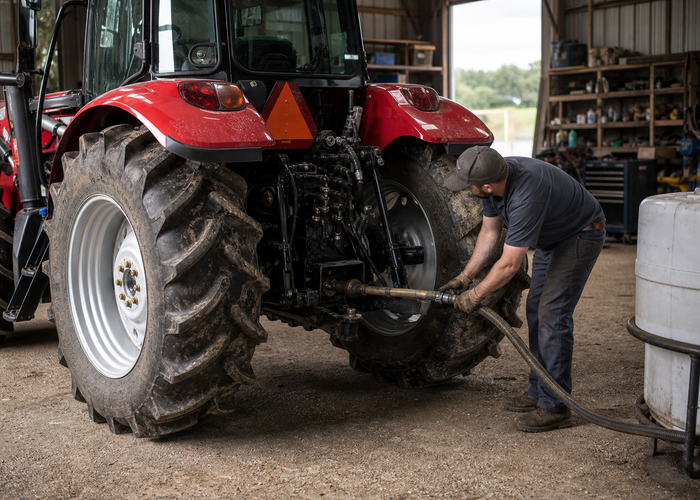
Start With the Job, Not the Fluid
The Iowa State Integrated Crop Management article Are You Getting the Most Out of Your Tractor? makes an important point: proper ballast and tire pressure work together. If either one is wrong, a tractor can spin too much, carry unnecessary axle load, and burn more fuel than the job should require. That is why an operator should begin with the implement, travel speed, and field condition instead of beginning with a favorite ballast method.
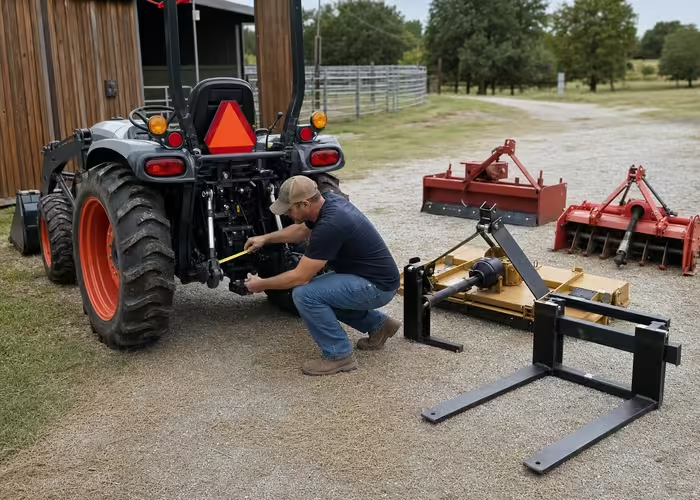
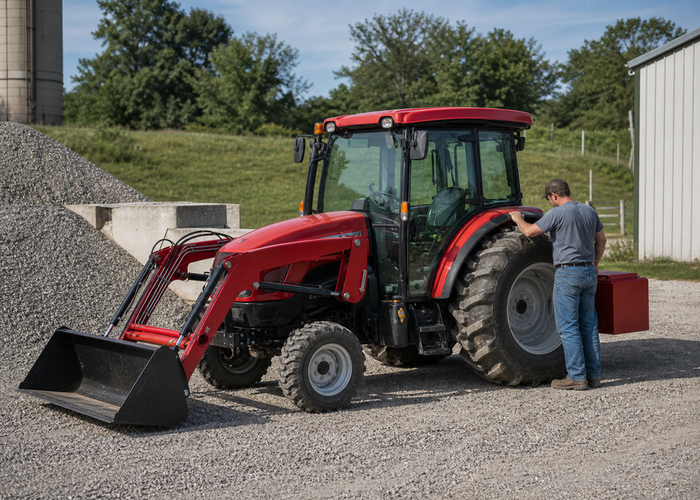
Loader work usually wants easily removable rear weight because the tractor often moves between transport, stacking, grading, and pallet handling. A ballast box or heavy rear attachment gives the operator quick correction when the front axle is busy, and it can be removed when the tractor returns to mowing or light hauling. That makes it practical for owners browsing the Gama e traktorëve 25-50 HP for acreage chores that change from week to week.
Primary tillage and heavy drawbar work are different. In those jobs, evenly distributed weight and carefully managed tire pressure often matter more than quick removal. The Texas A&M reference Controlling Tractor Wheel Slip for Efficient Operation explains why moderate slip is healthier than either severe spinning or excessive dead weight. Too much slip wastes power; too little slip can mean the tractor is carrying more weight than the soil or task really needs.
When Liquid Ballast Helps
Liquid-filled rear tires lower the center of gravity and keep weight close to the axle without taking up three-point hitch space. For mowing slopes, carrying a lighter rear attachment, or maintaining year-round stability on a utility tractor, that is a real advantage. The K-State publication Getting the Most From Your Tractor is useful here because it connects ballast decisions to traction, slip, and horsepower transfer rather than treating weight as a guessing game.
Liquid ballast also reduces the temptation to hang a large rear implement on the tractor just to add mass. That can be helpful in tight yards, livestock buildings, and areas where extra implement length makes reversing awkward. Still, filled tires are not free weight. They increase total machine mass every hour the tractor moves, which can matter on wet soils, tender pastures, or frequent road travel.
When Cast Wheel Weights or a Ballast Box Make More Sense
Cast wheel weights and ballast boxes are better when the operator needs seasonal flexibility. A tractor that spends spring doing loader work, summer mowing, and autumn pulling lighter transport wagons may benefit from weight that can be added or removed without touching tire fluid. That approach is also easier when owners are deciding between models shown on the Linja e produkteve të makinerive QiLu and need one chassis to cover several different jobs.
Wheel weights also avoid fluid handling and freeze-protection concerns. The tradeoff is that they can be less convenient to install and may not lower the center of gravity as much as fluid in the tire. A ballast box, meanwhile, is excellent for loader balance but may be less helpful in close-turning field work where extra rear overhang becomes annoying.
Water, Calcium, Beet Juice, and Washer Fluid Are Not Equivalent
Operators sometimes discuss ballast fluids as if they were interchangeable. They are not. Plain water is inexpensive, but freeze protection becomes a real problem in cold climates. Calcium chloride has a long history because it adds significant weight, yet it brings corrosion risk if tubes, rims, or valve stems are neglected. The K-State tire guide Selecting Tractor Tires is useful because it keeps ballasting tied to tire performance and inflation practice rather than marketing claims.
Beet-juice-based products and other non-corrosive commercial fills are popular because they offer freeze protection with less rim risk, though they are often more expensive than simple water mixtures. Windshield washer fluid is sometimes considered on smaller machines, but operators still need to weigh local freeze conditions, toxicity concerns, availability, and serviceability. None of these fluids should be chosen without checking the actual operating climate and the wheel/rim maintenance routine.
The Purdue traction presentation Traction Improvement: Ballasting, Tires, & Inflation Pressure is helpful because it reminds operators that tire pressure and contact patch are part of the same system. Ballast fluid may improve stability, but the gain can be lost quickly when tire pressure remains too high for the load and field condition.
Tire Pressure and Wheel Slip Decide Whether Ballast Helps
The most expensive ballast mistake is adding weight without checking inflation. A tractor with overinflated rear tires may carry plenty of mass and still put power into rutting, bouncing, or polishing the soil surface instead of pulling cleanly. The Iowa State and Texas A&M references both point back to the same operational truth: traction is the product of weight, tire setup, and slip together.
That is also why a tractor that feels weak with one implement can feel strong with another after a setup correction. The owner may not need more horsepower; the tractor may simply need a better balance between rear axle loading, front axle share, and tire footprint. When comparing sizes inside the Gama e traktorëve 75-100 HP, setup discipline often protects the investment better than buying extra horsepower as insurance.
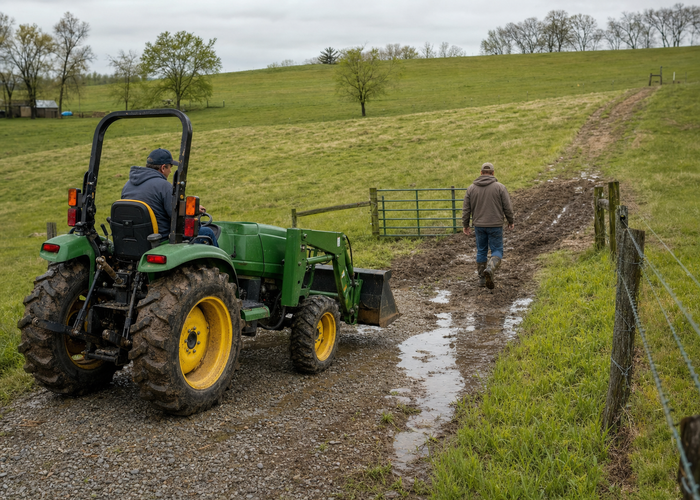
A second practical point is soil condition. Ballast that makes sense on a dry feeding lane can be excessive on soft field margins. Extra weight may improve stability, but it also increases compaction and rolling resistance. The right answer is often job-specific rather than universal, especially on smaller farms where one tractor shifts among pasture work, driveway material handling, and seasonal tillage.
Loader users should also watch where the weight sits in relation to the hitch and axle. A rear implement used as ballast may improve counterweight, but if it adds too much rear length it can make tight buildings and gates harder to manage. That is one reason many owners also review broader zgjidhjet e aplikimit të produktit before finalizing a year-round setup.
Finally, a ballast plan should fit the operator’s service routine. If the tractor is shared among several jobs and several people, the best setup is usually the one that is easy to inspect, easy to repeat, and hard to misuse. A slightly less aggressive ballast plan that the whole team applies correctly is often safer than a more optimized setup that only one experienced operator understands.
A Practical Comparison Table
| Ballast method | Përshtatja më e mirë | Main advantage | Main caution |
|---|---|---|---|
| Liquid-filled rear tires | Slope mowing, utility work, year-round stability | Low center of gravity and no hitch space required | Always carries extra weight and may complicate service |
| Cast wheel weights | Seasonal traction tuning | Predictable axle weight without fluid handling | Removal and installation are slower |
| Kuti çakëlli | Front loader work | Quick removable rear counterweight | Adds rear length and does not help when removed |
| Heavy rear implement | Owners using an implement anyway | Dual-purpose weight and working tool | May be awkward in tight yards and transport |
This table is a starting point, not a substitute for load calculations and operator judgment. The right choice depends on whether the tractor spends more hours lifting, pulling, mowing, transporting, or travelling on wet ground.
How To Test a New Ballast Setup Safely
A new ballast setup should be tested in a low-risk environment before it is trusted on a slope or in a busy yard. Start on level ground, travel slowly, raise and lower the loader through its normal range, and pay attention to steering feel, rear-tire squat, and how confidently the tractor stops. If the machine feels light in the rear during loader use or too dead and unresponsive on turf, that feedback is worth more than a debate about which ballast fluid is fashionable.
Operators should also test the setup with the actual attachment mix they expect to use, not just with an empty bucket. A machine that feels balanced with no load may behave very differently once the loader is carrying gravel, the three-point hitch is lifted, or a bale spear is installed. In practice, the safest ballast decision is usually the one that remains predictable across the real sequence of work the farm asks the tractor to do.
Mistakes That Cost Fuel, Tires, and Stability
The first common mistake is treating ballast as permanent regardless of season. A tractor that stays over-weighted all year may be stable, but it can also consume more fuel, wear tires faster, and compact areas where flotation matters. The second mistake is ignoring front-to-rear balance and focusing only on the rear axle. Stability depends on the whole machine, not a single component.
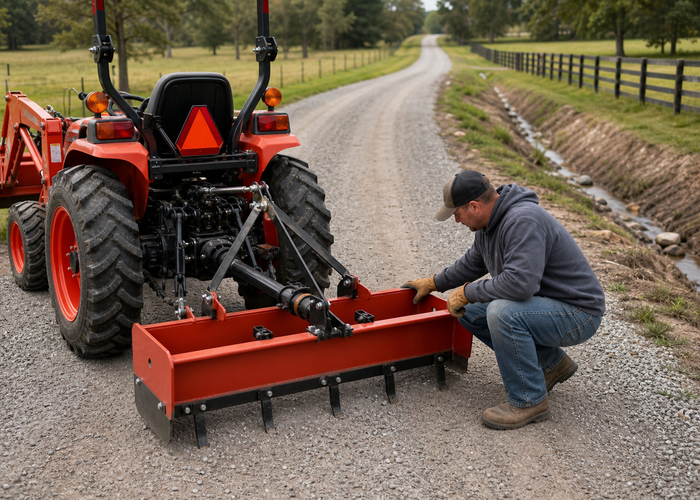
The third mistake is forgetting that implements change the answer. A rear mower, bale spear, blade, sprayer, or box scraper shifts the center of gravity and the practical ballast requirement. Operators who use different attachments across the week should revisit the setup each time rather than copying one favorite formula from memory. That is especially true when moving between compact utility chores and larger field tasks.
The fourth mistake is skipping documentation. If a farm has already found a setup that works for loader gravel work, hay wagon towing, or pasture mowing, write it down. Tire pressure, ballast method, implement choice, and speed target should all be part of the record. The Blogu i QiLu Machinery is a natural place for owners to connect machine selection topics with repeatable operating routines.
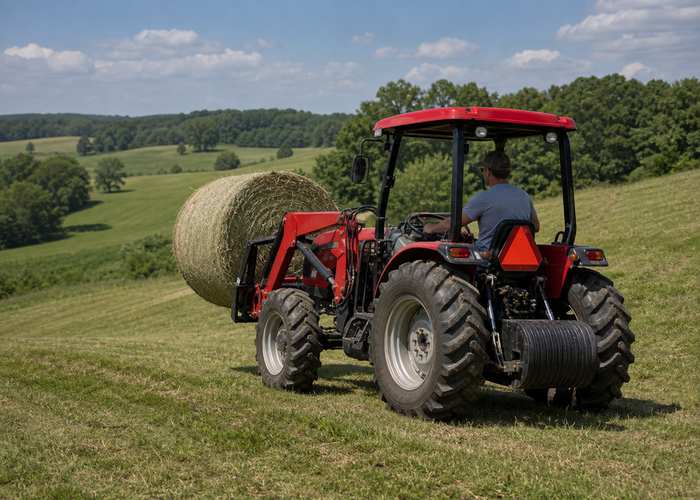
A good ballast decision should leave the operator with a tractor that feels settled, steers predictably, keeps slip in a reasonable range, and does not carry useless mass into soft areas. That balance matters more than brand labels or internet arguments about one fluid being the single best answer for every tractor.
For buyers comparing tractor sizes for mixed chores, it helps to think in three layers. First, pick the machine that can run the implement. Second, choose the ballast method that suits the main job. Third, tune tire pressure and seasonal weight adjustments so the tractor remains practical across the rest of the year. Owners looking beyond utility models may also compare the Gama e traktorëve 120-160 HP when heavier draft work or larger transport jobs are planned.
In other words, the best ballast choice is the one that supports the job sequence the farm actually performs. Cheap weight that stays on at the wrong time can cost more than a flexible setup chosen with intention. Practical operators win by matching ballast to the workday, the season, and the soil under the tractor.
FAQ
Is liquid ballast always better than wheel weights?
No. Liquid ballast lowers the center of gravity and is excellent for constant stability, but wheel weights are often better when the operator wants to change setups seasonally without handling fluid.
Should a loader tractor always carry a ballast box?
Not always. A ballast box is useful when the loader is the main job, but some farms already have a heavy rear implement that provides the needed counterweight more efficiently.
Can too much ballast reduce performance?
Yes. Excess weight can increase rolling resistance, fuel use, soil compaction, and tire wear. The goal is enough weight for traction and stability, not the highest possible weight.
What should be checked first before changing ballast?
Start with the implement, axle balance, tire pressure, expected field condition, and whether the tractor needs permanent stability or removable counterweight. That sequence usually leads to better choices than selecting a fluid by habit.