Email: [email protected] Whatsapp: +8618266768780

Email: [email protected] Whatsapp: +8618266768780


The “bigger is better” era of industrial machinery is over — and the job site data is proving it decisively.
For decades, contractors defaulted to larger equipment under the assumption that raw size translated to raw capability. On sprawling construction sites with unlimited access, that logic held. But modern job sites tell a different story. Tight urban footprints, indoor demolition projects, and landscaping work in confined residential spaces have fundamentally shifted what operators need from their equipment. The machines that win today are the ones that deliver maximum output within minimum space — and that shift is exactly what makes the Skid Steer Loader QL-460T such a significant development in compact equipment.
Industrial manufacturers are under growing pressure to produce high-performance components that support the full manufacturing chain — from consumer electronics to automotive assembly — and that requires precise, reliable material handling at every stage. As Equipment World’s 2025 buyer’s guide notes, demand for compact loaders has surged as operators prioritize machines that can navigate restricted environments without sacrificing lifting capacity or hydraulic performance.
At the center of this evolution is the concept of power-to-weight ratio — a metric that has become the definitive benchmark for evaluating modern compact loaders. A machine that weighs less but delivers equivalent or superior hydraulic force and rated operating capacity isn’t a compromise; it’s an engineering achievement. According to Thompson Tractor’s loader selection guide, matching machine capability to site-specific demands is one of the most critical decisions an operator can make.
The QL-460T represents the current pinnacle of this thinking — a machine engineered from the ground up around efficiency, structural integrity, and job site adaptability. Understanding what makes it exceptional starts with what’s underneath: its core architecture.
The QL-460T’s performance advantage isn’t accidental — it’s the direct result of deliberate architectural decisions made at every level of the machine’s design.
Hydraulic efficiency is where compact power is won or lost. The QL-460T’s hydraulic system is engineered to deliver maximum flow with minimal energy waste, translating engine output directly into usable lifting and pushing force. In practice, a poorly designed hydraulic circuit creates back-pressure, heat buildup, and sluggish response — the exact problems that plague underpowered alternatives on demanding job sites. The QL-460T addresses this with optimized valve routing and high-flow capacity that keeps cycle times fast during extended operation.
The chassis tells an equally important story. Structural integrity in a compact skid steer isn’t just about raw steel thickness — it’s about how load forces are distributed across the frame during real-world tipping, lifting, and lateral stress. The QL-460T’s welded steel chassis is designed to resist torsional flex, which is the hidden failure mode that shortens the operational life of machines that look solid but aren’t engineered for continuous industrial use. A rigid, well-braced frame also protects internal components from vibration-induced wear over time.

Continuous industrial use demands serious thermal management. The QL-460T’s cooling system is sized to handle prolonged duty cycles without throttling performance — a critical consideration since overheating is among the leading causes of unplanned downtime on active work sites.
Underlying all of this is a commitment to OEM-quality core components. As Unisur Lifecare notes, modern manufacturing requires high production capacity and global reach to stay competitive — and that scale only delivers results when the underlying components meet strict engineering tolerances. Sourcing components that meet OEM specifications ensures that efficiency, durability, and cooling performance hold up across thousands of operating hours.
That commitment to component quality raises an important question: who is actually building the machine, and what does their manufacturing philosophy look like?
The difference between a machine that lasts a decade and one that fails at month eighteen often comes down to a single factor: who built it and how.
The compact equipment market is saturated with generic assemblers — companies that source components from multiple third-party suppliers, bolt them together, and ship the result with a warranty that barely covers the break-in period. A dedicated skid steer loader manufacturer, by contrast, controls the design, engineering, and production of critical components under one roof. That vertical integration isn’t a marketing distinction; it’s a durability guarantee baked into every weld and tolerance spec.
Vertically integrated manufacturing tightens quality control at every stage of production. When the same engineering team that designs a hydraulic circuit also oversees its fabrication, error margins shrink. Tolerances are validated against real-world load cycles, not just catalog specs. In practice, this means fewer field failures, more predictable service intervals, and replacement parts that actually fit the first time. Understanding how hydraulic systems perform under load underscores why in-house engineering of these systems matters so much to long-term reliability.
Custom-made parts are where longevity is truly won or lost. Specialized manufacturers handle more than 120 distinct custom-made OEM products per year to meet specific industrial needs — a volume that reflects deep engineering capability rather than off-the-shelf dependency. For the QL-460T, this translates directly into three tangible manufacturing standards:
The result is a machine whose engineering pedigree you can trust — not because of a specification sheet, but because every part was purpose-built for this application. That foundational build quality is what allows the QL-460T to deliver something equally important: performance you can actually control in the field.
The QL-460T proves that compact dimensions and full-size capability aren’t mutually exclusive — on real job sites, its maneuverability is a genuine competitive differentiator.
Tight spaces don’t slow the QL-460T down. In industrial facilities where corridor widths and doorframe clearances can kill productivity, the machine’s compact footprint lets operators navigate without dismantling temporary structures or rerouting workflows. A common pattern is that facilities with narrow interior aisles — think warehousing, manufacturing floors, or utility tunnels — lose significant labor hours when equipment simply can’t reach the work zone. The QL-460T eliminates that bottleneck cleanly.
Beyond raw access, the precision of the control interface makes a measurable difference during delicate tasks. Whether you’re placing materials near finished surfaces or positioning loads within tight tolerances, responsive hydraulic controls translate operator intent directly into machine movement. Understanding how hydraulic circuits respond under load helps explain why fine-motion control at low speeds feels intuitive rather than twitchy — the architecture is engineered for proportional response, not binary input.
“The real test of a compact loader isn’t what it can lift — it’s whether you can position that load exactly where you need it, without touching anything you shouldn’t.”
Ground pressure management is another practical advantage. Distributing machine weight across a wider footprint protects finished concrete, pavers, and landscaped surfaces that would otherwise require costly repair after a job wraps.
Versatility across attachment types amplifies every one of these strengths. Buckets, augers, trenchers, and pallet forks all mount to the same standardized interface — meaning one machine adapts across project phases rather than sitting idle. That kind of adaptability reflects the design philosophy of a serious industrial manufacturer focused on long-term operational value. And as we’ll see, that value compounds significantly when you integrate the QL-460T into a larger equipment fleet.
Fleet decisions carry more weight than single-unit purchases — the right compact loader either streamlines your entire operation or creates friction at every maintenance interval.
Sourcing equipment from a proven original equipment manufacturer isn’t a preference; it’s a risk management strategy that protects your fleet investment over years, not months.
As David Weidman of Celanese observed, industrial components from established manufacturers “seldom will be seen on the retail shelf because they are essential components in the manufacturing supply chain.” The same logic applies to professional-grade compact equipment — the QL-460T exists within a deeper supply chain of engineered reliability that generic alternatives simply can’t replicate.
Ecosystem Fit
The QL-460T is designed to complement a mixed fleet rather than compete within it. Its auxiliary hydraulic outputs support a wide attachment library — buckets, augers, trenchers, pallet forks — meaning fleet managers can standardize tooling across multiple machines. Reduced attachment redundancy translates directly into lower capital expenditure and simpler storage logistics on busy job sites.
Serviceability at Scale
For fleet mechanics, predictable maintenance cycles matter as much as initial specs. The QL-460T’s accessible service points and standardized fluid intervals reduce downtime between jobs. According to Equipment World’s 2025 buyer’s guide, serviceability is consistently ranked among the top purchasing criteria by fleet operators — and rightly so, because deferred maintenance compounds into major repair costs over a machine’s lifecycle.
Long-Term Value Retention
High-specification compact loaders hold resale value better than entry-level alternatives, particularly when they carry documented maintenance histories and manufacturer-backed warranties. Buyers in the secondary market pay a measurable premium for machines from established production lines because parts availability and technical support don’t disappear after year three.
Understanding how to maximize that investment starts with how the machine is operated day to day — which is exactly where the next section picks up.
Getting the most from compact loader performance requires more than just hours in the seat — it demands deliberate technique, disciplined inspection habits, and a working understanding of the machine’s hydraulic architecture.
Optimizing hydraulic flow is the single biggest lever operators have over attachment productivity. The QL-460T’s auxiliary hydraulic circuit allows flow adjustments to match specific attachment demands — high-flow tools like cold planers need maximum output, while standard buckets and forks perform best at lower settings. In practice, running excessive flow to a low-demand attachment generates unnecessary heat, accelerating wear on seals and reducing overall system efficiency. Dialing in the right flow rate for each tool isn’t optional; it’s foundational to sustained output.
Daily inspection discipline separates operations that run smoothly for years from those that face expensive, avoidable breakdowns. A consistent pre-shift walk-around should cover hydraulic fluid levels, track or tire condition, loader arm pivot pins, and all attachment coupler locks. Quick-attach systems deserve particular attention — a loose coupler on a compact skid steer operating in a confined space creates serious risk, and catching it at the start of a shift takes thirty seconds. At production scales where thousands of units move through demanding environments daily, rigorous quality checks aren’t a formality — they’re what keeps downtime from compounding across a fleet.
Fuel efficiency responds directly to operator technique. Smooth, deliberate inputs — avoiding abrupt boom actuation or aggressive simultaneous hydraulic and drive commands — keep engine load consistent and prevent the RPM spikes that burn fuel without adding productive work. According to Equipment World’s 2025 buyer’s guide, understanding a machine’s hydraulic priority mapping is one of the most overlooked efficiency strategies among new operators.
Safety protocols for compact skid steers carry nuances that full-size machine training doesn’t always cover. The reduced sight lines inherent to the cab-forward design require operators to establish clear pedestrian exclusion zones before beginning any cycle. Backup alarms, structured spotting procedures, and strict no-ride policies on the loader arms are non-negotiable — the compact footprint that makes the QL-460T so agile also means bystanders can be in the danger zone before a standard warning system triggers.
These operational fundamentals are the foundation — but the relationship between machine and manufacturer extends well beyond daily technique, which is something Qilu Machinery has built directly into its long-term support model.
The manufacturers that earn long-term loyalty aren’t just building machines for today’s job sites — they’re engineering for the regulations, expectations, and demands that tomorrow will bring.
Qilu Machinery operates as a strategic partner, not simply a vendor. That distinction matters when job site conditions shift, compliance requirements tighten, or your fleet needs to scale quickly. The QL-460T reflects a deliberate engineering philosophy: build ahead of current standards so operators aren’t caught scrambling when those standards evolve. Emission regulations, noise ordinances, and worksite safety codes are all trending stricter across U.S. municipalities, and equipment purchased today needs to hold up against that reality.
Continuous improvement is embedded at the factory level. Qilu’s manufacturing process incorporates iterative design feedback from real-world deployments, meaning each production cycle refines tolerances, hydraulic calibration, and structural integrity based on how machines actually perform under load — not just how they perform in controlled test conditions. In practice, this means fewer design compromises reach the field.
Sustainability is also becoming a baseline expectation, not a differentiator. Leading manufacturers across the heavy equipment supply chain are moving toward 100% recycled materials and cellulosic alternatives to virgin fibers in their production processes, according to CEYPABASA. Qilu’s factory-level sustainability commitments align with this industry-wide shift, reducing the environmental footprint without compromising the structural reliability that operators depend on. Understanding what “skid” actually means in the context of machine design helps clarify why material quality at the foundation of a loader’s frame is non-negotiable.
Choosing equipment from a manufacturer invested in long-term partnership means your fleet evolves alongside the industry. As the next section will show, those cumulative advantages — power, build quality, maneuverability, and manufacturer support — add up to something that genuinely redefines what a compact loader standard looks like.
The QL-460T earns its place at the top of the compact skid steer conversation by delivering industrial-grade capability in a package that fits where full-size machines simply can’t go.
Power-to-size ratio is the machine’s defining advantage. Compact equipment has historically forced operators to choose between muscle and maneuverability — the QL-460T refuses that trade-off. Its rated operating capacity and hydraulic output rival machines in a significantly larger class, making it a genuine workhorse rather than a job-site compromise. For contractors working in tight urban corridors, landscaped estates, or indoor renovation projects, that density of performance per square foot of footprint is a measurable competitive edge. According to Equipment World’s 2025 buyer’s guide, buyers increasingly prioritize exactly this metric when evaluating compact loaders.
Manufacturing discipline drives uptime, not just specs on a sheet. A machine’s rated capacity means little if it’s sidelined for repairs. What separates the QL-460T is the quality control embedded at the factory level — precision tolerances, consistent weld integrity, and component selection that reflects engineering intent rather than cost-cutting. Flexible OEM partners capable of handling over 120 distinct custom products annually demonstrate the kind of manufacturing breadth that translates directly into durability and reliability on real job sites.
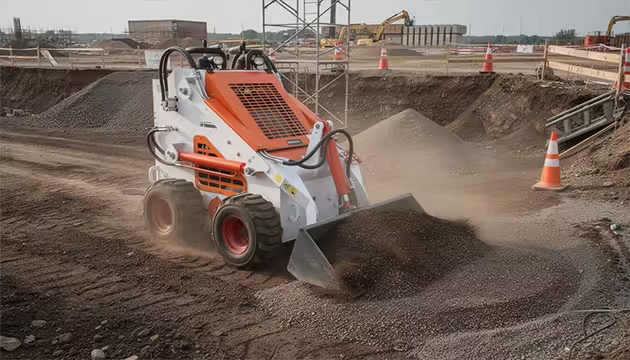
Maneuverability is a strategic asset, not a consolation prize. On modern job sites where space constraints are the norm rather than the exception, a machine that pivots, positions, and transitions without hesitation isn’t just convenient — it’s profitable. Reduced repositioning time compounds across a full shift into measurable productivity gains.
Choosing a manufacturer with a genuine OEM focus ensures that long-term support, parts availability, and technical guidance remain consistent throughout the machine’s service life. If you still have specific questions about applications, comparisons, or maintenance requirements, the next section addresses the most common ones directly.
The QL-460T consistently draws the same questions from buyers — and the answers reveal just how well this machine fits demanding, real-world job sites.
The QL-460T is built for versatility across a wide range of applications. In practice, operators use it for landscaping, grading, debris removal, agricultural material handling, utility trenching, and confined-space construction tasks where a full-size machine simply won’t fit. Its compact footprint makes it equally effective on residential lots, municipal projects, and commercial job sites where access is limited but productivity expectations aren’t.
On performance relative to larger skid steers, the trade-off isn’t as steep as many buyers assume. The QL-460T delivers hydraulic flow and rated operating capacity figures that overlap meaningfully with mid-size machines, according to compact equipment sizing guides published by industry spec resources. Where larger machines win on raw bucket capacity, the QL-460T wins on maneuverability, fuel efficiency, and the ability to work in spaces that would otherwise require manual labor. Technical experts also recommend watching the machine in action before purchasing — operational video reveals load handling nuances that spec sheets alone can’t communicate.
Hydraulic system maintenance follows a straightforward schedule: check fluid levels before each shift, replace hydraulic filters at manufacturer-specified intervals, inspect hose connections for wear or leaks monthly, and flush the system during annual service. Keeping hydraulic oil clean is the single highest-impact action an operator can take to extend system life.
For technical support, Qilu Machinery provides direct manufacturer access through its official website, regional dealer networks, and video documentation that walks through common service procedures. Reaching out early — before a problem escalates — is the approach that keeps downtime to a minimum.
The QL-460T isn’t a compromise machine. It’s a deliberate engineering choice for operators who need industrial capability without industrial footprint. If your next project demands precision, power, and flexibility in equal measure, this compact skid steer loader deserves serious consideration.





-1.png)