Email: [email protected] Whatsapp: +8618266768780

Email: [email protected] Whatsapp: +8618266768780

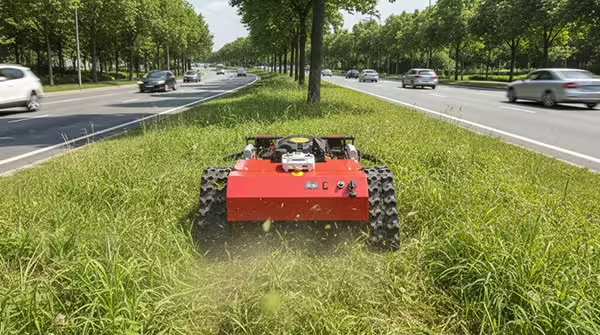
American manufacturing is no longer defined by who builds the most — it’s defined by who builds the best. For decades, the industrial narrative centered on volume: how many units rolled off an assembly line, how fast, how cheap. That model is giving way to something more nuanced, and frankly more demanding. The real competitive edge in modern manufacturing belongs to precision-focused producers who serve specific market needs rather than chasing mass-market scale.
The evolution of U.S. manufacturing has been a long pivot from broad-stroke production toward tighter tolerances, more specialized equipment, and measurable performance outcomes. This isn’t just a domestic trend — it reflects a global restructuring of the productivity chain. Specialized manufacturers now sit at the center of that chain, supplying components and finished equipment that larger brands often cannot produce as efficiently or as precisely.
This shift raises a question that more buyers are asking: who actually makes the equipment, and does the brand name on the side tell the whole story? In practice, the answer matters more than most purchasing teams realize. A manufacturer’s engineering philosophy, material standards, and quality controls directly shape the performance you get in the field — whether that’s heavy agricultural machinery or a precision lawn solution. As one precision machining company puts it, the goal is to “manufacture quality components to contribute to the productivity chain in national and international markets.” That mission statement captures the new manufacturing ethos better than most corporate mission decks.
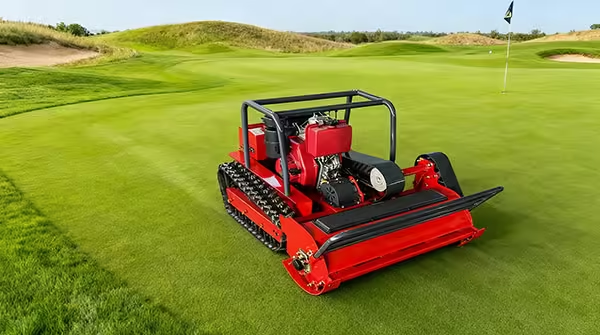
The Lawn Mower-QL500Y is a useful case study for understanding this evolution. It doesn’t come from a legacy brand with decades of marketing behind it. Instead, it comes from Shandong Qilu Industrial, a specialized heavy machinery manufacturer built around engineering capability rather than brand recognition. Understanding what makes the QL500Y worth considering starts with understanding what defines a top-tier manufacturer in 2026 — which is exactly where this discussion goes next.
In 2026, the defining trait of a top manufacturing company isn’t size — it’s the ability to turn specialized expertise into measurable outcomes for end-users.
Market cap alone no longer predicts who leads manufacturing innovation. Companies like GE Aerospace and RTX have maintained their elite status not purely through scale, but through relentless investment in precision engineering and collaborative research. GE Aerospace, for instance, has doubled down on advanced materials and propulsion technology — capabilities that filter directly into the performance of every product they touch. RTX operates similarly, funneling R&D into systems where failure simply isn’t an option.
Innovation networks have become just as important as internal R&D. The Manufacturing USA initiative exemplifies this shift, connecting private companies, universities, and federal agencies into collaborative hubs designed to accelerate breakthroughs. The result? Innovations that once took a decade to commercialize now reach the factory floor in years, sometimes months.

Sustainability is reshaping production economics at every level. CEYPABASA, for example, manufactures 130 metric tons of recycled containerboard daily using 100% recycled materials — a production model that demonstrates how environmental responsibility and operational efficiency aren’t mutually exclusive. Across sectors, manufacturers are rethinking raw material sourcing, waste reduction, and energy consumption as core competitive levers, not afterthoughts.
This matters to end-users because a manufacturer’s internal priorities become the product in your hands. When a company defines its manufacturing requirements around precision, durability, and sustainability from the outset, the equipment that reaches the market reflects those commitments.
That same principle applies to a specialized Lawn Mower Manufacturer — and it’s precisely what makes understanding the QL500Y’s engineering lineage so revealing. The next section breaks down exactly what that looks like in practice.
Precision-built commercial equipment separates itself from consumer-grade alternatives not by appearance, but by the engineering decisions made at every stage of production.
The QL500Y is designed for high-efficiency industrial use, with a core focus on precision mechanical parts — and that intent shapes every specification, material choice, and assembly decision behind the machine. According to qilumachinery.com, this isn’t incidental. It reflects a deliberate manufacturing philosophy where field performance is the benchmark, not shelf appeal.
Engineering specs on the QL500Y reflect commercial-grade demands that consumer mowers simply aren’t built to meet. The drivetrain tolerances, blade engagement systems, and frame construction are calibrated for sustained, high-load operation across varied terrain — not occasional weekend use. What typically happens with consumer-grade equipment is that cost-cutting during production creates compounding performance issues in the field. The QL500Y avoids this by prioritizing component integrity from the ground up.
Durability isn’t just about material hardness — it’s about how a machine is assembled and what quality controls govern that process. A dedicated lawn mower manufacturer with specialized production lines brings a level of process consistency that general-purpose factories can’t replicate. When one facility focuses on a specific class of machinery, tolerance control tightens, defect rates drop, and end-users receive equipment that performs as specified.
This distinction matters deeply when evaluating sourcing decisions. Buyers searching for a reliable manufacturing company near me often discover that proximity alone doesn’t guarantee specialization. A manufacturer’s focus and process depth — not just location — determines whether a machine like the QL500Y will hold up under real operational pressure.
That kind of specialized, process-driven expertise doesn’t emerge in isolation. It’s increasingly shaped by collaborative industrial ecosystems — which is exactly what the next section examines.
The Manufacturing USA network proves that coordinated public-private investment — not isolated effort — is what pushes industrial technology forward at scale.
Public-private partnerships are the engine behind modern manufacturing advancement. When government agencies co-invest with private companies in research infrastructure, the results move faster than either sector could achieve independently. According to Deloitte’s analysis of the American manufacturing renaissance, targeted collaboration between institutions accelerates the adoption of advanced production techniques across entire industries — not just within individual firms.
That collaborative pressure matters especially when semiconductor-grade precision enters the picture. The tolerances required in semiconductor manufacturing — measured in microns — have gradually raised expectations for adjacent industrial categories, including heavy machinery and commercial outdoor equipment. When an industrial manufacturer operates within or alongside the semiconductor supply chain, those precision standards don’t stay contained. They migrate. Resound Technology Inc., registered by SEMI (Global Industry Association) as a manufacturer and seller of industrial auxiliaries within the semiconductor supply chain, is one example of how precision-driven standards flow outward from chip production into broader manufacturing ecosystems.
California-based manufacturing hubs have been particularly influential in setting national benchmarks. The concentration of engineering talent, regulatory rigor, and technology investment in those regions creates a kind of standards pressure that ripples outward — tightening what buyers expect from equipment regardless of where it’s built or sold.
Bold stat callout: Cross-sector collaboration has been shown to compress technology adoption timelines by measurable margins, according to Brookings Institution research on U.S. manufacturing potential.
What all of this points toward is a supply chain where collaboration isn’t optional — it’s structural. Understanding how electric equipment fits into that chain reveals how deeply interconnected design decisions and material sourcing have become. That interconnection, in turn, raises a critical question about who should be building your equipment — which is exactly where specialized manufacturers enter the conversation.
Choosing a specialized industrial manufacturer over a generic supplier is one of the most consequential procurement decisions a buyer can make — and the difference shows up directly in performance and total cost.
Contract manufacturer vs. dedicated manufacturer: A contract manufacturer produces components or finished goods on behalf of other brands, often switching between product categories and client specs with little continuity. A dedicated product manufacturer, by contrast, owns the full design-to-delivery process. That ownership creates accountability that a contract arrangement rarely can. When something goes wrong at the component level, a dedicated manufacturer has both the incentive and the institutional knowledge to diagnose and resolve it quickly.
Expert Tip: Before signing a purchase agreement, ask your supplier directly: “Do you manufacture this product, or do you source it from a third party?” The answer will tell you everything about the support chain you’re buying into.
Quality control in precision industrial equipment isn’t just about end-of-line inspection. Specialized manufacturers integrate tolerance checks at every stage of production — from raw material intake to final assembly. This is especially critical for components like cutting decks, hydraulic fittings, and drivetrain elements, where micron-level variance can compound into operational failure over time. As AMAPARTS Precision Machining notes, quality component manufacturing actively “contribute[s] to the creation of jobs by manufacturing quality components for international markets” — a signal that production standards are tied to real reputational stakes.
The ROI case for buying from a manufacturer that owns its process becomes clear over a three-to-five year ownership window. Replacement parts are consistent, technical documentation is accurate, and warranty support is backed by engineers who built the machine — not a reseller reading from a spec sheet. For buyers evaluating long-term equipment investment returns, this distinction between a manufacturer and a middleman often represents thousands of dollars in avoided downtime costs.
Expert Tip: Watch for “white-label” products rebranded under unfamiliar names with vague country-of-origin labeling. If a supplier can’t name the factory or provide traceable component documentation, that’s a red flag.
The white-label trap is particularly common in industrial equipment, where identical machines ship under dozens of brand names at varying price points. Without process ownership, there’s no engineering continuity — and no single party accountable when performance falls short. As the industry continues to evolve, the manufacturers who endure are those building toward tomorrow’s standards today.
The manufacturing equipment landscape is shifting fast — and understanding who manufactures tomorrow’s machinery means tracking the forces reshaping the entire industry today.
Four trends are defining what industrial equipment must deliver by 2026:
The machines that win tomorrow are being engineered today — not retrofitted at the last minute.
The QL500Y anticipates each of these pressures. Its robust build tolerates the higher operational cycles that scaled recycling and processing facilities demand. Its architecture accommodates IoT retrofit without structural compromise, and its efficient powertrain aligns with evolving emissions expectations.
In practice, buyers who evaluate equipment only against current requirements often find themselves re-purchasing within five years. The smarter approach is sourcing from manufacturers whose engineering roadmap already reflects 2026 realities — which raises a practical question: how do you actually identify and vet that kind of manufacturer near you?
Finding the right manufacturing company requires more than a quick online search — it demands a structured evaluation process that filters ambition from actual capability.
The most reliable manufacturers prove their credibility before you sign a single purchase order.
Facility visits and certifications matter most. Before committing to any supplier, request an in-person or virtual facility tour. A well-organized production floor, documented quality control checkpoints, and visible safety protocols signal operational discipline. Equally important: verify certifications. Verified membership in industry associations like SEMI indicates a manufacturer’s commitment to global standards — and that commitment should be visible in documentation, not just claimed in a brochure.
Ask the right questions upfront. When evaluating a potential contract manufacturer, treat the first conversation like a structured audit. Key questions include:
These aren’t aggressive questions — they’re baseline due diligence that any credible supplier will welcome.
Global reach, local reliability. One common misconception is that international manufacturers can’t offer the responsive support a local vendor provides. In practice, global manufacturers with dedicated dealer networks and regional service infrastructure often outperform local alternatives on both consistency and parts availability. Equipment designed with durability at its core — such as high-clearance machinery built for demanding environments — typically comes backed by the kind of technical support that generic regional suppliers struggle to match.
Ultimately, the criteria that define a trustworthy manufacturing partner — transparency, certification, responsive communication — also reflect something deeper about how modern manufacturing excellence is measured. That’s precisely what the next section examines.
Manufacturing excellence today is defined by precision, specialization, and mission — not simply by output volume or revenue size. As the previous sections have outlined, the companies shaping tomorrow’s industrial landscape are those investing in smarter processes, cleaner materials, and purpose-built equipment.
A common pattern in high-performing manufacturing operations is a relentless focus on the full productivity chain — from raw material sourcing to final delivery. Modern manufacturing giants, as ZEISS notes, are increasingly focused on “Inventing the Future” through technological advancement rather than simply scaling older production models. That shift in philosophy is exactly what separates industry leaders from those still catching up.
According to WorkRise, the evolution of U.S. manufacturing reflects structural shifts toward higher-skill, higher-value production — a trend that rewards companies prioritizing innovation over commodity output.
The takeaway is straightforward: the manufacturers winning in 2025 and beyond are those treating quality, sustainability, and specialization as non-negotiable pillars. Still have questions about which companies and products are leading that charge? The answers to the most common ones are coming up next.
The manufacturing landscape is shifting fast — and the right information helps businesses make smarter decisions about equipment, partners, and growth.
What businesses are considered manufacturing?
Manufacturing encompasses any operation that transforms raw materials into finished goods. This includes automotive assembly, food processing, textile production, electronics fabrication, and heavy equipment production. Even small custom-fabrication shops qualify — the defining characteristic is value-added transformation, not company size.
What are the top manufacturing companies by innovation?
Rather than ranking by revenue, today’s innovation leaders are defined by how aggressively they adopt automation, precision engineering, and sustainable production. Companies earning that distinction typically invest heavily in R&D, maintain tight quality control standards, and design machinery that adapts to shifting market demands. The most innovative manufacturers solve problems before their customers identify them.
Why is the QL500Y considered a leader in its class?
The QL500Y reflects exactly the manufacturing philosophy this article has explored: precision-built, mission-specific, and designed for real-world operational demands. Its engineering prioritizes durability and efficiency — qualities that matter whether you’re a small contractor or a large-scale operator. It isn’t the largest machine available, but it delivers where performance benchmarks count most.
How does the Manufacturing USA initiative help small businesses?
Manufacturing USA consists of a network of linked institutes that help US manufacturers become more competitive — giving smaller operations access to technology, training, and collaborative resources that were previously available only to large enterprises. For small businesses, this levels the playing field considerably.
[YouTube Video Placeholder: Innovation and Collaboration in Manufacturing]
American manufacturing’s evolution isn’t a story of decline — it’s a story of reinvention. Whether you’re sourcing equipment, evaluating partners, or scaling operations, understanding that reinvention puts you ahead. Explore the QL500Y’s full specifications and discover how precision-built machinery fits the new manufacturing model.






-1.png)