Email: [email protected] Whatsapp: +8618266768780

Email: [email protected] Whatsapp: +8618266768780


The industrial economy no longer rewards companies that try to do everything — it rewards those that do one thing exceptionally well.
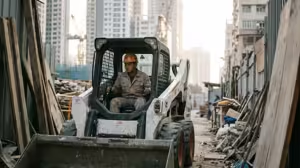
For decades, diversified manufacturing conglomerates dominated supply chains by sheer scale. Bigger facilities, broader catalogs, and wider distribution networks seemed like an unbeatable formula. But that model is cracking under the pressure of rising complexity. Modern industrial infrastructure — from the hydraulic systems inside a Mini Skid Steer Loader QL-390W to the microcomponents embedded in electric vehicle batteries — demands a level of precision that generalist factories simply cannot sustain at competitive margins.
Specialized manufacturers have become the invisible backbone of the global economy. As a leading industry CEO put it: “Our products seldom will be seen on the retail shelf, but are essential components for consumer electronics and automotive parts.” That observation captures something profound about how B2B manufacturing actually works. The parts that matter most — the ones that determine whether a machine performs or fails — never make it to a consumer display. They live inside other products, quietly driving billions of dollars in economic activity.
This shift isn’t accidental. Advanced manufacturing solutions are increasingly built around deep technical expertise rather than broad capacity. In practice, a specialist with intimate knowledge of one product category can iterate faster, reduce defect rates, and respond to custom specifications in ways a generalist manufacturer structurally cannot.
Technical expertise is the primary currency of 2025 manufacturing — and the companies investing in it are pulling ahead. According to Manufacturing.gov, technology adoption across focused production environments is directly tied to long-term competitiveness.
Understanding why specialists outperform starts with examining how they build their operations from the ground up — and vertical integration is at the center of that story.
Vertical integration is one of the clearest differentiators between manufacturers that simply survive and those that consistently lead their industries.
In the context of heavy machinery, vertical integration means a manufacturer controls its production chain from raw material sourcing through final assembly — rather than depending on a fragmented network of outside suppliers. For a Skid Steer Loader Manufacturer, this might mean producing core hydraulic components, fabricating steel frames, and assembling finished units all under one roof. That internal ownership isn’t just an operational preference; it’s a strategic advantage that compounds over time.
Automated technology lines are the engine behind this advantage. When production processes run on automated systems, manufacturers achieve tighter tolerances, more consistent output, and dramatically reduced material waste compared to manual or outsourced approaches. As noted in research on advanced manufacturing solutions, automation allows facilities to simultaneously serve multiple market segments — such as industrial and commercial clients — while using smart systems to redirect byproducts and minimize losses. Precision isn’t accidental; it’s engineered into every stage of the line.
Supply chain resilience is another major payoff. When external suppliers face disruptions — whether from logistics bottlenecks, geopolitical instability, or raw material shortages — vertically integrated manufacturers absorb far less shock. Internal production buffers keep lead times predictable and quality standards consistent. Supply chain partners that internalize key production steps are consistently better positioned to honor delivery commitments even when outside markets are volatile.
Finally, vertical integration unlocks private label and co-packing flexibility. Manufacturers who control their own production capacity can configure output for different clients, brands, or specifications without renegotiating third-party contracts. That adaptability — whether applied to loader configurations or broader product lines — is precisely what major industry players have built into their operational DNA, as the next section explores.
The world’s most successful industrial manufacturers don’t just build products — they engineer entire ecosystems of innovation, capital, and collaboration that smaller producers can study and replicate.
The defining trait of manufacturing’s top tier is relentless R&D investment backed by long-term strategic vision. Companies like General Electric and Lockheed Martin have built their dominance not on scale alone, but on a commitment to what General Electric itself describes as “inventing the future of flight.” That kind of ambition requires billions in capital expenditure, proprietary materials research, and multi-decade development cycles — a model that sets the standard across every tier of industrial production.

R&D as a competitive moat is perhaps the clearest lesson these giants offer. Lockheed Martin, Raytheon Technologies, and General Electric collectively invest at a scale that filters down into supplier networks, workforce training programs, and process innovations that eventually reach mid-market manufacturers. Their capital-intensive frameworks demonstrate that in specialized production, cutting corners on development costs invariably produces inferior outcomes. For a smaller industrial manufacturer studying these models, the takeaway is direct: specialize deeply, invest proportionally, and treat innovation as infrastructure rather than overhead.
Collaboration amplifies what capital alone cannot buy. The Manufacturing USA initiative formalizes this principle through a national network of institutes where large manufacturers, universities, and startups share R&D resources and applied research. The result is a rising tide — breakthroughs achieved at the top cascade into practical tooling, materials, and process improvements available to producers at every scale. Companies that compare load capacity and machine specs before committing to equipment are applying the same discipline these giants use: rigorous analysis before capital deployment.
What these models collectively reveal is that innovation without capital structure is ambition without traction — a reality that shapes how the next generation of heavy machinery producers must approach their own development pipelines.
Every company that manufactures specialized heavy machinery operates in a high-stakes financial environment where the barriers to entry are steep and unforgiving.
High-tech production lines for specialized industries can cost tens of millions of dollars — and that figure doesn’t include the ongoing R&D investment required to stay competitive. According to Deloitte, these capital demands reshape how manufacturers plan, finance, and ultimately deliver products to global markets.
The financial complexity doesn’t stop at the factory floor. Consider the layers of cost and risk involved:
Long lead times are not a flaw — they are a feature of responsible manufacturing. When engineers design a machine to perform reliably in demanding field conditions, cutting corners on production timelines introduces compounding risk downstream.
The QL-490W exists precisely because this environment demands more than a generic product. It reflects the kind of focused engineering investment that only emerges when a manufacturer commits deeply to a single category rather than spreading resources thin. Comparing compact loader specs side by side reveals how that investment translates into measurable performance differences — differences that matter when equipment failure on a job site carries real financial consequences.
Understanding this cost structure sets the stage for a more important question: how do you identify which manufacturer has genuinely made that commitment?
Choosing the right manufacturing company goes far beyond typing “skid steer loader near me” into a search engine — the real differentiators live in technical depth, support infrastructure, and a provable track record of innovation.
The manufacturer’s spec sheet tells you more than their sales pitch ever will. When evaluating a potential partner, start by moving past marketing language and into the engineering data: rated operating capacity, hydraulic flow rates, breakout force, and machine dimensions under load. These numbers reveal whether a manufacturer truly understands the physics of compact, high-torque machinery — or simply resells rebranded units with a fresh coat of paint.
In practice, specialized focus translates directly to better performance outcomes. Manufacturing leaders increasingly recognize that deep category expertise — rather than broad catalog breadth — is what drives customer trust and long-term value. That principle applies just as powerfully when selecting compact machinery partners as it does anywhere else in the industrial supply chain. And it sets the stage for understanding exactly how that specialization gets built into individual machines at the engineering level.
Specialized machinery wins where generalist equipment fails — and the QL-490W is a textbook example of what engineering precision can achieve in a compact form factor.
The QL-490W isn’t just smaller; it’s smarter by design. Qilu Machinery developed this model specifically for high-performance industrial applications where tight operating environments and sustained torque demands collide. That dual requirement — compact footprint plus high output — is notoriously difficult to engineer without sacrificing one for the other. The QL-490W resolves that tension through a tightly integrated drivetrain architecture that delivers consistent power without the bulk of standard full-size loaders.
Use cases reveal where this model truly separates itself from generalist alternatives:
In practice, generalist equipment often forces operators to choose between power and access. The QL-490W removes that trade-off by concentrating torque delivery into a shorter wheelbase — a manufacturing feat that demands tolerances most generalist production lines aren’t calibrated to hit consistently.
Manufacturing precision is non-negotiable at this scale. Compact, high-torque machinery amplifies any production variance — a misaligned component that causes minor inefficiency in a large loader creates significant performance degradation in a mini skid steer. That’s why top manufacturing companies in this niche invest heavily in quality control protocols that go far beyond standard inspection checkpoints.
Qilu Machinery’s focus on the QL-490W reflects a deliberate specialization strategy: rather than spreading engineering resources across a broad product catalog, they concentrate expertise where it creates the most measurable value. That focus is exactly what the next phase of industrial manufacturing will reward — a dynamic that the trends emerging in 2026 and beyond are already beginning to confirm.
Specialized manufacturing is entering a period of measurable, data-backed expansion — and the companies investing now will be the ones defining industry standards by 2026.
Market growth is no longer speculative. The global market for specialized manufactured products is projected to reach nearly $400 billion by 2032, driven by a CAGR of 8.8%. That trajectory points to a fundamental shift: buyers are moving away from generalist suppliers toward partners with deep vertical expertise and proven production infrastructure.
AI and automation are accelerating that divide. Manufacturers mastering AI-driven processes gain real-time visibility into production quality, predictive maintenance cycles, and demand forecasting — capabilities that generalist operations simply cannot replicate at the same cost efficiency. What typically happens in this environment is that top-tier manufacturers pull further ahead while mid-tier operations struggle to close the technology gap.
Regional manufacturing hubs are reshaping domestic supply chains as well. California and Texas are emerging as concentrated centers of industrial equipment production, combining access to skilled labor, port logistics, and state-level incentives for advanced manufacturing investment. For B2B buyers, sourcing from within these hubs reduces lead times and simplifies compliance with evolving domestic content standards.
Sustainable production lines are shifting from a differentiator to a baseline expectation. As energy transition pressures mount, manufacturers that have already optimized for energy-efficient output face lower operational costs and stronger regulatory positioning heading into the next decade.
| Factor | Now (2025) | 2026 and Beyond |
|---|---|---|
| Market focus | General-purpose equipment | Specialized, application-specific units |
| Technology adoption | Selective automation | AI-integrated production standard |
| Regional sourcing | Dispersed supply chains | Concentrated domestic hubs |
| Sustainability | Competitive advantage | Baseline compliance requirement |
These converging trends make one thing clear: the right manufacturing partner today is not just a vendor — it’s a long-term strategic asset, a point the next section addresses directly.
The right manufacturing partner isn’t defined by headcount or revenue — it’s defined by depth of specialization, production integrity, and genuine alignment with your operational goals.
Vertical integration and technical specialization should outrank company size in every vendor evaluation. A manufacturer that controls its entire production process — from raw material sourcing through final quality checks — delivers shorter lead times, tighter tolerances, and more consistent output than a larger company relying on fragmented supply chains. ManufacturingUSA.com reinforces this point: innovation and collaboration, not scale alone, drive competitive advantage in today’s global market.
Investment in high-tech production lines is another non-negotiable signal. Before committing to a partner, verify that their facility uses modern CNC machining, automated welding, or precision casting — not legacy processes patched together over decades. In practice, manufacturers that reinvest in production technology consistently deliver better tolerances and more reliable component performance. A walk through a facility, even a virtual tour, tells you more than a product catalog ever will.

Industry context matters just as much as equipment specs. A manufacturer who understands B2B procurement cycles, dealer networks, and jobsite performance requirements will configure solutions that actually fit your business — not just your equipment list. That contextual fluency reduces miscommunication, shortens onboarding, and protects your bottom line over the full product lifecycle.
Finally, let the equipment itself speak. Machines like the QL-490W — engineered with purpose-built hydraulics, load-optimized frames, and operator-centered ergonomics — reflect the kind of manufacturer worth partnering with. Specialized design decisions compound over time, paying dividends in uptime and reduced maintenance costs.
These principles raise natural follow-up questions for any buyer navigating this space — and the next section addresses the most common ones directly.
The right manufacturing partner separates industrial operations that scale from those that stall — and these questions cut straight to what matters most.
What defines a “top” manufacturing company in the industrial sector?
According to Wikipedia and CompaniesMarketCap, top manufacturers are typically measured by revenue, market capitalization, and their role in critical infrastructure. However, size alone doesn’t define leadership. In practice, the most respected industrial manufacturers combine financial stability with deep domain expertise, repeatable quality standards, and supply chain resilience — metrics that matter far more to an operations buyer than a stock ticker.
How does vertical integration affect equipment lead times?
Vertically integrated manufacturers control more of their own production inputs — raw materials, components, and assembly — which directly compresses delivery windows. When a supplier doesn’t depend on third-party vendors for critical parts, disruptions stay contained. A vertically integrated partner can often cut standard lead times by 20–40% compared to manufacturers relying on fragmented supply chains. For time-sensitive industrial projects, that compression is often the deciding factor.
Why is the QL-490W considered a leader in the mini skid steer category?
The QL-490W stands out because it combines a high-torque drive system with a compact footprint built for demanding site conditions. Its ergonomic cab design, attachment compatibility range, and consistent performance specs reflect the kind of purpose-built engineering that defines category leadership — not just marketing positioning.
What should I look for in a manufacturer’s technical support?
Strong technical support means more than a phone number. Look for clear response time commitments, factory-trained technicians, parts availability guarantees, and clear escalation paths. The best manufacturers treat post-sale support as a production input, not an afterthought. Before signing any agreement, ask specifically how warranty claims are handled and what average resolution times look like — those answers reveal more than any brochure.
Specialized manufacturing partners aren’t just vendors — they’re long-term infrastructure decisions. Choose accordingly.




-1.png)