Email: [email protected] Whatsapp: +8618266768780
Email: [email protected] Whatsapp: +8618266768780

Welcome to My Blog!
Before we dive into the content, I’d love for you to join me on my social media platforms where I share more insights, engage with the community, and post updates. Here’s how you can connect with me:
Facebook: https://www.facebook.com/profile.php?id=100072217509763
LinkedIn: https://www.linkedin.com/company/74949059/admin/dashboard/
YouTube:https://www.youtube.com/@tractormanufacturer-lc5qz
TikTok: https://www.tiktok.com/@tractormanufacturer
Now, let’s get started on our journey together. I hope you find the content here insightful, engaging, and valuable.
The first diesel tractor, introduced in the early 1930s, was a game-changer, offering fuel efficiency and torque that gasoline tractors couldn’t match, per ISO 15550. Today’s modern farm machines, equipped with precision agriculture tools, take that legacy to new heights, meeting EU emissions standards like Regulation 2016/1628.
This blog dives deep into the first diesel tractor, comparing its mechanics, impact, and limitations with the cutting-edge features of modern farm machines.


The first diesel tractor, launched in the early 1930s, was a pioneering machine that used a compression-ignition engine, unlike the spark-ignition gasoline tractors of the 1920s. Think of it like the first microwave oven in a kitchen—revolutionary, powerful, but basic compared to today’s smart appliances. Key features included:
In the UK’s post-Depression farms, the first diesel tractor was a lifeline, enabling farmers to cultivate larger areas with fewer resources, setting a new standard for agricultural efficiency.
The first diesel tractor wasn’t just a machine—it was a turning point for agriculture, much like the invention of the wheel for transport. Its impact was profound:
For small-scale farmers in the Netherlands, the first diesel tractor meant less reliance on manual labor, freeing time for crop diversification and boosting food security during tough economic times.
Despite its breakthroughs, the first diesel tractor had flaws, like an early smartphone with a clunky interface. These limitations shaped future innovations:
In France’s small vineyards, farmers struggled with the first diesel tractor’s bulk, prompting demand for lighter, more agile machines that would inspire modern farm machines.
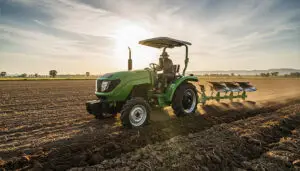
Modern farm machines, including tractors, combines, and autonomous implements, are the high-tech descendants of the first diesel tractor. They’re like smartphones compared to rotary phones, packed with advanced features:
In Sweden’s tech-forward farms, modern farm machines use real-time data to optimize yields, making them indispensable for large-scale agriculture in 2025.
Modern farm machines have leapfrogged the first diesel tractor, incorporating innovations that make farming faster and greener. Key advancements include:
In Spain’s olive groves, modern farm machines with automated harvesters save hours of manual work, showcasing how far we’ve come from the first diesel tractor’s manual operations.
The first diesel tractor was the foundation for today’s machines, like a Model T leading to a Tesla. Modern farm machines retain the diesel engine’s core strengths—torque and durability—while adding:
In Germany’s precision-focused farms, modern farm machines owe their efficiency to the first diesel tractor’s pioneering diesel technology, now enhanced with digital tools.
To highlight the evolution from the first diesel tractor to modern farm machines, the following table compares their key features, including engine power, technology, emissions, versatility, and operator comfort. Designed for farmers in Poland or Italy, this table avoids pricing and focuses on technical differences, aligned with standards like ISO 15550 and EU Regulation 2016/1628.
| Feature | First Diesel Tractor | Modern Farm Machines |
|---|---|---|
| Engine Power | 20–60 horsepower, single/multi-cylinder diesel, per ISO 15550 | 100–600 horsepower, diesel/hybrid, EU Stage V compliant, per Regulation 2016/1628 |
| Technology | Manual controls, no GPS or automation, per EN 1553 | GPS, AI, IoT, autonomous operation, per ISO 11783 |
| Emissions | High particulates, no emissions control, per ISO 8178 | 80% lower NOx with SCR, hybrid options, per EU Regulation 2016/1628 |
| Versatility | Limited to plowing/tilling, no PTO or hydraulics, per ISO 4254 | 10+ attachments (plows, seeders, harvesters), per ISO 6489 |
| Operator Comfort | Open seat, 90–100 dB noise, per ISO 3744 | Climate-controlled cabs, 70–80 dB, touchscreens, per ISO 4254 |
| Fuel Efficiency | 0.06–0.08 gallons/hp-hour, per Nebraska Tractor Test | 0.04–0.06 gallons/hp-hour, 20% better, per ISO 8178 |
| Terrain Suitability | Flat, large fields; heavy (5,000–10,000 lbs), per EN 13683 | All terrains, adjustable tracks/wheels, per ISO 12188 |
This table shows how modern farm machines have transformed the first diesel tractor’s legacy into a versatile, eco-friendly powerhouse, perfect for Europe’s diverse farms, from the UK’s rolling hills to France’s vineyards.
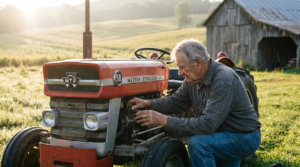
Using the first diesel tractor was like cooking with a vintage stove—effective but requiring skill. Tips for its operation, relevant for historical enthusiasts or collectors in the UK, include:
In Germany’s agricultural museums, operators of the first diesel tractor follow these steps to demonstrate its historical power, keeping it functional for educational displays.
Modern farm machines are like self-driving cars—packed with tech that demands smart use. Practical tips for farmers in Spain or Sweden include:
In the Netherlands’ high-tech farms, these practices ensure modern farm machines deliver maximum productivity, building on the first diesel tractor’s efficiency.
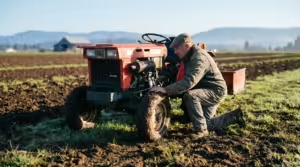
Maintenance keeps both the first diesel tractor and modern farm machines running smoothly, like tuning a classic car versus a hybrid SUV. Key tasks include:
In Italy’s olive farms, proper maintenance ensures modern farm machines and restored first diesel tractors perform reliably, honoring their shared diesel heritage.


The first diesel tractor and modern farm machines have reshaped agricultural economics, like steam engines did for industry. Their contributions include:
For small farmers in the UK, modern farm machines continue the first diesel tractor’s legacy of affordability and productivity, ensuring economic viability.
Sustainability is where modern farm machines outshine the first diesel tractor, like a solar panel versus a coal furnace. Key environmental advantages include:
In Sweden’s eco-conscious farms, modern farm machines align with EU sustainability goals, building a greener future on the first diesel tractor’s foundation.
The first diesel tractor and modern farm machines are cultural icons, like vinyl records and streaming music. Their social impact includes:
In France, the first diesel tractor’s legacy lives in museum exhibits, while modern farm machines drive innovation, connecting past and future farmers.
The first diesel tractor, with its rugged diesel engine and game-changing efficiency, was the spark that ignited modern agriculture. From its debut in the 1930s to the GPS-guided, eco-friendly modern farm machines of 2025, the evolution of farm machinery reflects human ingenuity and a commitment to feeding the world sustainably.
Whether you’re inspired by the first diesel tractor’s simplicity or modern farm machines’ sophistication, both are vital to agriculture’s past and future.
The first diesel tractor, introduced in the early 1930s, used a compression-ignition engine (20–60 horsepower) for plowing and tilling, offering 30–40% better fuel efficiency than gasoline models, per ISO 15550.
It reduced fuel costs by 20–30% and doubled land cultivation capacity, revolutionizing 1930s agriculture in Europe, per EN 13683.
Modern farm machines include tractors, combines, and autonomous implements with GPS, AI, and hybrid engines (100–600 horsepower), per ISO 11783, meeting EU Stage V emissions standards.
They offer precision agriculture, 80% lower emissions, 10+ attachments, and climate-controlled cabs, compared to the first diesel tractor’s basic, high-emission design, per EU Regulation 2016/1628.
Modern machines cut CO2 by 30% with hybrid engines and SCR, support no-till farming, and offer electric options, unlike the first diesel tractor’s high particulate emissions, per ISO 8178.
-1.png)