Email: [email protected] Whatsapp: +8618266768780

Email: [email protected] Whatsapp: +8618266768780

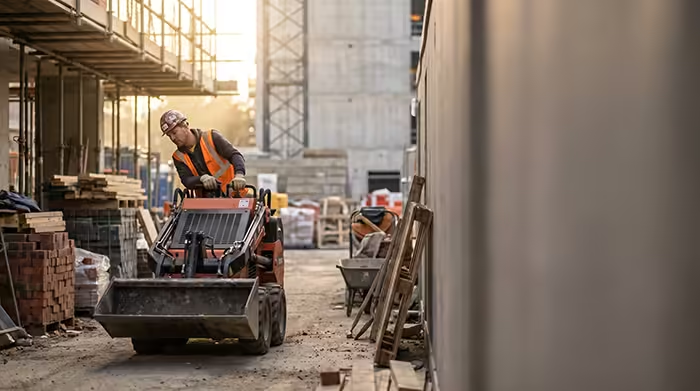
Choosing a mini skid steer loader manufacturer isn’t about comparing horsepower figures on a spec sheet — it’s about understanding the engineering philosophy that shaped every bolt, weld, and hydraulic circuit in the machine.
Most buyers start with rated operating capacity, engine output, or attachment compatibility. Those numbers matter, but they only tell part of the story. What actually determines whether a machine holds up through a punishing season of trenching, grading, and material handling is the intent behind its design. As Simon Sinek put it, “People don’t buy what you do; they buy why you do it.” That principle applies just as directly to capital equipment as it does to consumer brands.
Purpose-driven design shows up on the job site in ways that raw specs never reveal. A manufacturer that engineers around real operator fatigue will build tighter turning radii, more ergonomic controls, and faster hydraulic response — not because a competitor forced them to, but because their whole philosophy centers on daily usability. The Mini Skid Steer Loader QL-490T, for example, is built around the reality that crews work in tight urban alleys and congested job sites where every minute of downtime compounds into real project costs.
The manufacturer’s role doesn’t end at the factory gate, either. According to industry research on skid steer selection, long-term ownership costs — parts availability, service network density, and software support — are often driven more by manufacturer commitment than by initial build quality. A technically rigorous manufacturer invests in that entire lifecycle, not just the sale.

That foundation of technical expertise is ultimately what earns trust. And trust, in heavy equipment, is what separates a machine you rely on from one you merely tolerate. Understanding what makes a manufacturer’s philosophy genuinely different — rather than just marketed as such — is exactly where the real evaluation begins.
A specialized manufacturer’s true value lies not in what it claims, but in how consistently those claims align with the machines it delivers.
Defining specialization goes beyond a narrow product catalog. A manufacturer focused exclusively on compact equipment — rather than one producing everything from forklifts to farm equipment — develops deeper institutional knowledge. That focused expertise shapes tooling choices, component sourcing, and the cumulative refinements that separate a machine that lasts a decade from one that falters after two seasons of hard use. When a company’s entire R&D investment targets the Skid Steer Loader category, every design iteration is informed by a tighter feedback loop between engineers and end users.
Messaging consistency is one of the most underrated signals of manufacturing quality. It sounds counterintuitive, but brands with clear and consistent messaging experience 23% higher revenue growth — a pattern that reflects organizational alignment as much as marketing discipline. When a manufacturer communicates the same core values across its spec sheets, dealer conversations, and after-sale support, it signals that internal teams are operating from the same quality standard. Inconsistency, on the other hand, often points to siloed departments where production and customer-facing teams aren’t sharing the same blueprint.
Expert Insight: Brand positioning isn’t just a marketing exercise — it’s a proxy for process discipline. A manufacturer that can’t articulate what makes its machines different usually hasn’t resolved that question internally, and that ambiguity finds its way into the product itself.
Vetting claims against real-world output is the final filter. Review equipment forums, compare specifications across model lines, and look for transparency around maintenance requirements and wear-part availability. Manufacturers who publish detailed service guidance for their equipment signal confidence in what they’ve built. That transparency is where engineering philosophy becomes a provable, testable reality — which sets the stage for examining exactly how those standards translate into specific machine performance.
The QL-490T represents what happens when a serious Skid Steer Loader Manufacturer applies genuine engineering discipline to a compact machine — performance and practicality in a footprint that fits where full-size equipment simply cannot.
Performance begins with purposeful specs. The QL-490T runs on a twin-cylinder engine producing approximately 23 HP, paired with a rated operating capacity designed to handle demanding material loads without compromising stability. Its hydraulic flow supports a wide range of attachments, from augers and trenchers to buckets and pallet forks — meaning the machine adapts to the task rather than forcing operators to adapt around it. That kind of hydraulic versatility is what separates capable compact machines from ones that underdeliver in the field.
Versatility is where the QL-490T earns its place on job sites. In landscaping, it grades terrain, moves mulch, and navigates tight residential yards without damaging turf. In light construction, it shifts material, digs footings with the right attachment, and works within confined urban spaces. You can see how it stacks up against comparable models to understand where its specification sweet spot sits.
Operator comfort and maintenance access aren’t afterthoughts here. The cab layout reduces fatigue on extended shifts, with intuitive controls positioned for natural hand movement. Service points — engine access, hydraulic checks, filter locations — are deliberately reachable, cutting downtime during routine maintenance windows.
OEM standards are baked into every design decision. Unique, original product engineering serves as a powerful trust signal, as Studio 36 Digital notes — it communicates to buyers and operators alike that a manufacturer stands fully behind what it builds. That confidence in the product is precisely what drives the real-world return on investment, which the next section examines in depth.
Working directly with an industrial manufacturer — rather than a third-party reseller — fundamentally changes what you get for your money, your timeline, and your long-term operating costs.
Buying through the source isn’t just convenient; it’s a structural advantage that compounds over the life of your equipment.
Direct support and parts availability sit at the core of that advantage. When something needs attention on a job site, waiting weeks for a reseller to locate and ship a component isn’t just frustrating — it’s expensive downtime. OEM relationships mean parts come from the same engineering pipeline that built the machine, with accurate specifications and faster fulfillment. In practice, that translates to shorter maintenance windows and fewer costly workarounds.
Customization access is another differentiator that rarely gets discussed upfront. Resellers sell what’s on the shelf. Manufacturers can adapt attachment configurations, hydraulic flow settings, or cab specifications to match specific operational needs. That flexibility matters when your job site has conditions that don’t fit a standard catalog spec. Exploring available skid steer configurations before purchase gives buyers a clearer picture of what’s actually possible through direct channels.
Precision engineering reduces long-term costs in ways that don’t always show up in the initial price comparison. Tighter tolerances mean less wear over time. Better component fit means fewer failure points. The upfront investment in a well-engineered machine routinely pays back through reduced maintenance spend across a three-to-five year ownership window.
Value clarity also drives better buying decisions. Research from CEB indicates that clear, specific value propositions result in 2.3 times higher lead-to-customer conversion rates — which reflects a broader truth: when manufacturers communicate exactly what a machine does and why, buyers make better-matched purchases and report higher satisfaction.
Understanding why OEM manufacturing quality matters locally — and how global production standards affect what lands on your job site — is worth examining more closely.
Choosing the right OEM manufacturer means understanding that global scale and genuine quality are not the same thing — a distinction that directly affects your job site outcomes.
Heavy machinery supply chains are genuinely global. Steel sourcing, hydraulic components, and engine assemblies often cross multiple borders before a finished machine ships. That reality isn’t a problem in itself. The problem emerges when a manufacturer treats international production as a cost-cutting exercise rather than a quality-control opportunity. According to DOZR’s comparison of skid steer brands, performance differences between manufacturers often come down to component sourcing decisions and assembly discipline — not country of origin.
“Scale does not always equal specialized quality. The world’s largest companies often serve mass markets, while smaller, focused manufacturers serve operators who demand precision.”
Qilu Machinery approaches this differently. By maintaining tight oversight across its production process — from material selection through final inspection — the company ensures that a machine built for export meets the same standards as one sold domestically. That consistency matters enormously for buyers in the U.S. who are evaluating cost-effective options like the compact and capable QL-460T without sacrificing reliability.
This connects to a broader truth worth internalizing: the richest company isn’t automatically your best partner. Large conglomerates spread engineering attention across hundreds of product lines. A focused OEM manufacturer, by contrast, concentrates expertise on a narrower range of machines — resulting in deeper knowledge, tighter tolerances, and more responsive support. For small businesses and independent contractors, that focus translates into fewer unplanned maintenance costs and less downtime.
“When a manufacturer’s reputation rests entirely on compact equipment, the incentive to get every weld, seal, and hydraulic circuit right is simply higher.”
Understanding these manufacturing realities sets the foundation for something equally important — knowing how to build a working relationship with your equipment provider that goes beyond the initial purchase.
The manufacturer relationship doesn’t end at purchase — it’s the foundation that determines whether your equipment delivers value for years or becomes a liability.
A successful long-term partnership with your mini skid steer loader manufacturer depends on more than competitive pricing. The best providers operate with a level of transparency that keeps your crew informed from day one.
Transparency in lead times and shipping is often underestimated until it’s missing. Delays in equipment delivery can cascade across an entire project schedule, costing far more than the loader itself. A reliable manufacturer communicates realistic timelines upfront, flags potential disruptions early, and follows through. Whether you’re sourcing a made in usa product or working with a quality international OEM, accountability in logistics separates professional suppliers from transactional ones.
Technical support and operator training resources are equally critical. Access to documentation, training videos, and responsive service contacts means your operators spend less time troubleshooting and more time producing. Practical guidance on getting the most out of compact equipment can accelerate that learning curve significantly, especially for crews adopting new attachments or workflows.
What’s less often discussed — but arguably just as important — is the manufacturer’s internal stability. Studies of 252 companies show that employee retention is a key indicator of operational stability. That finding carries real weight in equipment manufacturing. When engineering teams, quality control staff, and technical support personnel stay with a company long-term, institutional knowledge compounds. Tolerances get tighter. Assembly consistency improves. Customers notice the difference.
Stable manufacturer teams produce better machinery — not as a platitude, but as a predictable outcome of retained expertise. A company with low turnover builds processes and standards that are difficult to replicate quickly.
Understanding what makes a manufacturer partnership durable sets the stage for an equally important decision that many equipment buyers overlook: how the legal and financial structure of your own business shapes the economics of ownership.
How you structure your business legally can be just as consequential as which loader you buy — especially when heavy machinery is involved.
For contractors and landscaping professionals, choosing between an LLC and an S-Corp is one of the most common — and most consequential — decisions in the construction sector. Both structures offer meaningful protections, but they work differently depending on your growth trajectory, financing needs, and how much equipment you own.
Asset protection is the first reason machinery owners pay close attention to business structure. An LLC creates a clear legal boundary between personal assets and business liabilities. If a loader causes property damage or is involved in an accident on a job site, a properly maintained LLC can shield your personal finances. An S-Corp offers similar protection but with added complexity in governance requirements. For solo operators or small crews just acquiring their first compact loader, an LLC typically offers the cleaner starting point.
Tax treatment of equipment depreciation is where the two structures begin to diverge meaningfully. Both allow you to depreciate heavy machinery as a business expense — reducing taxable income significantly in the years following a major purchase. However, an S-Corp can offer additional payroll-related tax advantages for owners who draw a salary, potentially lowering self-employment tax obligations over time. That said, the added administrative overhead of an S-Corp isn’t always worth it until revenues reach a threshold where those savings become substantial.
Business structure also directly impacts your financing options. Lenders evaluating equipment loans look at business credit history, liability protection, and organizational stability. A formally registered LLC or S-Corp signals credibility and opens access to better loan terms than a sole proprietorship. If you’re planning to expand your fleet — perhaps adding a versatile skid steer model alongside your current equipment — having the right structure in place before you apply can make a measurable difference in approval odds and interest rates.
Consult a Professional: Business formation and tax strategy are highly individual. Always consult a licensed accountant or business attorney before choosing a structure — the right answer depends on your specific revenue, liability exposure, and long-term goals.
With the legal and financial foundation in place, the final step is making a clear-eyed decision about which manufacturer and machine best fits your operation.
The manufacturer behind your machine matters as much as the machine itself — and every decision you make from here should reflect that reality.
After working through legal structures, supplier partnerships, and total cost of ownership, the core takeaway is straightforward: prioritize demonstrated technical expertise over polished marketing. Any manufacturer can produce a compelling brochure. Far fewer can back up that brochure with engineering depth, responsive parts networks, and long-term production stability. Comparing skid steer brands across the market consistently shows that the gap between strong and weak manufacturers shows up most clearly after the sale, not before it.
OEM partnerships deliver measurably better long-term ROI because they lock in parts compatibility, operator training, and warranty continuity from day one. Research suggests consistent brand alignment correlates with 23% higher growth — and that principle applies as much to equipment procurement as it does to marketing strategy. When your team, your dealer, and your manufacturer are all working from the same playbook, downtime shrinks and productivity compounds.
The QL-490T is a strong example of this balance in practice. It pairs a competitive power output with a compact footprint that fits residential, commercial, and infrastructure job sites without sacrificing rated operating capacity. For operations that need a capable machine at a slightly lower entry point, this compact alternative is also worth evaluating before finalizing a purchase decision.

Before signing any purchase agreement, verify manufacturer stability directly: request references from existing customers, confirm parts lead times in writing, and review the support infrastructure in your region. A manufacturer with a strong retention rate is one whose customers keep coming back — and that’s the most honest signal of quality available.
If you still have specific questions about how manufacturers compare, what differentiates model lines, or how direct purchasing affects your bottom line, the next section addresses those common questions directly.
Choosing the right mini skid steer loader manufacturer is one of the most consequential decisions you’ll make before a single bucket of dirt moves on your job site.
What should I look for in a skid steer loader manufacturer? Start with three non-negotiables: proven engineering standards, transparent parts availability, and responsive after-sale support. According to DOZR’s brand comparison guide, buyers often fixate on the “Big 3” manufacturers — a pattern confirmed by Google Search Trends — yet frequently find that specialized industrial manufacturers deliver better value for their specific application. Beyond brand recognition, prioritize:
How does the QL-490T compare to larger models? The QL-490T is purpose-built for confined job sites where a full-sized machine simply cannot operate efficiently. It delivers compact dimensions without sacrificing rated operating capacity, making it a practical alternative for landscaping, utility work, and interior demolition. Thompson Tractor’s buying guide notes that matching machine size to job scope directly reduces operating costs — and that logic applies squarely here.
What are the benefits of buying direct from an industrial manufacturer? Direct purchasing typically eliminates distributor markups, shortens communication on custom specs, and gives buyers direct access to engineering documentation. In practice, this matters most when you need a non-standard attachment configuration or a rapid parts order.
Are parts easily accessible for international brands? Accessibility varies significantly. The most reliable indicator is whether the manufacturer maintains a dedicated parts network or certified service partners in the US. Before committing, request documented parts lead times and confirm whether components are stocked domestically or shipped internationally — that distinction can mean days versus weeks of downtime on an active job site. Resources like H.O. Penn’s application guide reinforce that operational uptime, not just purchase price, determines your true cost of ownership.


-1.png)