Email: [email protected] Whatsapp: +8618266768780
Email: [email protected] Whatsapp: +8618266768780


If you’re searching for a China mini excavator manufacturer, you’re probably doing the obvious comparisons first: machine size, digging depth, attachments, and price.
That’s fine. But it’s rarely the reason imports go sideways.
For US buyers, the fastest way to lose weeks (or thousands of dollars) is to treat a mini excavator like any other piece of hardware. It’s a regulated, documented, shipped, and serviced machine. The “best” supplier isn’t the one with the prettiest spec sheet. It’s the one who can consistently deliver the right documentation, packaging, and support for your specific use.
Key Takeaway: At the awareness stage, the smartest move is to evaluate a manufacturer’s documentation + process discipline before you get emotionally attached to a particular model.
Below is a paperwork-first framework that helps you compare manufacturers (and any mini excavator producer or mini excavator wholesaler) without falling into the common traps.
A mini excavator (often called a compact excavator) is essentially a smaller excavator designed for confined spaces and light-to-medium earthmoving work. For a neutral, plain-language definition of what an excavator is, see Simple English Wikipedia’s definition of an excavator. For a more specific reference on tracked excavator types, Wikipedia’s crawler excavator overview is a useful baseline.
Why definitions matter: the moment you cross borders, terms turn into paperwork. Your customs broker, shipping partner, and compliance documents will ask for descriptions that need to match what’s actually being shipped.
Most buyers shop mini excavators like this:
The problem is that a quote can look “cheap” while your landed cost becomes expensive. The cost creep usually comes from:
So the unique angle here is simple: treat supplier selection like a process audit, not a product shootout.
This checklist is designed to be binary. Each item is a Yes/No.
1) Can they clearly explain how they handle US import compliance?
You’re not asking for legal advice. You’re checking whether they’ve shipped to the US before and understand what buyers and brokers must prepare.
A serious supplier should be able to point you to official guidance (and speak clearly about what they can provide vs. what your broker files).
2) Do they proactively ask how the machine will be used?
If a supplier never asks about:
…they’re likely selling “a machine,” not supporting an outcome.
3) Can they provide a clean “documentation pack” sample in English?
Ask for a sample pack (PDF is fine). If it’s sloppy, inconsistent, or doesn’t match the actual product description, that’s a red flag.
4) Are Incoterms written in the quote, not implied?
Incoterms define who pays for transport, who carries risk at each step, and who handles what paperwork.
Here’s what to clarify in plain terms:
If a supplier refuses to be specific about Incoterms and cost components, you’re not looking at a “cheap” option. You’re looking at an unknown.
5) Do they agree on how pre-shipment inspection works?
Even awareness-stage buyers should do this: define what gets checked before the machine leaves.
At minimum, ask for photo/video evidence of:
6) Do they know that EPA Form 3520-21 exists, and can they support your filing?
US import clearance for engines/equipment can require an EPA declaration. The official form source is the EPA “Publications and Forms” page that includes Form 3520-21.
CBP also calls this out directly in CBP requirements for importing off-road engines and equipment.
Your supplier doesn’t file for you, but they should be able to provide the data your broker needs.
7) Do you have an ISF plan before the container is loaded?
ISF (Importer Security Filing) isn’t a “nice to have.” Timing matters.
The legal reference is the eCFR text of 19 CFR 149.2 (ISF timing), which specifies that (with exceptions) filings are required 24 hours before cargo is laden aboard the vessel at a foreign port.
If you’re new to importing, the practical rule is: treat ISF as a pre-departure requirement, not a “we’ll do it when it arrives” task.
8) Do they offer parts support with clear lead times?
A legitimate mini excavator producer should be able to answer:
If every answer is vague, expect downtime later.
9) Do they provide service guidance that a US mechanic can actually use?
A good supplier can support you remotely with:
You’re not buying a “container of steel.” You’re buying a machine that will eventually need attention.
Use this table as a request list when you’re comparing a China mini excavator manufacturer vs. another manufacturer.
| Document / proof item | Ask for (format) | Why it matters | When you need it |
|---|---|---|---|
| Commercial invoice + packing list | PDF + editable copy | Prevents customs delays from mismatched descriptions | Before shipping |
| Bill of lading (draft) | Confirms shipper/consignee and shipment details | Before vessel departure | |
| Country of origin statement | Helps your broker with entry documentation | Before shipping | |
| Engine/equipment compliance data needed for import declarations | PDF + photos of relevant labels | Supports your broker’s EPA/entry filing process | Before shipping |
| Operation & maintenance manual (English) | Reduces service mistakes and downtime | Before arrival | |
| Parts list / exploded view | Speeds parts ordering and compatibility checks | Before first service | |
| Packing/crating photos | Photo set | Reduces transit damage disputes | At loading |
| Pre-shipment inspection photos/video | Photo/video | Confirms what actually left the factory | Before final payment |
You don’t need perfect precision to make better decisions. You need a consistent framework to compare quotes.
Here’s a practical cost breakdown model you can apply to every supplier quote:
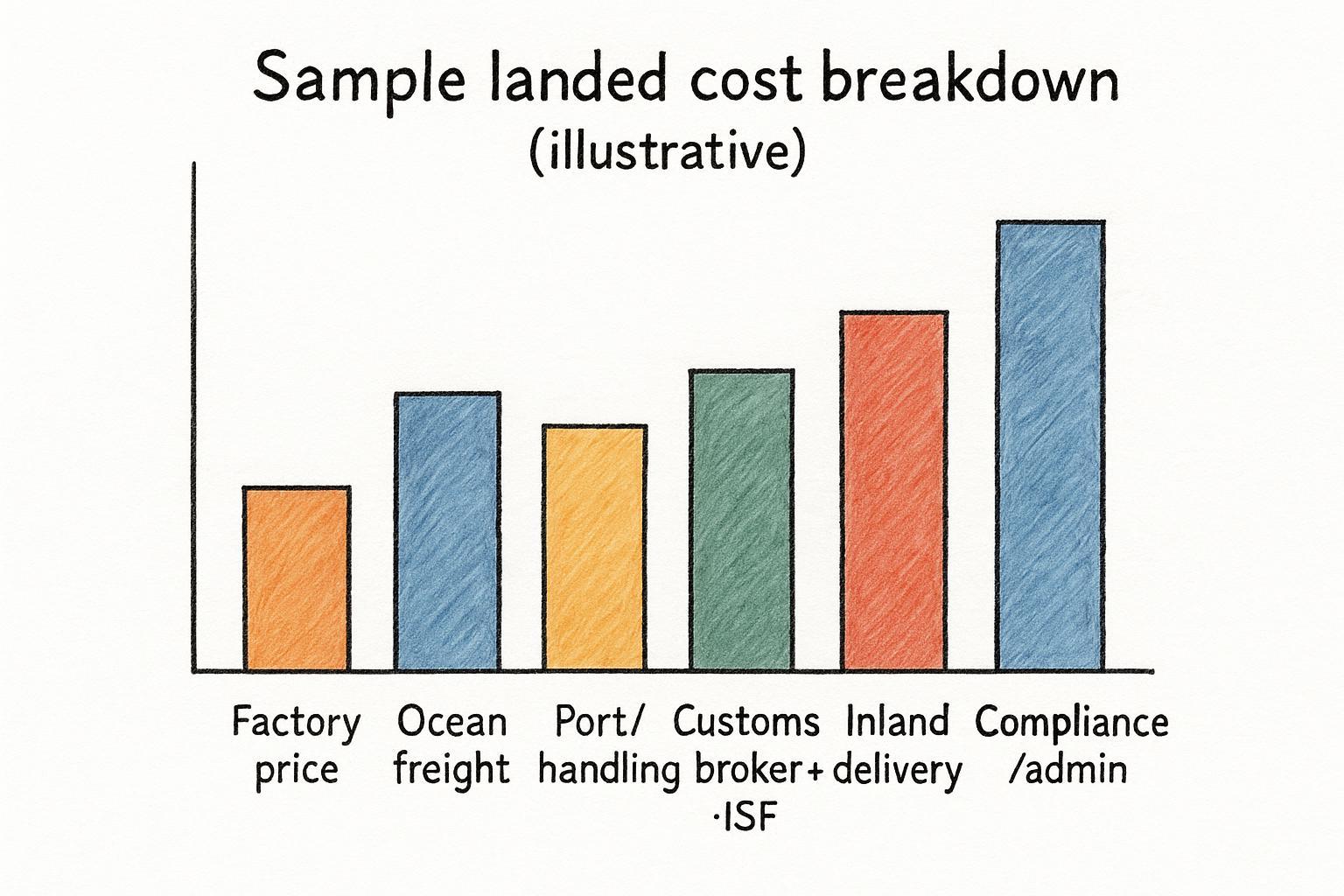
Pro Tip: When comparing a mini excavator wholesaler quote vs. a manufacturer quote, normalize everything to the same Incoterm and the same destination zip code. Otherwise, you’re comparing different cost models.
Below is a template that forces clarity without being confrontational.
Subject: Mini excavator quote request + documentation checklist (US buyer)
Hello,
I’m evaluating a China mini excavator manufacturer for a US purchase. Please quote the following:
To compare suppliers fairly, please also confirm:
Thank you,
If you’re still deciding what size class fits your typical jobs, these pages can help you anchor the discussion around real machine classes:
If you want, send your target job type (landscaping, utilities, farm, rental) and your delivery zip code. I can help you turn this checklist into a one-page comparison scorecard you can use across quotes.
A producer manufactures the machine (and typically controls QA, parts, and engineering changes). A wholesaler usually sources and resells, which can be fine, but you need to verify who owns quality responsibility and after-sales support.
Often, yes. Talk to your customs broker early and use official guidance to confirm what applies to your exact engine/equipment configuration.
It is an EPA declaration form used when importing certain engines/equipment to document compliance status or applicable exemptions.
ISF is a pre-arrival data filing for ocean shipments into the US. It is generally due before the container is loaded at the foreign port (your broker handles the details).
It depends on your experience and how much control you want. Choose one Incoterm, then compare all quotes on the same basis.
Use a phased approach: require a documentation pack sample, define pre-shipment inspection proof, confirm parts availability, and ensure Incoterms and timelines are written down. You’re paying for predictability.




-1.png)