Email: [email protected] Whatsapp: +8618266768780
Email: [email protected] Whatsapp: +8618266768780


If you’re Googling “China Skid Steer Loader manufacturer”, you’re not looking for another list of “top suppliers.” You’re looking for a way to verify a factory, reduce compliance risk, and get a quote you can actually trust—before money changes hands.
Here’s the uncomfortable truth: most supplier comparison content is spec-sheet theatre. It tells you what a skid steer loader could do, not whether a supplier can deliver the machine you need with the documentation and safety baseline U.S. buyers care about.
This guide gives you a practical, decision-stage method to separate a real Skid Steer Loader producer (with traceable processes) from a Skid Steer Loader wholesaler who’s only brokering what they can find.
Key Takeaway: Don’t choose a supplier by promises. Choose them by what they can prove—on paper, in photos/video, and in inspection results.
A skid-steer loader is a compact, rigid-frame machine with lift arms that can take a wide range of attachments; it’s known for zero-radius turning by driving wheels on each side independently, per the skid-steer loader definition (Wikipedia).
When buyers search for a China skid steer loader manufacturer, the results usually mix:
The fix is simple: judge suppliers by verifiable outputs (documentation + QC) rather than by what they call themselves.
Before you ask about discounts, request a Quote Pack that includes the items below. Tell suppliers you’ll compare all bidders using the same checklist.
Pro Tip: If a supplier resists items 7–9 (PDI + inspection + traceability), they’re telling you their QC system can’t stand up to verification.
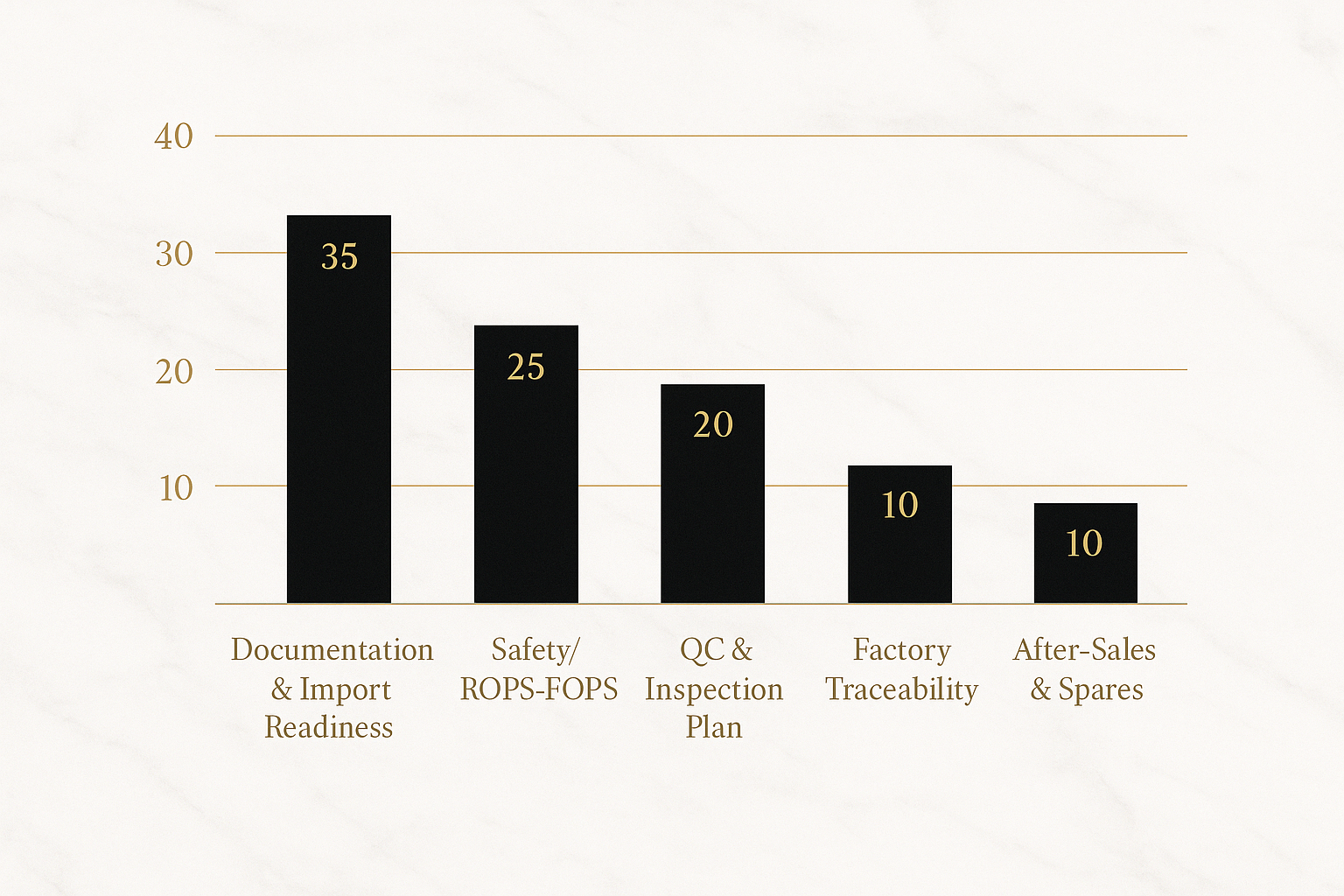
Below is a buyer-friendly scorecard you can use to compare bids. Score each category from 0–5, then multiply by the weight.
| Category | Weight | What “5/5” looks like | Red flags |
|---|---|---|---|
| Documentation & import readiness | 35% | Clean invoice terms, consistent docs, clear export packing plan, understands buyer-side import steps | Vague docs, inconsistent names/addresses, can’t explain what’s included |
| Safety: ROPS/FOPS + operator protection | 25% | Clear compliance statement + evidence; seat belt provisions; safe operating guidance | “Yes” with no documentation; avoids safety questions |
| QC & inspection plan | 20% | PDI checklist + accepts third-party inspection + clear rework process | Refuses inspection; no test checklist |
| Factory traceability | 10% | Serial/batch traceability + photos/video of production + labeled assemblies | Only showroom photos; no traceability |
| After-sales & spares | 10% | Starter spares list + lead times + clear warranty claim process | “No problem” but no parts list, no process |
For compact equipment, rollover hazards are not theoretical. OSHA has discussed rollover hazards and noted that ROPS and seat belts are feasible protections for compactors and skid steer equipment in its OSHA interpretation on ROPS/seat belts for compactors and skid steer equipment.
And while exact requirements depend on the equipment type and jobsite context, OSHA has also addressed seat belt provision and references to SAE seat belt specs in an OSHA interpretation on seat belt requirement for earthmoving equipment.
You chose EXW as the primary trade term. That’s fine—but it shifts more responsibility to the buyer side: inland pickup, export coordination, and clean documentation flow.
To avoid delays, build your import checklist around official guidance.
Buyers sometimes treat EXW like “cheap shipping.” It isn’t. It’s “you own the process earlier.”
The fix: before pickup, confirm in writing:
⚠️ Warning: If your paperwork is inconsistent, the lowest EXW price can turn into the highest total cost after delays and rework.
You shouldn’t choose a machine by “more horsepower” alone. Start from the job:
Because verified numeric specs weren’t accessible via data tools in this session, treat these pages as starting points and request the full technical datasheet in the Quote Pack.
Subject: RFQ — Mini Skid Steer Loader (EXW) + Quote Pack Request
Hello,
We are sourcing a mini skid steer loader for U.S. use and will compare suppliers using a standardized verification checklist.
Please quote EXW price and provide a Quote Pack that includes:
Please also confirm lead time, MOQ, and after-sales spare parts lead times.
Thank you.
If you want, send your requirements (job type, attachments, door/gate width constraints, preferred operating weight/ROC range), and we’ll reply with a decision-ready quote pack aligned to your checklist.
Models referenced in this guide (same pages above): 18kW Skid Steer Loader (QL390W), QL1100 Mini Skid Steer Loader (QL-390T), and Mini Skid Steer Loader QL-460T.
A manufacturer can usually provide traceability, PDI checklists, and documented QC processes. A wholesaler may still be legitimate, but often can’t provide consistent factory-level evidence across batches.
Ask for the certificate number, issuing body, scope (must cover relevant manufacturing), and recent audit/surveillance record. Don’t rely on a screenshot alone.
It should map to specific directives/standards and an identifiable technical file. Your RFQ should request what’s CE-marked and what documents support it.
ROPS/FOPS are operator-protection structures that reduce risk during rollovers and falling-object scenarios. OSHA has discussed rollover hazards and protective measures for compact equipment in its interpretive guidance.
It can be, if you have a competent forwarder and you control inspection and documentation early. If you don’t, consider terms that shift more logistics responsibility to the supplier.
Ask for third-party pre-shipment inspection acceptance in writing and request a PDI checklist. Resistance here is often the clearest signal.
Yes. The Quote-Pack Test generalizes well to compact loaders and similar equipment because it’s document- and process-driven.
-1.png)