Email: [email protected] Whatsapp: +8618266768780


Picture this: a narrow backyard gate, a crew standing idle, and a full-size loader that simply cannot fit. This scenario plays out daily across landscaping, hardscape, and construction sites where access defines profitability. Choosing the right mini skid steer is not merely a purchasing decision. It is a strategic investment in the kind of precision, access, and operational elegance that separates productive crews from stalled ones.
According to Certeg Machinery’s 2026 Buyer’s Guide, mini skid steers have become one of the most versatile tools on modern construction and landscaping sites, particularly where space is constrained and labor costs are rising. As Friday Parts’ Mini Skid Steer Models Guide notes, a single machine equipped with the right attachments can dig, lift, trench, clear, and grade while navigating spaces where larger equipment cannot follow.
Yet the market is dense with options. Walk-behind units, stand-on platforms, tracked configurations, and ride-on models each serve distinct purposes. Engine power, hydraulic flow, rated operating capacity, attachment compatibility, and total ownership cost all demand careful consideration before you commit.
This guide walks you through every dimension of choosing the right mini skid steer: what to look for and consider across format, terrain, performance specs, safety, brands, pricing, and long-term ownership. Whether you are equipping a professional crew or expanding a small operation, you will leave with a clear, confident framework for your decision.
What a Mini Skid Steer Is and Who Really Needs One
A mini skid steer compact tool carrier is, at its core, a machine designed to trade raw scale for access, finesse, and surface respect. As Skidsteers.net’s Buying Guide describes it, the mini skid steer moves material fast without disturbing lawns or pavers, turns inside tight footprints, and can be towed with simpler rigs than full-size equipment demands.
How Mini Skid Steers Differ from Full-Size Loaders
Full-size skid steers and compact track loaders offer greater payload and speed. Mini skid steers offer something more valuable in confined environments: the ability to enter, work, and exit without damage or delay. They pass through 36 to 42-inch gates and operate under low eaves where larger machines simply cannot follow.
Industries and Crews That Benefit Most
Landscapers, hardscape crews, arborists, fence and deck installers, pool builders, concrete finishers, and facilities management teams consistently choose minis. According to Skid Pro’s Ultimate Guide, construction contractors also rely on them for site preparation on small renovation projects where space is limited.
Job Site Conditions Where a Mini Outperforms
Backyard dirt moves, pallet shuttling on pavers, trench spoils removal, barn feed runs, stump cleanup, and snow clearing on walkways are all tasks where the mini’s compact format produces faster cycle times than a larger machine that requires more staging and maneuvering room.
Why Access and Low Disturbance Often Matter More Than Raw Power
As Certeg Machinery notes, mini skid steers replace repetitive hand labor such as wheelbarrowing, shoveling, and manual trenching with mechanized productivity. Lower ground pressure protects finished surfaces. Fewer ruts, fewer scratches, and fewer corrective repairs translate directly into client trust and repeat business.
Key Takeaway: When access and surface integrity define project success, a mini skid steer compact tool carrier outperforms larger loaders on total job time, regardless of raw capacity differences.
Stand-On vs Walk-Behind vs Ride-On: Choosing Your Operating Format
Format is the first structural decision you face. The distinction between stand-on vs walk-behind mini skid steer configurations shapes operator fatigue, visibility, productivity, and suitability across job types in ways that specifications alone cannot convey.
Stand-On Mini Skid Steers: Visibility and Productivity Advantages
As Certeg Machinery’s 2026 guide notes, modern buyers increasingly prefer stand-on models for faster travel, better visibility, and reduced operator fatigue. The elevated platform delivers clear sightlines to attachment edges and bucket tips, which is critical when working near obstacles or setting stone.
Walk-Behind Pedestrian Models: The Narrowest Access Solution
Walk-behind units retain relevance in ultra-tight environments: interior slabs, pool decks, greenhouses, and basements where headroom and ventilation limit options. According to Skidsteers.net, operators trailing behind the machine provide surgical movement at the cost of travel speed, making them best suited for slow, precise, and clean work.
Ride-On Mini Skid Steers: Comfort for Extended Shifts
Ride-on micro-cab or pod configurations address operator comfort during extended-duration tasks. The Bobcat MT100, highlighted in Friday Parts’ Models Guide, offers a ride-on platform at 24.8 HP and a 1,000-lb rated operating capacity, reducing fatigue during long production days.
Matching Operating Format to Your Job Site Conditions
If your crew operates the machine for several hours daily, a stand-on model will deliver greater productivity and operator acceptance. Walk-behind units suit seasonal or part-time fleets where purchase price sensitivity outweighs speed requirements.
Learning Curve and Operator Skill Considerations
Walk-behind operation requires proper body positioning training, as the operator serves as part of the counterweight system. Stand-on platforms generally offer more intuitive control, particularly for operators transitioning from larger equipment.
Pro Tip: Evaluate your most demanding daily route first. The format that removes the greatest friction on that route will serve your entire fleet better than a compromise choice.
Tracks vs Tires: Selecting the Right Undercarriage for Your Terrain
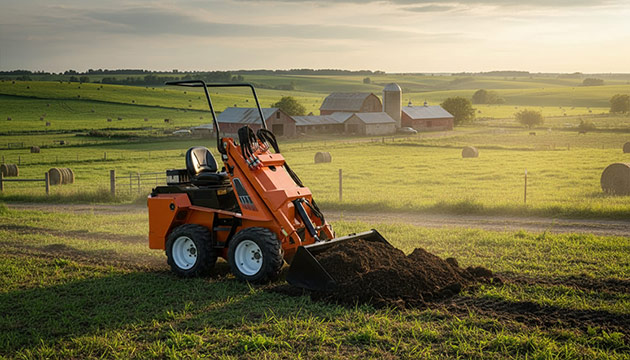
Undercarriage selection profoundly affects surface protection, traction, maintenance cost, and long-term productivity. The mini skid steer tracks vs tires decision deserves the same rigor you apply to engine and lift specifications.
How Rubber Tracks Distribute Weight and Protect Delicate Surfaces
As MMSCE’s Evaluation Factors guide explains, compact track loaders have lighter ground pressure, measured in PSI, resulting in superior flotation on soft, uneven terrain. This makes tracked configurations the preferred choice for landscaping on established turf, freshly graded soil, and finished garden beds.
Wheeled Units: Speed and Lower Maintenance Cost
Wheeled mini skid steers excel on hard surfaces: concrete, asphalt, and compacted dirt. They offer faster travel speeds, lower initial purchase prices, and less complex maintenance schedules. According to Certeg Machinery, tires suit hard, paved environments where ground disturbance is not a concern.
Terrain Types That Favor Tracks Versus Tires
| Terrain Type | Recommended Undercarriage | Key Reason |
|---|---|---|
| Soft soil, mud, turf | Rubber tracks | Low PSI, superior flotation |
| Concrete, asphalt | Tires | Speed, maneuverability |
| Finished pavers | Rubber tracks | Surface protection |
| Compacted gravel | Either | Operator preference |
Slope Performance and Stability Differences
Tracked configurations provide more consistent traction on inclines. Wheeled units can lose grip on wet slopes, creating load management risks. Always verify a machine’s certified slope rating before committing it to hillside or embankment work.
Long-Term Wear and Replacement Costs
Tracks wear faster than tires and carry higher replacement costs. However, on soft terrain, tracked units avoid the rework costs associated with surface damage. Factor both wear replacement and damage prevention into your total cost model.
Key Takeaway: Match your undercarriage to your most frequent terrain. Tracks protect surfaces and provide flotation. Tires offer speed and lower maintenance on hard ground.
Size and Weight Specifications: Balancing Access with Capability
Mini skid steer size and weight selection involves more nuance than simply choosing the most compact model available. As AHM Corp’s buying guide emphasizes, finding the balance between compact design and functional capability is the central challenge in the selection process.
Standard Gate and Doorway Clearance Dimensions
Most residential gates measure 36 to 42 inches wide. The Toro Dingo TX 1000 measures 33.7 inches wide, and the Bobcat MT100 measures 35.6 inches, both fitting comfortably through standard gates. Verify the width of your most restrictive recurring job site before finalizing any model selection.
How Machine Weight Affects Ground Pressure
Heavier machines exert greater PSI on soft or finished surfaces. The Bobcat MT100 weighs 3,390 lbs while the Toro Dingo TX 1000 weighs 2,610 lbs, according to Friday Parts. On delicate turf or finished patios, that 780-lb difference in machine weight has meaningful surface impact implications.
Trailer Capacity and Tow Vehicle Requirements
As Skidsteers.net notes, most minis ride on light trailers that a standard pickup can tow legally without commercial licensing. Verify your tow vehicle’s Gross Vehicle Weight Rating against the combined weight of trailer, machine, and attachments before purchasing.
Matching Dimensions to Your Most Restrictive Job Site
According to MMSCE, size and weight choice should be driven by task demands, attachment weights, and worksite constraints. Measure your narrowest gate, lowest ceiling, and softest surface before committing to a spec sheet.
Why Heavier Is Not Always Better
A heavier machine with a higher payload rating may underperform a lighter model when access is restricted or surface protection is required. Capability is only valuable when the machine can reach the work.
Pro Tip: Build a simple constraint checklist: narrowest entry, softest surface, maximum trailer payload. Any machine that fails one constraint is eliminated regardless of other specifications.
Rated Operating Capacity and Lift Performance: The Numbers That Drive Productivity
Among all performance specifications, mini skid steer rated operating capacity (ROC) is the single most critical number for daily productivity. Understanding how it is calculated and how lift path affects real-world performance separates informed buyers from those who regret their choices.
How ROC Is Calculated and Why the 50% vs 35% Rule Matters
As MMSCE’s Evaluation Factors guide explains, ROC is calculated as 50% of tipping load for skid steers and 35% of tipping load for compact track loaders. This means a compact track loader and a skid steer in the same size class may carry meaningfully different actual capacity ratings despite similar physical dimensions.
Vertical Lift Path: Advantages for Truck Loading and High-Reach Work
Vertical lift path machines increase reach at full lift height, making them ideal for dumping into high-sided trucks, stacking pallets, and reaching over walls. The Ditch Witch SK800, noted in Friday Parts’ guide for its best-in-class 83-inch hinge pin height, exemplifies vertical lift path advantage for high-side loading.
Radial Lift Path: Strengths for Grading and Ground-Level Tasks
Radial lift path loaders maximize lifting power at lower heights, providing increased reach at truck bed height and superior control near ground level. They excel at digging, backfilling, and loading flatbed trucks at medium height.
Matching ROC to Your Heaviest Loads
For small frame machines, ROC typically ranges between 500 and 1,750 lbs, according to MMSCE. Identify the heaviest attachment and load combination in your regular work. Your chosen machine’s ROC must exceed that combined weight with a reasonable safety margin.
Understanding Tipping Load, Breakout Force, and Hinge Pin Height
Hinge pin height determines whether you can clear a truck wall or fence. Breakout force determines how aggressively the bucket can enter compacted material. Both specs belong in your evaluation alongside ROC.
Key Takeaway: ROC calculation methodology differs between machine types. Always verify the tipping load formula used and match your chosen machine’s ROC to your heaviest real-world load combination.
Engine Power and Hydraulic Flow: Fueling Attachment Performance
Mini skid steer hydraulic flow and engine power specifications determine whether your attachments operate at full efficiency or struggle through every task. As AHM Corp advises, moving beyond raw horsepower numbers to understand real-world performance is essential.
Horsepower Ranges and Daily Productivity
Most mini skid steers operate between 20 and 30 HP. The Toro Dingo TX 1000 produces 24.9 HP, and the Bobcat MT100 delivers 24.8 HP, per Friday Parts. These figures represent capable all-day performers for standard landscaping, material handling, and light earthwork.
Hydraulic Flow Rate (GPM) and Pressure (PSI): Why These Specs Matter More
Hydraulic flow rate in gallons per minute and system pressure in PSI directly determine attachment motor speed and cutting force. The Toro Dingo TX 1000 delivers 15.2 GPM while the Bobcat MT100 provides 12 GPM. Higher flow enables faster auger rotation, more aggressive trenching, and more responsive hydraulic breaker cycles.
Standard-Flow vs High-Flow Hydraulic Systems
As MMSCE details, standard-flow systems suit most buckets, augers, and tillers. High-flow systems are required for demanding attachments such as hydraulic cold planers, forestry mulchers, and high-speed brush cutters. Confirm your attachment roster before selecting a hydraulic configuration.
Engine Type Options: Diesel, Gasoline, and Electric
Diesel engines offer torque and fuel economy on long production days. Gasoline engines lower initial cost and suit lighter-duty cycles. According to Certeg Machinery’s 2026 guide, electric-platform mini skid steers are gaining traction for indoor demolition and zero-emissions work environments.
Matching Your Hydraulic System to Your Attachment Roster
List every attachment you intend to run. Identify the one with the highest GPM and PSI requirement. That figure defines your minimum hydraulic specification.
Pro Tip: Never underspec hydraulics to save initial cost. An attachment running at 60% efficiency because of insufficient flow costs you more in lost productivity than the price difference between standard and high-flow systems.
Attachments: Multiplying the Value of a Single Machine
The attachment ecosystem is what transforms a mini skid steer into a multi-task platform that justifies its purchase price many times over. According to Friday Parts’ Models Guide, quick-switching between tools in minutes allows a single loader to handle multiple tasks, directly doubling small crew productivity.
Bucket and Material-Handling Attachments
Dirt buckets, rock buckets, and combination buckets form the foundation of most attachment libraries. Skid Pro’s Ultimate Guide distinguishes these by application: dirt buckets for soft material, rock buckets with reinforced cutting edges for aggregate, and combo buckets for mixed conditions.
Earth-Working Attachments: Augers, Trenchers, Tillers, and Grading Blades
Augers drill holes for posts, trees, and footings. Trenchers cut precise lines for irrigation and utility work. Tillers prepare soil for planting. Grading blades finish surfaces after bulk excavation. Each expands the machine’s billable scope significantly.
Demolition and Clearing Attachments
- Hydraulic breakers: Break concrete and hardpan efficiently
- Grapples: Handle brush, debris, and loose material
- Stump grinders: Eliminate stumps after tree removal
- Brush cutters: Clear overgrown vegetation on acreage work
Snow and Seasonal Attachments
Snow plows, snow blowers, and salt spreaders extend a mini skid steer’s earning season through winter. As Skid Pro notes, the compact design makes minis particularly effective for clearing driveways, sidewalks, and small commercial properties.
Universal Quick-Attach vs Proprietary Coupler Systems
Universal quick-attach systems allow cross-brand attachment use, protecting your investment as your fleet evolves. Proprietary couplers may offer tighter integration but create ecosystem lock-in. Verify attachment compatibility with your chosen brand before committing to either system.
Key Takeaway: Your attachment roster determines your machine’s true revenue potential. Prioritize quick-attach systems that allow switching in minutes and support cross-brand compatibility.
Operator Controls, Comfort, and the Learning Curve
Mini skid steer operator controls and ergonomics directly affect how long operators can work productively and how quickly new team members reach competence. As Certeg Machinery’s 2026 guide identifies, operator controls, comfort, and learning curve are key buying criteria that deserve dedicated evaluation.
Joystick vs Hand-Lever vs Foot-Pedal Control Systems
Joystick controls offer intuitive, low-fatigue operation for experienced operators. Hand-lever systems are common on walk-behind units and require deliberate two-hand coordination. Foot-pedal systems free hands for precise positioning tasks but add to the learning curve for new operators.
Electrohydraulic Controls: Precision and Price
Electrohydraulic systems deliver finer modulation of speed and attachment response. They reduce operator effort during precision tasks such as grading and pallet placement. They also carry a higher price premium and greater service complexity than mechanical systems.
Operator Platform Ergonomics
As Skidsteers.net notes, platform isolation reduces vibration, allowing operators to sustain productivity through long patio and hardscape days. Padded standing surfaces and properly positioned hand controls significantly reduce cumulative fatigue during multi-hour shifts.
Visibility and Sightlines
The Toro Dingo TX 1000’s patented control layout, highlighted in Friday Parts’ guide, was designed specifically for precision operation in tight residential spaces. Elevated sightlines reduce the cognitive load of working near obstacles, walls, and planted areas.
Control System Complexity and Training Time
Simpler mechanical systems allow new operators to achieve basic competency within hours. Complex electrohydraulic systems may require days of practice before operators develop confident, efficient technique. Factor your crew’s experience level into your control system selection.
Pro Tip: Whenever possible, conduct a live operator trial before purchasing. Control feel and sightline quality are difficult to assess from a specification sheet alone.
Safety Features and Operator Protection Essentials
Mini skid steer safety features protect your operators, your clients’ properties, and your business from liability exposure. As AHM Corp specifically notes, safety enhancements such as seatbelts are non-negotiable features in any serious equipment evaluation.
Rollover Protection Structures (ROPS) and Falling Object Protection (FOPS)
ROPS and FOPS certifications verify that a machine’s frame meets structural standards for protecting operators during tip events or overhead impact. These certifications are mandatory considerations for any professional fleet purchase.
Operator Presence Interlock Systems
Interlock systems cut hydraulic and drive power when the operator leaves the platform or releases the controls. This prevents runaway incidents on slopes and during attachment changes, which represent two of the most common mini skid steer accident scenarios.
Seatbelts and Restraint Systems
Ride-on and stand-on platforms with restraint systems provide an additional layer of protection during tip events. As Certeg Machinery’s guide notes, proper restraint verification is part of slope and load safety requirements that every buyer should confirm before operation.
Slope Rating Limits and Tipping Hazards
Manufacturer slope ratings represent tested limits, not generous buffers. Operating near rated slope limits with a raised load dramatically increases tip-forward risk. Always lower your load before traversing slopes and verify the machine’s certified grade rating against your actual job site terrain.
Load Management Safety: Avoiding Tip-Forward Incidents
Carrying loads at maximum height while traveling amplifies tip-forward risk. Best practice requires lowering the attachment to transport height before moving between work areas, particularly on uneven ground.
Key Takeaway: Safety systems are not optional upgrades. ROPS, interlocks, and restraint systems represent baseline requirements for responsible equipment ownership and operator protection.
Top Mini Skid Steer Brands and Models: What the Market Offers in 2025–2026
The mini skid steer brands and models landscape in 2025–2026 offers more choices than ever, spanning established industry leaders, value-focused mid-market manufacturers, and emerging electric platforms. According to Certeg Machinery’s 2026 guide, the market is experiencing rapid growth driven by rising labor costs and expanding attachment ecosystems.
Tier-One Brands and Their Flagship Models
According to Friday Parts’ top 10 ranking, the most prominent brands include:
- Toro Dingo TX 1000: 24.9 HP, 15.2 GPM hydraulic flow, 33.7-inch width, 1,000-lb ROC. Toro is credited with creating the mini skid steer market and remains the benchmark for user-friendly controls.
- Bobcat MT100: 24.8 HP, 12 GPM, 35.6-inch width, 1,000-lb ROC, extensive dealer network.
- Ditch Witch SK800: 860-lb ROC, best-in-class 83-inch hinge pin height, 42-inch width, engineered for underground and high-reach applications.
- Vermeer and Boxer round out the tier-one category with strong dealer support and diverse model ranges.
Mid-Market Brands Offering Strong Value
Several manufacturers offer competitive performance at lower price points, particularly suited to small contractors and owner-operators entering the market. These brands may carry narrower dealer networks but can represent strong value when local service support is confirmed.
Emerging and Electric-Platform Brands
As Certeg Machinery notes in its 2026 market trends analysis, electric-platform mini skid steers are gaining share in indoor demolition, greenhouse, and zero-emissions-required environments. Evaluate battery range, charge time, and service infrastructure carefully before committing to an electric model.
Evaluating Dealer Network Strength
Parts availability, service response time, and technician proximity determine how much downtime you absorb over the machine’s life. A machine from a manufacturer with limited regional dealer presence may cost more in lost productivity than a premium-priced unit with a strong local service network.
Key Takeaway: Brand reputation matters, but dealer proximity and parts availability often determine real ownership satisfaction more than any specification on a data sheet.
New vs Used Mini Skid Steers: Evaluating Risk and Value
The new vs used mini skid steer buying decision balances warranty protection, known machine history, and total cost of ownership against the price premium that new equipment commands. As Skidsteers.net’s Buying Guide notes, a practical inspection framework separates sound used purchases from costly mistakes.
Hour Meter Benchmarks for Used Purchases
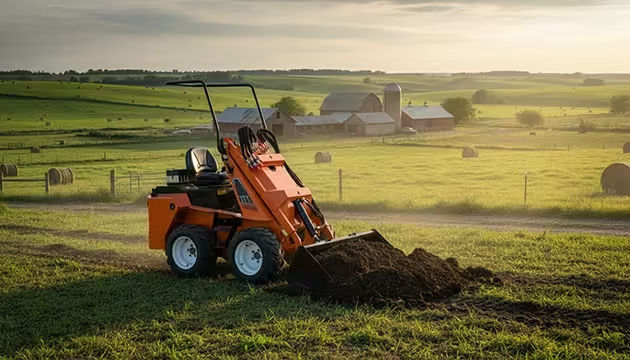
Well-maintained mini skid steers can operate reliably to 2,000 hours and beyond with proper service. Units below 500 hours with documented maintenance records represent the safest used purchases. Machines above 1,500 hours warrant detailed inspection of all major wear systems before purchase.
Critical Inspection Points on a Used Unit
- Tracks or tires: Check for cracking, separation, and uneven wear
- Hydraulic lines: Inspect for swelling, chafing, and connection weeping
- Lift arms: Look for cracks at weld points and bushing wear
- Quick-attach coupler: Verify locking mechanism function and wear
Assessing Engine and Hydraulic System Health
Start the engine cold and observe startup behavior, exhaust color, and warm-up time. Cycle all hydraulic functions under load and check for hesitation, drift, or abnormal heat buildup. These tests reveal issues that hour meters and visual inspection cannot.
Depreciation Curves and the Best Value Window
Mini skid steers depreciate most steeply in the first two years. A well-maintained 2 to 4-year-old unit from a tier-one brand often represents the best intersection of price, remaining service life, and parts availability.
Warranty Coverage Differences
New machines carry full manufacturer warranties, typically 12 to 24 months. Certified pre-owned programs from dealers may offer limited coverage. Private used purchases carry no warranty, transferring all risk to the buyer.
Pro Tip: Request all service records before inspecting a used unit. A clean machine with no documentation history is a yellow flag, not a green one.
Mini Skid Steer Pricing, Financing, and Calculating True ROI
Mini skid steer pricing and financing decisions shape cash flow, tax strategy, and long-term profitability far beyond the sticker price. As Skidsteers.net explains, understanding how pricing and financing truly play out requires modeling total cost alongside productivity gains.
Realistic Price Ranges by Class
| Class | Configuration | Approximate Price Range |
|---|---|---|
| Entry-level | Walk-behind, wheeled | $8,000–$15,000 |
| Mid-range | Stand-on, tracked | $20,000–$35,000 |
| Premium | Stand-on, high-flow, tracked | $35,000–$55,000+ |
Financing Options and Section 179 Tax Deduction
Equipment loans, dealer financing programs, and Section 179 expensing under U.S. tax law can significantly reduce the effective first-year cost of a new purchase. Section 179 allows full equipment cost deduction in the year of purchase, improving cash flow for small business owners.
Leasing vs Buying: Cash Flow Implications
Leasing preserves working capital and provides access to newer equipment on shorter cycles. Purchasing builds equity and eliminates monthly payments after the loan term. For crews with consistent utilization above 500 hours per year, ownership typically produces better long-term returns.
Building a Simple ROI Model
As Skid Pro’s guide recommends, calculate ROI using three inputs: daily rental rate savings (what you would otherwise pay to rent), labor replacement value (hours of hand labor displaced), and attachment revenue potential (additional billable services enabled).
Rent-vs-Buy Break-Even Analysis
If local daily rental rates average $400 to $600 for a comparable machine, and you utilize the machine 100 or more days per year, ownership typically reaches break-even within 24 to 36 months on a mid-range unit.
Key Takeaway: Build your ROI model before your financing model. Know what the machine earns before you decide how to pay for it.
Maintenance Requirements and Long-Term Ownership Costs
Mini skid steer maintenance and ownership costs represent the most frequently underestimated dimension of equipment budgeting. As AHM Corp flags, maintenance costs are a key financial consideration, and Skid Pro’s guide provides essential maintenance practices for sustained performance.
Daily and Weekly Operator Checks
Every shift should begin with fluid level verification, track tension inspection, and attachment coupler condition review. These checks take under ten minutes and prevent the majority of field failures that result in costly emergency service calls.
Engine Service Intervals
Most mini skid steer engines require oil and filter changes every 250 hours. Air filter service typically occurs every 100 to 250 hours depending on dust exposure. Cooling system inspection and coolant replacement follow manufacturer-specified intervals, typically annually or every 500 hours.
Hydraulic System Maintenance
Hydraulic fluid changes and filter replacements are typically required every 500 to 1,000 hours. Regular inspection of all hydraulic lines, fittings, and cylinders for leaks protects both the machine and finished surfaces on job sites.
Track and Tire Wear Patterns
Rubber track replacement on compact mini loaders typically occurs between 1,200 and 1,800 hours of operation, with replacement costs ranging from $800 to $2,500 per set depending on brand and track width. Tires wear more slowly on smooth surfaces but can deteriorate rapidly on sharp aggregate.
Dealer Service vs Owner Maintenance
Owner-performed maintenance following manufacturer specifications preserves warranty coverage while reducing service costs. Complex repairs, hydraulic system overhauls, and major structural work benefit from dealer-trained technicians who carry OEM diagnostic tools.
Pro Tip: Keep a digital maintenance log from day one. Documented service history protects resale value and simplifies warranty claim submissions.
Transporting and Storing Your Mini Skid Steer Between Jobs
The operational advantage of a mini skid steer extends beyond the job site to how efficiently you move and protect it between shifts. As Skidsteers.net specifically notes, minis ride on light trailers a standard pickup can tow legally, which is a key competitive advantage over larger equipment that demands CDL licensing or specialized transport.
Trailer Options for Mini Skid Steers
Single-axle utility trailers suit lighter walk-behind and compact stand-on models. Tandem-axle trailers provide greater stability and payload capacity for heavier track machines. Dovetail ramp configurations reduce loading angle and make machine positioning easier, particularly on soft ground.
Tow Vehicle Requirements and Legal Payload Limits
Most half-ton and three-quarter-ton pickup trucks can legally tow a mini skid steer on a light utility trailer within standard GVWR limits. Always verify the combined weight of tow vehicle, trailer, machine, and attachments against your vehicle’s rated towing and payload capacity.
Proper Tie-Down Points and Load Securement
Use the manufacturer-designated tie-down points only. Four-point securement with appropriately rated chains or straps is standard best practice. Lower the attachment to the deck, engage the parking brake, and verify all connections before departure.
Loading and Unloading Safely
Approach ramps straight-on at low speed. On steep ramps, exit the machine in reverse to maintain center-of-gravity control. Inspect ramp angle, surface condition, and clearance between machine and trailer sides before every loading event.
Storage Best Practices
Protect hydraulic cylinders from UV degradation and corrosion by retracting them fully before storage. Maintain battery charge on electric-start models during extended storage. Seasonal preparation includes fuel stabilization, fluid top-offs, and track or tire cleaning to remove corrosive materials.
Key Takeaway: Transport and storage discipline protects your investment between earning cycles. A machine that starts every shift ready to work is worth more than one that requires corrective attention before each deployment.
You began this guide facing the same challenge that every serious equipment buyer encounters: a market filled with options and specifications, but little clarity on how to choose with confidence. Choosing the right mini skid steer requires methodical evaluation across format, undercarriage, size, performance specs, safety, brand support, and total ownership cost. Every dimension covered here informs a better decision.
Here is your implementation roadmap:
1. Define your constraints first. Measure your narrowest gate, softest surface, and trailer payload capacity. Eliminate any machine that fails a single constraint.
2. Select your format. Stand-on for productivity-focused crews. Walk-behind for ultra-narrow access or budget-sensitive fleets. Ride-on for extended daily operation.
3. Match undercarriage to terrain. Tracks for soft soil and finished surfaces. Tires for hard ground and speed.
4. Verify ROC and hydraulic flow against your heaviest load and most demanding attachment.
5. Build your attachment library. Prioritize a universal quick-attach system that protects cross-brand compatibility.
6. Model ROI before financing. Calculate rental rate savings, labor displacement value, and attachment revenue potential.
7. Confirm dealer proximity and parts availability for your chosen brand before signing.
Do not attempt to evaluate every variable simultaneously. Work through this framework in sequence. Each decision narrows your viable options until the right choice becomes clear.
The mini skid steer that fits your gates, suits your terrain, powers your attachments, and earns more than it costs is not a compromise. It is the precise tool the work requires. Choose it deliberately, maintain it consistently, and it will serve your operation with quiet, reliable distinction for years ahead.
Frequently Asked Questions
What size mini skid steer do I need for residential landscaping work?
For most residential landscaping applications, a stand-on tracked model with 33 to 36 inches of width and 1,000 lbs of rated operating capacity provides the best balance of access and capability. The Toro Dingo TX 1000, at 33.7 inches wide and 1,000-lb ROC, is specifically designed for tight residential environments. If your primary sites have standard 36-inch gates, verify machine width before any other specification.
How do I choose between a tracked and a wheeled mini skid steer?
If you work primarily on soft soil, established turf, or finished hardscape surfaces, choose a tracked configuration for its lower ground pressure and superior flotation. If your work centers on concrete, asphalt, or compacted gravel, a wheeled unit offers faster travel and lower maintenance cost. For mixed fleets, tracked models provide broader application coverage across varying terrain conditions.
What hydraulic flow rate do I need to run demanding attachments efficiently?
Standard attachments such as buckets, augers, and tillers typically operate within 10 to 15 GPM at standard pressure. Demanding attachments such as forestry mulchers, cold planers, and high-speed brush cutters require high-flow systems exceeding 20 GPM. Identify your most demanding attachment first, then verify that your chosen machine’s hydraulic output meets or exceeds that requirement before purchasing.
How do I calculate whether buying a mini skid steer makes more sense than renting?
Begin with your local daily rental rate for a comparable machine, typically $400 to $600 per day. Multiply by your projected annual utilization days. If that figure approaches or exceeds the financed annual cost of ownership within 24 to 36 months, purchasing delivers better long-term value. Factor in Section 179 tax deduction eligibility, which can significantly reduce effective first-year purchase cost for qualifying businesses.
What are the most important safety features to verify before purchasing a mini skid steer?
Prioritize rollover protection structure (ROPS) certification, operator presence interlock systems, and restraint systems appropriate to the platform format. Verify the machine’s certified slope rating against your actual job site terrain. For ride-on and stand-on models, confirm that seatbelts or restraint bars meet current safety standards. As AHM Corp notes, these features are non-negotiable in any serious professional equipment evaluation.
How many hours on a used mini skid steer is too many to consider buying?
A well-maintained machine from a tier-one brand such as Bobcat, Toro, or Ditch Witch can operate reliably beyond 2,000 hours with proper service history. If the unit has exceeded 1,500 hours, conduct a thorough hydraulic system evaluation, track or tire inspection, and engine cold-start assessment before purchasing. Documented maintenance records are more important than the hour meter reading alone. Machines with clean service documentation at 1,200 hours often represent safer purchases than undocumented units at 600 hours.


-1.png)