Email: [email protected] Whatsapp: +8618266768780

Email: [email protected] Whatsapp: +8618266768780


The skid steer is the construction industry’s ultimate utility player — compact enough to fit where others can’t, powerful enough to replace entire crews, and adaptable enough to handle almost any task you throw at it.
So, what are skid steers, exactly? At their core, they’re compact loaders that steer by skidding — meaning the left and right wheels operate at different speeds to pivot the machine around a fixed point. This zero-radius turning mechanism is the defining feature that separates them from conventional articulated loaders. Where a standard loader needs a wide arc to change direction, a skid steer can spin in place on its own footprint. On a congested urban jobsite, that difference is everything.
The machine’s real advantage isn’t what it lifts — it’s where it can go and what it can become with the right attachment.
Greg Rostberg of Bobcat Co. captured this philosophy precisely, noting that skid-steer loaders are “maneuverable, due to their ability to turn in their own tracks; compact, allowing them access to areas larger equipment cannot go; and versatile.” That three-word summary — maneuverable, compact, versatile — is exactly why contractors across residential, commercial, and municipal sectors keep coming back to this machine class.
The shift toward urban infrastructure development has accelerated demand for exactly this profile. Tighter lot sizes, narrower access lanes, and hard-surface job zones have made the bulky full-size loader increasingly impractical. In response, the industry has leaned hard into compact, wheel-based units — and that’s where the wheel skid steer loader format earns its reputation. On asphalt, concrete, and packed gravel, wheeled machines deliver better surface efficiency than their tracked counterparts, with less surface damage and faster cycle times.
Understanding this foundational versatility sets the stage for a deeper question: which size and spec actually hits the performance sweet spot for modern job demands?
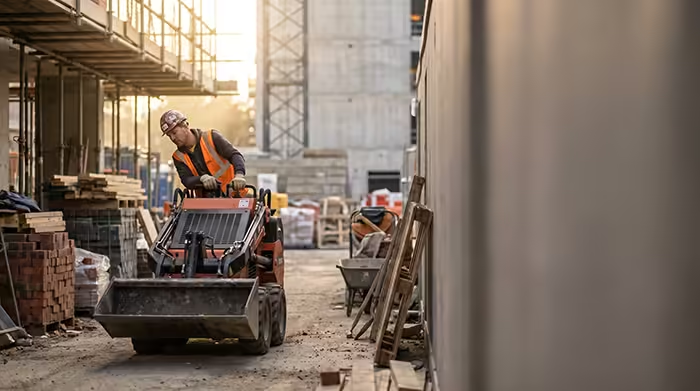
The 1,751–2,200 lb Rated Operating Capacity range has become the construction industry’s definitive sweet spot — powerful enough for real work, compact enough for real-world jobsites. If you’ve ever asked what is a skid loader and whether the size actually matters, the answer is yes — and this ROC range explains why.
According to data from For Construction Pros and Bobcat Co., skid steer loaders in the 1,751–2,200 lb ROC class are the most popular size category in the construction industry. That’s not a coincidence. This range hits the balance point where lifting power, machine footprint, and operational cost all align.
Understanding exactly how capacity is calculated matters here — the ROC is typically 50% of the machine’s tipping load, meaning a 2,000-lb ROC machine can tip at roughly 4,000 lbs. Knowing how ROC is measured in practice helps you avoid undersizing a machine for demanding applications.
The practical advantages of this size class are substantial:
A mid-size unit in this class consistently outperforms both lighter mini loaders (which sacrifice capacity) and larger machines (which sacrifice maneuverability) on mixed-use commercial and residential sites.
This is precisely the design philosophy behind the QL-460W. Rather than chasing maximum power figures, the engineering priority centers on delivering peak utility within this proven ROC window — which, as you’ll see, is also where Chinese manufacturers have made their most significant competitive advances.
China’s role in global machinery production is far more sophisticated than most buyers realize — and understanding it changes how you evaluate every purchase decision.
The global supply chain already runs through China, whether you recognize it or not. Major international equipment brands maintain significant manufacturing operations there precisely because the infrastructure, engineering talent, and production scale are world-class. Doosan Bobcat, for example, operates substantial facilities in China to serve global markets — a fact that reframes the entire conversation about what “Chinese-made” actually means. When buyers ask what is skid steer loader manufacturing supposed to look like, the honest answer increasingly points east.
Quality control in Chinese factories has undergone a genuine transformation over the past decade. Manufacturers like Qilu Machinery have invested heavily in ISO-certified processes, precision welding standards, and multi-stage inspection protocols that mirror — and in some cases exceed — what buyers find in comparable equipment from other regions. The evolution isn’t theoretical; it’s documented in materials certifications, component sourcing from Tier 1 suppliers, and export compliance records across North American and European markets. Buyers willing to look past outdated assumptions will find capacity specs and structural integrity that hold up under real-world scrutiny.
“The distinction isn’t where it’s made — it’s how it’s made and by whom.”
One underappreciated advantage of sourcing directly from a Chinese manufacturer is attachment customization. Factory-direct relationships mean buyers can specify auger drives, hydraulic thumb configurations, pallet fork dimensions, and bucket profiles without the markup layers that come with third-party distributors. For contractors who’ve already established which machine type fits their terrain, this direct access to engineering teams unlocks a level of spec flexibility that the traditional dealer model rarely offers.
That manufacturing depth doesn’t exist in isolation — it’s part of a broader global shift in how compact equipment gets built, distributed, and valued, which the next section explores in full economic detail.
The compact loader market isn’t a niche trend — it’s a structural realignment driven by real economic forces reshaping how contractors work worldwide. According to Grand View Research, the global skid steer loader market is projected to reach $12.56 billion by 2030, growing at a CAGR of 4.4%. That number tells a specific story about where construction spending is heading.
Urbanization is the engine powering this growth. Emerging economies across Southeast Asia, Latin America, and Sub-Saharan Africa are adding dense urban infrastructure at a pace that demands nimble, cost-effective equipment. Large machines simply don’t fit the narrow streets, congested job sites, or tight utility corridors that define modern urban builds. The wheel skid steer loader — compact, maneuverable, and attachment-versatile — has become the practical answer to this constraint.
| Market Driver | Impact on Contractor |
|---|---|
| Urbanization in emerging economies | Stronger demand for compact machines on dense, restricted job sites |
| Construction & mining sector (46% of usage) | Broad application base justifies capital investment |
| Rising attachment ecosystem | One machine replaces multiple single-use tools |
| Lower acquisition cost vs. full-size loaders | Faster ROI on smaller project budgets |
Construction and mining together account for roughly 46% of total skid steer usage globally — a dominance that reflects just how deeply embedded these machines have become in core infrastructure work. As explored in compact equipment’s performance advantages, the shift toward smaller machines isn’t about compromise — it’s about matching the right tool to the actual scope of modern projects.
The QL-460W sits precisely at the intersection of these forces. It targets the $12.56 billion growth curve not by chasing volume specs, but by delivering practical capacity — 2,000 lb ROC, urban-ready wheel drive, and attachment flexibility — at a price point accessible to independent contractors entering expanding markets. The engineering choices behind that positioning are worth examining in detail.
The Mini Skid Steer Loader QL-460W is engineered for one specific reality: high-intensity urban work where space is at a premium but power cannot be sacrificed.
Hydraulic precision is where the QL-460W earns its keep. The machine runs a dedicated hydraulic circuit that separates drive functions from attachment control — a design choice that delivers smooth, responsive tool operation even under load. In practice, this means an operator running an auger or hydraulic breaker gets consistent flow and pressure without the stuttering that plagues single-circuit systems. That separation is what makes fine-grade work on confined job sites feel controlled rather than reactive.
Accessible engine layout is the second engineering win worth understanding. The QL-460W’s service points — oil fill, filter, coolant — are grouped and front-facing, which means routine maintenance doesn’t require partial disassembly. Buyers researching ownership costs consistently flag this as a factor that gets underweighted at purchase and overvalued after six months of field use. Shorter service windows translate directly into more billable hours.
Wheel-based maneuverability is the third differentiator, and it’s particularly relevant for contractors working on paved urban surfaces. Unlike tracked machines that can scuff or damage finished concrete and asphalt, the QL-460W’s rubber-tired configuration lets it move freely across surfaces without leaving marks. For utility work, landscaping installs, or renovation sites inside developed areas, that matters both practically and contractually. You can learn more about how engine and hydraulic specs shape real-world performance before committing to a configuration.
To see these systems working together under real conditions, the video below captures the QL-460W in action:
[VIDEO EMBED: QL-460W Mini Skid Steer in operation]
Of course, a capable hydraulic system only stays capable with the right tooling attached to it — and that’s exactly where the next piece of the puzzle comes in.
A single mini skid steer with the right attachment ecosystem can replace five or six specialized machines on a jobsite — and that’s not marketing copy, it’s operational reality.
According to Fortune Business Insights, construction and mining applications account for approximately 46% of total skid steer usage, driven almost entirely by attachment versatility. The ability to swap tools in minutes transforms a compact loader from a niche piece of equipment into the most productive unit on your crew.
The most impactful attachments for urban and commercial worksites include:
The cost logic here is straightforward: every attachment you add reduces the number of machines you need to rent, transport, or maintain.
What makes this possible at scale is the universal quick-attach plate system used by leading manufacturers. A reputable Skid Steer Loader Manufacturer will engineer their mounting interface to accept a broad range of third-party attachments, giving buyers flexibility without locking them into a proprietary ecosystem. Qilu’s QL-460W follows this approach, and for operators considering heavier-duty cycles, the higher-capacity loader options in the same lineup use the same compatible interface.
Tip: Before purchasing any attachment for the QL-460W, verify the auxiliary hydraulic flow rating matches your tool’s requirements. Mismatched flow specs are the most common — and most avoidable — source of underperformance in the field.
Choosing attachments wisely is closely tied to understanding the machine’s full capability — which leads naturally into what separates reliable Chinese mini skid steer purchases from costly mistakes at the buying stage.
Buying a Chinese mini skid steer rewards buyers who ask sharp questions upfront — the difference between a great investment and a costly mistake often comes down to a handful of pre-purchase checks.
Verify credentials before anything else. Successful international buyers consistently prioritize manufacturers that offer transparent technical specifications and direct communication, according to industry buying guides. Ask for export documentation, certifications, and references from buyers in comparable markets. A manufacturer with a clean export history and verifiable CE or EPA compliance is operating at a different level than one that can’t produce paperwork on request.
Component transparency is non-negotiable. A reputable manufacturer will tell you exactly which engine, hydraulic pump, and control valves are fitted — brand names, model numbers, and tier ratings included. Vague answers like “quality Chinese components” are a red flag. The QL-460W, for example, specifies its powertrain and hydraulic circuit openly, which is the standard every serious buyer should hold manufacturers to. This matters especially for long-term equipment decisions where parts availability defines total cost of ownership.
Wear parts and local support define the real cost. Filters, seals, bucket teeth, and hydraulic fittings wear out — that’s not a flaw, it’s physics. The question is whether replacements are available within a reasonable timeframe and at a reasonable price. Buyers sharing real-world feedback on forums like irate4x4 and YouTube consistently flag parts access as the make-or-break factor after purchase.
The hidden cost comparison shifts the math significantly. Legacy brand machines carry premium purchase prices, inflated dealer margins, and proprietary service requirements that lock you into expensive maintenance cycles. Qilu models offer comparable specifications at a fraction of the acquisition cost — and when component sourcing is transparent, ongoing costs stay predictable. When you add up those hidden costs over a five-year ownership window, the upfront value difference often funds an entire second attachment package.
These four checkpoints give any buyer a practical framework for making a confident, well-informed decision — the kind of foundation that feeds directly into understanding the broader ROI case for this class of equipment.
A Chinese mini skid steer offers serious jobsite capability at a price point that makes ROI achievable faster than most buyers expect. After walking through performance classes, attachment ecosystems, and what separates a smart purchase from a regrettable one, the picture becomes clear: the value proposition here is real, not just a discount.
The skid steer’s defining advantage has always been its zero-radius turning capability — no other compact machine repositions as quickly inside tight job corridors. That mechanical reality hasn’t changed, but what has changed is who manufactures machines built around it. The skid steer loader category has expanded dramatically, and the best units from manufacturers like Qilu now deliver high-spec hydraulics, robust frames, and genuine operator ergonomics at a fraction of legacy brand pricing.

Here’s what this article has consistently pointed toward:
The skid steer market’s 4.4% CAGR, tracked by Grand View Research, reflects sustained demand for labor-saving compact technology — and Chinese manufacturers are capturing a growing share of that growth by competing on specifications, not just price.
If questions remain about compatibility, operational lifespan, or how these machines compare to track loaders, the next section addresses the most common buyer questions directly.
A Chinese mini skid steer is one of the most practical compact equipment investments available today — but smart buyers still have sharp questions before signing off.
What is the difference between a skid steer and a track loader?
A skid steer uses four wheels that grip and “skid” to turn, while a compact track loader uses rubber tracks for ground contact. In practice, wheel-based skid steers generally deliver lower maintenance costs on hard surfaces like concrete and asphalt, according to Construction Equipment Maintenance Logs. Track loaders trade that cost efficiency for superior traction on soft, muddy, or uneven terrain. Your choice should follow your dominant work surface, not brand preference.
How long does a typical mini skid steer last?
With consistent maintenance — fluid changes, filter replacements, and greasing pivot points — a well-built mini skid steer can realistically log 2,000 to 4,000 hours before major component work is required. Chinese models have closed that durability gap significantly, as real-world owner discussions on forums like TractorByNet confirm. Longevity correlates more with operator care than country of manufacture.
Can I use standard attachments on the QL-460W?
Yes. The QL-460W is designed with a universal quick-attach interface, meaning most standard skid steer attachments — augers, buckets, pallet forks, grapples — connect without custom adapters. If you’re comparing compact equipment options more broadly, this overview of leading compact models provides helpful context for evaluating attachment compatibility across machine categories.
Why are Chinese skid steers more affordable than Western brands?
Lower labor costs, scaled manufacturing, and leaner distribution networks all contribute. The savings reflect structural cost advantages, not compromised engineering. Components often source from the same global suppliers used by established Western manufacturers.
Ready to put capability and value together? Explore the QL-460W product page and see what this machine delivers for your operation.




-1.png)