Welcome to Shandong Qilu Industrial Co., Ltd

 English
 Arabic
 Bulgarian
 Bengali
 Czech
Czech
 Danish
 German
 Greek
Greek
 Spanish
 Finnish
 French
 Hindi
Hindi
 Croatian
 Hungarian
 Indonesian
 Italian
 Japanese
 Korean
 Lithuanian
 Dutch
Dutch
 Norwegian
 Polish
 Portuguese
 Romanian
 Russian
 Slovak
 Slovenian
 Swedish
 Thai
Thai
 Turkish
 Ukrainian
 Vietnamese
 Tagalog
 Malay
Malay
 Estonian
 Catalan
 Latvian
 Urdu
Urdu
 Serbian
 Persian
 Swahili
 Albanian
 Armenian
 Icelandic
 Bosnian
 Luxembourgish
 Afrikaans
English Arabic
Bulgarian
Bengali
Czech
Danish
German
Greek
Spanish
Finnish
French
Hindi
Croatian
Hungarian
Indonesian
Italian
Japanese
Korean
Lithuanian
Dutch
Norwegian
Polish
Portuguese
Romanian
Russian
Slovak
Slovenian
Swedish
Thai
Turkish
Ukrainian
Vietnamese
Tagalog
Malay
Estonian
Catalan
Latvian
Urdu
Serbian
Persian
Swahili
Albanian
Armenian
Icelandic
Bosnian
Luxembourgish
Afrikaans
Afrikaans
English Arabic
Bulgarian
Bengali
Czech
Danish
German
Greek
Spanish
Finnish
French
Hindi
Croatian
Hungarian
Indonesian
Italian
Japanese
Korean
Lithuanian
Dutch
Norwegian
Polish
Portuguese
Romanian
Russian
Slovak
Slovenian
Swedish
Thai
Turkish
Ukrainian
Vietnamese
Tagalog
Malay
Estonian
Catalan
Latvian
Urdu
Serbian
Persian
Swahili
Albanian
Armenian
Icelandic
Bosnian
Luxembourgish
Afrikaans
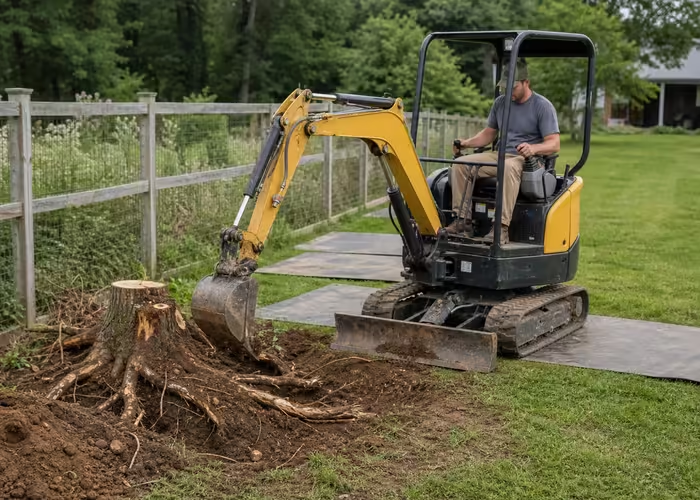
Mini Excavator Stump and Root Removal: Dig Zone, Turf Protection, and Cleanup Plan
A practical mini excavator stump and root removal guide for dig zone planning, turf protection, root cleanup, and property-safe excavation.
Mini excavator stump and root removal can look like a simple digging job, but the real work is planning the dig zone. Roots spread under turf, driveways, fences, drainage lines, irrigation, and landscape beds. Pulling too hard in the wrong direction can damage more than the stump itself.
QiLu Machinery buyers looking at mini excavator equipment should match machine size to access width, soil type, root diameter, lifting needs, and cleanup route. A compact machine can protect tight properties when the operator plans mats, spoil piles, and swing clearance.
This guide combines practical excavation steps with general safety thinking from NIOSH and ground-condition awareness from USDA NRCS.
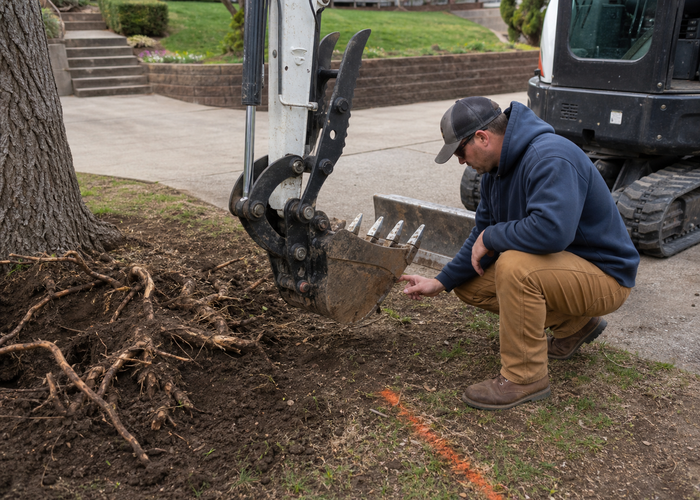
Mark the Dig Zone Before the Bucket Touches Soil
Identify the stump, visible roots, nearby utilities, irrigation, fence posts, retaining walls, paving edges, and desired final grade. The dig zone should include where the excavator sits, where spoil goes, where root sections are staged, and where the cleanup machine or trailer will travel.
Use mats or boards where turf must be protected. A mini excavator is lighter than a large machine, but repeated track turns can still scar lawn or soften soil. Plan travel in straight, slow movements and avoid unnecessary pivoting.
Utilities, Irrigation, and Hidden Lines
Root jobs often happen near houses, barns, driveways, and fences, where hidden utilities are common. Do not assume shallow roots are the only concern. Irrigation lines, lighting cables, drains, and communication lines can sit near the root zone.
If utility location is uncertain, stop and confirm. A small stump job is not worth damaging a buried service. Mark what is known, expose cautiously, and keep helpers out of the bucket swing area.
Root Cutting and Lift Direction
Cut roots in sections rather than trying to lift the whole stump at once. Work around the stump, expose major roots, and separate them before applying lift. Lifting against uncut roots can pull turf, heave pavement, or swing the machine unexpectedly.
For broader equipment planning, compare this type of job with product application solutions and all QiLu Machinery products.
Protect the Property During Removal
Keep spoil organized. Separate usable topsoil from root debris and avoid burying roots in the final grade. A messy pile slows cleanup and can leave voids or settlement after the job is finished.
Watch the fence, driveway, and lawn edges during every swing. It is easy to focus on the bucket and forget the counterweight or blade. Use a spotter when visibility is limited, but keep that person out of the swing radius.
If the stump is close to a structure, reduce force and expose more material before lifting. The safest removal is often slower and more surgical than the operator first expects.
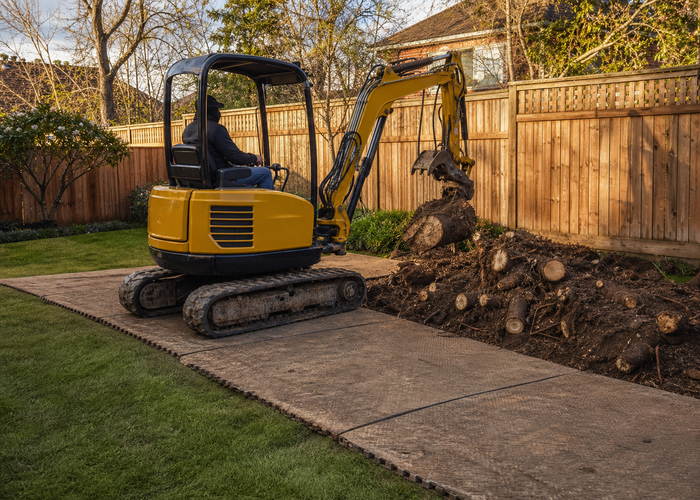
Backfill, Settlement, and Finish Grade
After removal, inspect the hole for loose roots, soft pockets, and unstable edges. Backfill in layers where needed and avoid leaving organic debris that will decay and settle. Match the finish grade to drainage, not just appearance.
Document root size, access constraints, utility concerns, turf protection, and cleanup time. These notes help estimate future stump jobs and choose whether a mini excavator, stump grinder, or hand work is better.
Short Stump Removal Checklist
Mark utilities, protect turf, plan spoil, expose roots, cut sections, lift slowly, watch swing clearance, separate debris, backfill in layers, and photograph the finished site.
Field Scenario: How the Plan Changes the Workday
A good equipment plan changes the first hour of work. Instead of driving directly into the task, the operator reads the ground, checks the machine, studies the route, confirms bystander distance, and decides what the first safe pass should accomplish. This short pause often prevents the long delays that come from rutting, damaged attachments, blocked access, poor drainage, or a machine that has to be recovered later.
The job should be described in ordinary field language. What surface is being protected? Where will material move? What happens if the ground softens? Which edge, fence, doorway, ditch, or slope cannot be damaged? Which part of the route must stay open for other equipment? These questions make the machine choice more practical than a simple horsepower or weight comparison.
Operator Communication and Stop Rules
Every job needs a stop rule that everyone understands. The operator should stop when the machine handles differently, when the route changes, when a person enters the work zone, when a hose or pin looks wrong, when visibility is poor, or when the planned first pass no longer matches the real ground. Stopping early is a professional decision, not a sign of uncertainty.
Helpers should stand where the operator can see them, never between the machine and a fixed object. When a spotter is needed, agree on signals before the machine moves. If the signal is unclear, the operator should stop and reset communication rather than guess.
Inspection Clues During the Job
Some problems appear only under load. A driveway may look firm until the blade begins to pull gravel. A root may seem loose until it lifts a section of lawn. A snow pile may look harmless until it blocks a door, drain, fuel tank, or equipment path. The operator should treat these changes as information and adjust the plan.
Records are useful when they capture the moment something changed. Write down the surface condition, attachment setting, machine behavior, weather, and result. Over several jobs, those notes show which setup works, which route creates damage, and which attachment saves time.
Planning Resources and Link-Rich Notes
For internal planning, compare the task with QiLu Machinery’s all machinery products, product application solutions, equipment application page, and machinery blog. These pages help connect a single job to the wider equipment fleet instead of choosing a machine in isolation.
For external reference, use general safety and site-planning resources from OSHA, NIOSH, USDA NRCS soil health guidance, University of Minnesota Extension farm safety resources, and CDC agricultural safety resources. These resources do not replace the operator manual, but they reinforce the same habits: inspect first, protect people, read the ground, and stop when the machine gives a warning.
Recordkeeping That Actually Helps
A useful record can be short: date, operator, machine, attachment, ground condition, work goal, unusual observations, and follow-up action. The important part is reviewing the pattern. If the same lane washes out, the same root area damages turf, or the same snow pile blocks access, the plan needs to change before the next job.
Managers should turn repeated notes into action. That action may be a repair, a better route, a different attachment, a drainage improvement, or a new training point. A note that is never reviewed is just storage; a reviewed note becomes better uptime.
Choose the Removal Method Before Choosing Force
Not every stump should be attacked with the same digging pattern. A small ornamental tree beside open turf may only need a shallow trench around the roots and a controlled lift. A mature tree near a driveway, fence, drain, or retaining wall needs a slower method that exposes roots, separates them, and protects the surrounding structure. The mini excavator gives the operator reach and precision, but precision comes from planning, not from pulling harder.
Start by deciding what must remain undisturbed. If the lawn is the priority, mats and straight travel matter. If a driveway edge is the priority, bucket teeth should not pry against the pavement. If drainage is the priority, backfill and finish grade must be planned before the stump comes out. These priorities change the machine route, bucket angle, spoil location, and cleanup sequence.
Decision Table for Stump and Root Jobs
| Site condition | Best first move | Risk if ignored |
|---|---|---|
| Stump near utility marks | Expose soil slowly and confirm depth before lifting roots | Damaged buried service or unsafe emergency repair |
| Soft turf access | Use mats, travel straight, and limit track pivots | Ruts that cost more to repair than the stump removal |
| Roots under pavement edge | Cut and remove sections without prying against the slab | Cracked pavement or heaved driveway edge |
| Large root ball | Separate major roots, reduce weight, and lift in stages | Machine instability or uncontrolled stump movement |
Bucket Technique and Stability
A mini excavator is most controlled when the operator uses the boom, arm, bucket, and blade together rather than treating the bucket as a hook. Set the blade to stabilize the machine where the manual allows it, keep the tracks positioned for the expected load, and avoid side-loading the bucket. If the stump resists, the root system is still holding. More digging is usually better than more force.
Operators should also think about where the root ball will go after it breaks free. A wet root mass can be heavier than it appears, and the soil attached to it can fall at the wrong moment. Keep bystanders away from the lift path, set pieces down before repositioning, and avoid carrying debris across turf when a loader, trailer, or staging area would reduce damage.
Cleanup Planning Makes the Job Look Professional
The difference between rough removal and professional removal often appears after the stump is gone. Loose roots, uncompacted backfill, mixed debris, and poor drainage can leave the site worse than before. Separate root debris from soil. Shake loose soil only where it will be reused safely, and do not bury large organic pieces in the hole because they decay and settle.
Backfill should be placed in manageable layers, especially if the area will support mowing equipment, small tractors, trailers, or foot traffic. The final surface should shed water away from structures and should not create a hidden depression. For larger property plans, compare stump removal with related application solutions, equipment application examples, and the broader QiLu Machinery blog.
When to Use Another Tool Alongside the Excavator
A mini excavator can expose and remove roots, but a stump grinder, chainsaw, grapple, loader, or hand tool may still be part of the safest plan. The decision should be based on access, finish requirements, debris handling, and surface protection. For example, grinding may be cleaner for a stump close to a patio, while excavation may be better when roots must be removed before trenching, grading, or drainage work.
Use public safety resources as a reminder to plan around people, not just soil. OSHA, CDC agricultural injury prevention resources, and NIOSH all reinforce practical habits that fit this work: maintain visibility, control the work area, inspect equipment, and stop when the situation changes.
Questions Buyers Should Ask Before Assigning a Machine
For buyers comparing mini excavator options, stump removal is a useful test of real job fit. Ask about access width, operating weight, digging depth, bucket choices, auxiliary hydraulic needs, service points, and transport. A very small machine may protect access but take longer on large roots. A larger unit may dig faster but need more space and stronger turf protection.
Also ask how the excavator will work with other machines on the property. If the same crew maintains gravel lanes, clears snow, hauls material, or prepares drainage, the best fleet may include a tractor or skid steer as well as the excavator. The complete QiLu Machinery product range can help buyers think in terms of workflow rather than a single task.
That workflow view also improves estimates. Crews can quote time, access protection, hauling, backfill, and finish grading more clearly when they separate digging from cleanup instead of treating stump removal as one rough operation.
Practical FAQ
How should this guide be used? Use it as a planning aid together with the machine manual, site rules, and the operator’s field judgement.
What should stop the job? Stop for unstable handling, damaged pins, leaking hoses, unclear visibility, bystanders in the work area, unexpected ground movement, or any condition the operator cannot explain.
How can a small crew stay consistent? Keep the checklist near the machine, use the same stop rules every day, and review short job notes at least weekly.
Mini excavator stump and root removal is cleaner when the operator thinks beyond the stump. The better plan protects turf, utilities, fences, drainage, and cleanup access from the first bucket movement.