Welcome to Shandong Qilu Industrial Co., Ltd

 English
 Arabic
 Bulgarian
 Bengali
 Czech
 Danish
 German
 Greek
 Spanish
 Finnish
 French
 Hindi
 Croatian
 Hungarian
 Indonesian
 Italian
 Japanese
 Korean
 Lithuanian
 Dutch
 Norwegian
 Polish
 Portuguese
 Romanian
 Russian
 Slovak
 Slovenian
 Swedish
 Thai
 Turkish
 Ukrainian
 Vietnamese
 Tagalog
 Malay
 Estonian
 Catalan
 Latvian
 Urdu
 Serbian
 Persian
 Swahili
 Albanian
 Armenian
 Icelandic
 Bosnian
 Luxembourgish
 Afrikaans
English Arabic
Bulgarian
Bengali
Czech
Danish
German
Greek
Spanish
Finnish
French
Hindi
Croatian
Hungarian
Indonesian
Italian
Japanese
Korean
Lithuanian
Dutch
Norwegian
Polish
Portuguese
Romanian
Russian
Slovak
Slovenian
Swedish
Thai
Turkish
Ukrainian
Vietnamese
Tagalog
Malay
Estonian
Catalan
Latvian
Urdu
Serbian
Persian
Swahili
Albanian
Armenian
Icelandic
Bosnian
Luxembourgish
Afrikaans

Loader Lift Capacity vs Breakout Force: What Matters More for Pallets, Gravel, and Round Bales?
A practical tractor loader guide for separating lift capacity from breakout force before handling pallets, gravel, or round bales.
A tractor loader spec sheet becomes misleading when the buyer treats every number as if it described the same moment in the lift. Loader lift capacity and breakout force are connected, but they answer different work questions. One number matters when a pallet must be raised and carried safely. The other matters when the bucket has to pry, peel, or start a dense load moving. Mixing them leads to overconfidence, awkward ballast choices, and jobs that feel far heavier in the yard than they looked on paper.
That confusion appears most often when a buyer compares a farm tractor loader package for three common jobs: unloading palletized materials, carrying gravel for repairs, and moving round bales without feeling unstable at every turn. The right comparison is not simply which loader posts the biggest number. It is which number lines up with the work height, the load shape, the surface condition, and the operator habits that will actually define the day.
The article Loader Lift Capacity Explained is helpful because it separates lift points and test conditions instead of treating capacity as one universal promise. That same discipline matters when a buyer studies a utility machine such as the QL 60HP tractor or a heavier platform such as the QL 904B tractor.
Start With the Work Height, Not the Marketing Number
Lift capacity only becomes meaningful when the buyer asks where the load must end up. A pallet that only needs to rise enough to clear a trailer deck is a different task from a pallet that must be set onto a high rack, stacked in a shed, or carried across rutted ground before placement. Many disappointment stories start when the loader can break the load free from the ground but feels weak or unstable once the boom rises toward its upper range.
This is why the practical first step is to describe the full work sequence. Is the tractor unloading seed, feed, fencing, or paving blocks? Is it scooping wet gravel from a stockpile and feathering it onto a shoulder? Is it carrying wrapped bales from a field edge to a barn apron? Those jobs challenge the loader differently, and buyers who already study tractor application solutions usually make better loader decisions because they connect the spec sheet to the route, the surface, and the attachment, not just the machine.
What Lift Capacity Really Answers
Lift capacity is the better decision number when the main risk is whether the machine can raise and carry a load to the needed height without losing control. On pallet work, bagged feed, fertilizer totes, or stacked landscape material, the important question is not how aggressively the bucket can dig into a pile. The important question is whether the tractor stays planted and steerable with the load low, then remains predictable when the operator raises the load for final placement.
General tractor safety guidance from University of Minnesota Extension and Penn State Extension keeps returning to the same point: stability is a system, not a single spec. Tire condition, rear ballast, loader height, speed, slope, and surface all decide whether a quoted capacity can be used responsibly.
What Breakout Force Really Answers
Breakout force matters more when the bucket has to start a stubborn load moving. Wet clay packed against a bank, compacted gravel at the base of a pile, manure that has settled hard, or a bucket edge peeling sod all depend on force close to the ground. Breakout force is useful because it describes how strongly the loader can curl or pry a load loose before the actual carry phase begins. It is not a substitute for safe full-height lifting performance.
That distinction matters because some buyers assume the higher breakout number means the tractor will also feel stronger with a pallet or bale at carrying height. In real work the opposite can happen. A loader can feel convincing while digging into a pile, then reveal its real limitation when the material has to be raised and moved. A buyer using the wider product application solutions pages to match loader chores with transport distance and surface condition will usually spot that difference earlier.
Why Pallets, Gravel, and Round Bales Stress the Loader in Different Ways
Pallets are compact, dense, and often unforgiving. They test fork geometry, mast height targets, steering feel, and whether the rear of the tractor remains composed when the front axle carries a concentrated load. Gravel behaves differently. It may start as a breakout-force problem at the pile, then become a stability problem while traveling with a full bucket. Round bales shift the decision again because the load sits farther forward and higher on a spear or clamp, which changes leverage and operator visibility.
That is why one loader can feel excellent on bucket work and only average on bale handling, or comfortable with a moderate pallet but clumsy when stacking. The article Tractor Maintenance and Inspection Basics is worth reviewing before purchase because it reminds buyers to study front axle condition, ballast, hydraulic response, and steering components rather than assuming the loader number stands alone.
| Task | The number to study first | Why it matters |
|---|---|---|
| Pallet unloading | Lift capacity at useful height | The load must be raised, kept level, and carried without unstable steering or light rear tires. |
| Dense gravel stockpile | Breakout force first, then carry capacity | The bucket has to enter and curl the material loose before the tractor can move it efficiently. |
| Round bale handling | Lift capacity with ballast and front leverage in mind | The load sits forward, changes visibility, and amplifies the need for a planted rear end. |
| Driveway or shoulder repairs | Balanced view of both numbers | The job mixes prying into pile edges with repeated carry-and-spread passes on uneven ground. |
No table removes the need for a route walk. Buyers should still note the narrow gate, the slope near the barn, the soft shoulder after rain, and the place where the tractor must turn while loaded. The video The Truth About Lift Capacity – What Do These Numbers Actually Mean? is useful because it frames loader numbers around real lift situations rather than brochure shorthand.
Ballast, Tires, and Surface Condition Change the Meaning of Every Number
A loader number without ballast context is incomplete. Rear wheel weights, liquid-filled tires, a ballast box, or a heavy rear implement can change the tractors behavior dramatically. The goal is not to make the rear look heavy for its own sake. The goal is to restore balance so steering, braking, and axle loading stay predictable while the bucket or forks are carrying the job.
Tire choice also shifts the working limit. The comparison in Bobcat’s compact tractor tire guide is a good reminder that industrial, agricultural, and turf tires trade grip, flotation, surface damage, and sidewall feel differently. A loader that feels stable on a firm yard with one tire type can feel far less convincing on damp ground with another.
Surface condition makes the final decision. A tractor that can lift enough on level concrete may still be the wrong tool on a sloped shoulder, around washouts, or beside a barn apron with potholes. This is why buyers should connect loader choice to actual travel patterns on the QiLu Machinery blog and not stop at the published maximum figure.
Pallet Work Rewards Predictability More Than Aggression
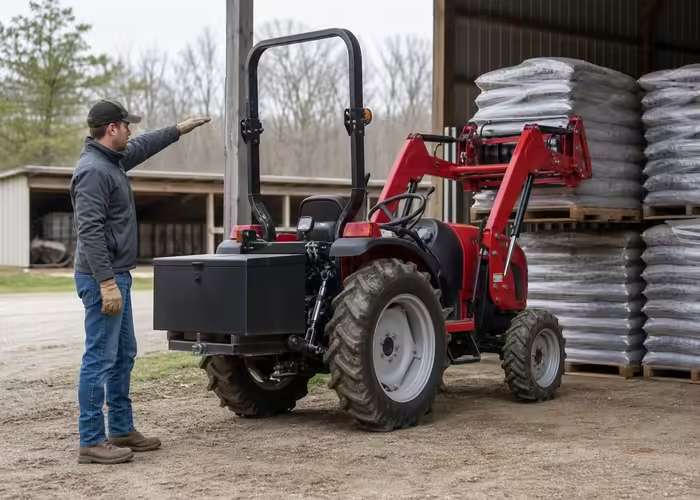
For pallet handling, buyers should prioritize fork visibility, level lifting, rear ballast, and enough capacity at real placement height. A tractor that approaches the job calmly and repeats it safely is worth more than a loader that only impresses when prying into a gravel bank. If the daily work includes unloading seed, parts, pavers, or bagged material, ask for the capacity that matters at the pins or forward position that matches the actual fork frame.
Gravel Work Rewards a Balanced Spec Sheet
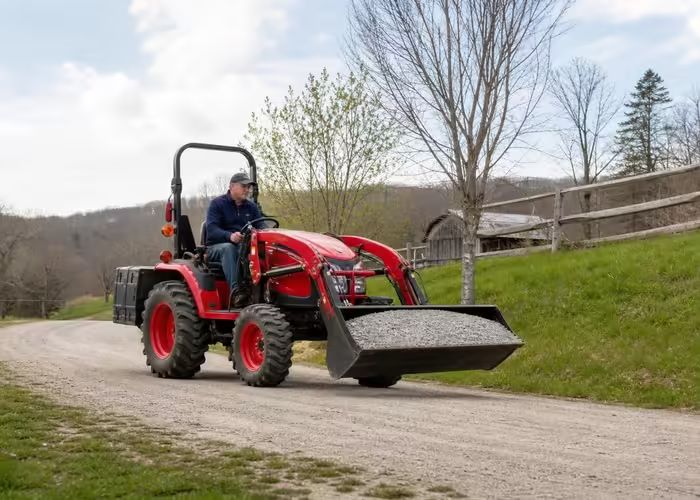
Gravel jobs ask the loader to do both kinds of work. The bucket must penetrate and curl into the pile, which makes breakout force relevant, but the tractor must then carry and place the load over distance, which makes capacity, ballast, and traction equally important. A buyer planning lane or shoulder maintenance should compare these loader chores with the transport and grading tasks shown across the tractor range before deciding that a higher digging number is the same thing as a better day in the field.
Buyer Checklist Before Ordering a Loader Tractor
Ask what the tractor will lift most often, how high the load must go, what ballast will stay on the machine, which tires will be fitted, what slope the machine must cross while loaded, and whether round bales or pallets will be handled on the same route. Then ask whether the operator will actually keep the bucket low in transport and use the tractor as its manual intends. The answers usually expose whether lift capacity or breakout force deserves more attention.
Test the Loader With the Attachment That Will Actually Stay on the Tractor
Many buyers compare loader numbers while imagining the bare bucket, then spend most of the year using forks, a bale spear, or a different bucket profile. That is a mistake because attachment geometry changes leverage, visibility, and how far the load sits from the front axle. A loader that feels excellent with a bucket may feel much less generous once pallet forks move the weight farther forward. The practical answer is to compare the machine in the form it will actually work, not in the stripped-down form that looks strongest on paper.
The same logic applies to counterweight strategy. If a rear blade, mower, ballast box, or heavy three-point implement will be part of the normal day, include it in the buying discussion from the start. The loader should be evaluated as one half of a balanced tractor system. Once the tractor is thought of that way, the buyer stops chasing the largest isolated number and starts chasing the safest combination of front work, rear support, tire contact, and route confidence.
A short property test can reveal more than a long dealership explanation. Lift a realistic pallet, raise it only as high as the real job requires, turn across the actual lane, stop, reverse, and place the load precisely. Then repeat the test with bucket material if gravel work matters. If the tractor feels composed in both patterns, the spec sheet is probably aligned with the work. If it only feels good at one stage of the sequence, the buyer has learned whether lift capacity or breakout force is carrying too much of the sales story.
Choose the Number That Matches the Hardest Normal Day
The best loader purchase is built around the hardest normal day, not the easiest demonstration. If the tractor will mostly carry pallets, buy for safe lift and carry behavior. If it will often peel dense material from the pile face, breakout force matters more, but only if the machine still stays controllable once the load is moving. If it must do both, balance the two numbers and do not ignore ballast, tires, or route quality.
Lift capacity and breakout force are not rival specs. They are different answers to different questions. The mistake is asking one to do the work of the other. Buyers who keep that distinction clear usually end up with a tractor loader that works more calmly, damages fewer surfaces, and feels less stressful when the job gets wet, heavy, or uneven.
Practical FAQ
Can breakout force tell me if a loader can stack pallets? No. Breakout force helps explain how strongly the bucket can start a load moving near the ground. Pallet stacking depends much more on usable lift at the required height, rear ballast, and overall stability.
Is more lift capacity always the best answer for round bales? Not by itself. Bale handling still depends on front leverage, rear ballast, tire grip, route quality, and whether the operator keeps the load low while traveling.
What should I test on a real property visit? Test the loader on the worst regular surface, with the likely attachment, through the tightest turn, and up the slope that will appear during daily work. That is where the difference between lift capacity and breakout force stops being theoretical.