As an R&D engineer who’s spent the last month testing compact and utility configurations across mixed plots, I focus on whether a configuration truly fits the daily jobs on 2–50 acre farms. Disclosure: Qilu is our product. In this guide, I’ll outline how a Qilu farm tractor can match small-farm tasks through measurable criteria—power and PTO, hydraulics, maneuverability, hitch compatibility, emissions, and safety—then show replicable examples with internal resources.
A Qilu farm tractor should be sized by tasks first: mowing width, tillage depth, loader duty cycle, and haul weights—not just acreage.
Use PTO horsepower (typically ~10–20% lower than engine HP) for implement matching; a Qilu farm tractor in the 60 HP class often supports 540 PTO for cutters and tillers.
Hydraulics matter: total and implement flow (GPM) drive loader cycle times and rear-remote attachments; compact Qilu farm tractors commonly align with ~14–18 GPM total in the 60 HP class (industry benchmarks).
Maneuverability: turning radius around ~3.0–3.6 m suits most paddocks and orchards; choose tire and axle setups that keep a Qilu farm tractor nimble.
Emissions operations (EPA Tier 4 Final / EU Stage V) influence DEF and DPF practices; plan maintenance and fuel handling to keep a Qilu farm tractor performing cleanly.
What makes a Qilu farm tractor a strong fit for small farms
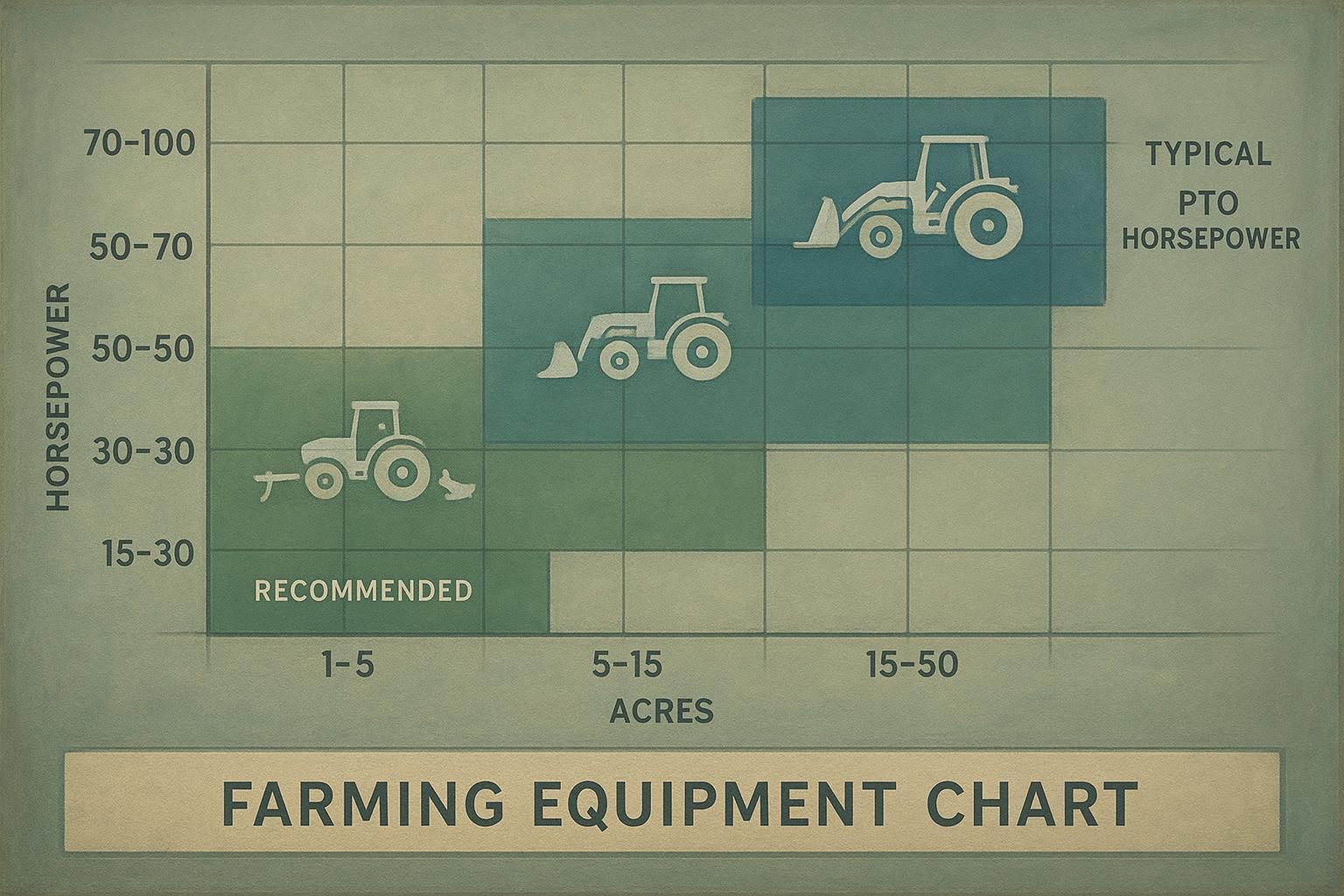
For a small farm, “fit” means one tractor covering more jobs with fewer compromises. Start with tasks and implements, then select the power class:
A Qilu farm tractor in the compact/utility class is built for this blend of tasks. Focus on:
PTO speeds (often 540 rpm, with additional options such as 760/1000 rpm on specific models)
Hitch category (Cat I/II depending on configuration)
Hydraulic rear remotes (number and flow)
Loader compatibility and ballast strategy
The aim is a balanced platform: enough power at the PTO, adequate hydraulic flow, and a turning radius that fits your rows and paddocks.
Power, PTO, and hitch — the engineering primer
Engine horsepower tells you the tractor’s total output, but implements “feel” the PTO horsepower. Due to drivetrain and parasitic losses, PTO HP is usually ~10–20% below engine HP; match implements to PTO HP requirements, not the engine number. For most small-farm attachments (rotary cutters, tillers, augers), 540 PTO speed is standard.
PTO speed options: Many compact/utility platforms support 540 rpm, and some offer 760/1000 rpm for specialty implements.
Hitch category: Cat I fits sub-compact/compact implements; Cat II is common as you move toward 60–90 HP utility classes. Ensure your Qilu farm tractor hitch and PTO match the implement’s spec.
Safety note: Always use PTO guards and correct shaft length; avoid sharp angles that stress U-joints.
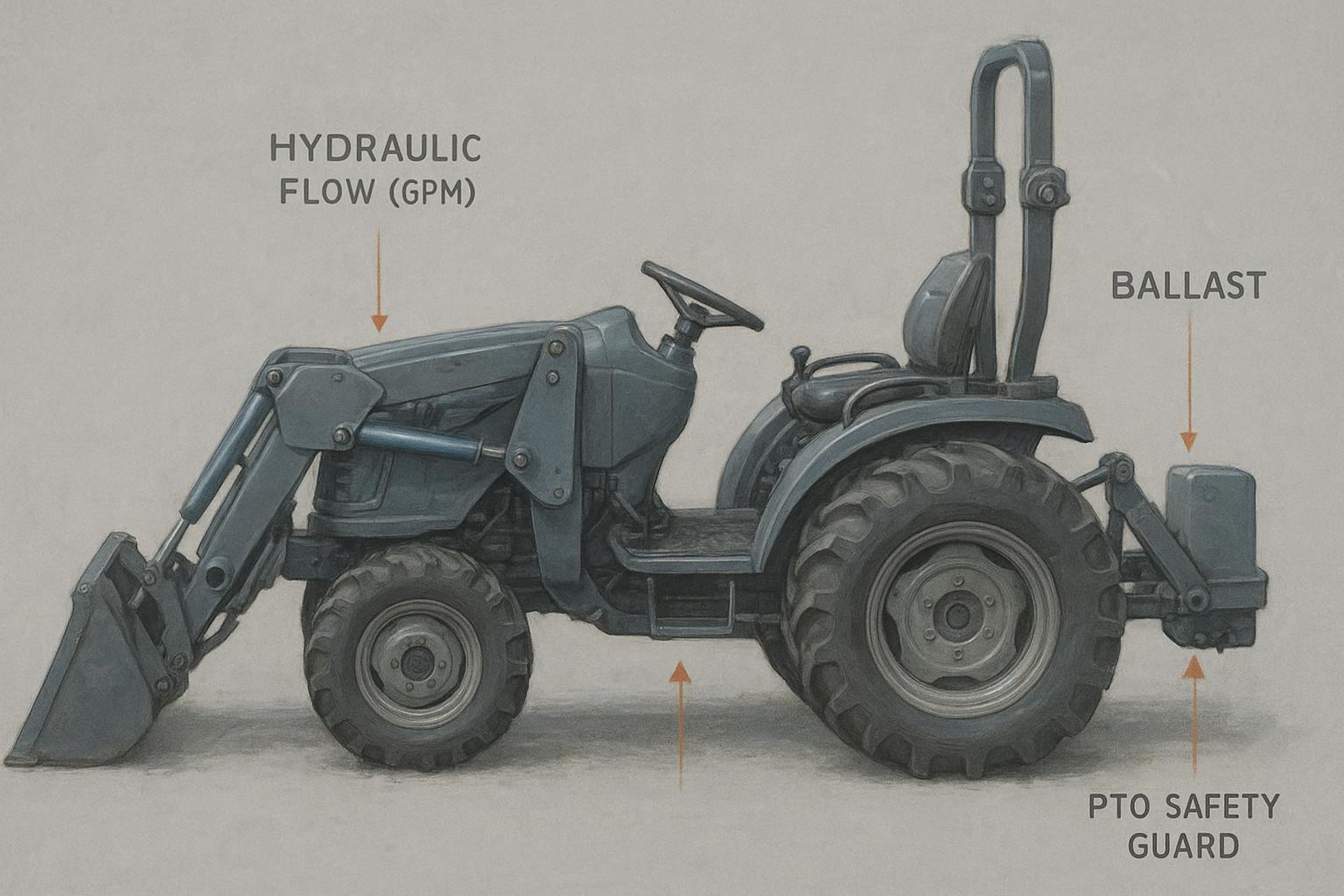
Hydraulic flow drives your loader cycle times, rear-remotes, and steering assist. Two figures matter: total hydraulic flow (sum of pumps) and implement/main flow (available to loader/rear remotes). In compact 60 HP classes, industry examples often show ~14–18 GPM total with ~9–17 GPM available to implements; 90 HP utilities rise into the ~20–33 GPM total range.
Loader stability depends on rear ballast—via a 3-point ballast box or heavy rear implement—to keep your Qilu farm tractor planted and reduce rollover risk. Tire choice (R1 ag vs. R4 industrial), wheel track, and 4WD also influence traction and soil compaction.
Maneuverability matters in tight orchards and fence lines. Expect turning radii roughly ~3.0–3.6 m in compact/utility ranges, varying with axle type (2WD vs. MFWD), tire size, and fender clearance. Adjust tread width to balance stability and row clearance so your Qilu farm tractor stays agile without sacrificing safety.
Practical example — setting up a 12-acre mixed-use farm
For a 12-acre mixed plot with pasture, a garden block, and a few paddock lanes, a 60 HP configuration can be efficient if sized to tasks.
Implements: 6–7 ft rotary cutter, 6 ft rotary tiller, loader with 0.5–0.6 yd bucket, pallet forks.
PTO: 540 rpm suffices for cutter and tiller; verify PTO HP against implement requirements.
Hydraulics: Aim for implement flow in the ~11–16 GPM range for responsive loader cycles.
Ballast: Use a 3-point ballast box (600–900 lb) or heavy rear implement when lifting.
Duty cycle (typical week):
Mowing: 4 hours (6–7 ft cutter at 4–5 mph, 540 PTO)
Tilling/garden prep: 2 hours (6 ft rotary tiller, 540 PTO)
A Qilu farm tractor in the 60 HP class aligns with this profile and keeps tasks consolidated. Review the QL-60HP product page for configuration details and to confirm PTO speed options and transmission.
When a 90 HP utility makes sense on a small orchard
If you manage ~30–50 acres of orchard with narrow rows, frequent spraying, and pallet handling, stepping up to a ~90 HP utility can reduce cycle times and provide hydraulic headroom for sprayers and loaders.
Hydraulics: Target implement flows ~15–23 GPM.
Hitch: Cat II for heavier orchard implements.
Maneuverability: Consider narrow tread options; check turning radius with the exact tire and axle setup so the Qilu farm tractor navigates rows without crop damage.
For orchard tasks needing more capacity, see the QL-904B page and evaluate whether the footprint and hydraulics match your row spacing and attachments.
Emissions and safe operation essentials
Modern compact and utility tractors are shaped by emissions frameworks. In the US, Tier 4 Final controls particulate matter (PM) and NOx in nonroad diesel engines; in the EU, Stage V adds particulate number (PN) limits and in-service monitoring.
DEF and SCR: Many engines use diesel exhaust fluid (DEF) with selective catalytic reduction (SCR). DEF consumption often tracks a few percent of fuel use; see the EPA’s diesel exhaust fluid guidance for handling and storage.
DPF regeneration: Where a diesel particulate filter (DPF) is present, follow operator guidance for active/passive regeneration and avoid long idling during soot accumulation. Tier context is summarized at DieselNet’s nonroad standards overview.
EU Stage V: Legal context is defined in Regulation (EU) 2016/1628; UNECE technical documents explain PN methodologies and ISM. See AEM’s overview of global nonroad emissions regulations.
Video: Compact tractor safety and rollover prevention
Watch: University of Maine Cooperative Extension — Avoiding Tractor Rollovers (YouTube). This authoritative training complements safe loader ballast and slope practices.
Total cost of ownership — sample calculation
Below is a simple, replicable TCO snapshot for a Qilu farm tractor in a 60 HP compact/utility configuration. Adjust inputs to match your hours, fuel prices, and maintenance program.
Item
Assumption
Annual Cost
Operating hours
300 hrs/year
—
Diesel price
$4.00/gal
—
Fuel rate at typical load
2.0 gal/hr
$2,400
DEF consumption (if applicable)
2% of fuel (48 gal) at $3.50/gal
$168
Routine maintenance
Filters/fluids, minor wear
$600
Depreciation
10-year horizon, $45,000 purchase, 35% residual
$2,925
Misc. repairs
Contingency
$400
Estimated annual TCO
—
$6,493
Sensitivity: A ±15% swing in diesel price shifts annual fuel cost by ±$360; ±10% change in hours shifts fuel by ±$240 and maintenance proportionally.
Shandong Qilu Industrial Co., Ltd. is a professional manufacturer and exporter integrating the development and production of excavators, loaders and tractors. We provide the best service, absolutely.


-1.png)