A mini farm tractor—often called a compact or small utility tractor—packs full agricultural capability into a tighter footprint. For most buyers, we’re talking roughly 15–60 engine horsepower, with 25–50 HP covering the majority of small-farm, orchard, and greenhouse needs. Here’s the deal: engine horsepower moves the tractor; PTO horsepower powers your implements. If you’re spraying orchards, tilling in greenhouses, mowing, or hauling produce down the road, you’ll get the best fit by matching PTO power, hydraulics, width/height, and turning radius to the tasks and the space you actually operate in.
This guide explains the core technical features, a step-by-step selection workflow, scenario-specific targets (orchards, greenhouses, small plots, road transport), and two neutral 50 HP examples using Qilu models to illustrate real-world workflows. You’ll also find safety practices backed by authoritative sources and a quick comparison table to help you shortlist.
Key takeaways
A mini farm tractor’s PTO horsepower—not just engine HP—must match implement needs (e.g., airblast sprayers often demand 45–75 PTO HP; rotary tillers need ~4–6 PTO HP per foot of width).
Physical fit matters: overall width (~1.3–1.6 m), low profile, and tight turning radius (≈2.5–3.5 m) are make-or-break in orchards and greenhouses.
Transmission choice affects control: hydrostatic excels at precise low-speed work; shuttle/mechanical offers robust efficiency for ground-engaging tasks; creeper gears help when you need sub–2 km/h crawl.
Hydraulics and 3‑point lift determine loader cycle speed and implement handling; verify pump flow and lift capacity at 24 inches behind the hitch.
Safety isn’t optional: keep PTO guards/shields in place, operate with ROPS and seat belt, and follow SMV and lighting/marking guidelines on public roads.
What is a mini farm tractor?
A mini farm tractor sits below full-size utility tractors in physical dimensions while handling everyday work on small farms, orchards, vineyards, and municipal properties. Practical bands you’ll see in the market:
Sub‑compact: roughly 15–25 engine HP; very small footprint for light-duty jobs and the tightest spaces.
Compact: roughly 25–50 engine HP; heavier frames, wider stance; suitable for loader work, mowing, tillage on small-to-medium plots.
50 HP class: at the boundary of compact and utility; supports heavier implements and transport tasks while still fitting many specialty-row operations.
Industry references converge on these ranges as usable guideposts, even though OEM category lines vary. For context, overview charts and explainers from independent sources outline how compact utility tractors commonly span ~25–50 HP and how the 50–100 HP band edges into utility class; they also stress the difference between engine horsepower and PTO horsepower, especially for implement matching. See the practical horsepower chart from FM World Agri and small-tractor sizing context from TractorToolsDirect for background.
Core technical features that matter on a mini farm tractor
Understanding these specifications helps you match a mini farm tractor to real tasks.
Engine HP vs PTO HP (and why PTO HP rules your implements)
Engine horsepower gets you moving, but PTO horsepower (always lower than engine HP due to drivetrain losses) powers your implements:
Rotary tillers typically need about 4–6 PTO HP per foot of width. A 5‑foot tiller tends to require roughly 20–30 PTO HP. This rule of thumb appears consistently across implement seller guidance.
Rotary cutters/mowers vary by width and vegetation density; plan for ~15–30 PTO HP for typical compact widths.
Airblast sprayers (orchards) are PTO-intensive. University of Vermont Extension notes in a 2024 orchard equipment resource that spray tractors generally require about 45–75 PTO horsepower to power an airblast sprayer.
The takeaway: verify the implement’s PTO HP requirement, then confirm your tractor’s PTO HP on the spec sheet—engine HP alone can’t guarantee compatibility.
Transmissions and creeper gears for precision
Hydrostatic transmissions provide smooth, variable speed control—ideal for mowing in tight spaces, loader work, and greenhouse operations where precise creep speeds matter.
Mechanical/shuttle transmissions (e.g., 8F/8R or 8+2) are durable and efficient for tillage, cultivation, and tasks with repeat forward/reverse cycles.
Creeper gear options enable sub‑1–2 km/h operation—a big help under orchard canopies or between greenhouse benches.
Hydraulics, 3‑point hitch, and PTO speeds
Hydraulic pump flow (liters/min or gpm) influences loader cycle times and how responsive hydraulic implements feel. On compacts between 25–60 HP, main implement pump flows commonly range from the high teens into the 20s l/min, with combined system flows higher when steering pumps are counted (examples vary widely by model and OEM).
3‑point hitch lift capacity (measured at 24 inches behind the hitch) determines what you can safely raise; compact frames often show roughly 900–1,200+ kg in this band, with variance by model.
Category I hitches dominate mini/compact tractors; the most common PTO speed is 540 rpm, with some models offering 540E or 1000 rpm options.
Width and height dictate where you can go. Orchards and greenhouses often need overall widths near 1.3–1.6 m and low profiles to avoid canopy and structural contact.
Turning radius drives headland maneuverability. Specialty narrow tractors can achieve sub‑3.5 m turning radii; premium setups advertise around ~2.9 m with advanced steering systems.
ROPS, PTO guarding, and road lighting/SMV basics
Always operate with ROPS and a seat belt. If your tractor can be retrofitted, university Extension programs provide guidance.
PTO guarding is a regulatory baseline. OSHA’s agricultural equipment rule (29 CFR 1928.57) requires guarding of PTO shafts and related power-transmission components; master shields and driveline shields must be present and maintained.
Public roads: follow lighting/marking and SMV emblem practices consistent with ASABE standards and state rules. Penn State Extension offers a plain-language summary of components (headlamps, tail lamps, hazard flashers, turn indicators, reflectors) and SMV mounting guidelines.
How to match a mini farm tractor to your tasks (a decision workflow)
A simple decision flow prevents mismatches and costly rework.
List your primary tasks and context. Examples: mowing 12 acres of mixed pasture; towing an airblast sprayer through 10‑ft orchard rows; cultivating greenhouse beds with 5‑ft implements; hauling bins to the packing shed.
Map tasks to PTO power, hydraulics, and transmission choices.
Rotary tillers: width × 4–6 PTO HP per foot; pick hydrostatic or creeper gears for slow, precise passes.
Airblast sprayers: verify the fan and pump demands; UVM Extension suggests a 45–75 PTO HP band; confirm your tractor’s PTO HP, not just engine HP.
Loader work: look for responsive hydraulic flow and adequate lift; hydrostatic often eases frequent forward/reverse cycles.
Constrain by physical fit.
Orchard rows: target overall width ~1.3–1.6 m; plan turning radii ≈2.5–3.5 m.
Greenhouses: consider low-profile setups and narrow widths; ensure aisle clearance and ventilation.
Choose transmission and options.
Hydrostatic for precise speed control and frequent direction changes.
Shuttle/mechanical for durability in ground-engaging tasks; add creeper gears for sub‑2 km/h crawl when needed.
Confirm safety and compliance.
ROPS + seat belt; PTO guards/shields intact.
SMV emblem, lighting and marking per state/ASABE guidance for road travel.
Shortlist models and verify exact specs.
Check PTO horsepower on the spec sheet.
Confirm hydraulic pump flow and 3‑point lift at 24 inches.
Test-fit implements or consult implement manufacturers.
Printable checklist (use this as your buyer’s worksheet)
Primary tasks and acreage listed (mowing, tilling, spraying, loader, hauling)
Required PTO horsepower verified against implements
Hydraulic flow and 3‑point lift capacity confirmed
Overall width/height and turning radius fit your rows/aisles
Transmission type selected (hydrostatic vs shuttle/mechanical) and creeper gears as needed
Safety features present: ROPS/seat belt, PTO guards, road lighting/SMV
Internal shortlist with PTO HP, hydraulics, lift, dimensions, and links to spec sheets
Scenario guidance: orchards, greenhouses, small plots, and road transport
Orchards and vineyards: narrow width, turning radius, and sprayer PTO bands
Orchards and vineyards prioritize narrow width, low profile, and crisp steering. Typical targets:
Width: roughly 1.3–1.6 m for many specialty rows (verify your spacing).
Turning radius: aim for ≈2.5–3.5 m depending on headland length and row spacing.
PTO needs: airblast sprayers often fall in the ~45–75 PTO HP range; a 50 HP engine tractor may or may not meet this depending on the actual PTO HP.
Operator tips:
Keep PTO master shields and driveline guards in place; do not step over a running PTO.
Consider creeper gears for under‑canopy cultivation and precision spraying.
Greenhouses and high tunnels: low profile and low-speed control
Confined structures demand compact geometry and disciplined speed control:
Aim for narrow widths (≤1.4–1.5 m) and low profiles to avoid structural contact.
Hydrostatic transmissions or creeper gears help maintain crawl speeds for transplant handling and bed prep.
Ensure adequate ventilation when operating combustion engines inside enclosed structures; plan tasks when fans and openings can run.
Small plots & family farms: versatile configurations
For mixed tasks across 5–20 acres, compact tractors in the 25–50 HP band offer flexibility:
25–35 HP: good for light tillage, mowing, loader work on smaller acreages.
35–50 HP: adds headroom for heavier implements and transport while retaining compact maneuverability.
Choose tire treads (R1/R3/R4) based on soil type and turf protection needs.
Budget-minded buyers can also explore curated lists like best cheap compact tractors for small farms, keeping in mind that exact PTO horsepower and hydraulics must be verified per model.
Road transport & municipal work: visibility and compliance
When traveling on public roads or performing municipal maintenance:
Use an SMV emblem cleanly mounted (commonly ~3–5 ft high); replace faded emblems.
Verify lighting/marking components: headlamps, tail lamps, hazard flashers, turn indicators, and reflectors consistent with ASABE guidance and local rules.
Keep loads secured and respect local speed limits.
50 HP examples: mini farm tractor workflows using QL‑504Y and QL‑504E (Disclosure)
Disclosure: Qilu is our product. The following examples use publicly listed dimensions and weights to illustrate fit and workflow. Always verify PTO horsepower, hydraulic flow, and 3‑point lift for your actual implement matching.
Qilu QL‑504E (also listed as QL‑504G on certain pages) (50 HP): weight 1,410 kg; wheelbase 1,800 mm; overall dimensions 3,450 × 1,400 × 2,000 mm; geared transmission; use cases: greenhouse, orchard, small spaces, family use. See the page: Qilu QL‑504E 50HP.
Example A: Orchard spraying and light cultivation with a 50 HP mini farm tractor (QL‑504Y)
Context: A 12‑acre apple orchard with 10‑ to 12‑ft rows, mixed slopes, and a rear-mounted airblast sprayer.
Challenge: Fit a tractor that can navigate narrow headlands, maintain safe under‑canopy passes, and power a mid‑size airblast sprayer.
Selection rationale:
Geometry: The ~1.4 m overall width helps fit typical orchard rows; the 1,800 mm wheelbase supports stability.
Transmission: A shuttle/mechanical gearbox with creeper (if equipped) aids precision crawling in spray lanes.
PTO power: The sprayer demands are verified against the tractor’s PTO horsepower; if the sprayer requires, for example, ~55 PTO HP, the operator must confirm the tractor’s PTO HP rating or choose a smaller fan/pump configuration.
Workflow steps:
Pre‑check: Inspect PTO master shield and driveline guards; check tire pressures and ballast.
Calibrate sprayer: Use nozzle charts to set target gpm and pressure; add 25–30% margin for agitation and line losses per standard pump sizing guidance.
Operate at crawl: Engage low range/creeper; maintain steady rpm to keep PTO speed at 540.
Headlands: Plan turns in wider headlands or use multi‑point turns within safe limits.
Post‑run: Rinse and clean sprayer; inspect shields again; log maintenance.
Example B: Greenhouse handling and perimeter mowing with a 50 HP mini farm tractor (QL‑504E)
Context: A diversified vegetable operation with multiple high tunnels, 5‑ft benches, and perimeter grass areas needing mowing.
Challenge: Move pallets and trays through tight aisles; mow perimeter paths without damaging turf.
Selection rationale:
Geometry: 3,450 × 1,400 × 2,000 mm dimensions aid clearance in tunnels.
Transmission: Hydrostatic (if available on the chosen configuration) or low‑range gearing plus careful throttle for crawl speeds.
Tires: R3 (turf) or R4 (industrial) to balance traction and minimize compaction; verify pressure.
Workflow steps:
Ventilation: Open sidewalls and run fans before engine operation inside structures.
Handling: Use low gear/hydrostatic slow movement; keep forks low; spotters in tight turns.
Mowing: Choose a cutter width compatible with PTO HP and turf needs; verify manufacturer specs.
Daily checks: Inspect hydraulic couplers, ensure ROPS and seat belt use; confirm PTO guards intact.
Quick comparison table: 50 HP vs typical 35 HP vs 25 HP
Item
Engine HP
PTO HP
Weight
Wheelbase
Width
Hyd. Flow
3‑pt Lift
PTO speeds
Typical tasks
Source
Qilu QL‑504Y
50 (engine)
n/a
1,410 kg
1,800 mm
~1,400 mm
n/a
n/a
540/720 or 540/1000 (varies)
Orchard spray, rotary till, transport
Qilu product pages
Qilu QL‑504E/504G
50 (engine)
n/a
1,410 kg
1,800 mm
~1,400 mm
n/a
n/a
likely 540 rpm
Greenhouse, orchard, small spaces
Qilu product pages
Typical 35 HP compact
~35
~28–30
~1,300–1,700 kg
~1,700–1,900 mm
~1,300–1,600 mm
~18–25 l/min main
~900–1,200 kg
540
Mowing, light till, loader
OEM examples
Typical 25 HP sub/compact
~25
~18–20
~1,000–1,400 kg
~1,500–1,700 mm
~1,200–1,500 mm
~15–20 l/min
~500–900 kg
540
Mowing, light loader
OEM examples
Notes: “n/a” indicates data not visible on accessible product pages at the time of writing. Always confirm PTO horsepower, hydraulic flow, and 3‑point lift on official spec sheets before matching implements.
Maintenance, safety, and operator checklist
Pre‑season: Service engine oil and filters; check hydraulic fluid and hoses; inspect 3‑point hitch pins; test PTO shields and master shield; verify ROPS and seat belt condition.
Daily: Walk‑around inspection (tires, leaks), clean lights and reflectors, confirm SMV emblem visibility, test brakes/steering, check PTO disengagement and guards, ensure implements are pinned and locked.
PTO safety: Keep shields in place per OSHA agricultural equipment requirements; avoid loose clothing; never step over a rotating shaft; disengage PTO and shut down before dismounting.
Road travel: Follow Penn State Extension’s lighting/marking guidance; use hazard flashers and indicate turns; keep loads balanced and tied down.
Troubleshooting: Sluggish loader? Check hydraulic filters and pump flow specs; uneven tiller results? Verify PTO rpm and ground speed; poor spray coverage? Re‑check nozzle flow and pressure and calculate needed gpm plus 25–30% margin for agitation.
Visuals: orchard and greenhouse examples + YouTube safety video
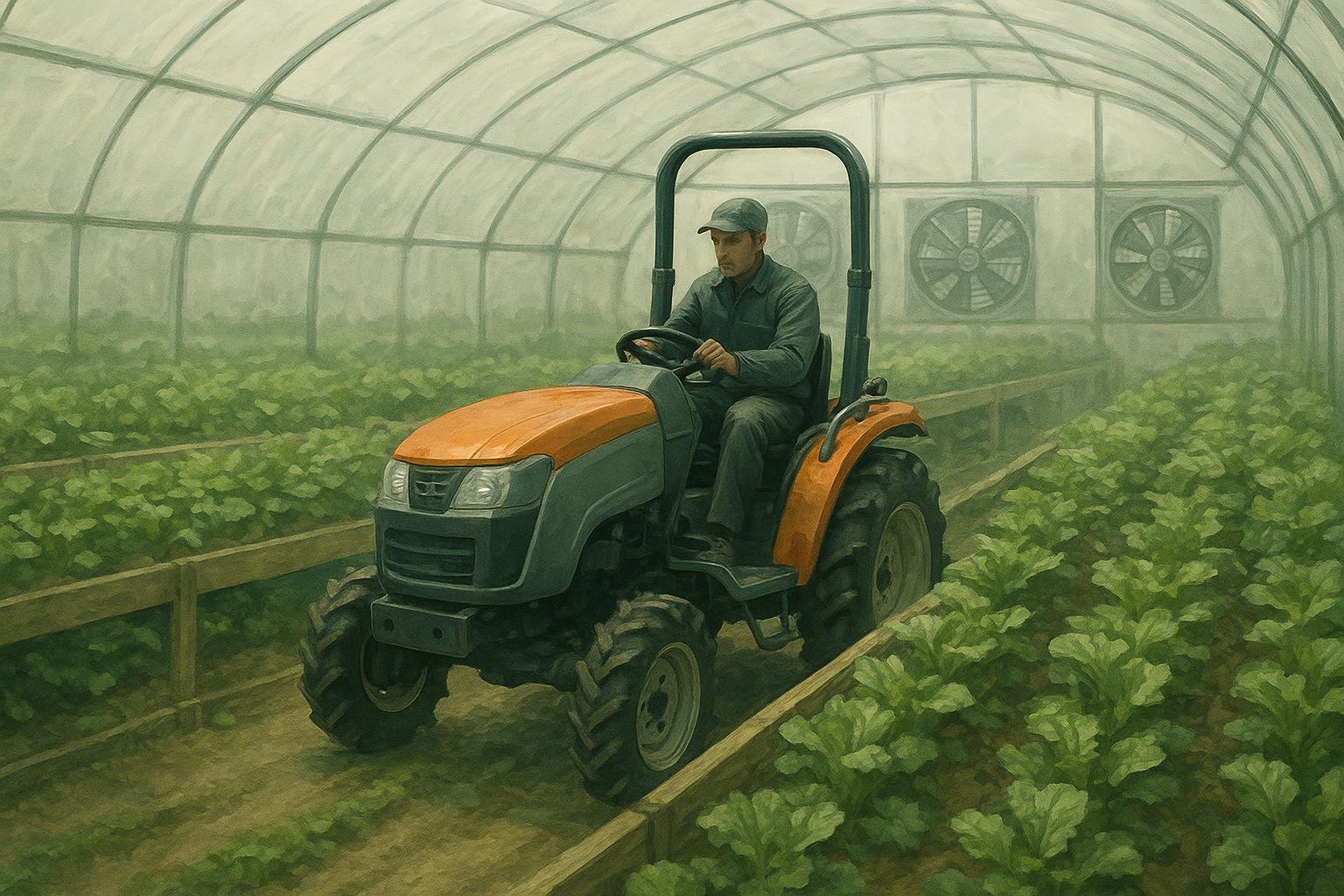
Caption: A mini farm tractor operating at controlled crawl speeds between greenhouse benches. Narrow width and low profile reduce structure contact risk; ventilation fans should be in use for engine operations.
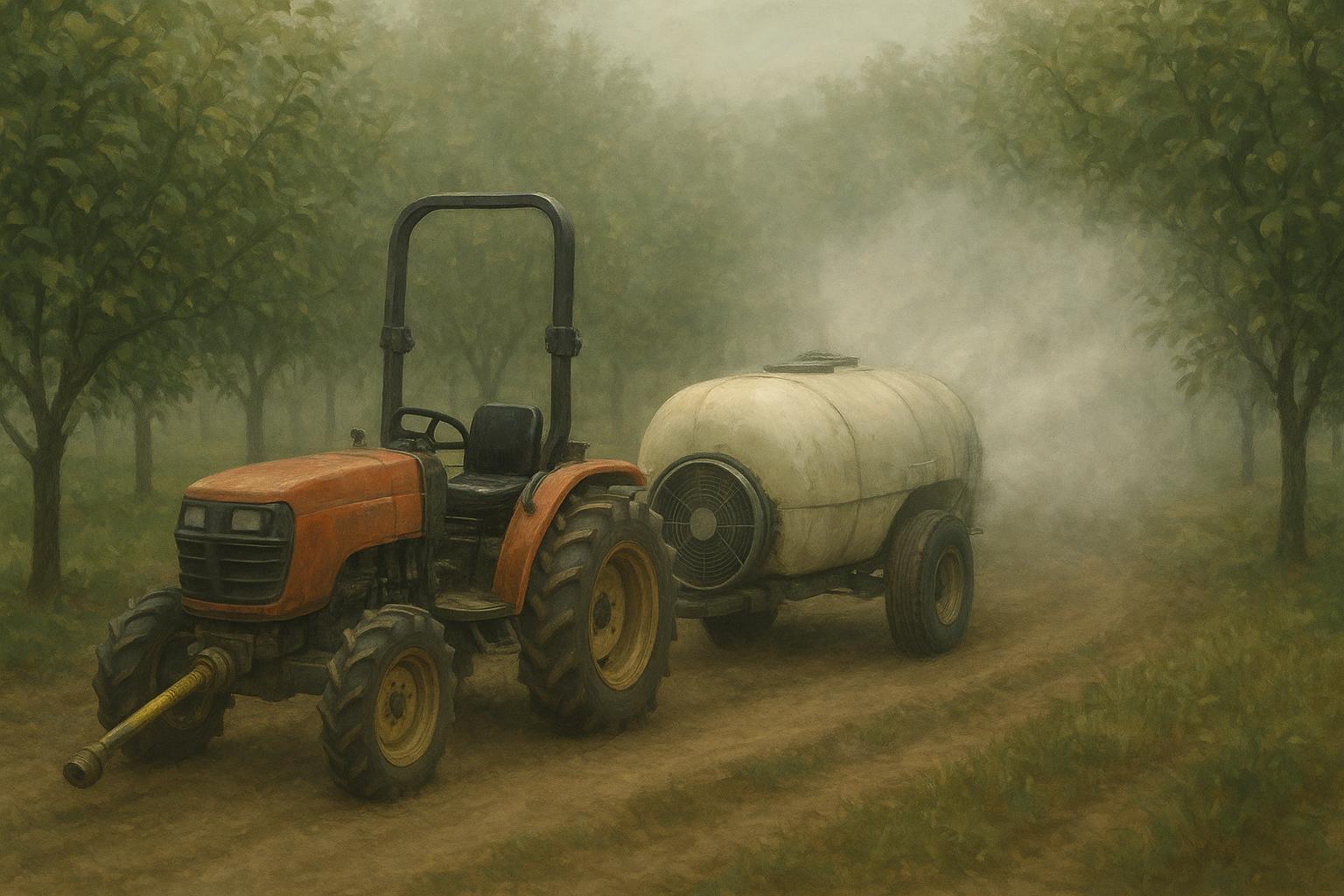
Caption: Orchard workflow with an airblast sprayer. PTO shields and ROPS are visible; confirm PTO horsepower meets the fan and pump requirements before field operations.
When you’re ready to inspect dimensions for orchard or greenhouse fit, review the 50 HP examples: Qilu QL‑504Y 50HP and Qilu QL‑504E 50HP (Disclosure: Qilu is our product). Verify PTO horsepower and hydraulics against your implements and local terrain.
FAQ: mini farm tractor selection, operation, and safety
What PTO speed do most mini farm tractors provide? Most compacts offer 540 rpm; some include 540E or 1000 rpm options. Always match implement requirements to actual PTO speed.
How do I decide between hydrostatic and shuttle/mechanical transmissions? Hydrostatic suits precise low‑speed work and frequent direction changes (mowing, loader). Shuttle/mechanical favors durability and efficiency for tillage and cultivation. Creeper gears add crawl speed control.
What width should I target for orchards and vineyards? Many specialty rows work well with overall widths ~1.3–1.6 m, but measure your spacing and allow margin for turning.
Can a 50 HP engine tractor run an airblast sprayer? It depends on PTO horsepower. Many airblast units need ~45–75 PTO HP. Confirm your tractor’s PTO HP and the sprayer’s requirement.
What tire tread is best for greenhouse and turf? R3 (turf) or R4 (industrial) help reduce compaction and turf damage; adjust pressures to spec for stability and protection.
What are the must‑do safety checks before field work? Inspect PTO shields, confirm ROPS/seat belt, test lights/flashers, check tire pressures and ballast, and verify implement pins/locks.
Do I need an SMV emblem on public roads? Yes for slow‑moving equipment; keep it clean, properly mounted, and replace when faded. Follow lighting/marking guidance and local regulations.
If you need a compact, orchard‑ready geometry and 50 HP class dimensions to evaluate, check Qilu QL‑504Y and Qilu QL‑504E—and verify PTO horsepower and hydraulics against your implements (Disclosure: Qilu is our product).
Shandong Qilu Industrial Co., Ltd. is a professional manufacturer and exporter integrating the development and production of excavators, loaders and tractors. We provide the best service, absolutely.








-1.png)