Email: [email protected] Whatsapp: +8618266768780

Email: [email protected] Whatsapp: +8618266768780


When you need a diesel tractor with PTO and reliable loader support, the right manufacturer decision will determine what you can actually get done—mowing, tilling, augering, hauling, grading—and how quickly you can get help when something breaks. This guide distills what matters most so you can verify specs, confirm loader fit, and secure local after-sales support before you sign.
Think in tasks, not in model names. On 5–50 acres, a diesel tractor with PTO often handles rotary mowing, garden tilling, driveway grading, post-hole digging with a PTO auger, and steady loader work for mulch, gravel, and manure. Write down primary attachments, their widths, and how often you’ll run each. If loader work is a weekly chore, loader performance and hydraulic specs move to the top of your decision list.
A compact diesel tractor with PTO in the 20–30 HP range can handle a 4–5 ft rotary cutter and tiller while managing light loader duties. Stepping into the 30–45 HP band opens wider implements and stronger loader performance. Your shortlist of manufacturers should clearly publish PTO horsepower ratings, three-point hitch category, and loader specs that fit these jobs. If they don’t, ask for documents before you consider them.
A diesel tractor with PTO has two power numbers to consider: engine horsepower and PTO horsepower. Engine HP is higher; PTO HP is what actually spins your mower, tiller, or auger. For most small implements, plan around the implement’s recommended PTO horsepower.
If you’re choosing between two manufacturers for a diesel tractor with PTO, pick the one that can document PTO horsepower ratings in writing and provide an operator’s manual or spec sheet before purchase.
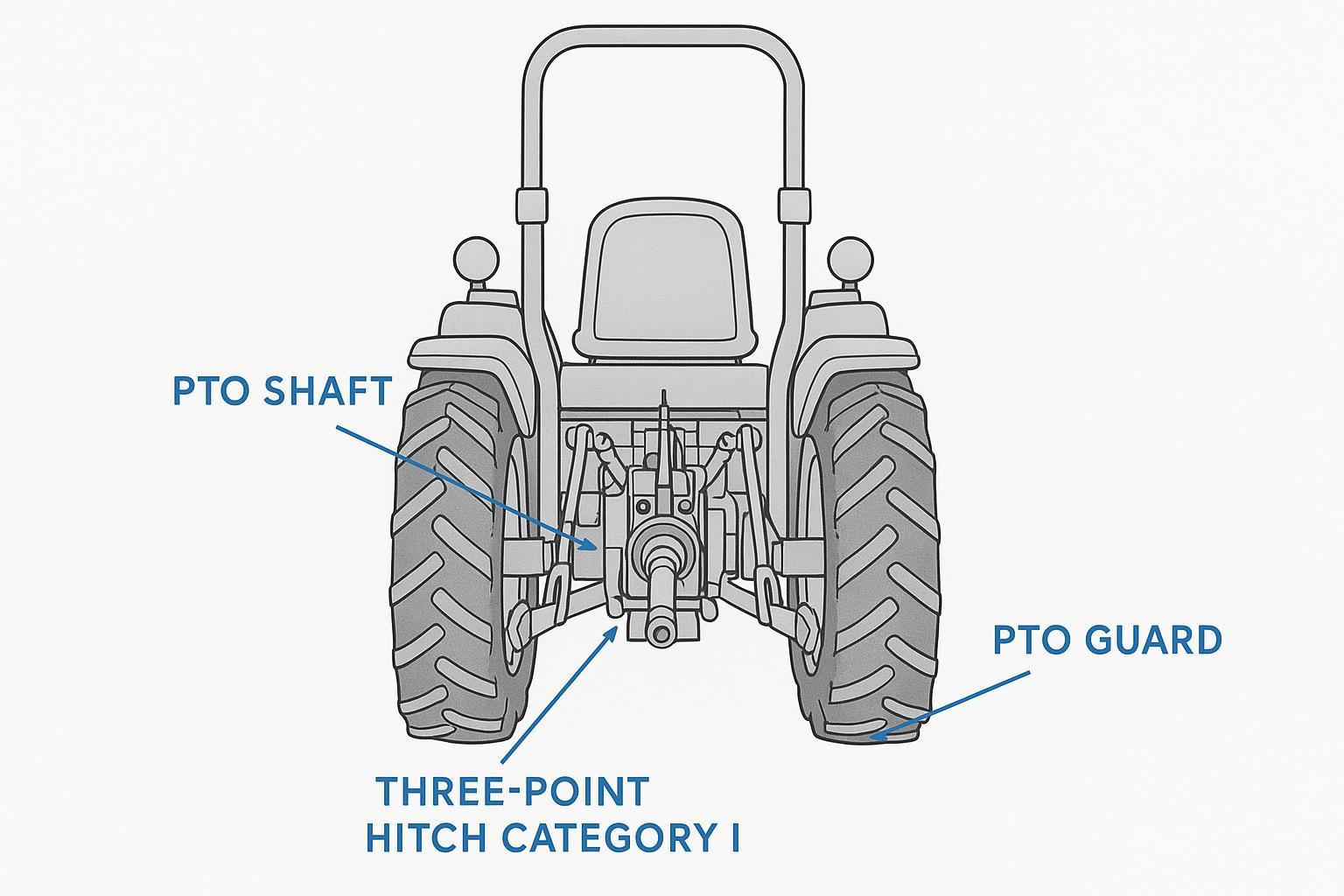
Before you fall in love with paint color, confirm the hitch. Category I is common on compact tractors; Category II appears as you move into heavier utility models. Category I typically covers about 20–45 HP with specific pin diameters; Category II runs larger. The University of Maine Extension summarizes pin sizes and typical ranges in their bulletin on three-point hitch specifications: see UMaine Extension Bulletin #2361. Measure your implements’ pins and spacing and match them to the tractor’s hitch category to avoid surprises.
Lift capacity also matters for heavier implements like a fully loaded tiller or a ballast box. Ask for the rear lift capacity at the standard 24 inches behind the hitch balls—published numbers should be comparable across manufacturers because that measurement point is widely referenced.
Loader work is often where buyers feel the difference between manufacturers. To ensure front-end loader compatibility on a diesel tractor with PTO, verify these items on paper and in person:
For a primer on core implement choices and compatibility reminders, see this guide to must-have implements for first-time tractor owners, which calls out the importance of confirming front-end loader compatibility before you buy.
A diesel tractor with PTO that fits your tasks is the first half of the decision; the other half is local support. Here’s what to verify with any manufacturer’s dealer network:
Ask for two references from nearby owners with similar acreage and loader attachments. If you can’t find evidence of local tractor dealer support—clear contacts, published service hours, and a straightforward warranty process—keep looking. For baseline coverage language, review the manufacturer’s warranty FAQ and then confirm specifics with your local dealer.
Disclosure: Qilu is our product. We’ll use the QL‑254Y purely as a practical example of how to verify specs with any manufacturer.
If the answers are clear and documented, you’re on the right track. If not, consider that a signal to widen your search.
Operator protection and PTO safety aren’t optional on any diesel tractor with PTO. University and government sources are crystal clear on the biggest risks and the controls that work:
Build these habits into your first week of ownership; they’re just as vital as any attachment.
Below is a conservative, non-exhaustive summary to orient your choices for a diesel tractor with PTO. Always verify against implement spec sheets and the manufacturer’s documentation.
| Tractor PTO HP band | Typical implements | PTO notes | Hitch notes |
|---|---|---|---|
| ~18–22 PTO HP | 4 ft rotary cutter, 4 ft tiller, light post-hole digger | 540 rpm common; check PTO horsepower ratings on implement | Category I; verify pin sizes and lift capacity |
| ~23–30 PTO HP | 5 ft rotary cutter, 5 ft tiller, medium post-hole digger | 540 rpm; confirm PTO type for frequent engagement | Category I; ballast recommended for loader work |
| ~31–45 PTO HP | 5–6 ft cutters and tillers, augers, small hay tools | Mostly 540 rpm; some implements may require more PTO power | Category I or II depending on model; confirm lift at 24 in |
Notes: Hitch category dimensions summarized by University of Maine Extension Bulletin #2361. Standard PTO speeds are widely referenced in extension safety materials and test protocols, including Penn State Extension’s PTO Safety and Farm-Energy/NTTL guidance on using tractor test data.
Below is a credible university resource that demonstrates safe loader operation principles you’ll apply to any diesel tractor with PTO.
Use this quick checklist before choosing a manufacturer for a diesel tractor with PTO:
If you want a broader view of attachments and where to start, see tractor attachments to prioritize purchases and match them to your tractor specs. For first-time owners, these notes on must-have implements also provide a practical checklist.
Q1: What PTO speed should I prioritize for small-acreage work with a diesel tractor with PTO? A: Prioritize 540 rpm because most compact implements use it. Verify the tractor’s PTO selector shows 540 clearly and that the operator’s manual explains how to engage it.
Q2: How do I know if a diesel tractor with PTO can safely run a post-hole digger? A: Check the implement’s recommended PTO horsepower and confirm the tractor’s PTO horsepower meets or exceeds it. Make sure you can maintain 540 rpm under load without lugging the engine and keep all guards in place.
Q3: What matters most for loader performance on a diesel tractor with PTO? A: Documentation. Confirm hydraulic flow and pressure, rated lift capacity at the pivot pin and 500 mm forward, quick-attach type, and whether a third function is available if you plan to use grapples.
Q4: Is Category I enough for most small farms using a diesel tractor with PTO? A: Often yes for 4–5 ft implements. Measure your implement pins and review University of Maine Extension’s category dimensions to be sure. Larger or heavier implements may push you into Category II.
Q5: How can I evaluate local support before choosing a manufacturer for a diesel tractor with PTO? A: Ask for parts stocking lists, warranty claim timelines, technician coverage, and two nearby customer references with similar workloads. If answers are vague, that’s a red flag.
Q6: Which safety features are non-negotiable on a diesel tractor with PTO? A: ROPS and a seat belt, intact PTO shielding, and clear shutdown procedures. University extension and safety investigations repeatedly show these controls prevent severe injuries.
References and further reading:
Internal resources for planning:







-1.png)