Email: [email protected] Whatsapp: +8618266768780
Email: [email protected] Whatsapp: +8618266768780


You’ve just bought a farm tractor and you’re ready to move pallets, gravel, and hay. This guide walks you through safe, efficient loader work with a compact farm tractor, from first‑week setup to proven workflows for pallet forks and bulk materials, plus troubleshooting and maintenance you can actually use. We’ll keep the advice grounded in authoritative guidance and real‑world practice so you can work confidently on your property.
A safe, productive week with a farm tractor starts with stability and sightlines. Roll‑Over Protective Structures (ROPS) should be locked upright and paired with a seat belt. Operator training materials emphasize carrying the loader close to the ground and avoiding quick starts and turns. Ohio State University Extension advises operators to keep the bucket “as low as possible when turning and transporting,” avoid quick maneuvers, and watch for surface depressions and obstructions; they also remind operators to plan slopes so that heavy loads travel uphill rather than downhill when possible. See the detailed guidance in the Ohio State University Extension fact sheet, Tractor Loader Safety for Trainers and Supervisors, for the full context and rationale (Ohio State University Extension—loader safety). The Ontario government echoes the same operating posture: when travelling, keep the loader close to the ground and maintain controlled speed and visibility (Ontario—tractors and self‑propelled equipment). For a standards overview, review OSHA’s equipment and ROPS sections to understand the safety framework (OSHA standards index).
Ballast and tire pressure. Loader work shifts your farm tractor’s center of gravity forward. Add rear ballast with a 3‑point implement or ballast box, consider cast wheel weights or liquid ballast in rear tires, and set tire pressures to spec for the load and terrain. Extension resources explain that appropriate ballast and tire pressure improve stability and traction while reducing wheel slip and tip‑over risk. If you’re operating a compact 25–40 HP class, check your specific model’s specs for basic dimensions/weights before choosing ballast—examples include the compact 25 HP class specs for the QL‑254Y farm tractor and the 30 HP class dimensions on the QL‑304Y farm tractor. For 35–40 HP classes, see the QL‑354Y farm tractor overview and the QL‑40 farm tractor page. Verify loader/fork options with the manufacturer before operating near capacity.
Route planning and visibility. Before the first job, walk your route to identify ruts, holes, or obstacles. Set speed to conditions, widen the wheel track if your model allows, and maintain clear sightlines. Do not travel with the bucket or pallet forks raised; keep them low, and use smooth, progressive steering and braking.
Pallet forks unlock efficient material handling on a compact farm tractor—seed, feed, lumber, and equipment can be moved without manual handling. Follow this safe, repeatable workflow.
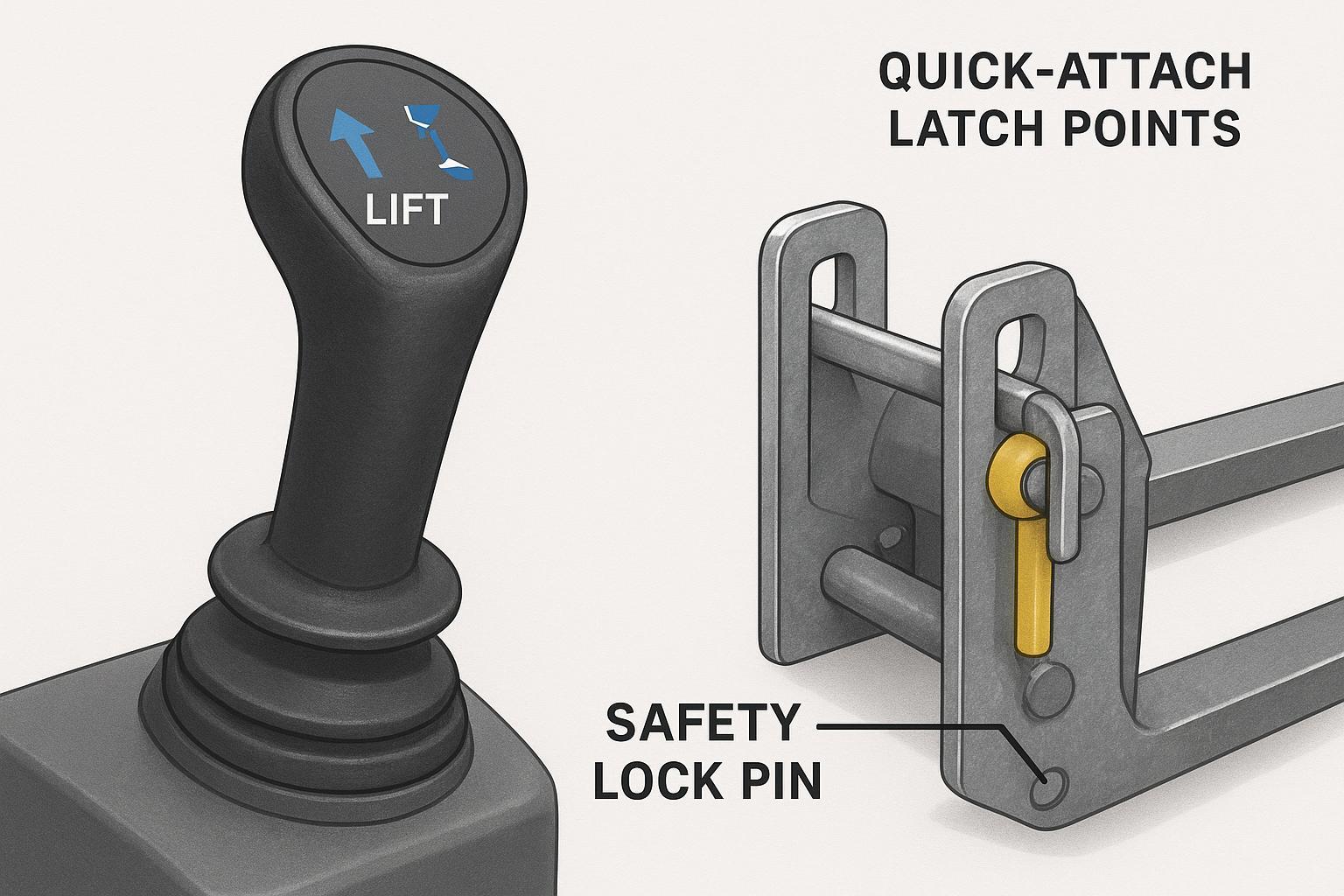
Caption: Loader joystick directions and quick‑attach safety pins—confirm lock engagement before lifting any load.
Product context example (neutral). Disclosure: Qilu is our product. A compact 25–30 HP farm tractor such as the QL‑254Y or QL‑304Y can be configured for light pallet handling on small farms when paired with model‑appropriate loader and forks. Always confirm loader/fork options and rated capacities for your specific configuration before operating near the limits.
Bulk materials demand smooth control and repeatability. Think of this workflow like a loop you’ll refine for speed and safety.
Cycle time estimates depend on distance, material, and operator skill. In a tight farmyard, compact farm tractor operators often complete a scoop‑haul‑dump cycle in roughly 30–90 seconds; longer routes and rough ground push that higher. Your priority is control and stability, not racing the clock—efficiency follows smooth technique.
Short‑haul staging—moving implements, bins, or bagged goods—benefits from forklift habits adapted to a farm tractor. Start by confirming the load’s weight and attachment security. Choose the shortest, safest path with good footing and minimal cross‑slope, then travel with the load close to the ground. Keep your hands light on the joystick, scan ahead for ruts or obstructions, and maintain a slow, steady pace. At the destination, lower the load fully to the ground or onto stable dunnage, neutralize the controls, and only then detach or reposition attachments. These habits protect stability and visibility, aligning with government operator precautions that emphasize low carry height and controlled speed during travel (Ontario—operator precautions).
Video: See a loader in action on the Qilu channel. While the demonstration shows a higher‑HP machine, the carry‑low, smooth‑control principles apply to compact models too: QILU Front End Loader demo.
Loader performance issues often trace back to simple causes: low hydraulic fluid, a clogged filter, a mis‑seated quick coupler, or worn seals. Start with a short inspection routine every day you run loader tasks, and never work beneath a raised loader without mechanical supports in place.
Daily inspection and greasing rhythm. Before operation, verify fluid levels, tire condition/pressure, secure pins/locks, working lights/brakes/steering, and joystick response. Lower the loader to the ground when parking or servicing. Many compact loader pivot points benefit from greasing about every 10 hours of loader use; consult your manual and adjust for heavy dust or rain exposure. Extension resources underscore that usage‑based greasing and timely filter changes keep hydraulics smooth and cool.
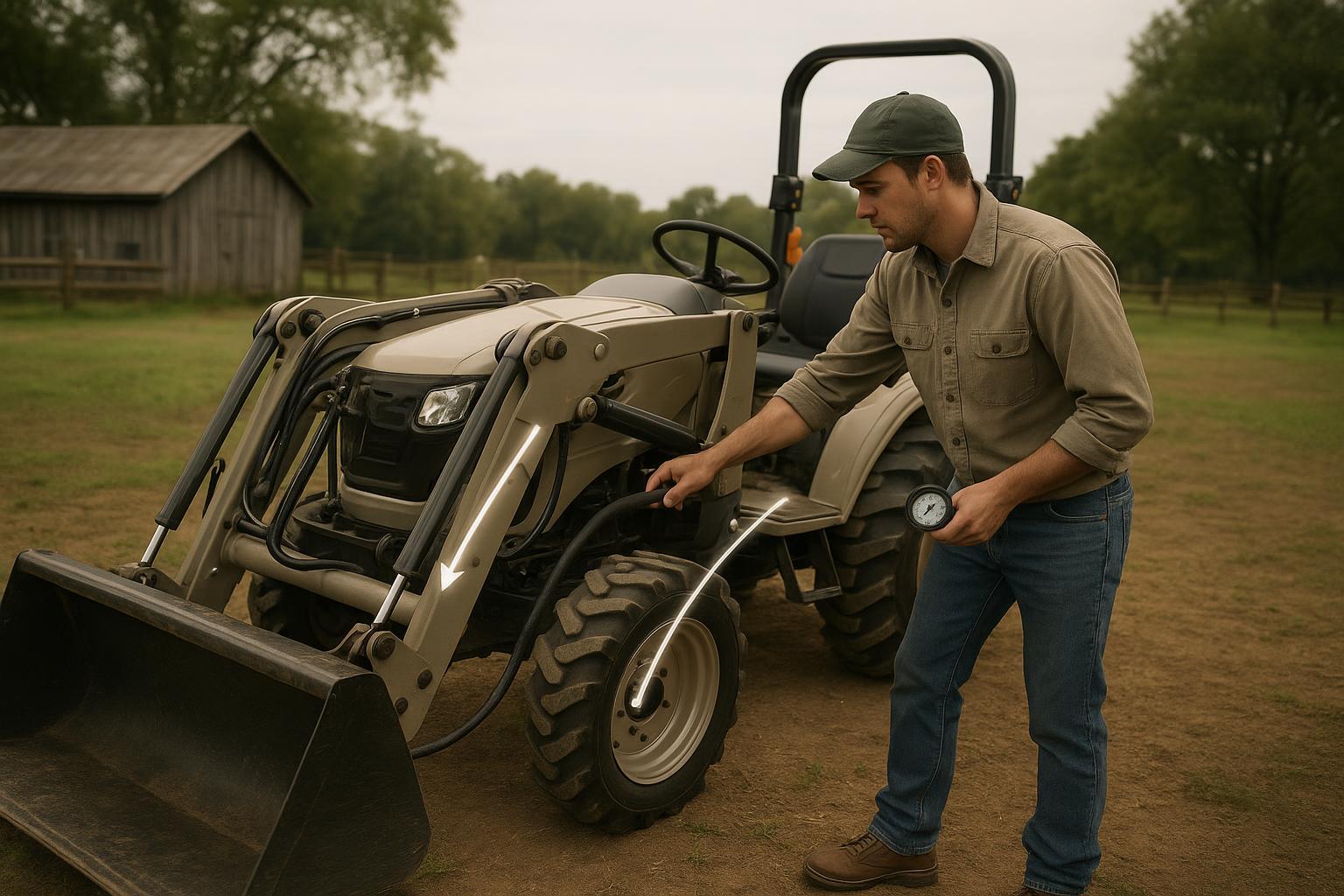
Caption: Pre‑use walk‑around—check hoses for leaks, verify tire pressure, and confirm pins/locks with the loader lowered.
Troubleshooting matrix (quick reference).
| Symptom | First checks you can perform safely |
|---|---|
| Loader won’t lift or is very slow | Check hydraulic fluid level; inspect for clogged hydraulic filter; verify quick couplers are fully seated and not swapped; listen for pump chatter. |
| Jerky movement | Confirm consistent engine RPM; inspect for contaminated hydraulic fluid; check couplers/hoses for restrictions; cycle joystick gently to purge air. |
| Bucket or forks drift down | Perform a hold test with a safe test load; inspect cylinder seals and control valve for internal leakage. |
| Tractor feels unstable with load | Add/verify rear ballast; reduce carry height; widen wheel track if possible; slow down. |
| Hydraulics overheating | Clean radiator/oil cooler fins; check fluid viscosity for ambient temperature; avoid prolonged stall conditions. |
| Visible leaks at hoses/fittings | Shut down, lower loader, relieve pressure, and inspect; replace damaged hoses; tighten fittings to spec. |
If symptoms persist after basic checks, consult a qualified technician. Many hydraulic issues require specialized gauges and service procedures.
The examples below help you ground ballast and space planning decisions. Always verify loader and pallet fork options and rated capacities for your exact configuration.
| Model (link) | Engine HP class | Transmission | Dimensions/tires (selected) | Loader/fork notes |
|---|---|---|---|---|
| QL‑254Y | ~25 HP | 8+2 gear | Wheelbase 1680 mm; Tires 6.0‑16 / 9.5‑24 | Confirm model‑specific loader and fork options with manufacturer. |
| QL‑304Y | ~30 HP | 8+2 gear (var.) | Approx. 3350×1400×2000 mm; weight ~1380 kg | Verify loader options and rated capacities before operation. |
| QL‑354Y | 35 HP class | 8+2 gear (var.) | Compact chassis suitable for small‑acreage work | Loader specs not published on page; confirm options. |
| QL‑40 | 40 HP class | 8+2 gear; 4WD | Compact 40 HP platform for versatile farm tasks | Check loader compatibility and fork availability with Qilu. |
Note: This table references information available on the product pages at the time of writing. For detailed loader specifications, contact the manufacturer or dealer.
Additional internal reading for new owners:
Is a farm tractor with pallet forks safe for moving stacked pallets? Yes—provided you keep the forks low during travel, avoid sharp turns, confirm rated capacities, and use rear ballast. University extension guidance emphasizes low carry height and smooth control during transport (OSU loader safety).
What ballast should I add to my compact farm tractor for loader work? Common options include a 3‑point ballast box or implement, cast wheel weights, and liquid ballast in the rear tires. Choose adjustable solutions when possible and verify tire pressure.
How high should I carry a bucket or pallet on a farm tractor? As low as practical for the terrain—often just a few inches above ground clearance—to preserve stability. Government and extension sources advise keeping loaders close to the ground when travelling (Ontario guidance).
Can I operate my farm tractor loader on slopes? Minimize slope exposure. If unavoidable, travel straight up or down and keep the load low. Avoid side‑hill travel with raised loads.
Why is my farm tractor loader slow or jerky? Start with hydraulic fluid level and filter checks, verify quick couplers, and keep engine RPM steady. Contaminated fluid or internal leakage may require service.
How often should I grease a farm tractor loader? Many compact loaders call for greasing pivot pins around every 10 hours of loader work; check your operator’s manual and adapt to dust/wet conditions.
Do I need a ROPS and seat belt on my farm tractor for loader work? Yes. The ROPS and seat belt work together to help protect you in a rollover; they’re most effective when used together and when you keep loads low and movements smooth.
What’s a safe speed when carrying a load on a farm tractor? There’s no single number for every site. “Match speed to conditions and loads” is the rule—slow, smooth travel preserves stability and control.
Which attachment should I choose: bucket, pallet forks, or grapple? Use a bucket for bulk materials (gravel, manure), pallet forks for stable, banded loads on skids, and grapples for irregular debris. Choose based on load shape and how securely you can carry it low.
Where can I get hands‑on training? Local agricultural extension offices, reputable training providers, and your dealer can provide operator training aligned with regional regulations.
A farm tractor is a powerful material‑handling partner when you set it up for stability, carry every load low, and follow predictable, smooth workflows. Start with a first‑week setup that prioritizes ballast, tire pressure, and route planning; practice the pallet fork and bulk material cycles; and build a maintenance habit that keeps hydraulics responsive. For compact models in the 25–40 HP class, review specs and loader options on the manufacturer’s pages before pushing limits—browse the compact model directory to compare configurations: Qilu farm tractor lineup. Stay safe, stay steady, and let the loader do the heavy lifting.





-1.png)