Welcome to Shandong Qilu Industrial Co., Ltd

 English
 Arabic
 Bulgarian
 Bengali
 Czech
Czech
 Danish
 German
 Greek
Greek
 Spanish
 Finnish
 French
 Hindi
Hindi
 Croatian
 Hungarian
 Indonesian
 Italian
 Japanese
 Korean
 Lithuanian
 Dutch
Dutch
 Norwegian
 Polish
 Portuguese
 Romanian
 Russian
 Slovak
 Slovenian
 Swedish
 Thai
Thai
 Turkish
 Ukrainian
 Vietnamese
 Tagalog
 Malay
Malay
 Estonian
 Catalan
 Latvian
 Urdu
Urdu
 Serbian
 Persian
 Swahili
 Albanian
 Armenian
 Icelandic
 Bosnian
 Luxembourgish
 Afrikaans
English Arabic
Bulgarian
Bengali
Czech
Danish
German
Greek
Spanish
Finnish
French
Hindi
Croatian
Hungarian
Indonesian
Italian
Japanese
Korean
Lithuanian
Dutch
Norwegian
Polish
Portuguese
Romanian
Russian
Slovak
Slovenian
Swedish
Thai
Turkish
Ukrainian
Vietnamese
Tagalog
Malay
Estonian
Catalan
Latvian
Urdu
Serbian
Persian
Swahili
Albanian
Armenian
Icelandic
Bosnian
Luxembourgish
Afrikaans
Afrikaans
English Arabic
Bulgarian
Bengali
Czech
Danish
German
Greek
Spanish
Finnish
French
Hindi
Croatian
Hungarian
Indonesian
Italian
Japanese
Korean
Lithuanian
Dutch
Norwegian
Polish
Portuguese
Romanian
Russian
Slovak
Slovenian
Swedish
Thai
Turkish
Ukrainian
Vietnamese
Tagalog
Malay
Estonian
Catalan
Latvian
Urdu
Serbian
Persian
Swahili
Albanian
Armenian
Icelandic
Bosnian
Luxembourgish
Afrikaans
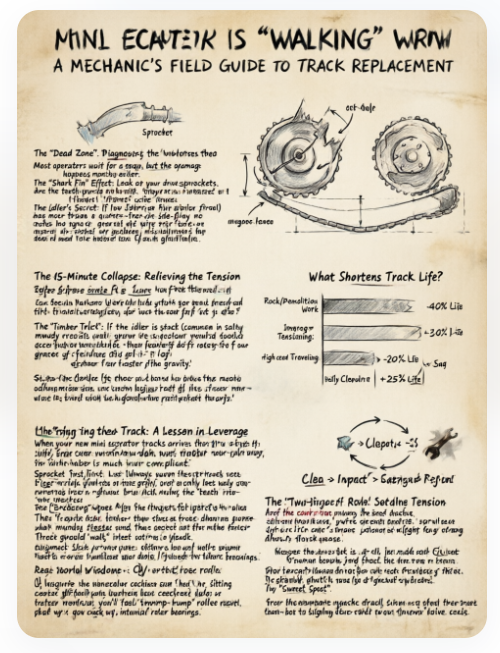
Why Your Mini Excavator is “Walking” Wrong: A Mechanic’s Field Guide to Track Replacement
Last week on a job site, I saw a 3-ton machine lose a track while backing off a trailer. The owner spent four hours with a crowbar and a lot of swearing, only to realize his tensioner was seized solid. It’s a classic scenario. Replacing Excavator Tracks shouldn’t be a battle of brute force; it’s about understanding the tension and the geometry of the undercarriage.
If you’re reading this, your mini excavator tracks are either showing steel cords or you’re tired of them popping off every time you make a sharp turn. Let’s skip the manual and talk about how this actually gets done in the dirt, without the corporate fluff.
The “Dead Zone”: Diagnosing the Undercarriage
Most operators wait for a snap, but the damage happens months earlier.
- The “Shark Fin” Effect: Look at your drive sprockets. Are the teeth pointed and hooked? If they are, a new track will be “chewed” from the inside out.
- The Idler’s Secret: If your idler (the big front wheel) has more than a quarter-inch of side-play, no amount of grease will keep that track on. It’s a mechanical misalignment that will ghost-ride your track off the rails.
The 15-Minute Collapse: Relieving the Tension
Before you touch a pry bar, you need to “kill” the tension.
Safety Check: Use the blade and boom to hoist the machine. Never work on a machine supported only by its own hydraulics. Block it up with heavy timber or jack stands.
The Grease Purge: Locate the inspection plate. When you back off that grease fitting, don’t just wait for it to ooze.
The “Timber Trick”: If the idler is stuck (common in salty or muddy environments), place a block of wood on the track and slowly drive forward. The mechanical force will force the grease out of the cylinder far faster than gravity.
Mounting the New Track: A Lesson in Leverage
When your new mini excavator tracks arrive, they’ll be stiff. If it’s cold, leave them in the sun for an hour—rubber has a memory, and “warm” rubber is much more compliant.
Alignment Check: Ensure the center rollers are sitting squarely between the track lugs. If they aren’t, you’ll feel a “thump-thump” during travel that can crack your internal roller bearings.
Sprocket First, Idler Last: Always thread the track over the drive sprocket first. This locks the “teeth” into the lugs.
The “Shoehorn” Move: Use two pry bars to guide the track over the idler. As you rotate the track slowly using the machine’s drive motor, the track should “walk” itself onto the guide.
The “Two-Finger” Rule: Setting Tension
After the track is on, pump in fresh grease. Don’t overdo it. I’ve seen guys pump grease until the track is tight as a guitar string. That’s a fast track to blowing out your final drive seals.
- Measure the sag in the middle of the track frame.
- For most compact machinery, a 10mm to 20mm gap is the “Sweet Spot.”
- Drive the machine forward and back 50 feet, then re-check. New tracks stretch slightly in the first few minutes of operation.
Real-World Wisdom: FAQ from the Shop Floor
Q: My track is “chirping.” Is that the rubber?
A: Usually, no. That high-pitched squeak is a “dry” roller. A roller that doesn’t spin freely will act like a brake, creating a hot spot on your mini excavator tracks. Replace it before it burns through the rubber.
Q: Can I use a pressure washer on the tracks?
A: Yes, but stay away from the seals on the rollers and the final drive. High-pressure water can force grit into the bearings. Focus on the mud packed in the lugs.
Q: Why does the machine drift to the left during travel?
A: If one track is significantly more worn than the other, or if one side has a tighter tension, the rolling resistance changes. It’s always best to replace Excavator Tracks in pairs to keep your drive motors synchronized.
The Final Word on ROI
At the end of the day, your undercarriage is a wear-and-tear system. You can’t stop the wear, but you can control the rate. According to industry insights shared on platforms like Equipment World, proper cleaning and tensioning can save an owner thousands over the life of the machine.
Treat your tracks like the foundation of a house. If the foundation is solid, the rest of the machine can do its job. For more technical deep-dives or to see our latest Durable Machinery Solutions, keep an eye on our project updates.