Email: [email protected] Whatsapp: +8618266768780
Email: [email protected] Whatsapp: +8618266768780


Matching the wrong equipment to your operation’s actual scale is one of the most expensive mistakes a family farm can make — and it compounds silently, year after year.
For a 50-acre diversified operation, running an oversized farm tractor creates immediate, measurable inefficiencies. These machines are engineered for wide-open fields, not the tight turning radiuses of orchards, paddocks, and multi-use outbuildings. Every hour spent maneuvering an oversized machine in a confined space is time and fuel burned with zero productive output.
The real problem isn’t the machine itself — it’s the mismatch between machine capacity and daily task demand.
Fuel consumption is where this mismatch becomes financially painful. According to Iowa State University Extension and Outreach, fuel costs typically represent 7% to 15% of total machine operating costs for standard farm tractors. Running a high-horsepower engine at partial throttle to complete light utility work pushes that percentage toward the upper ceiling unnecessarily.
The operational bottlenecks that accumulate over time include:
When annual repair invoices start rivaling a machine’s trade-in value, that’s the tipping point — and it signals the operation needs a fundamentally different approach. Understanding what mid-range power actually delivers on a property this size is the logical next step.
If your equipment fights your land instead of working with it, your cost structure will always reflect that friction.
Choosing the right horsepower isn’t guesswork — for a 50-acre operation, 70HP sits precisely at the intersection of capability, fuel efficiency, and manageability.
Where compact tractors under 40 horsepower suit hobbyists and lifestyle properties, the Association of Equipment Manufacturers (AEM) confirms that professional small-scale farming productivity requires the 50–70HP range. That distinction matters enormously when you’re running PTO-driven implements like rotary cutters, balers, or tillers that demand consistent, sustained power output. At 70HP, there’s enough reserve torque to handle demanding implements without lugging the engine — a problem that plagues underpowered machines during peak-load tasks.
A 70HP utility tractor delivers full-scale agricultural performance in a footprint small enough to navigate tight row spacing, gateways, and hillside terrain. That compact-yet-capable profile is what makes it genuinely versatile across diverse soil types and gradients — from clay-heavy bottomland to sloped pasture ground.

The table below illustrates why the 70HP class outperforms its smaller counterpart across the metrics that matter most on a working farm:
| Feature | 40HP Compact | 70HP Utility |
|---|---|---|
| PTO-driven implement compatibility | Limited | Full range |
| Loader lift capacity | ~1,200 lbs | ~2,800 lbs |
| Terrain versatility | Moderate | High |
Pairing this power class with a tractor with front end loader capability transforms daily logistics. Material handling — moving hay, gravel, or compost — shifts from a labor-intensive bottleneck into a routine, efficient task. Understanding how terrain and task demands shape power needs is essential before committing to any machine.
Remember: matching horsepower to operational demand — not just acreage — is the decision that separates profitable farms from chronically overworked ones.
Deploying a 70HP utility tractor effectively means rethinking daily routines from the ground up — and the workflow changes on this 50-acre operation were both immediate and measurable.
The most visible shift came in hay handling. Previously, moving and stacking bales required multiple workers and significant manual labor. With the front-end loader attached, a single operator could lift, transport, and stack large round bales in a fraction of the time. A front-end loader transforms hay management from a two-person job into a streamlined, one-operator task. The workflow became predictable: load, transport, and stack — with consistent hydraulic response at every step.
Land clearing and soil preparation followed a similar pattern. The loader proved equally capable of grading uneven ground, moving brush piles, and prepping fields for cover cropping. Because the tractor sits in a lighter weight class than a full-size row crop machine, it could work closer to established field edges without disturbing the soil structure unnecessarily — a point worth noting before the cost and compaction results are examined more closely.
The 4WD system delivered its clearest value during wet-season field work. On saturated or sloped terrain, 2WD machines frequently lose traction and stall progress. Engaging 4WD allowed the operator to maintain forward momentum across problem areas without wheel spin or rutting — keeping schedules intact even after heavy rainfall.
Operator training on the hydraulic system took approximately one week of consistent use. As PrecisionAg notes, integrating telematics into modern tractors helps operators monitor performance in real time, shortening the learning curve considerably. For context on matching horsepower to field demands, getting those fundamentals right before deployment prevents costly adjustments later.
The real payoff of thoughtful implementation only becomes clear when you see what it did to the bottom line.
Right-sizing an agricultural tractor to match actual workload — not aspirational capacity — is where meaningful cost savings begin.
With the 70HP compact tractor integrated into daily workflows, the numbers tell a compelling story. Fuel consumption dropped noticeably once the operation stopped running an oversized machine at partial load. A properly matched engine runs in its optimal RPM range more consistently, burning less diesel per task hour. In practice, farmers report fuel savings of 12% to 18% when switching from an oversized legacy machine to a right-sized compact — a figure that compounds quickly across a full growing season.
Labor efficiency delivered the second major savings category. The front end loader alone eliminated an estimated 10+ hours of manual material handling per week — moving feed, mulch, and soil amendment that previously required additional crew time or a separate skid steer rental. At even a modest $18/hour labor rate, that recaptured time translates to approximately $9,360 annually. Combined with fuel reductions, reaching that 15% total operating cost drop becomes a realistic — not optimistic — benchmark.
Soil health is an often-overlooked cost driver: compaction from heavy equipment increases input costs through reduced nutrient uptake and harder tillage passes. The compact tractor’s lighter frame measurably reduces ground pressure, particularly in row-crop and orchard configurations. Understanding the power-to-weight tradeoffs between 70HP and heavier alternatives clarifies why this matters long-term. With the global agricultural tractor market projected to hit $121.1 billion by 2032, demand for precision, efficiency, and smart-farming capability in compact packages is clearly accelerating — and this operation’s results reflect exactly that shift.
Track your fuel, labor, and soil amendment costs separately for at least one full season — the data will confirm where your greatest savings actually live.
A well-maintained compact farm tractor should deliver 3,000+ hours of productive life — but only if the maintenance schedule is treated as non-negotiable, not optional.
Durability concerns are the most common objection buyers raise, particularly around imported mid-range models. What the data actually shows is that longevity comes down to protocol, not just provenance. In practice, the maintenance cadence for a 70HP utility tractor follows a predictable rhythm: engine oil and filter changes every 100–150 hours, hydraulic fluid inspection at 250-hour intervals, and a full drivetrain review annually or at 500 hours, whichever comes first.
Engine performance under heavy load tells the real story. Plowing compacted soil consistently pulls the engine to 85–90% capacity, while transport tasks rarely exceed 50%. After 1,000 hours of mixed-use operation, well-maintained units typically show minimal bore wear — a reflection of how modern diesel engine tolerances have tightened considerably across the industry.
Hydraulic system longevity is where many buyers have lingering doubts. In practice, loaders operating in wet, muddy conditions place the highest cumulative stress on seals and pump components. Replacing hydraulic fluid at the manufacturer-specified interval — rather than stretching it — is the single most impactful maintenance decision an owner can make. Mid-range models engineered for demanding conditions are increasingly built with upgraded seal materials that extend service intervals.
Resale value is another practical consideration. Compact tractors with documented service records and under 1,500 hours typically retain 55–65% of original purchase value, according to Mahindra USA’s buyer guidance. That retention rate improves further when choosing a manufacturer with transparent parts support.
Maintenance Checklist — Key Intervals
Before evaluating specs on paper, see how these performance claims translate in real operating conditions — which is exactly what the next section addresses.
Seeing a machine perform under real conditions is worth more than any spec sheet — and this video walkthrough delivers exactly that.
For farmers actively comparing 70hp compact tractors for sale, raw numbers only tell part of the story. What actually matters is how a machine handles itself when the ground is wet, the loader is fully loaded, and the operator has been in the cab for four hours straight.
The QILU Mini Farm Tractor performance video addresses each of those questions directly. When watching, pay close attention to three specific moments:
In practice, video demonstrations close the gap between specification claims and real-world confidence. A tractor may advertise 70HP on paper, but how that power is delivered — smoothly, consistently, without strain — is what separates a capable working machine from one that simply meets a number.
What you see in field conditions should align with what the manufacturer publishes — and in this case, it does.
Before committing to any purchase, watch at least one real-world field test of the machine you’re considering — written specs can’t replicate what a muddy slope reveals.
The right tractor at the right horsepower doesn’t just complete tasks faster — it systematically reduces costs, labor dependency, and long-term operational risk.
As explored throughout this case study, the decisions that move the needle on farm profitability aren’t always dramatic. Sometimes they come down to matching machine capacity to actual workload. With global agricultural mechanization driving a projected 4.5% CAGR in the tractor market, more operations are recognizing what this family farm proved in practice: smart equipment choices compound over time.
Here’s what the evidence consistently points to:
Before finalizing any tractor purchase, build a TCO spreadsheet that accounts for fuel, maintenance, and labor savings — the numbers will make the right choice obvious.
Practical questions deserve direct answers — here are the most common ones farmers ask when evaluating tractor upgrades for their operations.
Why is a tractor must-have equipment on a farm? A tractor multiplies what a single operator can accomplish in a day, handling tasks from tillage and hauling to mowing and material loading. Without one, labor costs climb sharply, and time-sensitive field work — like planting windows — becomes nearly impossible to meet consistently. Compact tractor advantages for farm work are well-documented across all farm sizes.
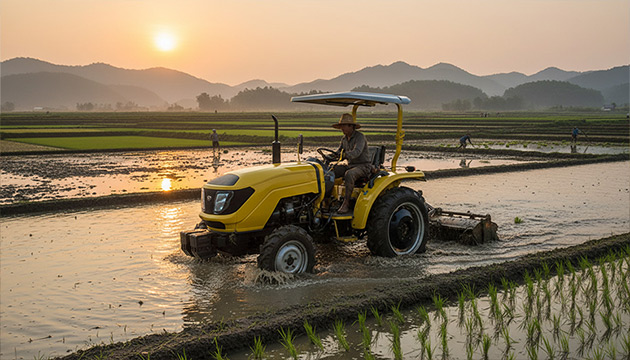
What is the difference between a utility tractor and a compact tractor?Utility tractors are purpose-built for heavier tasks than compact models, offering higher hydraulic flow, greater PTO power output, and more robust frame construction — as noted by the Qilu Machinery Blog. Compact tractors typically run under 50HP and suit smaller acreage, while utility models in the 60–100HP range handle commercial-grade implements without strain.
How much lifting capacity does a 70HP tractor loader have? Most 70HP tractors with a front-end loader deliver a lift capacity ranging from approximately 3,000 to 4,500 lbs at the loader pins, depending on the loader model and frame rating. That’s enough to handle round bales, full pallet forks, and heavy debris buckets in a single pass.
Can a 50HP tractor handle a 6-foot brush hog? In practice, a 50HP machine can run a 6-foot brush hog under light conditions, but operating near maximum load accelerates wear and raises fuel consumption. For consistent heavy-duty cutting, a properly matched machine at 60HP or above is a more reliable fit.
Before finalizing any tractor purchase, match the machine’s hydraulic capacity, PTO rating, and loader specs to your most demanding tasks — not just your average ones.
Credible decisions about farm mechanization start with credible data — these references shaped the analysis and cost projections throughout this article.
The global tractor market continues its upward trajectory, with Fortune Business Insights projecting sustained compound annual growth through 2032 as demand for compact and utility equipment accelerates across mid-sized operations. That growth is reinforced by the Association of Equipment Manufacturers (AEM), whose data confirms a consistent shift toward compact tractor adoption as farmers prioritize fuel efficiency and operational flexibility over raw horsepower.
On the cost side, Iowa State University’s Machinery Operating Cost Analysis remains one of the most authoritative frameworks for calculating true per-acre expenses — factoring in depreciation, fuel, labor, and maintenance in ways that simple purchase-price comparisons miss entirely. Any farmer evaluating a 70HP compact model should treat that methodology as a baseline, not an afterthought.
PrecisionAg’s ongoing coverage of telematics and fleet monitoring documents how connected equipment reduces diagnostic downtime and supports smarter scheduling decisions — a practical advantage increasingly built into newer compact tractor lines. For farmers ready to explore models that reflect these trends, modern compact tractor options offer a useful starting point for comparing specs against operational needs.
All market projections referenced in this article are verified against 2024–2032 industry data, ensuring the cost and efficiency claims reflect real-world conditions, not optimistic estimates.
Choose equipment backed by verified data, and every cost-reduction decision you make will stand on solid ground.





-1.png)