Welcome to Shandong Qilu Industrial Co., Ltd

 English
 Arabic
 Bulgarian
 Bengali
 Czech
Czech
 Danish
 German
 Greek
Greek
 Spanish
 Finnish
 French
 Hindi
Hindi
 Croatian
 Hungarian
 Indonesian
 Italian
 Japanese
 Korean
 Lithuanian
 Dutch
Dutch
 Norwegian
 Polish
 Portuguese
 Romanian
 Russian
 Slovak
 Slovenian
 Swedish
 Thai
Thai
 Turkish
 Ukrainian
 Vietnamese
 Tagalog
 Malay
Malay
 Estonian
 Catalan
 Latvian
 Urdu
Urdu
 Serbian
 Persian
 Swahili
 Albanian
 Armenian
 Icelandic
 Bosnian
 Luxembourgish
 Afrikaans
English Arabic
Bulgarian
Bengali
Czech
Danish
German
Greek
Spanish
Finnish
French
Hindi
Croatian
Hungarian
Indonesian
Italian
Japanese
Korean
Lithuanian
Dutch
Norwegian
Polish
Portuguese
Romanian
Russian
Slovak
Slovenian
Swedish
Thai
Turkish
Ukrainian
Vietnamese
Tagalog
Malay
Estonian
Catalan
Latvian
Urdu
Serbian
Persian
Swahili
Albanian
Armenian
Icelandic
Bosnian
Luxembourgish
Afrikaans
Afrikaans
English Arabic
Bulgarian
Bengali
Czech
Danish
German
Greek
Spanish
Finnish
French
Hindi
Croatian
Hungarian
Indonesian
Italian
Japanese
Korean
Lithuanian
Dutch
Norwegian
Polish
Portuguese
Romanian
Russian
Slovak
Slovenian
Swedish
Thai
Turkish
Ukrainian
Vietnamese
Tagalog
Malay
Estonian
Catalan
Latvian
Urdu
Serbian
Persian
Swahili
Albanian
Armenian
Icelandic
Bosnian
Luxembourgish
Afrikaans
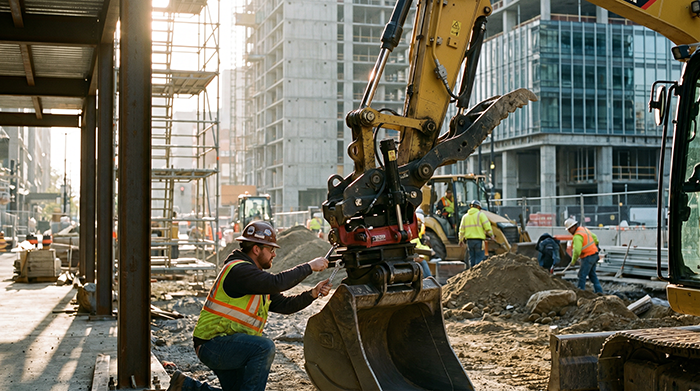
The Evolution of Earthmoving: Why Application Solutions Outperform Raw Horsepower
The job site of 2026 doesn’t reward the biggest engine — it rewards the smartest deployment. Contractors, fleet managers, and project owners have learned a hard lesson over the past decade: a powerful machine sitting idle between tasks is nothing more than an expensive anchor. The shift toward excavator application solutions isn’t a trend. It’s a fundamental rethinking of how earthmoving equipment creates — or destroys — project ROI.
The global excavator market is projected to grow from $51.2 billion in 2023 to approximately $71.9 billion by 2030, according to Allied Market Research, and that growth isn’t being driven by raw horsepower alone. It’s being driven by demand for machines that solve problems, not just move dirt.
Then vs. Now: The Machine Utility Shift
| Traditional Approach (Then) | Application-First Approach (Now) |
|---|---|
| One machine, one task | One machine, multiple revenue-generating functions |
| Idle time between specialized tasks | Continuous utilization across project phases |
| Multiple equipment rentals per project | Consolidated fleet with modular capability |
| ROI measured by dig depth and speed | ROI measured by billable hours per machine |
| Reactive equipment selection | Proactive solution planning before mobilization |
The economics are unambiguous. Machine idle time is a direct cost — fuel, depreciation, and rental fees continue whether the tracks are moving or not. High-utilization application strategies flip that equation entirely, keeping equipment productive across excavation, demolition, material handling, and utility work within a single project cycle.
Application Solution: A machine configuration strategy that pairs base equipment with purpose-matched attachments and control systems to maximize productive output across multiple task categories on a single job site.
This is precisely the philosophy that forward-thinking manufacturers like Qilu Machinery have built into their integrated product lines — designing base machines from the ground up to support multi-function deployment rather than bolting versatility on as an afterthought.
The real question isn’t which machine is most powerful. It’s which combination of machine and tooling unlocks the most value per project hour — and the answer starts with the attachments themselves.
Maximizing the ‘Swiss Army Knife’ Effect: High-Impact Attachments for 2026
If the previous section made one thing clear, it’s that raw power alone doesn’t close the gap between a good project and a great one. What does? Versatility — specifically, the ability to deploy the right tool for each task without swapping machines. The best excavator attachments 2026 has to offer are turning single-unit excavators into full project crews, and the ROI math is hard to argue with.
According to the Association of Equipment Manufacturers (AEM), using specialized tools like hydraulic shears and grapples can increase a machine’s utilization rate by up to 35%. That’s not a marginal improvement — that’s the difference between a machine that earns its keep and one that collects idle hours.
Quick-coupler system: A hydraulic or mechanical coupling device that allows an operator to swap attachments directly from the cab in minutes, eliminating manual pin changes and dramatically reducing transition downtime between tasks.
Hydraulic Shears and Grapples for Demolition and Recycling
Hydraulic shears are purpose-built cutting tools that replace traditional breaking methods with clean, controlled material separation — critical for selective demolition and on-site material recovery. In recycling applications, grapples allow precise sorting of steel, concrete, and debris without secondary handling equipment.
Key capabilities at the job site level:
- Rotating jaw mechanisms for multi-angle cutting without repositioning the machine
- High jaw-force ratings (often 400+ kN) for cutting rebar-embedded concrete
- Integrated material sorting that feeds directly into recycling workflows
- Reduced dust and vibration compared to hydraulic breakers in enclosed sites
High-Torque Augers and Trenchers for Utility and Infrastructure
High-torque augers are drill-head attachments designed to penetrate compacted soils, rock substrates, and urban fill layers where conventional digging methods slow to a crawl. Paired with chain trenchers, they form the backbone of utility installation on both municipal and commercial infrastructure projects.
What separates modern auger and trencher attachments from legacy tools:
- Planetary drive motors delivering consistent torque output across variable soil conditions
- Modular tooth configurations switchable between clay, rock, and frost-ground profiles
- Compatible with hybrid excavator flow rates, optimizing hydraulic efficiency on lower-emission platforms
- Precision depth control that integrates with grade management systems
The One-Machine Advantage: Quick-Couplers and Multi-Tool Workflows
The real multiplier here is the quick-coupler system. Without it, switching from a shear to an auger to a compaction plate could cost 45 minutes of labor per transition. With a modern hydraulic quick-coupler, that window collapses to under three minutes — meaning one operator, one machine, and one fuel load can credibly replace three specialized units across a single shift.
The most profitable excavators in 2026 aren’t the most powerful — they’re the most adaptable, cycling through task-specific attachments with near-zero downtime between each pass.
That said, attachment versatility has a ceiling in one critical environment: dense urban construction, where physical constraints, noise ordinances, and proximity to existing structures create challenges that no single attachment can fully solve on its own. That’s exactly where the next wave of application solutions is being put to the test.
Navigating the Urban Jungle: Compact Solutions for High-Density Construction
Urban construction has never been more demanding — or more constrained. Tight lots, occupied buildings on every side, pedestrian traffic, noise ordinances, and emissions regulations have fundamentally changed what it means to break ground in a city. The hybrid excavators market is responding directly to these pressures, and the machines arriving on job sites in 2026 are built around urban realities first, raw capacity second.
📊 By 2050, 68% of the world’s population is expected to live in urban areas — a demographic reality that is already compressing construction timelines, shrinking available workspaces, and pushing demand for compact application solutions to record highs.
Zero-Tail Swing: The Urban Game-Changer
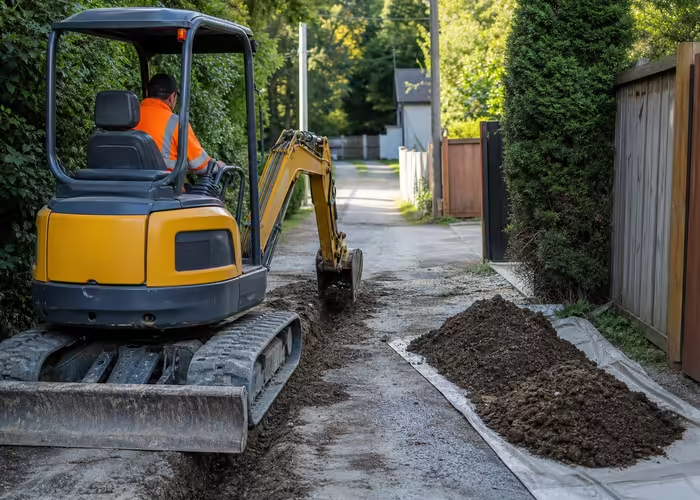
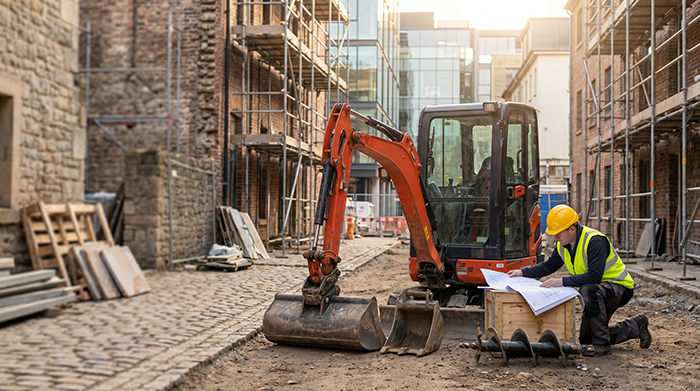
Zero-tail swing (ZTS) excavators are machines engineered so the rear of the house stays within the width of the tracks during a full 360-degree rotation. In practice, this means a contractor can work within inches of a building facade, a parked vehicle, or a live utility corridor without fear of collision or liability.
ZTS units have moved from niche to near-standard in dense metro markets. Their geometry unlocks job sites that would otherwise require extensive lane closures, shoring, or manual labor workarounds — all of which erode project margins quickly.
Precision Attachments for Structural Safety
Working near existing structures demands more than a smaller footprint. It requires excavator technologies improving productivity at the attachment level — hydraulic thumbs for controlled demo work, concrete pulverizers for selective structural removal, and vacuum excavation attachments that expose utilities without any risk of strike damage.
One practical approach is pairing a ZTS unit with a tiltrotator, which allows the bucket or tool to articulate in nearly any direction without repositioning the machine. This dramatically reduces the number of times an operator needs to reposition near sensitive structures.
Urban Survival Features: What to Look for in 2026
- Electric or hybrid powertrains that meet Stage V emissions standards and allow operation in zero-emission zones
- Reduced-noise hydraulic systems designed for compliance with urban noise ordinances (often sub-70 dB at 7 meters)
- Compact transport width under 1.5 meters for navigating narrow access points
- Integrated telematics for remote monitoring and compliance documentation
- Fine-grade hydraulic control for millimeter-level precision near utilities and foundations
Solving the ‘Last Mile’ of Urban Construction
The “last mile” problem in construction — those final, high-risk tasks that large equipment physically cannot complete — is where compact hybrid units generate their clearest ROI. A confined basement dig, a utility repair beneath an occupied streetscape, a retaining wall installation flanked by active storefronts: these scenarios demand machines that think small without working small.
The same discipline driving urban compact solutions is reshaping an entirely different sector — one where precision, not population density, is the primary constraint. Agricultural operators are discovering that small excavators solve field-level infrastructure challenges that traditional equipment simply wasn’t designed to handle.
Precision Agriculture and Farm Infrastructure: The New Frontier for Small Excavators
The conversation about hybrid excavator application solutions doesn’t stop at city limits. Increasingly, the agricultural sector is emerging as one of the most compelling growth arenas for compact and mid-size excavators — and the reasons are both practical and economic. Where traditional tractors once handled most earthmoving tasks on a farm, today’s small excavators are stepping in with a level of precision and versatility that older equipment simply can’t match.
Drainage and Irrigation: Getting the Grade Right
Precision drainage — the practice of designing field water management systems to exact tolerances to protect crop yields — has become a priority on modern farms facing unpredictable weather patterns. According to Qilu Machinery Industry Analysis, small equipment applications in farm construction are increasingly focused on precision drainage to mitigate climate-related crop risks. Laser-guided grading attachments fitted to compact excavators allow operators to cut drainage channels and irrigation runs to millimeter-accurate grades, eliminating the guesswork that comes with manual sloping and reducing costly rework.
Laser-guided grading: A technology-assisted digging method where onboard sensors and control systems automatically adjust bucket depth and angle to match a pre-programmed grade plan, ensuring consistent slope accuracy across an entire field.
This level of control is where smart excavator innovations are making a tangible difference on working farms — translating directly into drier fields, healthier root zones, and measurable yield protection.
Land Clearing, Fence Lines, and Small-Scale Construction
Beyond drainage, mulching attachments have redefined how farm operators approach fence line maintenance and brush clearing. A single compact excavator fitted with a drum mulcher can clear overgrown fence lines, process small timber, and leave behind a manageable residue — all in a single pass, without the need for a separate brush hog and tractor combination.
Drum mulcher attachment: A rotating cutting head mounted in place of a standard bucket that shreds vegetation, brush, and small-diameter trees into mulch on contact, eliminating debris hauling and burning.
For barn foundations and livestock water systems, small excavators offer the reach, lifting capacity, and maneuverability to work in tight farmyard spaces where full-size equipment creates more problems than it solves.
Farm vs. Construction: Application Quick-Check
| Task | Farm Application | Construction Application |
|---|---|---|
| Precision grading | Drainage channels, irrigation runs | Site prep, subgrade leveling |
| Mulching | Fence lines, brush clearing | Lot clearing, tree debris |
| Foundation work | Barn pads, water tank pits | Residential footings |
| Trenching | Irrigation pipe, utility runs | Utility corridors, drainage |
As the line between agricultural and construction capability continues to blur, the machines doing this work are getting smarter — and that intelligence layer is worth exploring on its own. The next section examines how the technology stack built into modern excavators is transforming decision-making from the cab outward.
The Tech Stack: Smart Innovations and Autonomous Trends in Excavation
The evolution of hybrid excavator application solutions isn’t just mechanical — it’s digital. Whether you’re breaking ground on a dense urban utility corridor or leveling farm infrastructure across rolling terrain, the intelligence built into modern machines is becoming just as important as raw hydraulic power. The next wave of competitive advantage belongs to operators and project managers who understand how to leverage the full technology stack available in today’s hybrid platforms.
Telematics and Real-Time Application Matching
Telematics refers to the integrated systems that collect, transmit, and analyze machine data in real time — think GPS positioning, fuel consumption rates, idle time tracking, and hydraulic load monitoring, all streamed to a centralized dashboard.
In practice, this data is transforming how equipment managers make attachment and sizing decisions. According to Teletrac Navman, matching the right excavator size and attachment to a specific application can reduce fuel consumption by 10–15%. That’s not a minor efficiency gain — on a multi-month project, it translates directly to measurable cost savings and a lower carbon footprint. Telematics eliminates the guesswork, replacing gut instinct with hard application data that prevents over-specifying a heavy machine for a task a compact hybrid handles just as well.
Semi-Autonomous Digging and Repetitive Trenching
Semi-autonomous excavation: A machine capability where predefined task parameters — trench depth, grade angle, bucket path — are executed with minimal operator input, typically on repetitive linear operations.
Autonomous excavators construction applications are no longer purely conceptual. Semi-autonomous digging modes are appearing in production-ready hybrid models, particularly for repetitive trenching operations in utility installation and pipeline work. The operator sets the target depth and grade; the machine’s control system handles the precision execution. This reduces operator fatigue on long trench runs, tightens tolerance consistency, and keeps productivity high even when experienced operators are in short supply.
Augmented Reality in the Cab
Augmented reality (AR) grade control overlays real-time depth, slope, and cut/fill data directly onto the operator’s field of view or cab display — eliminating reliance on external grade stakes and manual checks.
For precision-critical applications like drainage infrastructure or foundation grading, AR guidance systems reduce costly re-cuts and material waste. Combined with telematics feedback, they create a closed-loop system where every pass is informed by the last.
These innovations share a common thread: data-driven decisions that protect your budget. However, unlocking this value doesn’t happen by simply purchasing the right machine — it requires a supply partner who understands how to configure and support these systems for your specific application environment. That’s where supplier selection becomes a strategic decision, not just a procurement one.
Strategic Implementation: Why Your Supplier Choice Dictates Your ROI
All the smart technology in the world won’t deliver results if the partner behind your machine doesn’t understand how you’re using it. Whether you’re running small equipment applications for farm construction or managing a complex urban utility project, the supplier relationship determines how quickly problems get solved — and how much downtime costs you.
After-Sales Support Is the Real Differentiator
In practice, the most common source of lost ROI isn’t the machine itself — it’s the gap between purchase and productive deployment. Complex application environments demand responsive after-sales ecosystems: parts availability, attachment compatibility guidance, operator training, and remote diagnostics support. A machine sitting idle waiting on a replacement hydraulic coupler can erase weeks of projected savings.
Application Knowledge: The demonstrated ability of a supplier to match equipment configurations, attachment packages, and service protocols to specific end-use environments — not simply maintain inventory.
The distinction matters because reliable supplier status is earned through depth of expertise, not warehouse size. A supplier who understands how a tilt-rotator behaves differently in clay-heavy farmland versus compacted urban fill can configure your attachment package correctly the first time.
Customizing for Regional Demand
Regional soil conditions, permit requirements, and jobsite access constraints all influence which attachment combinations deliver the highest return. One practical approach is to work with suppliers who offer consultative pre-sale assessments — mapping your project pipeline to specific tool carriers, bucket profiles, and auxiliary hydraulic configurations before the machine ships.
Value Pillars to evaluate in your supplier relationship:
- Application depth — Can they specify the right tool for your exact soil and structure conditions?
- Parts infrastructure — Are critical components available regionally, or are lead times a liability?
- Training support — Do they offer operator onboarding for new attachment configurations?
- Integrated fleet guidance — Can they advise across both excavators and tractor product lines as your operation scales?
Recognized as a reliable supplier of industrial tractors and excavators with a focus on integrated application support, Qilu Machinery brings precisely this consultative approach — aligning machine specs, attachment ecosystems, and service infrastructure to your operational reality.
The right supplier relationship transforms equipment from a capital expense into a compounding asset. As you evaluate your next acquisition, the questions you bring to that conversation matter enormously — which is exactly where the expert guidance ahead can help.
Expert Insights: Frequently Asked Questions on Excavator Applications
These questions come up repeatedly among contractors, owner-operators, and farm managers exploring hybrid excavator application solutions for the first time. Clear answers here can save months of costly trial and error.
How do I choose between a compact and a standard excavator for my project?
Start with your site constraints, not your ambitions. Compact excavators (typically under 6 tons) excel in tight urban lots, landscaping, and utility trenching where swing radius and ground pressure matter. Standard machines deliver the bucket capacity and reach needed for bulk earthmoving and deep foundation work. As noted in industry reporting, the “over-specifying of a machine for a simple task is one of the leading causes of wasted operational costs in modern construction” — meaning a 30-ton machine on a residential job isn’t an upgrade, it’s an expense. Match tonnage to task first, then evaluate hybrid drivetrain options within that class.
What are the most versatile attachments for a first-time owner?
A hydraulic thumb, a tilt-rotation coupler, and an auger represent the highest-utility starting trio for new owners. These three attachments collectively expand a single machine’s usefulness across grading, material handling, post-hole drilling, and demolition prep — dramatically broadening your billable applications without purchasing additional equipment.
How does telematics improve the ROI of my excavator application?
Telematics — onboard sensor systems that transmit real-time operational data — eliminate guesswork around fuel consumption, idle time, and preventive maintenance windows. According to 2026 trend analysis from Turntide, smart monitoring systems are increasingly standard across hybrid equipment lines, giving operators actionable efficiency benchmarks that directly compress operating costs over a machine’s lifecycle.
Can one excavator really handle both farm work and urban construction?
In practice, yes — with the right attachment ecosystem. Modern quick-coupler systems allow a single mid-size hybrid excavator to switch between trenching buckets, grapples, and brush cutters within minutes, making dual-use ownership economically viable for rural contractors who seasonally shift between agricultural and municipal projects.
The bottom line: the right machine, matched precisely to your application mix and supported by a knowledgeable supplier, remains the clearest path to measurable project ROI in 2026 and beyond.
Key Takeaways
- The Evolution of Earthmoving: Why Application Solutions Outperform Raw Horsepower
- Maximizing the ‘Swiss Army Knife’ Effect: High-Impact Attachments for 2026
- Navigating the Urban Jungle: Compact Solutions for High-Density Construction
- Precision Agriculture and Farm Infrastructure: The New Frontier for Small Excavators
- The Tech Stack: Smart Innovations and Autonomous Trends in Excavation