Welcome to Shandong Qilu Industrial Co., Ltd

 English
 Arabic
 Bulgarian
 Bengali
 Czech
Czech
 Danish
 German
 Greek
Greek
 Spanish
 Finnish
 French
 Hindi
Hindi
 Croatian
 Hungarian
 Indonesian
 Italian
 Japanese
 Korean
 Lithuanian
 Dutch
Dutch
 Norwegian
 Polish
 Portuguese
 Romanian
 Russian
 Slovak
 Slovenian
 Swedish
 Thai
Thai
 Turkish
 Ukrainian
 Vietnamese
 Tagalog
 Malay
Malay
 Estonian
 Catalan
 Latvian
 Urdu
Urdu
 Serbian
 Persian
 Swahili
 Albanian
 Armenian
 Icelandic
 Bosnian
 Luxembourgish
 Afrikaans
English Arabic
Bulgarian
Bengali
Czech
Danish
German
Greek
Spanish
Finnish
French
Hindi
Croatian
Hungarian
Indonesian
Italian
Japanese
Korean
Lithuanian
Dutch
Norwegian
Polish
Portuguese
Romanian
Russian
Slovak
Slovenian
Swedish
Thai
Turkish
Ukrainian
Vietnamese
Tagalog
Malay
Estonian
Catalan
Latvian
Urdu
Serbian
Persian
Swahili
Albanian
Armenian
Icelandic
Bosnian
Luxembourgish
Afrikaans
Afrikaans
English Arabic
Bulgarian
Bengali
Czech
Danish
German
Greek
Spanish
Finnish
French
Hindi
Croatian
Hungarian
Indonesian
Italian
Japanese
Korean
Lithuanian
Dutch
Norwegian
Polish
Portuguese
Romanian
Russian
Slovak
Slovenian
Swedish
Thai
Turkish
Ukrainian
Vietnamese
Tagalog
Malay
Estonian
Catalan
Latvian
Urdu
Serbian
Persian
Swahili
Albanian
Armenian
Icelandic
Bosnian
Luxembourgish
Afrikaans
The Compact Revolution: Why the World is Scaling Down
The job site is shrinking — and that’s forcing the entire equipment industry to rethink what a productive machine actually looks like.
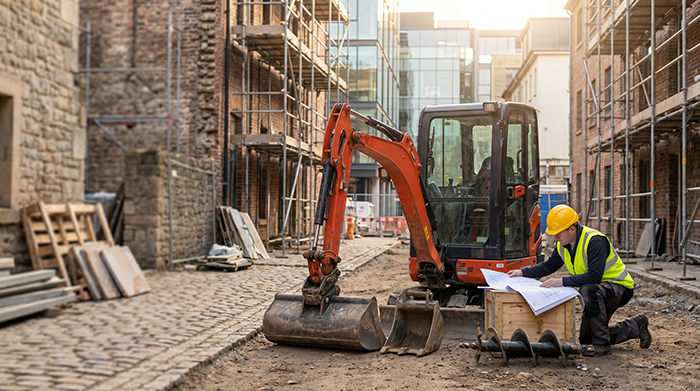
Urban redevelopment has fundamentally changed the nature of excavation work. Crews aren’t blasting through open fields to lay new highway infrastructure anymore. They’re threading utilities beneath century-old townhouses, restoring landscaping in gated communities, and installing drainage systems in backyard spaces where a full-size machine simply cannot go. According to the United Nations Department of Economic and Social Affairs, 68% of the world’s population is projected to live in urban areas by 2050 — a demographic reality that’s already reshaping equipment demand on the ground.
The sites are getting tighter. The tolerances are getting smaller. And the machines that win are the ones that can work without destroying everything around them.
That pressure is making traditional large excavators increasingly “site-locked” — powerful in open environments, but genuinely impractical the moment a gate, a narrow alley, or a delicate surrounding structure enters the picture. Contractors who rely exclusively on full-size iron are turning away profitable work. It’s not a capability problem; it’s a geometry problem.
This is precisely why the mini excavator has evolved from a niche convenience into a core production asset. The Grand View Research market data tells the story clearly: the global mini excavator market was valued at USD 7.47 billion in 2023, growing at a projected 4.2% CAGR through 2030.
But raw sales growth only tells part of the story. The deeper shift is philosophical. Savvy operators are no longer evaluating mini excavator uses through a single-task lens. They’re treating these machines as versatile tool carriers — a “Swiss Army Knife” approach that multiplies ROI across a single piece of compact equipment.
Understanding that starts with the engineering feature making it all possible: zero tail swing.
Zero Tail Swing (ZTS): The Engineering Key to Urban Access
As job sites get tighter, the machines working them have to get smarter. Zero tail swing technology is one of the most significant engineering advances in compact equipment — and for contractors navigating fenced yards, urban corridors, and crowded commercial sites, it’s essentially become non-negotiable.
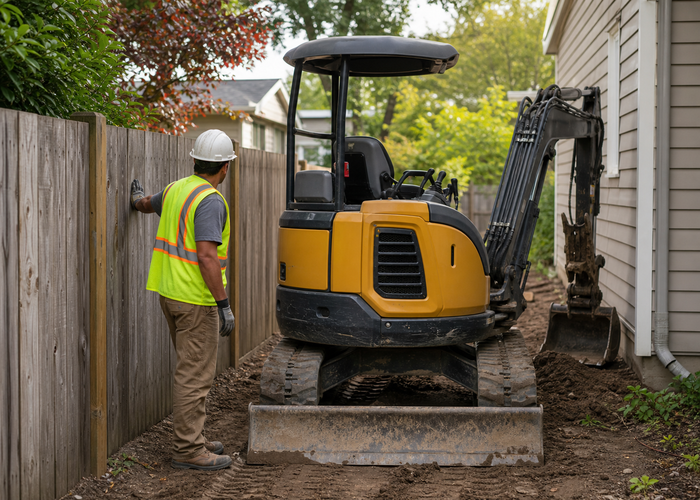
Zero tail swing (ZTS) is exactly what it sounds like: the excavator’s upper housing is engineered to rotate entirely within the width of its tracks. According to Equipment World, this design eliminates the risk of the counterweight striking nearby walls, parked vehicles, or bystanders during a full 360-degree rotation. That’s not just a convenience — it’s a fundamental shift in how safely and efficiently a machine can operate in constrained environments.
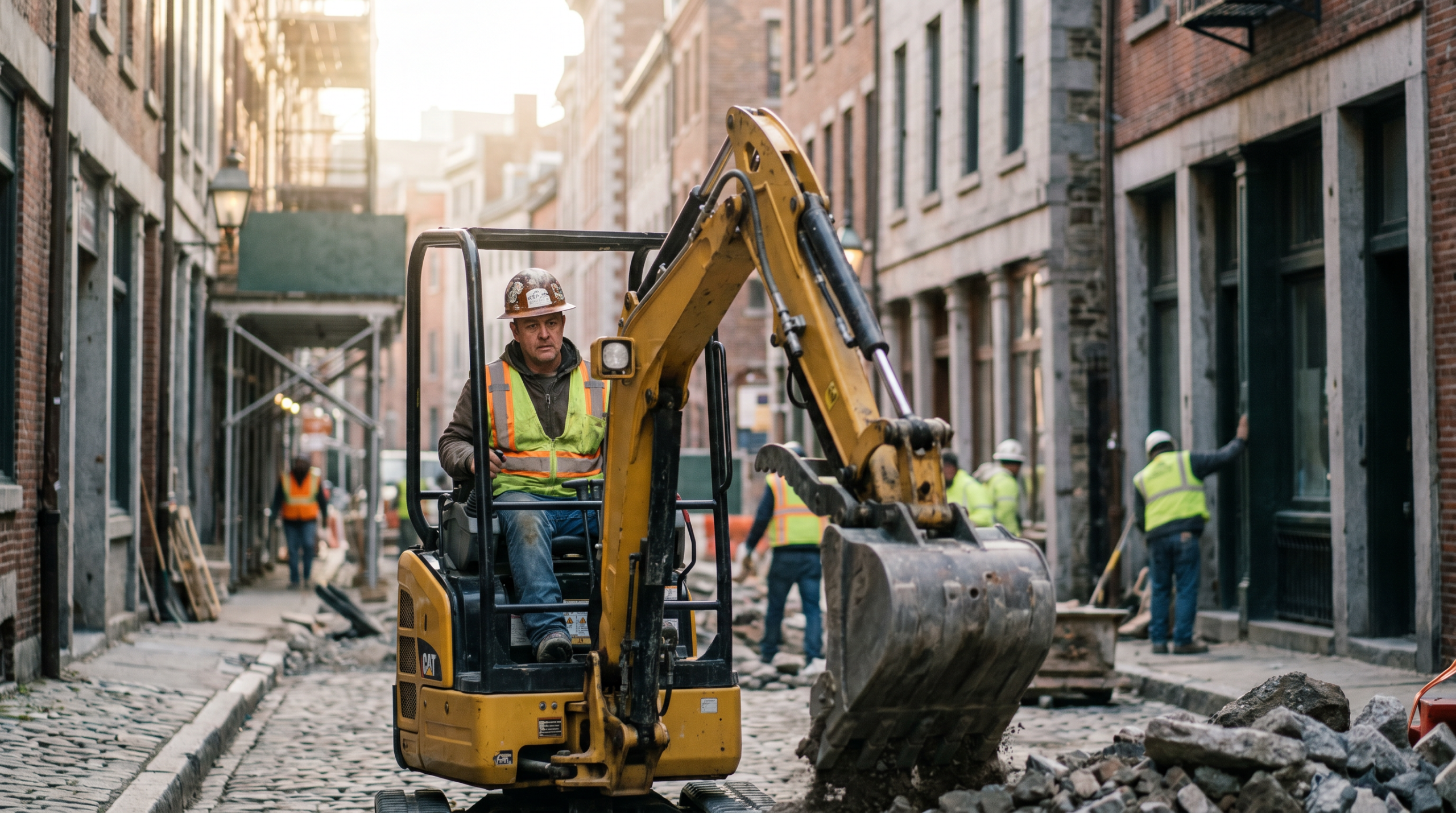
A conventional tail swing machine needs a significant clearance buffer behind the cab whenever the operator swings the boom. On a typical residential landscaping job, that extra footprint can make the difference between a machine that fits through a side gate and one that doesn’t. In practice, a ZTS mini excavator can rotate fully in corridors as narrow as five feet — something a conventional unit simply cannot do without risking costly contact with surrounding structures.
Key safety and operational benefits of ZTS include:
- Reduced liability exposure — no counterweight overhang means fewer incidents near structures and people
- Smoother workflow — operators don’t need to constantly reposition to avoid swing interference
- Gate access — most ZTS models pass through standard 36–48 inch residential gates with clearance to spare
- Pedestrian safety — critical on public-facing commercial sites where bystanders may be present
Pro Tip: Before committing to any machine on a tight-access job, confirm its swing clearance radius in the spec sheet — not just its track width. Some machines marketed as “zero tail swing” still have slight overhang at certain boom positions. Measure the actual rotation envelope at full swing before purchasing or renting.
When evaluating the best mini excavator for landscaping in confined residential or urban settings, ZTS isn’t a premium add-on — it’s a baseline requirement. And once you’ve unlocked true 360-degree freedom on a job site, you start asking a bigger question: what else can this machine do beyond just digging?
From Digger to Tool Carrier: Maximizing Attachment Versatility
Zero tail swing solves the access problem. But once you’re on-site and working, the real question is: how much can one machine actually do? The answer, increasingly, is a lot more than dig.
According to the Association of Equipment Manufacturers (AEM), modern mini excavators function as full-fledged tool carriers through advanced auxiliary hydraulic systems that allow seamless switching between augers, breakers, thumbs, rakes, and more. That single capability is quietly reshaping how contractors calculate equipment ROI.
Auxiliary Hydraulics: The Engine Behind Versatility
Early mini excavators were essentially one-trick machines. Today’s models ship with high-flow and variable-flow auxiliary hydraulic circuits that deliver precise power to a growing catalog of attachments. The operator doesn’t swap machines — they swap couplers. Setup time drops from hours to minutes.
Augers: Digging Smarter, Not Harder
Whether you’re setting fence posts, installing signage, or drilling pier footings, a hydraulic auger attachment turns a mini excavator into a precision boring machine. Consistent hole depth, repeatability, and torque control make this one of the highest-utilization attachments across landscaping and light construction crews.
Hydraulic Breakers: Demolition Without the Dedicated Machine
Hydraulic breakers replace the need for a standalone demolition tool on smaller sites. Breaking concrete flatwork, removing old footings, or splitting rock — a properly sized breaker matched to the excavator’s flow rate handles all of it efficiently without bringing in a second piece of equipment.
Rakes and Thumbs: Site Prep Redefined
For landscaping and grading applications, hydraulic rakes and mechanical thumbs are what transform a mini excavator into a true site-prep workhorse. The “best mini excavator for landscaping” isn’t about horsepower alone — it’s about how effectively the machine runs these finishing tools.
| Attachment Type | Primary Use Case | Labor Hours Saved |
|---|---|---|
| Hydraulic Auger | Post holes, pier footings | 4–6 hrs vs. manual drilling |
| Hydraulic Breaker | Concrete demolition, rock breaking | 6–8 hrs vs. jackhammer crew |
| Hydraulic Rake | Land clearing, debris removal | 3–5 hrs vs. hand raking |
| Mechanical Thumb | Material handling, brush clearing | 2–4 hrs vs. manual sorting |
Replacing three specialized machines with one mini excavator and four attachments isn’t just operationally cleaner — it’s a compelling financial argument. Reduced transport costs, lower insurance exposure, and single-operator deployment all compound the savings.
That same precision that makes these machines exceptional tool carriers also pays dividends when the bucket goes back on — particularly when you’re using a mini excavator for digging trenches where consistent depth and clean walls actually matter. That’s exactly where we’re headed next.
Precision Performance: Mini Excavators for Digging Trenches and Site Prep
Attachment versatility gets the headlines, but the foundation of any mini excavator’s value is still its ability to dig — accurately, efficiently, and in spaces where larger machines simply can’t operate. Trenching and site prep remain the bread and butter of compact excavator work, and getting those tasks right requires more than just raw digging power.
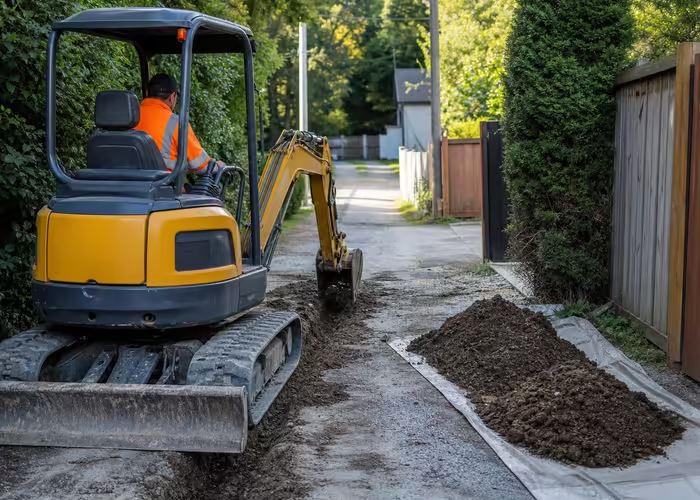
Consistent depth and grade are non-negotiable in utility trenching. Whether you’re laying conduit, drainage pipe, or fiber optic cable, variance in trench depth creates costly rework. In practice, operators rely on a combination of depth stops, boom geometry, and incremental bucket passes to maintain a uniform floor — rushing the process almost always introduces the grade inconsistencies that inspectors flag.
One underappreciated feature worth highlighting is the offset boom swing. This allows the arm to pivot left or right of the machine’s centerline, making it possible to dig parallel and tight to a foundation wall, curb, or existing structure without repositioning the entire machine. It’s a genuine productivity multiplier on confined urban lots.
Best Practices for Trenching with a Mini Excavator:
- Plan your spoil placement first — restricted sites leave little room to reposition piles mid-job
- Use overlapping bucket passes to maintain a clean, consistent trench wall
- Engage the offset boom for foundation-adjacent work rather than re-tracking
- Match mini excavator attachments — like narrow trenching buckets — to the specific pipe diameter being installed
- Work from the far end of the trench back toward the machine’s exit point
Managing spoil in tight quarters is often the overlooked challenge. Keeping piles low, compact, and clear of the trench edge prevents cave-ins and keeps the crew moving.
For contractors evaluating boom configurations suited to urban utility work, exploring options through a dedicated excavator supplier can clarify which offset and reach specifications best match your typical job profile — a detail that directly shapes the next conversation about where these machines actually come from.
The Strategic Advantage of Sourcing from a Chinese Manufacturer
The conversation around mini excavator quality has shifted dramatically. For years, “budget machine” and “Chinese-made” were treated as synonyms — a shorthand for compromised components and shortened service life. That narrative no longer holds up to scrutiny.
China has become a global hub for compact equipment, with manufacturers now prioritizing international certifications and advanced hydraulic components. The supply chain maturation driving this shift is structural, not superficial. Tier-1 suppliers producing hydraulic valves, track assemblies, and control systems for European and North American OEMs now feed directly into Chinese domestic production lines. The result is a generation of machines built to genuinely competitive specifications — not just competitive prices.
Quality, in 2025, is increasingly defined by what a machine can prove, not where it was assembled. For any serious buyer evaluating a compact mini excavator manufacturer in China, the benchmark has moved from country-of-origin skepticism to documentation-and-certification verification. Manufacturers pursuing EPA Tier 4 Final compliance for North American markets and CE marking for European distribution aren’t cutting corners — they’re engineering to the same regulatory thresholds that govern domestic production. Customization capabilities have expanded alongside compliance requirements, with leading manufacturers offering market-specific configurations covering engine tuning, control language localization, and attachment compatibility packages.
Qilu Machinery Engineering reflects this evolved standard directly. Their engineering focus on hydraulic precision — specifically valve response consistency and flow control stability under variable load — addresses one of the most common failure points in compact machines working attachment-heavy duty cycles. Chassis durability engineering, including reinforced slew ring mounting and undercarriage frame geometry, speaks to buyers who run machines hard across varied terrain. It’s a specification-forward approach that aligns with how contractors actually evaluate ROI: not the sticker price, but the cost-per-operating-hour across a realistic service life.
Of course, sourcing internationally still demands diligence. What a machine performs like on day one matters far less than how it behaves on day 1,000 — which makes maintenance protocol and parts availability critical factors worth examining closely.
Operational Deep Dive: Maintenance and Longevity
A machine’s ROI isn’t just built on what it can do — it’s built on how long it keeps doing it. Whether you’re running compact versatile excavators for sale or managing an established fleet, consistent maintenance is what separates a profitable asset from an expensive repair bill.
A practical daily maintenance routine covers:
- Grease points – Boom pins, bucket pins, and swing bearings need lubrication before each shift
- Hydraulic fluid levels – Low fluid accelerates pump wear faster than almost any other neglect
- Track tension – Too loose causes derailing; too tight accelerates undercarriage wear, especially in rocky or muddy terrain
- Visual walkaround – Check for hydraulic leaks, cracked hoses, and debris packed into drive sprockets
Beyond the basics, predictive maintenance can help operators monitor hydraulic temperatures, excessive idle time, and other warning signs before they become costly failures.
A well-maintained mini excavator routinely outlasts its expected service life by years. That kind of durability is what turns a smart purchase into a long-term profit center — and it raises questions buyers ask every day, which we’ll answer directly next.
Frequently Asked Questions About Mini Excavators
What is the most common use for a mini excavator?
Trenching remains the most frequent application — think utility lines, irrigation systems, and drainage work. However, the “Swiss Army knife” approach covered throughout this article is rapidly changing that picture, with operators increasingly pairing their machines with multiple attachments to handle grading, demolition, and lifting on the same job site.
Can a mini excavator dig through frozen ground or rock?
With the right attachment, yes. A hydraulic breaker or frost ripper can handle frozen soil and soft rock effectively. However, extremely hard rock typically requires larger equipment or specialized drilling, so always match the tool to the material.
How do I choose the right size for my landscaping business?
A 1.5- to 3-ton class machine covers the majority of residential and commercial landscaping tasks. Prioritize transport weight, yard gate clearance, and auxiliary hydraulic flow to support your planned attachment lineup.
Are Chinese mini excavators compatible with standard attachments?
Most modern Chinese-manufactured mini excavators use industry-standard coupler systems, making them compatible with a broad range of third-party attachments. Always confirm hydraulic flow specs and pin dimensions before purchasing attachments to avoid fitment issues.
Key Takeaways
- Reduced liability exposure — no counterweight overhang means fewer incidents near structures and people
- Smoother workflow — operators don’t need to constantly reposition to avoid swing interference
- Gate access — most ZTS models pass through standard 36–48 inch residential gates with clearance to spare
- Pedestrian safety — critical on public-facing commercial sites where bystanders may be present
- Plan your spoil placement first — restricted sites leave little room to reposition piles mid-job