Welcome to Shandong Qilu Industrial Co., Ltd

 English
 Arabic
 Bulgarian
 Bengali
 Czech
Czech
 Danish
 German
 Greek
Greek
 Spanish
 Finnish
 French
 Hindi
Hindi
 Croatian
 Hungarian
 Indonesian
 Italian
 Japanese
 Korean
 Lithuanian
 Dutch
Dutch
 Norwegian
 Polish
 Portuguese
 Romanian
 Russian
 Slovak
 Slovenian
 Swedish
 Thai
Thai
 Turkish
 Ukrainian
 Vietnamese
 Tagalog
 Malay
Malay
 Estonian
 Catalan
 Latvian
 Urdu
Urdu
 Serbian
 Persian
 Swahili
 Albanian
 Armenian
 Icelandic
 Bosnian
 Luxembourgish
 Afrikaans
English Arabic
Bulgarian
Bengali
Czech
Danish
German
Greek
Spanish
Finnish
French
Hindi
Croatian
Hungarian
Indonesian
Italian
Japanese
Korean
Lithuanian
Dutch
Norwegian
Polish
Portuguese
Romanian
Russian
Slovak
Slovenian
Swedish
Thai
Turkish
Ukrainian
Vietnamese
Tagalog
Malay
Estonian
Catalan
Latvian
Urdu
Serbian
Persian
Swahili
Albanian
Armenian
Icelandic
Bosnian
Luxembourgish
Afrikaans
Afrikaans
English Arabic
Bulgarian
Bengali
Czech
Danish
German
Greek
Spanish
Finnish
French
Hindi
Croatian
Hungarian
Indonesian
Italian
Japanese
Korean
Lithuanian
Dutch
Norwegian
Polish
Portuguese
Romanian
Russian
Slovak
Slovenian
Swedish
Thai
Turkish
Ukrainian
Vietnamese
Tagalog
Malay
Estonian
Catalan
Latvian
Urdu
Serbian
Persian
Swahili
Albanian
Armenian
Icelandic
Bosnian
Luxembourgish
Afrikaans

The Evolution of the Small Farm Tractor
Choosing the right farm tractors for a small operation has never been more nuanced — or more rewarding — than it is today. The modern market has shifted dramatically away from the massive, single-purpose row-crop machines of the mid-20th century toward nimble, multi-task compact units that can plow a field in the morning and grade a driveway in the afternoon.
Compact no longer means compromised. Today’s 25–40 HP machines deliver hydraulic capacity, attachment versatility, and build quality that would have seemed extraordinary in a full-size workhorse just a generation ago. According to the Association of Equipment Manufacturers, compact tractors under 40 horsepower account for approximately 65–70% of all annual tractor sales in the United States — a figure that reflects just how decisively this segment has become the industry standard for small and mid-scale operations.
That dominance is well-earned. The 25–40 HP range hits a practical sweet spot: powerful enough to run a mid-mount mower, a rear tiller, or a front loader simultaneously, yet compact enough to maneuver between tight fence lines and inside smaller outbuildings. Manufacturers have responded to this demand by packing these units with features once reserved for much larger machines — think live PTO, category 1 three-point hitches, and multi-function hydraulics. You can explore how these attachments translate to real field tasks across everything from soil prep to planting.
Understanding what’s under the hood — and what all those spec-sheet numbers actually mean — is where most buyers stumble first. The next section breaks down the essential terminology you’ll need before setting foot on a dealer lot.
Essential Terminology for Tractor Buyers
Understanding a few key specs separates a smart purchase from an expensive mistake — and it’s the foundation every best rated compact tractor buyer needs before comparing models.
Once you understand how the market has evolved, the next step is learning the language. Tractor spec sheets can feel overwhelming, but most buying decisions hinge on just four core concepts. Here’s what each one actually means in practical terms.
PTO (Power Take-Off) Horsepower
PTO horsepower is the actual power delivered to implements like mowers, tillers, and balers — and it’s always lower than the engine’s rated horsepower. According to Cornell Small Farms Program, this distinction matters enormously because an implement’s performance depends on PTO output, not engine output. A tractor rated at 35 engine HP may deliver only 28–30 PTO HP.
Category 1 Three-Point Hitch
A Category 1 hitch is the standard attachment system on most compact tractors, accepting implements with top link pins up to 7/8 inches in diameter. It’s the universal mounting point for rear-mounted tools — from box blades to finish mowers — and compatibility with this system dramatically expands your attachment options. You can explore common attachment options for small farms to understand what Category 1 supports.
Hydraulic Flow Rate (GPM)
Measured in gallons per minute, hydraulic flow rate determines how quickly and powerfully your loader, grapple, or remote cylinders respond. Higher GPM means faster, more capable hydraulic functions. In practice, a loader on a low-flow system feels sluggish — a detail dealers rarely emphasize upfront.
Hydrostatic vs. Gear Transmission
A hydrostatic transmission uses fluid pressure to deliver continuously variable speed with no clutching, making it ideal for tasks requiring frequent direction changes like loader work. A gear transmission offers more efficiency under sustained load, such as tilling long rows, but demands more operator skill. Neither is universally superior — your primary tasks should drive the choice.
With these definitions in hand, you’re ready to tackle one of the most debated questions in compact tractor buying: how much horsepower does your acreage actually need?
Determining the Right Horsepower for Your Acreage
Matching horsepower to acreage is the single most important decision a small farm buyer makes — get it wrong in either direction, and you’ll pay for it every time you fire up the engine.
Now that you understand the core specs covered in the previous section, it’s time to put those numbers to work. The table below provides a practical starting framework:
| Acreage | Recommended HP | Common Tasks |
|---|---|---|
| Under 5 acres | 18–24 HP | Mowing, tilling, light loader work |
| 5–10 acres | 25–35 HP | Category 1 implements, box blade, mid-duty FEL |
| 10–25 acres | 35–45 HP | Hay cutting, heavier clearing, post-hole drilling |
| 25+ acres | 45–60+ HP | Baling, rotary cutters, high-demand field work |
The 5–10 acre sweet spot. According to Hobby Farms Magazine, a tractor with 25 to 35 horsepower provides the ideal balance of fuel efficiency and the ability to run standard Category 1 implements for most small-scale operations of 5 to 10 acres. At this HP range, the best small compact tractor options offer enough muscle for box blades, tillers, and mid-weight front-end loaders without burning excessive diesel on routine tasks. Understanding how HP affects attachment compatibility can help you avoid costly mismatches.
When to jump above 40 HP. Operations involving regular hay production, large-scale brush clearing, or pulling a rotary cutter through dense growth will expose the limitations of a 35 HP machine quickly. In practice, heavy hay work and large-acreage clearing demand the additional torque that 40–50 HP engines deliver — particularly on uneven terrain where engines lug under load.
The fuel efficiency trade-off. Higher horsepower means higher fuel consumption, even at light loads, because larger diesel engines idle less efficiently. On a 7-acre property, running a 55 HP tractor to mow pasture is a common and costly pattern. Sizing down appropriately keeps operating costs manageable across years of ownership — an important consideration that connects directly to hydraulic capacity, which largely determines how hard your tractor actually works.
Why Hydraulic Capacity Trumps Engine Power
A tractor’s real-world usefulness is defined by its hydraulic system — not the horsepower badge on the hood.
When evaluating the best compact tractors, most buyers fixate on engine output while overlooking the system that actually determines what work gets done: hydraulics. According to the University of Missouri Extension, a front-end loader (FEL) enables roughly 80% of common utility tasks on a small farm — from moving material and grading driveways to loading trailers. If the hydraulics can’t keep up, the engine power behind them is largely wasted.
Hydraulic flow, measured in gallons per minute (GPM), is the true limiting factor for attachment performance. Low GPM means slower bucket curl, sluggish loader lift, and underperforming implements like hydraulic tillers or backhoes. In practice, a tractor rated at 25 HP but delivering only 5–6 GPM will frustrate owners far more than a slightly lower-horsepower model with 8–10 GPM. When comparing specs, always pull the hydraulic flow number alongside the engine rating — they tell very different stories.
Understanding lift capacity requires equal attention. Manufacturers typically list two figures:
- Lift capacity at the pins — the maximum weight the loader can raise at the attachment point
- Lift capacity at 500mm forward of the pins — a more realistic figure reflecting how the tractor performs with a loaded bucket extended to a working position
The second number is always lower, often significantly so, and is the one that reflects real-world loader work. Buyers who skip this distinction routinely discover their machine can’t lift a full bucket of gravel or wet compost to a useful height.
For tasks beyond basic loader work — like running a snow pusher or blower — hydraulic demand increases further. Before finalizing any purchase, confirm GPM output against the flow requirements of every attachment you plan to run. Choosing by hydraulics first leads to a tractor that actually delivers on the property — a point worth keeping in mind as we turn to drivetrain decisions next.
The 4WD vs. 2WD Debate for Small Properties
Choosing between 4WD and 2WD is one of the most consequential spec decisions small farm buyers make — and the performance gap is larger than most people expect.
For loader work and grading, traction is everything. When a front-end loader is loaded with soil, gravel, or compost, the rear wheels bear the bulk of that weight. A 2WD tractor can spin out or lose directional control precisely when you need confident forward momentum. According to PennState Extension, 4WD increases a compact tractor’s pulling power by up to 25% compared to a 2WD model of equivalent weight — a meaningful advantage during grading passes and heavy loader cycles.
Safety on sloped terrain shifts this debate decisively toward 4WD. On grades steeper than 15 degrees, 2WD tractors are significantly more prone to rear-wheel slippage and lateral sliding, especially on wet grass or loose soil. Four-wheel drive distributes braking and traction forces across all four contact points, reducing the risk of uncontrolled movement. For properties with rolling terrain, drainage ditches, or wooded hillsides, 4WD isn’t a luxury — it’s a safety floor. Resources like this overview of leading compact tractor models consistently show that top rated compact tractors offered in both drive configurations almost always hold higher resale values in 4WD spec.
Pros and Cons of 4WD for Small Farms:
- ✅ Up to 25% more pulling power for loader and grading work
- ✅ Improved stability and safety on slopes
- ✅ Stronger resale value retention
- ✅ Better wet-weather performance
- ❌ Higher upfront purchase price ($1,500–$3,000 premium, typically)
- ❌ Slightly increased mechanical complexity
- ❌ Marginally higher fuel consumption under light loads
Bottom Line: Unless your property is completely flat and your work is limited to light mowing, 4WD is worth the premium. The traction, safety, and resale advantages compound over time in ways that far outpace the initial cost difference — a point worth keeping in mind as you evaluate specific models.
Top Rated Compact Tractor Models for 2025
The compact tractor market in 2025 offers buyers a sharper range of choices than ever — but not every brand delivers equal value across reliability, ergonomics, and lift capacity.
With hydraulic performance and 4WD capability covered in earlier sections, the next logical step is mapping those specs onto actual models. Compact tractor horsepower ratings range widely across brands, so knowing which machines best translate specs into real-world productivity is essential before you commit.
Kubota L-Series remains the benchmark most buyers measure against. The L2501, one of the most searched and highest-resale models in the 25HP class, earns its reputation through tight hydraulic flow numbers, a proven diesel engine, and parts availability that holds up even in rural markets. Dealers stock components, resale values stay strong, and the machine handles a broad attachment catalog without complaint. For buyers prioritizing long-term ownership cost, the L-Series delivers. Best For: All-around reliability with strong resale protection.
John Deere 3-Series competes hard on operator comfort and dealer network density. The 3025E pairs a purpose-built cab layout with intuitive controls, making it a smart choice for operators who spend long hours on-machine or who need service support in remote areas. Best For: Buyers who prioritize ergonomics and service accessibility.
Mahindra holds a practical edge in weight and lift capacity relative to price point — a real advantage when running a heavy loader or large rear attachment. In practice, Mahindra models often outperform similarly priced competitors on three-point hitch ratings. Best For: Operators who need maximum lift without moving up a size class.
For buyers weighing value-engineered options, exploring how brands compare across specs can surface alternatives worth serious consideration — including manufacturers delivering high-utility performance at competitive price points.
The tractor alone, however, is only half the equation. The attachments you pair with it will determine daily productivity just as much as any spec sheet.
Essential Attachments: Beyond the Loader
The right tractor attachments for small farms can double your machine’s usefulness — but buying the wrong implements first is one of the most common and costly mistakes new owners make.
Now that you’ve evaluated drivetrain options and narrowed down top 2025 models, the next step is building a practical implement strategy. According to the University of Missouri Extension, grading, lifting, and snow removal are the three most common tasks small farm owners perform with attachments — and that insight should directly shape your purchasing priority.
The First Three Implements You Should Buy:
- Box blade — For driveway maintenance and land grading, a box blade is the most versatile ground-working tool available. Unlike a rear blade, which angles material to one side, a box blade captures and redistributes soil in both directions. This makes it far superior for leveling gravel driveways, filling low spots, and maintaining culverts. On the other hand, rear blades cost less and handle lighter-duty tasks like clearing snow or pushing debris, making them a reasonable secondary option once your box blade is in place.
- Rotary cutter (Brush Hog) — Field and pasture management demand consistent cutting of tall grass, brush, and light saplings. A rotary cutter matched to your tractor’s PTO output handles growth that a finish mower cannot. For properties between 5 and 20 acres, a 5- or 6-foot cutter is typically the practical sweet spot. If you’re still comparing compact models on a tighter budget, confirm PTO horsepower before spec’ing a cutter.
- Post-hole digger and pallet forks — These two implements often get treated as optional, but they’re immediately practical. A post-hole digger handles fence installation in hours rather than days. Pallet forks convert your loader into a materials handler capable of moving feed bags, lumber, and equipment around the property efficiently.
Choosing implements strategically now will also influence long-term costs — a topic the next section addresses in full.
Maintenance and Long-Term Ownership Costs
A compact tractor that runs reliably for 20+ years isn’t just about the machine you buy — it’s about the dealer behind it, the emissions system under the hood, and the service intervals you actually stick to.
Dealer support is often the most underestimated factor in total ownership cost. A tractor is only as good as the parts and technicians available when something breaks — and something always breaks eventually. Before committing to any brand, verify that a dealer is within a reasonable driving distance and carries common wear parts in stock. Waiting three weeks for a hydraulic seal during hay season isn’t a minor inconvenience; it’s lost income. Yanmar’s buyer guidance emphasizes dealer proximity as a core purchase criterion, not an afterthought.
Tier 4 emissions regulations add complexity that some small-farm owners would rather avoid. As Hobby Farms Magazine notes, tractors under 25 HP frequently fall outside Tier 4 Final requirements — meaning no diesel particulate filter (DPF) to regenerate, clog, or replace. In practice, a sub-25HP machine is simpler and cheaper to maintain for hobbyists and small-acreage owners. Buyers who need more power should budget for the added maintenance overhead that modern emissions systems bring, including potential regeneration cycles during fieldwork. Comparing this year’s standout models can help you identify which HP ranges offer the best balance of power and mechanical simplicity.
A consistent fluid and filter schedule is what separates a tractor that reaches 3,000 hours from one that fails at 800. Stick to these annual minimums:
- Engine oil and filter — every 100–200 hours or once per season
- Hydraulic fluid and filter — every 200–300 hours; inspect for milky color indicating moisture intrusion
- Transmission/transaxle fluid — every 200 hours or per manufacturer spec
- Coolant flush — every two years regardless of hours
- Air filter inspection — every 50 hours in dusty field conditions
- Fuel filter replacement — annually, or more often with lower-quality diesel
These intervals aren’t suggestions — skipped services are the primary cause of premature drivetrain failure in compact tractors.
Budget and maintenance planning go hand-in-hand with the decision many buyers face next: whether a new machine with a warranty or a used unit with lower upfront cost makes more financial sense for your operation.
New vs. Used: Finding the Best Value
The compact tractor market defies the usual “buy used to save money” logic — high resale values mean the gap between new and used pricing is often narrower than buyers expect.
According to rbauction.com, compact tractors typically retain 70–80% of their value after five years of use. That number changes the math significantly. A well-kept 5-year-old machine selling for $18,000 may not be much of a bargain compared to a new unit at $22,000 — especially once you factor in what’s missing: no warranty, unknown service history, and no manufacturer support.
New equipment financing often tips the scales further. Seasonal promotional offers from major manufacturers frequently include 0% APR for 60–84 months, which effectively lets you buy new at the same total cost as used, spread comfortably over time. If a dealer is running a zero-interest promotion, the carrying cost of new versus used shrinks to nearly zero — and you get a full warranty, current emissions compliance, and the latest hydraulic and transmission refinements.
That said, used machines remain a legitimate path for buyers with tighter budgets or mechanical confidence. The key is knowing what to inspect. A reliable used compact tractor typically passes these checks:
- Engine hours: Under 1,500 hours is low use; over 3,000 warrants scrutiny
- Hydraulic system: Look for weeping seals, slow loader response, or oil discoloration
- PTO shaft and splines: Check for wear, wobble, or damaged shielding
- Rear 3-point hitch: Test lift capacity and arm leveling under load
- Tires: Uneven wear signals potential axle or alignment issues
One caveat worth noting: used pricing on popular models can spike during high-demand periods — spring planting season especially — so timing your purchase matters. Whether you go new or used, having a complete picture of true ownership costs is what separates a smart buy from an expensive lesson. That ownership equation also extends into how safely you operate the machine — a topic that deserves its own careful attention.
Safety and Operation for New Farmers
Safe tractor operation isn’t optional — it’s the foundation every new farmer must build before turning a key. Compact tractors are powerful machines, and understanding their risks before fieldwork begins is just as important as choosing the right HP or hydraulic GPM.
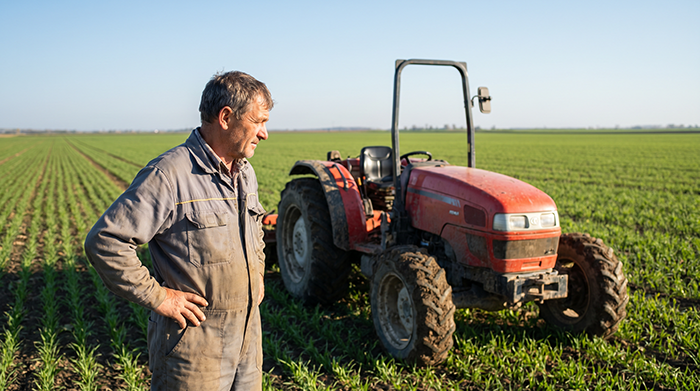
ROPS and seatbelt use are non-negotiable starting points. Every modern compact tractor ships with a Roll-Over Protective Structure, but the protection it offers is only activated when you’re wearing the seatbelt. According to PennState Extension, side rollovers are the most common type of tractor accident on small farms with uneven terrain. The ROPS creates a survival zone — but only if the operator stays inside it. Never disable, fold down, or bypass your ROPS on rough ground.
Center of gravity shifts dramatically with a raised loader. A front-end loader carrying a full bucket of soil or gravel moves the machine’s weight forward and upward, reducing rear-wheel traction and raising rollover risk significantly. In practice, operators should always carry loads low — no higher than 12 inches off the ground while traveling — and slow down before turning, especially on slopes. This is particularly relevant when running attachments on varied terrain, where surface conditions change quickly.
PTO entanglement is one of the most serious hazards in compact tractor operation. The Power Take-Off shaft spins at 540 RPM — fast enough to wrap loose clothing around it in a fraction of a second. Before connecting, disconnecting, or inspecting any PTO-driven attachment, always shut off the engine and wait for the shaft to stop completely.
A quick pre-operation checklist helps build safe habits:
- Confirm ROPS is upright and locked
- Fasten seatbelt before starting the engine
- Inspect all PTO shields and guards
- Lower the loader bucket to ground level
- Walk the work area for obstacles, ditches, or slopes
These fundamentals — once internalized — form the blueprint that the next section translates into a practical decision-making framework for your specific farm.
Key Takeaways: The Small Farm Tractor Blueprint
The right compact tractor is a 20-year investment — choosing one that meets your current needs plus roughly 20% extra capacity is the standard recommendation from the University of Missouri Extension.
After covering everything from horsepower math to safety protocols, the core decision points distill into a clear, repeatable framework. Keep these principles close when you start comparing models and talking to dealers.
- Match HP to acreage first. For farms in the 5–10 acre range, a 25–35 HP compact tractor covers the full workload — from loader work and mowing to tilling and baling — without overbuying on a machine that’s harder to maneuver in tight spaces. Undersizing is a common and costly mistake, so build that 20% capacity buffer into your target from day one.
- 4WD and a front-end loader are non-negotiable. These two features consistently deliver the highest return on investment across small farm operations. A 4WD drivetrain handles wet fields, slopes, and uneven terrain where 2WD machines bog down or lose traction. A loader transforms the tractor from a single-task tool into a daily workhorse for moving materials, grading, and loading.
- Hydraulic GPM determines attachment performance. Higher gallons per minute directly translates to faster, more responsive implements — especially for grapples, backhoes, and mid-mount mowers. Never evaluate a tractor by engine power alone; check the hydraulic spec sheet before committing.
- Dealer proximity protects your investment. Parts availability and qualified service within a reasonable distance can be the difference between a one-day fix and a week of downtime during a critical work window. According to KIOTI’s operational guidance, a strong dealer network is one of the most underrated purchase criteria new buyers overlook.
With this blueprint in hand, you’re ready for the final — and most important — step: getting behind the wheel.
Final Verdict: Selecting Your Workhorse
Choosing the best tractor for a small farm ultimately comes down to three things: hands-on evaluation, competitive pricing, and a long-term ownership mindset.
No spec sheet replaces seat time. Before signing anything, schedule a demo at your local dealership and operate the machine under realistic conditions — engage the loader, test the steering at low speeds, and run the PTO through a full cycle. What feels intuitive in a YouTube video may feel awkward in practice, and vice versa. As Hobby Farms Magazine puts it, “The best tractor is the one that you feel comfortable operating safely every single day.” That comfort only reveals itself when you’re actually behind the wheel.
Soliciting quotes from multiple dealers is just as essential as the test drive. Pricing on compact tractors varies more than most buyers expect — dealer incentives, regional freight costs, and package bundling (loader, backhoe, implements) can shift the final figure by thousands of dollars. Approach at least three dealers with an identical configuration request so you’re comparing apples to apples. Reference resources like Ritchie Bros. Auction’s small farm guide and AllMachines’ 2026 compact tractor specs and pricing to anchor your expectations before those conversations begin.
Finally, reframe how you think about this purchase. A compact tractor isn’t a one-season expense — it’s a working partner that will haul, grade, mow, and plant alongside you for decades. The Key Takeaways section already established that buying for 20% more capacity than you currently need protects that investment as your operation grows. View the machine through that lens: not as a cost, but as the foundation your farm grows on.
Take the next step today — request demos from two or three local dealers, compare specifications side by side, and move forward with confidence.