Welcome to Shandong Qilu Industrial Co., Ltd

 English
 Arabic
 Bulgarian
 Bengali
 Czech
Czech
 Danish
 German
 Greek
Greek
 Spanish
 Finnish
 French
 Hindi
Hindi
 Croatian
 Hungarian
 Indonesian
 Italian
 Japanese
 Korean
 Lithuanian
 Dutch
Dutch
 Norwegian
 Polish
 Portuguese
 Romanian
 Russian
 Slovak
 Slovenian
 Swedish
 Thai
Thai
 Turkish
 Ukrainian
 Vietnamese
 Tagalog
 Malay
Malay
 Estonian
 Catalan
 Latvian
 Urdu
Urdu
 Serbian
 Persian
 Swahili
 Albanian
 Armenian
 Icelandic
 Bosnian
 Luxembourgish
 Afrikaans
English Arabic
Bulgarian
Bengali
Czech
Danish
German
Greek
Spanish
Finnish
French
Hindi
Croatian
Hungarian
Indonesian
Italian
Japanese
Korean
Lithuanian
Dutch
Norwegian
Polish
Portuguese
Romanian
Russian
Slovak
Slovenian
Swedish
Thai
Turkish
Ukrainian
Vietnamese
Tagalog
Malay
Estonian
Catalan
Latvian
Urdu
Serbian
Persian
Swahili
Albanian
Armenian
Icelandic
Bosnian
Luxembourgish
Afrikaans
Afrikaans
English Arabic
Bulgarian
Bengali
Czech
Danish
German
Greek
Spanish
Finnish
French
Hindi
Croatian
Hungarian
Indonesian
Italian
Japanese
Korean
Lithuanian
Dutch
Norwegian
Polish
Portuguese
Romanian
Russian
Slovak
Slovenian
Swedish
Thai
Turkish
Ukrainian
Vietnamese
Tagalog
Malay
Estonian
Catalan
Latvian
Urdu
Serbian
Persian
Swahili
Albanian
Armenian
Icelandic
Bosnian
Luxembourgish
Afrikaans
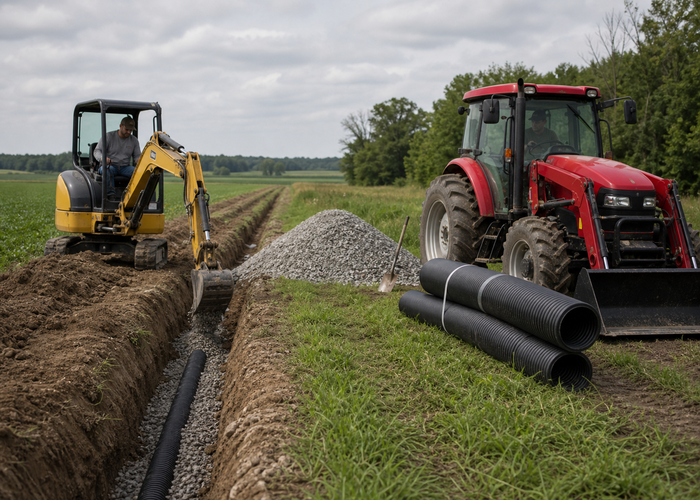
Mini Excavator and Tractor Combo Planning for Farm Drainage Jobs
A practical farm drainage guide covering how mini excavators and tractors work together for trenching, material staging, outlet prep, and safer workflow.
Farm drainage jobs rarely fail because the trench was difficult to dig. They fail because the workday was planned around only one machine. A mini excavator may cut the trench accurately, but someone still has to deliver pipe, move gravel, manage spoil, and support cleanup around the field edge. That is why many drainage jobs run better as a mini excavator and tractor combination rather than a single-machine effort.
The combination matters most when the property already uses both machine types for other chores. A compact excavator handles trench accuracy, outlet shaping, and tight digging near ditches or structures, while a tractor manages trailers, pallets, backfill support, and longer-distance hauling. Buyers evaluating the mini excavator range and the farm tractor range should think of drainage as a workflow, not just a digging specification.
That workflow starts before the trench opens. Material staging, outlet access, soil moisture, spoil placement, and trench safety rules all shape the machine plan. If the site has long runs, limited field access, or a sensitive outlet near a ditch bank, the best decision often combines an excavator from the Eco series or Pro series with a tractor that can keep pipe, gravel, and tools arriving in the right order.
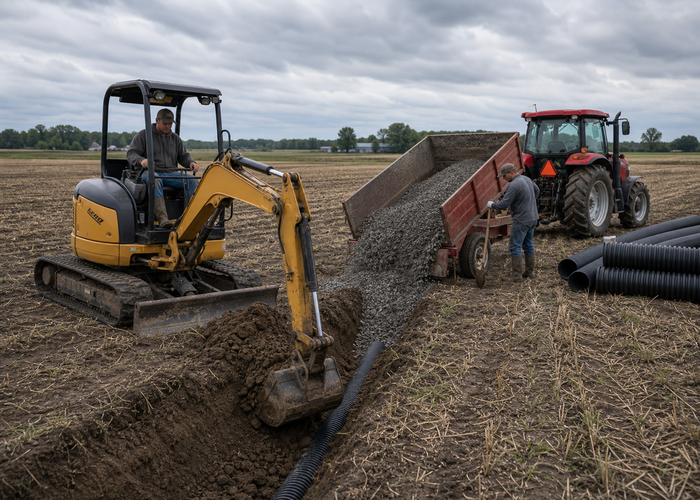
Why the Excavator and Tractor Roles Are Different
A mini excavator earns its place on drainage work by controlling trench depth, reach, and precision. A tractor earns its place by reducing dead time. When one operator digs and another keeps stone, pipe, and fittings moving, the trench stays productive. When the excavator has to wait for materials or the tractor cannot approach the work area efficiently, the job slows down for reasons unrelated to digging skill.
The University of Illinois drainage guide page Subsurface Drainage is useful because it reinforces how drainage performance depends on layout, spacing, outlet conditions, and installation quality rather than simply the act of opening soil. Precision matters, but logistics matter too. A trench that is cut accurately and then handled poorly can still produce weak results.
That is why drainage planning should assign tasks clearly. Let the excavator own trench accuracy, pipe placement support, and outlet shaping. Let the tractor own material flow, spoil management, and travel between stack area and trench line. Once those roles are clear, the site usually needs less improvisation and fewer machine delays.
Use the Excavator Where Reach and Control Matter Most
Short-radius digging near a ditch bank, culvert, or existing structure is a strong reason to rely on the excavator. The machine can clean the invert, shape the outlet, and work with smaller bucket movements than a larger loader-based approach. That control becomes especially valuable when the outlet is the one place on the project where rework is most expensive.
It also makes sense to use the excavator for final trench cleanup before pipe and stone go in. A tractor can support grading and haul duties, but it does not replace the excavator’s ability to fine-tune trench shape or reach over a spoil line from stable ground. Buyers looking for that precision often start with the machine detail shown on the mini excavator manufacturer in China page and then match it to the support tractor they already own or intend to buy.
Use the Tractor to Keep the Digging Crew Fed With Material
Pipe, geotextile, stone, and tools rarely begin the day exactly where the trench ends up. A tractor with a trailer or loader can shorten walking and waiting dramatically. That makes a difference on longer runs where the excavator would otherwise pause while the crew relocates pipe bundles or gravel stock.
North Dakota State University’s article Tile Drainage is a useful reminder that drainage systems are part of larger water-management strategy. Installation quality matters, but so does whether materials arrive in the right order and whether the crew protects trench shape while working. A support tractor helps maintain that order.
Start the Job With Layout, Outlet, and Safety Checks
Drainage work should begin with the line, the outlet, and the spoil plan before the first bucket of soil is moved. Wisconsin Extension’s article Maintaining Tile Drainage Systems is valuable because it focuses attention on function, inspection, and long-term performance. A clean trench means little if the outlet is poor, the grade is wrong, or the crew cannot maintain the finished system later.
The NRCS chapter Drainage Water Management also helps frame drainage as a planned system with control points, not a one-off dig. Even on smaller private jobs, the lesson transfers well: define where the water is going, how the outlet behaves, and how the installed line will be accessed and maintained.
Safety needs the same front-end attention. OSHA’s trenching fact sheet Trenching and Excavation Safety and the OSHA standard 29 CFR 1926.651 make it clear that soil conditions, protective systems, access, and spoil placement are not optional details. A drainage job should never be planned around people stepping into unstable trenches because the material flow or layout was handled poorly.
Once layout and safety are defined, the excavator and tractor can be matched to travel distance and soil condition. A soft field edge may ask the tractor to stay on a firmer route and shuttle material to a closer staging point, while the excavator reaches out from a stable position. On firmer ground, the tractor may be able to work closer and cut waiting time further.
The support tractor’s loader height and trailer plan matter as much as its horsepower. The machine does not need to dig the trench, but it does need to move material without sinking, spilling, or forcing awkward hand transfers. That is why a right-sized support tractor from the 50-70 HP tractor range is often more useful than a poorly matched larger machine on drainage support duty.
The crew should also decide in advance where spoil goes and how pipe bundles will be opened. Small procedural choices have large effects on trench quality. If spoil slides back into the trench line or pipe gets dragged over rough ground because the tractor cannot stage it well, the excavator operator spends the day fixing logistics mistakes instead of digging productive footage.
A Practical Combo Workflow for Smaller Farm Drainage Jobs
| Project step | Mini excavator role | Tractor role |
|---|---|---|
| Layout and staking | Confirm digging line and outlet approach | Carry stakes, measuring tools, and crew supplies |
| Opening the trench | Cut grade, manage trench width, clean base | Stay ready with pipe, gravel, and fittings |
| Pipe and stone placement | Support accurate placement and spot corrections | Deliver pallets, stone, and replacement parts without delay |
| Outlet shaping and cleanup | Finish outlet and final contouring | Remove spoil, haul leftovers, and restore travel lanes |
| End-of-day protection | Leave trench and outlet in a safe state | Move barriers, tools, and remaining materials out of the work zone |
This sequence keeps each machine on the task it performs best. It also lowers the chance that the excavator becomes a very expensive waiting platform while material handling falls behind.
Plan the Day-Before Staging as Carefully as the Trench
The cleanest drainage jobs often look easy because the difficult planning happened the day before. Pipe bundles are stacked where the tractor can approach them cleanly, gravel is placed on firm ground, the outlet route is checked, and the crew already knows which direction the trench will open. That preparation reduces the number of improvised moves that disturb the trench line once digging begins.
Support equipment should also be arranged around weather. If rain is likely, the tractor may need a firmer shuttle route and a backup staging area. If the field edge is soft, it may be smarter to keep the tractor farther back and use the excavator’s reach rather than risk rutting the access point. Those decisions are small on paper, but they often separate a smooth drainage day from a repair-heavy one.
Another useful step is loading the tractor with the support items that always seem to be missing at the worst time: stakes, string line, fittings, repair couplers, trench access ladder, and cleanup tools. A support tractor that arrives ready for those small needs saves more time than one that simply has adequate horsepower.
Outlet Protection Should Be Planned Before the Main Run Opens
Many crews focus on the middle of the trench and leave the outlet details too late. That is risky because the outlet often needs the most careful shaping, bank protection, and inspection access. If riprap, culvert connection hardware, or erosion control material is part of the plan, the tractor should stage it before the excavator reaches the outlet rather than after the bank is already disturbed.
This is one reason drainage combination planning benefits from a machine layout review on the excavator application solutions page as well as the tractor pages. The outlet can be the place where bucket control, machine stance, and support access all matter at once, so it deserves machine planning of its own.
Where Buyers Often Underspec the Combination
The most common mistake is buying the excavator correctly and the support tractor carelessly. A tractor that cannot carry the pipe safely, move gravel efficiently, or travel well on the field approach turns into a bottleneck. The second mistake is selecting machines without thinking about outlet conditions. A drainage line that ends at a ditch bank or culvert often asks much more of the excavator than the mid-run trench does.
Another mistake is separating the drainage job from the rest of the property. If the excavator will also handle utility trenches, stump removal, and ditch maintenance, or if the tractor also needs to mow, tow, and support general farm chores, then the combined purchase should reflect those recurring roles. That is where the broader Chinese mini excavator manufacturer page and the product application solutions become useful as comparison context rather than isolated product pages.
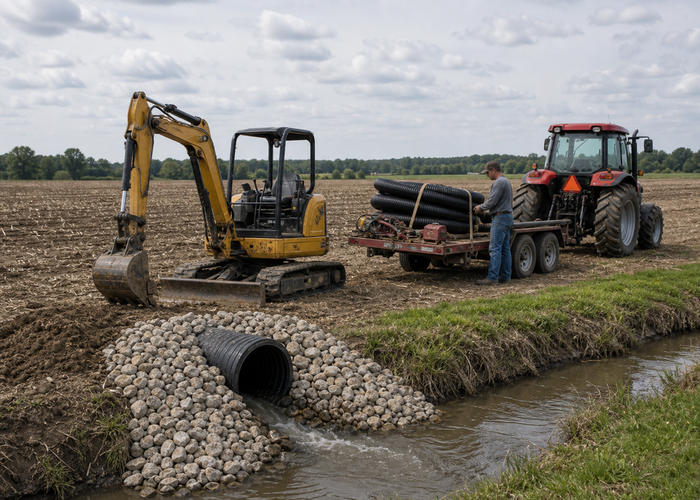
The best drainage combo is the one that keeps the trench crew moving without sacrificing safety or finish quality. That usually means a mini excavator sized for precise digging and a tractor sized for real support work, not just casual hauling. When both machines are matched to the route, staging plan, and outlet challenge, the job feels organized from the first cut onward.
It also means respecting cleanup and inspection after the trench is closed. The outlet should remain visible, spoil should not block future observation, and the travel path should be restored well enough that later maintenance is straightforward. A good combination plan thinks about the first repair visit before the install day is even over.
Support tractors are especially valuable during that final phase because they can remove leftover pipe, unused gravel, and temporary barriers without asking the excavator to stop finishing contour work. When the site is left clean and the outlet is easy to find, the drainage system is more likely to be maintained correctly in the months that follow.
It also means documenting what worked. Travel lanes, loader bucket choice, trailer setup, pipe staging order, and spoil placement strategy should all be written down after a successful job. That record makes the next drainage project faster and safer than starting from scratch every time.
For buyers planning equipment around real farm maintenance rather than one isolated task, drainage is a strong example of why machine combinations matter. The right excavator and the right tractor create a smoother job than either one can create alone, and that pairing is exactly the type of practical ownership planning worth keeping on the QiLu Machinery blog.
FAQ
Why use a mini excavator and a tractor together on drainage work?
Because the excavator handles trench precision while the tractor handles material flow, haul support, and cleanup. Splitting those roles reduces waiting and keeps the trench crew productive.
What should set the excavator size for farm drainage?
The trench depth, outlet difficulty, reach needs, and how precisely the machine must work near ditches, structures, or existing lines. Precision and stable positioning matter more than choosing the largest unit available.
What makes the support tractor important?
It keeps pipe, gravel, tools, and spoil movement from slowing the dig. A weak support tractor can turn a well-chosen excavator into a machine that waits too often.
What is the most common drainage planning mistake?
Starting to dig before the crew has settled the layout, outlet, spoil placement, and safety plan. Good drainage jobs are organized before the first bucket is lifted.