Welcome to Shandong Qilu Industrial Co., Ltd

 English
 Arabic
 Bulgarian
 Bengali
 Czech
Czech
 Danish
 German
 Greek
Greek
 Spanish
 Finnish
 French
 Hindi
Hindi
 Croatian
 Hungarian
 Indonesian
 Italian
 Japanese
 Korean
 Lithuanian
 Dutch
Dutch
 Norwegian
 Polish
 Portuguese
 Romanian
 Russian
 Slovak
 Slovenian
 Swedish
 Thai
Thai
 Turkish
 Ukrainian
 Vietnamese
 Tagalog
 Malay
Malay
 Estonian
 Catalan
 Latvian
 Urdu
Urdu
 Serbian
 Persian
 Swahili
 Albanian
 Armenian
 Icelandic
 Bosnian
 Luxembourgish
 Afrikaans
English Arabic
Bulgarian
Bengali
Czech
Danish
German
Greek
Spanish
Finnish
French
Hindi
Croatian
Hungarian
Indonesian
Italian
Japanese
Korean
Lithuanian
Dutch
Norwegian
Polish
Portuguese
Romanian
Russian
Slovak
Slovenian
Swedish
Thai
Turkish
Ukrainian
Vietnamese
Tagalog
Malay
Estonian
Catalan
Latvian
Urdu
Serbian
Persian
Swahili
Albanian
Armenian
Icelandic
Bosnian
Luxembourgish
Afrikaans
Afrikaans
English Arabic
Bulgarian
Bengali
Czech
Danish
German
Greek
Spanish
Finnish
French
Hindi
Croatian
Hungarian
Indonesian
Italian
Japanese
Korean
Lithuanian
Dutch
Norwegian
Polish
Portuguese
Romanian
Russian
Slovak
Slovenian
Swedish
Thai
Turkish
Ukrainian
Vietnamese
Tagalog
Malay
Estonian
Catalan
Latvian
Urdu
Serbian
Persian
Swahili
Albanian
Armenian
Icelandic
Bosnian
Luxembourgish
Afrikaans
Mini Skid Steer vs Compact Tractor for Landscape Material Handling
A practical comparison of mini skid steers and compact tractors for mulch, gravel, pallet, and backyard landscape material handling.
Landscape material handling looks simple until the access path narrows. A machine may only need to move mulch, gravel, pavers, and pallets from the driveway to the work area, yet the difference between a clean job and a frustrating one often comes down to gate width, turning space, and how much material has to be moved each trip. That is exactly where the choice between a mini skid steer and a compact tractor becomes practical instead of theoretical.
Buyers usually see both machines as small-property tools, but they solve different bottlenecks. A mini skid steer is built to work in tight access zones and repeated short shuttle trips, while a compact tractor often earns its keep when the same property also needs PTO work, field mowing, grading, and trailer pulling. Anyone comparing the mini skid steer lineup against the farm tractor range should begin with the daily work pattern, not the general idea of versatility.
That work pattern includes how material arrives, how far it travels, whether the operator must cross lawns or slopes, and whether the machine needs to switch from loading to another job the same afternoon. On some properties, a nimble tracked loader such as the QL260 mini skid steer is the right answer. On others, the better fit is a tractor from the 25-50 HP tractor range with a front loader and rear attachment support.
Start With Access Width, Not Lift Capacity
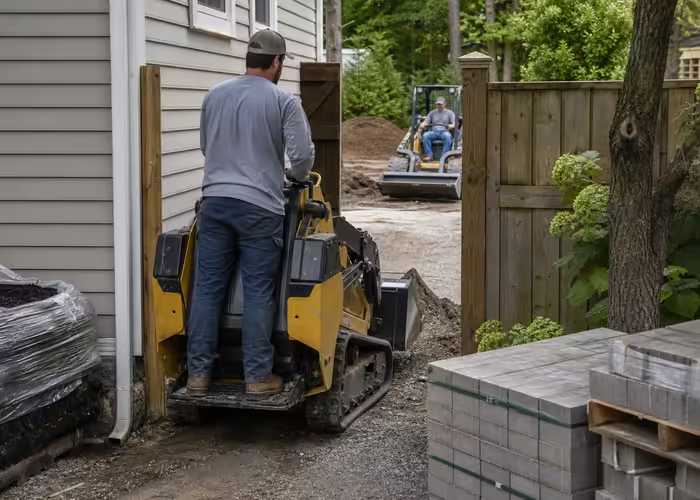
The first question in landscape handling is often the least glamorous one: where does the machine need to go? A compact tractor may carry more efficiently across open ground, but if the real work happens behind a side-yard gate or between retaining walls, the larger machine loses time before the job even starts. Kansas State’s PDF Skid-Steer Loader Safety for the Landscaping and Horticultural Services Industry is helpful because it frames skid steers around the conditions where their compact footprint matters most.
That does not mean every narrow property should default to a mini skid steer. If materials can be staged in the open and then distributed by hand for the final few feet, a tractor may still complete the total project faster. The deciding factor is whether tight access is the exception or the dominant operating condition.
This is also why machine width should be checked with the actual bucket or attachment in mind. Tires, tracks, and loader arms are only part of the picture. Bucket corners, pallet forks, and operator stance all affect whether the machine can work comfortably around fences, house corners, and parked vehicles.
Travel Distance Changes the Winner
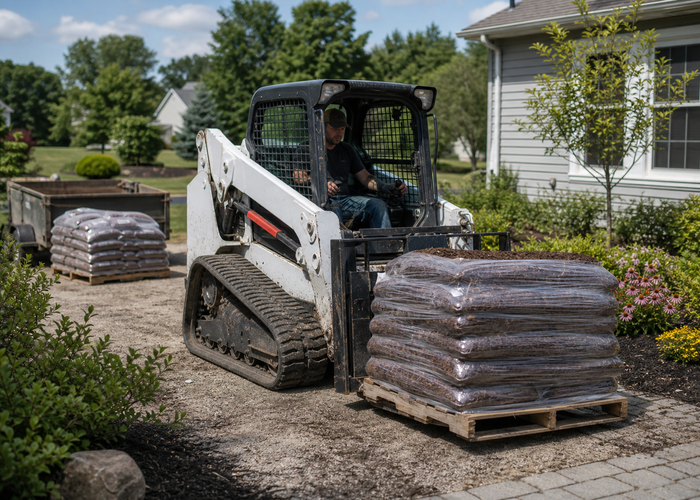
If the machine spends most of the day moving material from a pallet or stockpile fifty feet away, the mini skid steer has a strong case. If it must shuttle stone from a distant stack, tow a trailer, and then transition to box blade or PTO work, the compact tractor gains ground quickly. Efficiency is not only about how much one bucket holds. It is about how many non-value-adding minutes the machine spends travelling back and forth.
That is where property shape matters. A loader that feels fast in a narrow backyard may feel slow on a long gravel drive with repeated haul cycles. A compact tractor can often carry those longer runs more comfortably, especially when the same machine also supports the rest of the site maintenance schedule through the week.
Attachment Strategy Decides Whether You Need a Loader or a Multi-Tool
Mini skid steers are at their best when the project is mostly material handling, light grading, augering, or trench support in tight zones. Compact tractors become more valuable when the property owner also needs mowing, tilling, seeding, or other PTO-driven tasks after the landscape material has been moved. That is why a loader comparison alone can be misleading.
Penn State’s article Managing Machinery and Equipment is useful because it pushes owners to think about total equipment use, downtime, and fit to the operation. If the property needs one machine to touch many categories of work over a season, the tractor’s broader utility can outweigh the mini skid steer’s access advantage.
On the other hand, if the job list is dominated by mulch, soil, block, and pallet movement through constrained spaces, the mini skid steer often pays back in reduced wheelbarrow labor and easier placement. Buyers who already know they need a compact tracked loader can compare machines such as the QL380 mini skid steer and then judge whether a tractor still belongs elsewhere on the property.
Compact Tractors Need Ballast and Stability Discipline
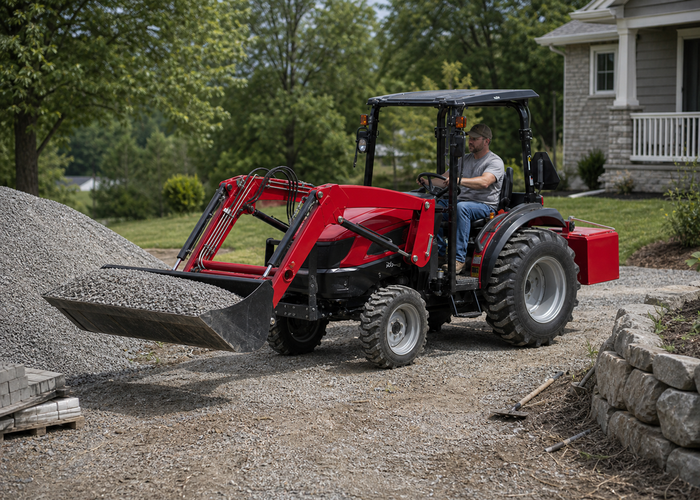
A compact tractor with a front loader is useful, but it is not a miniature wheel loader. Penn State’s Tractor Stability and Instability is a strong reminder that center of gravity, loader height, slope, and ballast all matter. A tractor becomes the wrong choice quickly when the operator treats it as if it were built only for front-bucket work.
Rear ballast, tire pressure, and lift height discipline are part of the compact tractor decision, not optional add-ons. If the project involves repeated lifting near retaining walls or driveway slopes, those setup details determine whether the machine feels predictable or uneasy. Buyers who need that kind of year-round loader work should also review the tractor application solutions instead of assuming a front loader alone defines the package.
Mini Skid Steers Bring Their Own Safety Pattern
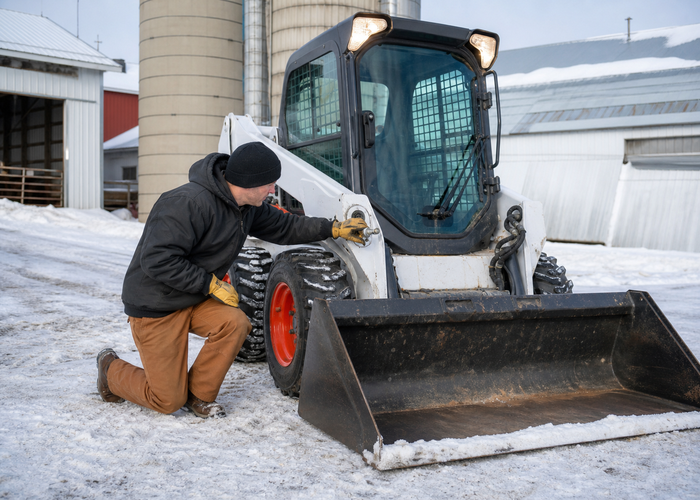
Compact size does not make a machine harmless. The CDC/NIOSH page Preventing Injuries and Deaths from Skid-Steer Loaders and Penn State’s Skid Steer Safety for Farm and Landscape both emphasize visibility, operator positioning, and safe entry/exit practices. In residential jobsites, that matters because bystanders, pets, and obstacles often sit closer to the work zone than they would on a farm lot.
The machine choice also changes ground impact. Tracked mini skid steers spread weight differently and can feel more secure on certain soft surfaces, but they may still mark finished areas during aggressive pivoting. Compact tractors can ride more gently when set up correctly, yet their larger turning circle may require more reversing and correction in landscaped spaces.
PTO requirements are another clean divider. If the machine will run a finish mower, rotary cutter, tiller, or spreader beyond the handling job, Penn State’s Power Take-Off Safety matters because it highlights how tractor utility expands only when the operator respects the PTO system that comes with it. A mini skid steer cannot replace that part of property maintenance without separate equipment.
That is why buyers should treat the comparison as a workflow choice. A mini skid steer excels when tight access and repeated short handling cycles dominate. A compact tractor excels when the property needs one machine to move material and then handle broader land-care work. Both are productive when matched to the real job; both are frustrating when purchased from a vague idea of versatility.
A Decision Table for Landscape Material Handling
| Job condition | Mini skid steer advantage | Compact tractor advantage |
|---|---|---|
| Narrow gates and tight backyards | Fits constrained access and places material close to the work zone | Usually loses time unless materials can be staged in the open |
| Long shuttle distance from stockpile to job | Works, but repeated travel may be slower | Carries more comfortably over longer runs |
| Mostly loading, grading, and pallet handling | Strong match for repeated short-cycle handling | Useful if space is open and ballast is managed well |
| Need for mowing, tilling, or PTO tasks later | Requires another machine | One machine can handle multiple seasons of work |
| Finished lawns and mixed property maintenance | Good in access zones, but turning style still matters | Better long-term utility if the property is not access constrained |
A buyer who reads this table honestly will usually see the answer. The wrong purchase often happens because the property has one spectacularly difficult access point and ten ordinary maintenance tasks, or the opposite. The machine should be chosen for the dominant pattern, not the loudest single example.
Think About the Entire Site Finish, Not Just the Material Pile
Landscape jobs are judged after the load is delivered. The machine that moves mulch efficiently but tears the route, scuffs the paving edge, or forces too many correction turns may not be the cheapest machine by the end of the week. That is one reason experienced crews walk the full route before deciding what machine belongs on the site. They look at the drop location, reversing room, lawn sensitivity, and where the operator will have to pass close to structures.
Mini skid steers often shine on finish-sensitive sites because they can place material closer to the final location and reduce hand labor. Compact tractors, however, may treat the rest of the property better if the work area is open and the machine needs to transition into mowing, spreading, or trailer work after the material is moved. A property that wants one machine for spring soil movement and summer maintenance may still find better value in the tractor after looking at the full calendar instead of the first delivery.
That is also where operator fatigue becomes a real cost. Repeated tight reversals, awkward visibility around fences, and long hand-transfer distances wear a crew down faster than people expect. A machine that keeps the operator comfortable and the path simple often delivers a better workday even if its brochure numbers are less dramatic. Matching the machine to the route, not just the bucket load, is what makes the job feel efficient from morning through cleanup.
How To Size the Loader Around Real Material Density
Mulch, wet soil, decorative stone, and pavers do not behave like the same load. A machine that feels perfect on bagged mulch may need a different bucket habit when the project turns to dense aggregate. That is why lift capacity should be read as a boundary, not a promise that every material will be equally easy to handle in every part of the yard.
The compact tractor buyer should think about ballast and bucket fill discipline. The mini skid steer buyer should think about how often the job demands full loads through narrow access versus smaller, quicker cycles. When owners make this comparison carefully and then cross-check with the skid steer application solutions, they usually reach a more realistic answer than they would from comparing horsepower alone.
The Cost of Choosing the Wrong Machine
The price penalty of a mismatch does not always show up in the invoice. It shows up in labor hours, hand-carrying, damaged turf, and attachments that stay unused. A contractor who buys a compact tractor for a mostly backyard handling business may own a versatile machine that still cannot reach the work efficiently. A property owner who buys only a mini skid steer may move mulch beautifully and still need a second machine for mowing, tillage, and field upkeep.
That is why it helps to compare the expected work calendar, not just the next project. Look at spring mulch movement, summer mowing, fall grading, storm cleanup, and any recurring loader or PTO tasks. Cross-checking those needs against the broader QiLu Machinery product lineup usually reveals whether the property needs a tight-access specialist or a more general machine.
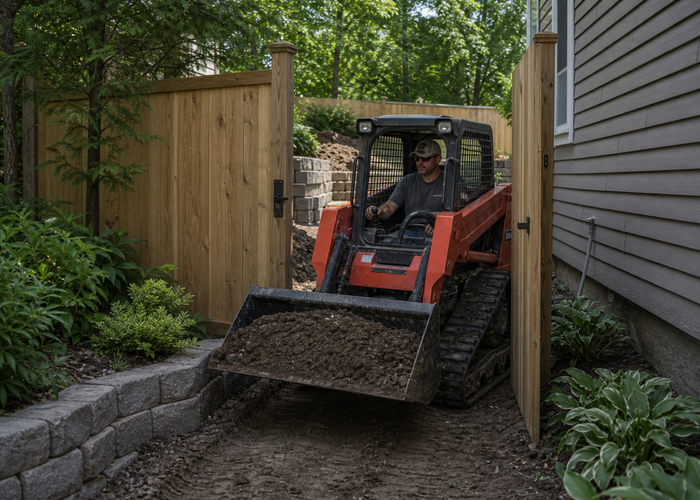
Another cost is operator confidence. Mini skid steers and compact tractors ask for different habits. The former rewards precise positioning in tight spaces. The latter rewards smooth loader practice, ballast discipline, and a wider working envelope. A crew or owner who understands those habits will work faster and damage less property than one who tries to make the machine behave like something it is not.
Equipment planning also changes if the same property expects winter snow, summer mowing, and occasional trailer towing. A mini skid steer can still be the right first purchase when access is the hard limit, but it should not be treated as a quiet replacement for every seasonal role a compact tractor would cover. Likewise, a tractor should not be treated as a universal substitute for a machine that must work inside gates, between houses, and against retaining walls every week.
When the comparison is handled well, the answer becomes clear. Choose the mini skid steer when access is the bottleneck and the work is concentrated on short-cycle handling. Choose the compact tractor when the property needs a loader plus PTO-driven maintenance across the season. If both patterns are significant, then the honest answer may be that the property eventually needs both roles, just not on the same purchase day.
For today’s buying decision, start with the real path materials must travel, the tasks that repeat every month, and the attachments that actually generate value. That approach leads to better machine ownership than choosing the unit that looks most versatile in a yard photo. It is also the type of machine-planning logic worth preserving on the QiLu Machinery blog for future crew and property decisions.
FAQ
When is a mini skid steer the better choice?
When the property has narrow access, repeated short-cycle material handling, and little need for PTO-driven land-care work. Tight placement is where the machine usually earns its advantage.
When does a compact tractor beat a mini skid steer?
When the site is more open, shuttle distances are longer, and the same machine also needs to mow, grade, tow, or run rear PTO attachments through the season.
Can a compact tractor replace a mini skid steer in a backyard?
Sometimes, but only if the access path is wide enough and materials can be staged sensibly. If the machine cannot reach the work area cleanly, its extra versatility will not save time on the actual job.
What is the biggest mistake in this comparison?
Comparing only lift capacity or horsepower. Access width, travel distance, attachment needs, and recurring seasonal tasks usually decide the better machine long before raw power does.