Welcome to Shandong Qilu Industrial Co., Ltd

 English
 Arabic
 Bulgarian
 Bengali
 Czech
Czech
 Danish
 German
 Greek
Greek
 Spanish
 Finnish
 French
 Hindi
Hindi
 Croatian
 Hungarian
 Indonesian
 Italian
 Japanese
 Korean
 Lithuanian
 Dutch
Dutch
 Norwegian
 Polish
 Portuguese
 Romanian
 Russian
 Slovak
 Slovenian
 Swedish
 Thai
Thai
 Turkish
 Ukrainian
 Vietnamese
 Tagalog
 Malay
Malay
 Estonian
 Catalan
 Latvian
 Urdu
Urdu
 Serbian
 Persian
 Swahili
 Albanian
 Armenian
 Icelandic
 Bosnian
 Luxembourgish
 Afrikaans
English Arabic
Bulgarian
Bengali
Czech
Danish
German
Greek
Spanish
Finnish
French
Hindi
Croatian
Hungarian
Indonesian
Italian
Japanese
Korean
Lithuanian
Dutch
Norwegian
Polish
Portuguese
Romanian
Russian
Slovak
Slovenian
Swedish
Thai
Turkish
Ukrainian
Vietnamese
Tagalog
Malay
Estonian
Catalan
Latvian
Urdu
Serbian
Persian
Swahili
Albanian
Armenian
Icelandic
Bosnian
Luxembourgish
Afrikaans
Afrikaans
English Arabic
Bulgarian
Bengali
Czech
Danish
German
Greek
Spanish
Finnish
French
Hindi
Croatian
Hungarian
Indonesian
Italian
Japanese
Korean
Lithuanian
Dutch
Norwegian
Polish
Portuguese
Romanian
Russian
Slovak
Slovenian
Swedish
Thai
Turkish
Ukrainian
Vietnamese
Tagalog
Malay
Estonian
Catalan
Latvian
Urdu
Serbian
Persian
Swahili
Albanian
Armenian
Icelandic
Bosnian
Luxembourgish
Afrikaans

How to Choose Between 35HP and 40HP Tractors: What Matters for Real Work? (2026)
If your main jobs are tilling, plowing, and seasonal rotary cutting, the 35HP vs 40HP tractor decision comes down to one thing: matching PTO horsepower to implement size. Disclosure: Qilu Machinery is our product. In this comparison, we’ll look at Qilu’s QL‑354Y (35HP) and QL‑404Y (40HP) through the lens of ground‑engaging field work and show how PTO output, tractor weight/traction, hydraulics, and 3‑point lift translate into real work.
Updated as of 2026‑01‑22. Some specifications (net PTO HP, hydraulic GPM, 3‑pt lift) may require confirmation from model spec sheets; pricing is quote‑based and subject to change.
Key takeaways: 35HP vs 40HP tractor rules of thumb
- The single decision criterion is PTO horsepower → implement sizing. If you plan to run a 6‑ft rotary cutter or wider tillers regularly, a 40HP tractor typically makes that easier. If your work centers on 5‑ft cutters and light tillage, a 35HP tractor often suffices.
- Typical pairing in many conditions: 35HP vs 40HP tractor → 5‑ft vs 6‑ft cutter. LSU AgCenter advises ~10–15 hp per foot for rotary tillers; that maps well to 35HP (about 48–60 inches) vs 40HP (about 60–72 inches) depending on soil and depth.
- Heavier chassis and ballast help any tractor keep blade speed and tilling depth under load. A 40HP unit tends to have more margin in mixed/heavy vegetation, clay soils, or slopes.
- Quote‑based pricing on Qilu means you should request a current spec and price before deciding.
TL;DR verdict: Who should choose which 35HP vs 40HP tractor?
Choose Qilu QL‑404Y (40HP) if your routine work includes 6‑ft rotary cutters, wider tillers, or heavier plowing. The extra PTO power and likely traction margin typically maintain blade speed and tiller bite in mixed conditions. Choose Qilu QL‑354Y (35HP) if your primary jobs are 5‑ft cutting, light tilling, and small‑plot passes. You’ll generally spend less on acquisition and fuel while covering the tasks many acreage owners face.
Visit the official model pages: Qilu China 35HP Tractor QL‑354Y and Qilu OEM 40HP Tractor QL‑404Y.
QL‑354Y vs QL‑404Y comparison table (as of 2026‑01‑22)
| Field | QL‑354Y (35HP) | QL‑404Y (40HP) | Notes / Sources |
|---|---|---|---|
| Model link | QL‑354Y product page | QL‑404Y product page | Internal Qilu links |
| Engine HP (rated) | 35 HP (confirm with sales/spec sheet) | 40 HP (confirm with sales/spec sheet) | Qilu naming confirms class; verify engine rating on spec sheet |
| Net PTO HP @540 rpm | Confirm with sales/spec sheet | Confirm with sales/spec sheet | PTO is the key choice criterion |
| PTO type | Confirm with sales/spec sheet | Confirm with sales/spec sheet | Live/independent to be verified |
| Recommended rotary cutter width | Typically 5‑ft in many conditions | Typically 6‑ft in many conditions | TAMU example of 40‑hp + 6′ mower; cutter duty level matters |
| Recommended tiller width | ~48–60 inches (10–15 hp/ft) | ~60–72 inches (10–15 hp/ft) | LSU AgCenter tiller guidance |
| Hydraulics (total/implement GPM) | Confirm with sales/spec sheet | Confirm with sales/spec sheet | Loader cycle speed depends on flow |
| Rear remotes | Confirm with sales/spec sheet | Confirm with sales/spec sheet | |
| 3‑pt hitch category | Confirm with sales/spec sheet | Confirm with sales/spec sheet | Likely Cat. I; confirm |
| 3‑pt lift (ball ends / @24″) | Confirm with sales/spec sheet | Confirm with sales/spec sheet | |
| Transmission & ratios | Confirm with sales/spec sheet | Confirm with sales/spec sheet (8+2 gear often cited) | Verify model‑specific gearing |
| Operating weight / wheelbase | Confirm with sales/spec sheet | Confirm with sales/spec sheet | Weight/traction affect cutting/tilling under load |
| Loader specs (if equipped) | Confirm with sales/spec sheet | Confirm with sales/spec sheet | Lift @ pin, breakout, cycle times |
| Fuel use estimate at PTO load | Method: gal/hr ≈ PTO hp × 0.044 | Method: gal/hr ≈ PTO hp × 0.044 | Penn State Extension formula |
| Tire options | Confirm with sales/spec sheet | Confirm with sales/spec sheet | Ag/industrial/turf choices |
| Service & warranty | Confirm with sales/spec sheet | Confirm with sales/spec sheet | |
| Best‑for capsule | 5‑ft cutters, light tilling, small plots | 6‑ft cutters, wider tillers, heavier field loads | Scenario‑based guidance |
| Pricing note | Quote‑based; contact sales | Quote‑based; contact sales | Subject to change; as of 2026‑01‑22 |
According to the Texas A&M Forages program’s operations tables, a “40‑hp tractor w/6′ rotary mower” pairing appears in typical cost scenarios, supporting that a 40HP machine often runs a 6‑ft cutter under normal pasture conditions. See the TAMU reference: Weed and Brush Management in Texas (TAMU Forages). For tillers, LSU AgCenter advises roughly 10–15 hp per foot of tiller width, which helps anchor the 35HP vs 40HP tractor decision around your target width and soil.
35HP vs 40HP tractor: PTO horsepower vs implement size
For ground‑engaging field work, PTO horsepower—not engine horsepower—is the spec that determines implement width and how confidently you can keep tool speed under load. PTO runs at a rated speed (commonly 540 rpm) and must sustain that speed as vegetation density, soil resistance, and slope change. The 35HP vs 40HP tractor question is really: what width and duty of tool will you run most often, and under which conditions?
If you’re new to PTO, start with a primer: Tractor PTO: A Complete Guide. The gist is simple: match PTO output to implement requirements and be realistic about your field conditions.
- Rotary cutters: Duty rating and vegetation density matter. Light‑duty 6‑ft cutters can sometimes be spun by 35HP tractors in thin grass, but you’ll likely slow ground speed and risk poor cut quality in thick pastures. A 40HP tractor more typically maintains blade speed with a 6‑ft deck across mixed conditions.
- Rotary tillers: Use LSU’s 10–15 hp/ft rule. If you want to till 60 inches deep into clay at a meaningful pace, a 40HP tractor is the safer bet. If you mostly groom loam or garden beds at 48–54 inches and shallow depth, 35HP is typically adequate.
- Plowing: Bottom plow count, soil type, and desired depth set resistance. In heavier soils, the 40HP tractor’s margin—plus ballast—helps keep traction and speed.
Safe wording matters because duty level, blade sharpness, ballast, and technique can swing outcomes. When in doubt, downsize implements or add ballast to protect driveline components and preserve cut quality in any 35HP vs 40HP tractor setup.
Implement width and field productivity: a worked example
Here’s a practical way to feel the difference between a 35HP vs 40HP tractor in rotary cutting. Acres/hour depends on width, speed, and an efficiency factor (overlap, turns, terrain).
- Formula: Acres/hour ≈ (Ground speed in mph × Cutter width in feet × Field efficiency 0.8) / 8.25.
Assume equal ground speed of 4.5 mph and field efficiency of 0.8.
- 5‑ft cutter (QL‑354Y scenario): Acres/hour ≈ (4.5 × 5 × 0.8) / 8.25 ≈ 2.18 acres/hour.
- 6‑ft cutter (QL‑404Y scenario): Acres/hour ≈ (4.5 × 6 × 0.8) / 8.25 ≈ 2.61 acres/hour.
That’s about a 20% gain in coverage simply from width. On a 50‑acre pasture, the 6‑ft setup could save roughly 8–10 hours across similar conditions. Of course, the wider cutter requires sufficient PTO horsepower and traction to keep blade speed up; if a 35HP tractor bogs, your real‑world speed may drop below the assumed 4.5 mph.
For fuel planning at PTO load, Penn State Extension summarizes average diesel specific fuel consumption as about 0.044 gal per PTO hp‑hr. Fuel per hour ≈ PTO hp × 0.044. If, hypothetically, the net PTO hp of your setup is 30 vs 34, then:
- 30 PTO hp: 30 × 0.044 ≈ 1.32 gal/hr.
- 34 PTO hp: 34 × 0.044 ≈ 1.50 gal/hr.
Multiply by local diesel price to estimate cost per hour. Methodology references: Penn State Extension’s machinery management guide and Farm‑Energy’s tractor test data explainer.
How a 35HP vs 40HP tractor handles mixed field conditions
Mixed pasture, heavy weeds, or clay soils raise the load on your PTO and the resistance against your tires. In many cases, a 40HP chassis paired with a 6‑ft cutter or wider tiller will keep tool speed steadier across those conditions, especially with proper ballast and ag tires. A 35HP setup typically shines on 5‑ft cutters and modest tillage depths where maneuverability and lighter ground pressure help you weave around obstacles and avoid rutting.
If your workload swings between light and heavy weeks, watch your symptoms: blade speed dropping audibly, rough cut quality, or the tiller stalling in deeper passes are signs you’re at the margin. You can improve outcomes by sharpening blades, reducing pass depth, slowing ground speed, and adding ballast—or by stepping up from a 35HP vs 40HP tractor depending on how often the heavy work recurs.
Hydraulics, 3‑pt lift, and traction: secondary but important
While the 35HP vs 40HP tractor choice hinges on PTO → implement sizing, hydraulics and 3‑point lift affect how smooth and safe your day feels.
- Hydraulics (GPM): Higher total and implement hydraulic flow typically reduce loader cycle times and improve responsiveness. If your duty cycle has frequent loader work (pallet forks, aggregates), the 40HP platform often carries higher flow and weight, though you should confirm hydraulic GPM, remotes, and loader lift on the spec sheet for both QL‑354Y and QL‑404Y.
- 3‑point hitch lift: Verify lift at the ball ends and at 24 inches behind. Wider tillers and heavier plows demand higher lift capacity for safe transport and headland maneuvers. Marked “confirm with sales/spec sheet” until official numbers are provided.
- Weight and traction: Heavier tractors put power down better and maintain tool speed in heavy going. Ballast (liquid tire ballast or wheel weights) can help a 35HP machine handle awkward patches, but the 40HP chassis typically gives more margin. Tire choices (ag vs industrial/turf) change ground pressure and bite.
For a deeper look at ballast and implement matching within the Qilu ecosystem, see Must‑Have Implements for First Time Tractor Owners.
How to choose a 35HP vs 40HP tractor for your farm
When you’re choosing between the QL‑354Y and QL‑404Y, think in scenarios rather than a single winner.
- If you will regularly run 6‑ft rotary cutters or wider tillers in mixed/heavy conditions → pick QL‑404Y. The extra PTO margin and likely traction advantage typically keep blade speed and depth steadier.
- If your primary work is ≤ 5‑ft cutting, light tilling, and short passes on small paddocks → pick QL‑354Y. You’ll meet the job with lower acquisition and operating cost.
- If loader work will exceed 30% of your duty cycle → lean QL‑404Y, but confirm hydraulic flow (GPM) and loader lift specs before finalizing.
- If maneuverability and transport ease matter most (tight lanes, frequent hauling) → QL‑354Y’s lighter weight and shorter wheelbase can help.
- If budget is tight yet occasional heavier work pops up → start with QL‑354Y and operate conservatively: sharpen blades, reduce pass depth, add ballast, and slow ground speed.
For broader buying context, see Qilu’s guides: How to Buy a Tractor: Tips and Advice and Big Tractor vs. Small Tractor — Which One Do You Need?.
Pricing, maintenance, and TCO notes for a 35HP vs 40HP tractor
Both QL‑354Y and QL‑404Y are acquired via quote on Qilu’s site. Pricing is influenced by options, tires, loader packages, and regional logistics. As of 2026‑01‑22, pricing is quote‑based and subject to change.
Operating cost varies with PTO load and hours. Use the Penn State Extension method to estimate fuel per hour and your local diesel price to translate into cost. Maintenance intervals and serviceability (filter access, greasing points) affect downtime; consult the owner’s manual and spec sheet for the final word, and see Qilu’s maintenance overview: 2026 Guide to Efficient Compact Tractor Care and Customization.
If your needs point beyond 40HP, consider Qilu’s other buying resources like the 50HP Tractor Buying Guide for perspective on stepping up.
Safety notes for rotary cutters and tillers
Ground‑engaging work exposes you to rotating driveline components and cutting edges. Before choosing a 35HP vs 40HP tractor, make sure your safety practices are locked in.
- Ensure all PTO shields and guards are present and functional. OSHA’s machine‑guarding resources outline common hazards around rotating equipment: see OSHA machine guarding overview.
- Keep bystanders clear, use proper hitching technique, and verify implement driveline angles. Extension Ag‑Safety offers a helpful mechanical hazards primer: Shear or cutting points overview.
Field demo: rotary cutter setup and basics (YouTube)
A well‑set cutter is half the battle. This neutral, practical tutorial shows safe hookup and operating tips for a 3‑point rotary cutter:
- The Basics: How to Connect a 3‑Point Rotary Cutter — YouTube tutorial.
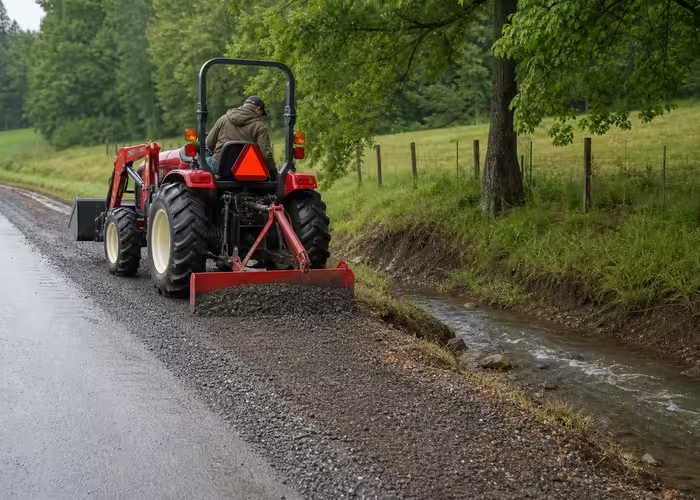
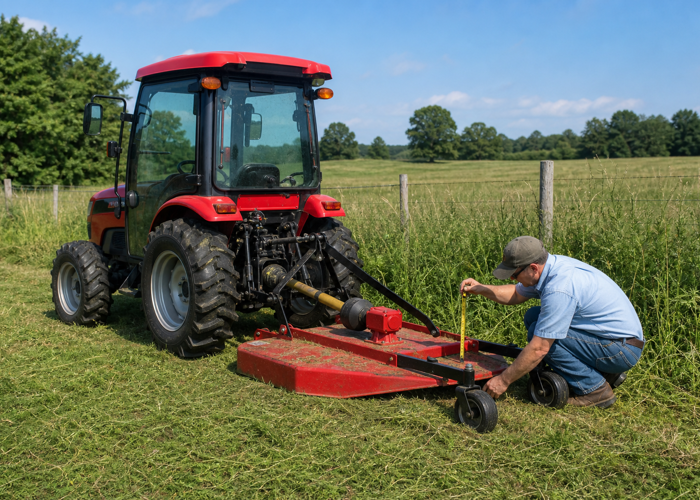
Image illustrations


FAQs: 35HP vs 40HP tractor
- Can a 35HP tractor run a 6‑ft rotary cutter? Sometimes, in light vegetation and flat terrain, with sharp blades and conservative ground speed. For mixed/heavy conditions, a 40HP tractor more typically maintains blade speed on a 6‑ft deck.
- What PTO HP do I need for a 6‑ft tiller? LSU AgCenter suggests 10–15 hp per foot. A 6‑ft tiller can require ~60–90 PTO hp depending on depth and soil resistance. Many compact owners limit width or depth accordingly; confirm your tractor’s net PTO hp.
- How much fuel will a 35HP vs 40HP tractor use under PTO load? Estimate using Penn State Extension’s average 0.044 gal per PTO hp‑hr. Multiply by your tractor’s net PTO hp and by local diesel price for a cost/hr figure.
- Which tractor is better for heavy loader work? Likely the 40HP platform due to typical advantages in hydraulic flow and chassis weight, but confirm GPM, remotes, and loader lift on the spec sheet before finalizing.
- Should I buy the more affordable 35HP and upgrade implements later? If most of your work is 5‑ft cutting and light tilling, 35HP is a reasonable starting point. If 6‑ft cutting or heavier tillage becomes routine, plan to step up in power or adjust techniques (slower speed, added ballast, shallower passes).
Final thoughts and next steps on a 35HP vs 40HP tractor
Choosing a 35HP vs 40HP tractor is fundamentally about implement width and the conditions you face. If your calendar reads “6‑ft rotary cutters and wider tillers,” the QL‑404Y typically makes that work more predictable. If your list is “5‑ft cutters, light tilling, small‑plot chores,” the QL‑354Y often hits the sweet spot on cost and capability.
Explore the models, request current specs and a quote, and match your implements confidently:
- Visit Qilu China 35HP Tractor QL‑354Y.
- Visit Qilu OEM 40HP Tractor QL‑404Y.
For PTO concepts and buying context, see Tractor PTO: A Complete Guide and How to Buy a Tractor: Tips and Advice.