Welcome to Shandong Qilu Industrial Co., Ltd

 English
 Arabic
 Bulgarian
 Bengali
 Czech
Czech
 Danish
 German
 Greek
Greek
 Spanish
 Finnish
 French
 Hindi
Hindi
 Croatian
 Hungarian
 Indonesian
 Italian
 Japanese
 Korean
 Lithuanian
 Dutch
Dutch
 Norwegian
 Polish
 Portuguese
 Romanian
 Russian
 Slovak
 Slovenian
 Swedish
 Thai
Thai
 Turkish
 Ukrainian
 Vietnamese
 Tagalog
 Malay
Malay
 Estonian
 Catalan
 Latvian
 Urdu
Urdu
 Serbian
 Persian
 Swahili
 Albanian
 Armenian
 Icelandic
 Bosnian
 Luxembourgish
 Afrikaans
English Arabic
Bulgarian
Bengali
Czech
Danish
German
Greek
Spanish
Finnish
French
Hindi
Croatian
Hungarian
Indonesian
Italian
Japanese
Korean
Lithuanian
Dutch
Norwegian
Polish
Portuguese
Romanian
Russian
Slovak
Slovenian
Swedish
Thai
Turkish
Ukrainian
Vietnamese
Tagalog
Malay
Estonian
Catalan
Latvian
Urdu
Serbian
Persian
Swahili
Albanian
Armenian
Icelandic
Bosnian
Luxembourgish
Afrikaans
Afrikaans
English Arabic
Bulgarian
Bengali
Czech
Danish
German
Greek
Spanish
Finnish
French
Hindi
Croatian
Hungarian
Indonesian
Italian
Japanese
Korean
Lithuanian
Dutch
Norwegian
Polish
Portuguese
Romanian
Russian
Slovak
Slovenian
Swedish
Thai
Turkish
Ukrainian
Vietnamese
Tagalog
Malay
Estonian
Catalan
Latvian
Urdu
Serbian
Persian
Swahili
Albanian
Armenian
Icelandic
Bosnian
Luxembourgish
Afrikaans
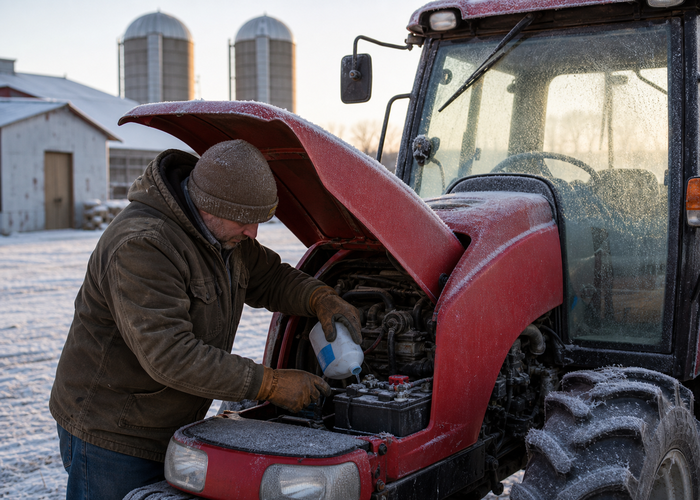
Cold Weather Tractor Starting and Battery Care for Winter Chores
A practical winter tractor guide covering battery care, block heaters, glow plugs, fuel anti-gel planning, storage, and cold-start routines.
Winter tractor trouble usually starts before the key is turned. A machine left outside with a weak battery, summer-blend fuel, dirty terminals, and no block-heater plan may still start once or twice, but eventually it chooses the worst possible morning to stop cooperating. That moment is expensive because winter chores rarely wait for a comfortable repair window.
Cold-weather starting is therefore less about one clever trick and more about a repeatable routine. Owners comparing the farm tractor category should think not only about snow or feeding work, but also about how the tractor will be stored, charged, fueled, and warmed between uses. A practical winter machine is one that stays ready when temperature, moisture, and time pressure all become unfriendly.
That same thinking matters across several sizes. A compact unit in the 25-50 HP tractor range can suffer just as much from poor winter preparation as a larger unit in the 50-70 HP tractor range. The difference is usually not class size. It is whether the operator manages battery charge, fuel condition, glow-plug time, oil thickness, and storage details consistently.
Battery Health Decides More Than Most Operators Admit
The Penn State article Preparing and Storing Farm Equipment for Winter makes a simple but important point: batteries must stay charged in storage if you want them to survive winter and remain dependable. A battery that drifts downward is not only weaker at cranking; it can also freeze and suffer permanent damage.
The University of Tennessee guidance Cold Weather Diesel Engine Starting Tips is equally practical because it reminds operators that cold increases the difficulty of starting dramatically. Thicker oil, slower chemical activity in the battery, and greater resistance inside the engine mean a marginal battery in October becomes a failure point in January.
That is why winter prep should include terminal cleaning, cable inspection, voltage checks, and a real charging plan. If the tractor is used irregularly, a battery maintainer or scheduled recharge is often a better answer than hoping a weekly start-up will solve everything. Hope is not a maintenance strategy in freezing weather.
Use Warm-Up Aids Before Forcing the Starter
North Dakota State University’s winter article Tractors Require Extra Caution in Winter stresses how valuable a block heater can be. That matters because many starting failures are really viscosity and temperature problems, not raw engine problems. Warming the engine block reduces strain on the starter and battery while helping oil circulate sooner after ignition.
The Washington State University preventive-maintenance PDF Tractor Preventive Maintenance also emphasizes starting aids in cold weather, including block heaters and glow plugs for diesels. Operators who skip those aids often respond by over-cranking, which overheats electrical components and still leaves the engine reluctant to fire.
Practical winter starting means building a sequence: plug in the heater early enough, confirm the battery is healthy, cycle the glow plugs as recommended, and only then crank the engine. That routine is far better than repeated aggressive starts with no temperature preparation.
Let the Engine Catch Up Before Heavy Work
The UNH bulletin Fall and Winter Tractor Maintenance notes that cold machines need a warm-up period before heavy use. That is not idle superstition. It is about allowing oil, coolant, and drivetrain components to move toward working temperature before the operator asks for full hydraulic response or immediate load.
For a chore tractor, this matters because winter work often feels urgent. Snow, livestock feeding, and icy access lanes encourage operators to rush. A few minutes of sensible warm-up are cheaper than pushing a cold machine straight into high hydraulic demand or hard travel.
Fuel Choice and Anti-Gel Planning Need To Be Decided Before the Storm
Purdue’s winter safety note Tractors Require Extra Caution in Winter points directly to winter-grade diesel, anti-gel planning, and keeping replacement filters available. That advice matters because many so-called starting problems are actually fuel-flow problems caused by waxing, water, or clogged filters.
The Alternative Fuels Data Center page Biodiesel Fuel Basics adds another useful caution: cold-weather performance changes with blend level. Operators using biodiesel blends need to understand how blend percentage, base diesel quality, and local temperature interact instead of assuming every winter fuel behaves the same.
Good practice is simple. Buy the right seasonal fuel from a reliable supplier, keep the tank reasonably full to reduce condensation, store additives before you need them, and avoid treating the tractor like a chemistry experiment on the coldest morning of the year.
Storage Habits Matter as Much as Fluids
Indoor storage will not cure every winter problem, but it changes several of them in your favor. The battery stays warmer, snow does not pack around linkages and electrical connectors, and block-heater use becomes easier to manage. Even a simple shed can improve morning reliability compared with total exposure in an open lot.
When indoor storage is not available, the machine should still be parked with intent. Place it on drained ground, protect it from drifting snow where possible, and keep cords, chargers, and access paths practical. Winter readiness is not just about the engine; it is also about whether the operator can reach the tractor safely and service it without wasting time in the dark.
Owners planning year-round use may also find it helpful to compare winter chores against the broader tractor application solutions and product application solutions pages. Snow removal, feeding, lane maintenance, and cold-weather transport each put slightly different demands on the machine.
Another under-rated winter issue is operator discipline. Repeated short starts without full charging time can slowly weaken the battery, while postponing terminal cleaning or filter changes increases the odds of failure during the next cold snap. Winter machines need fewer improvised starts and more deliberate preparation.
Cold weather also reveals small electrical problems that stayed hidden in summer. Loose grounds, tired cables, marginal alternator output, and weak starters often become obvious only after temperatures drop. That is one reason a pre-winter inspection saves more frustration than a mid-storm repair.
Finally, winter readiness is cumulative. Battery condition, fuel condition, storage, heating aids, and warm-up procedure all stack together. One strong habit cannot fully cancel three weak ones.
A Morning Start Routine That Prevents Panic
When the temperature drops sharply, the easiest way to reduce stress is to follow the same starting order every time. First, confirm that the battery charger or maintainer did its job and that the cables are tight. Second, verify that the tractor has winter-ready fuel and that any additive was mixed before the cold snap rather than poured into a gelled system after the problem started. Third, plug in or switch on any warming aid early enough to matter instead of expecting a last-minute connection to solve an overnight freeze.
Fourth, cycle the glow plugs or intake heater exactly as recommended for the machine instead of guessing. Diesel starting systems are designed around sequence, and impatience often undoes the benefit of good maintenance. Fifth, crank the engine decisively rather than with repeated tiny attempts that only chip away at the battery reserve. If the engine does not respond, step back and diagnose the missing piece instead of turning the starter into a troubleshooting tool.
After the engine starts, resist the urge to drive off immediately with a full hydraulic load. Give the charging system a chance to recover, watch gauges and warning lights, and let the engine and fluids begin warming together. Those few minutes also give the operator time to confirm that steering, brakes, and hydraulics are responding normally before the machine is asked to move feed, push snow, or travel on an icy lane.
It also helps to prepare the tractor the night before a storm instead of trying to recover from every problem in the morning. Top off the tank, set out the extension cord, verify the charger connection, and place filters, gloves, and additive where they can be reached quickly. Winter reliability often comes from ordinary preparation completed while conditions are calm, not from heroic repairs made after the machine already refuses to start. When the forecast is severe, check tire condition and clear the parking area too, so the first successful start is not wasted on avoidable access trouble.
This routine sounds simple, but simple routines are exactly what survive real winter mornings. If several people use the same tractor, write the steps down and keep them visible near the parking area or charger. Reliability improves quickly when the whole team handles cold starts the same way instead of passing along a collection of half-remembered tricks.
A Working Winter Checklist
| Area | What to check | Why it matters |
|---|---|---|
| Battery | Charge level, terminals, cable condition | Cold sharply reduces starting power |
| Fuel | Seasonal blend, water control, filters, anti-gel plan | Prevents waxing and poor fuel flow |
| Engine prep | Block heater, glow plugs, oil suited to season | Reduces starter and battery strain |
| Storage | Shed space, charger access, dry parking surface | Improves reliability and service access |
| Warm-up routine | Idle time before heavy load | Protects engine and hydraulic components |
A short written checklist beside the charger or heater plug is often enough to keep these steps from being skipped when the weather is miserable and the operator is in a hurry.
Common Winter Starting Mistakes
The first mistake is cranking too long on a weak system. If the battery, glow plugs, or fuel are not ready, repeated cranking mainly converts battery energy into frustration. The second mistake is ignoring the fuel side of winter problems and assuming every no-start condition is electrical.
The third mistake is waiting until the first cold event to buy supplies. If the tractor needs additive, filters, a charger, or a new extension cord, those decisions should be made before the weather forces them. The fourth mistake is storing the tractor in a way that makes plugging in or charging so inconvenient that the routine quietly stops happening.
The best winter tractor is not the one with the most dramatic cold-start story. It is the one that keeps showing up for chores because the owner manages the details consistently. That is the standard worth aiming for when reviewing the QiLu Machinery product range or planning a dedicated seasonal setup.
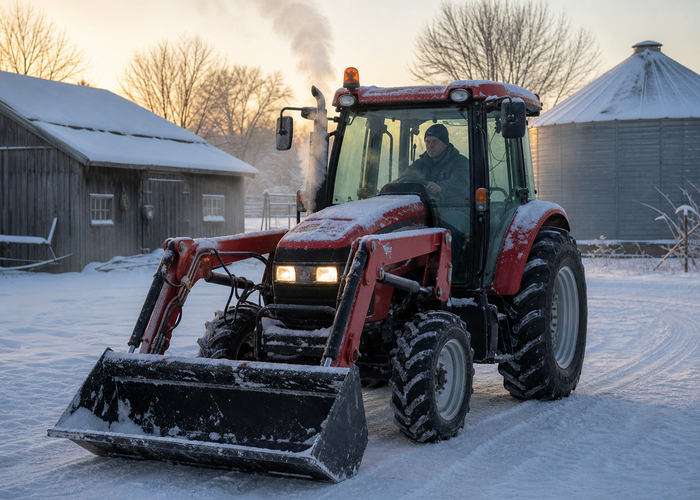
Good winter preparation also protects the machine after it starts. A charged battery lasts longer, a warmed engine wears less, and clean fuel reaches injectors more predictably. Reliability is not just about getting the tractor to fire; it is about getting it to work without unnecessary strain.
For operators who alternate among snow removal, feeding, and yard maintenance, winter readiness should be documented the same way hydraulic or ballast setups are documented in other seasons. The QiLu Machinery blog can then serve as the place where machine selection and daily operating routines support each other, especially when those routines need to be matched to a practical farm tractor article library for different seasons and workloads.
Cold weather will always make tractors work harder. The goal is not to eliminate winter, but to remove the preventable reasons a tractor fails in it. Charge the battery, prepare the fuel, use warm-up aids, and keep the routine simple enough to repeat on the coldest morning when patience is shortest and daylight is limited.
FAQ
Should I start a tractor regularly during storage just to keep it alive?
Only if the tractor will run long enough to recharge the battery and reach operating temperature. Very short starts can actually worsen battery and moisture problems.
What is the first thing to check when a tractor will not start in the cold?
Check battery condition and cable integrity first, then confirm glow-plug or heater use and look at fuel-flow issues such as gelling or a blocked filter.
Is a block heater worth the trouble for a chore tractor?
Yes, especially in consistently cold climates. It reduces starting strain, improves oil circulation after start-up, and makes cold mornings much more predictable.
Can fuel blend really affect winter tractor starting?
Absolutely. Seasonal diesel quality, biodiesel blend percentage, water contamination, and additive use all affect cold-weather flow and starting behavior.