Welcome to Shandong Qilu Industrial Co., Ltd

 English
 Arabic
 Bulgarian
 Bengali
 Czech
Czech
 Danish
 German
 Greek
Greek
 Spanish
 Finnish
 French
 Hindi
Hindi
 Croatian
 Hungarian
 Indonesian
 Italian
 Japanese
 Korean
 Lithuanian
 Dutch
Dutch
 Norwegian
 Polish
 Portuguese
 Romanian
 Russian
 Slovak
 Slovenian
 Swedish
 Thai
Thai
 Turkish
 Ukrainian
 Vietnamese
 Tagalog
 Malay
Malay
 Estonian
 Catalan
 Latvian
 Urdu
Urdu
 Serbian
 Persian
 Swahili
 Albanian
 Armenian
 Icelandic
 Bosnian
 Luxembourgish
 Afrikaans
English Arabic
Bulgarian
Bengali
Czech
Danish
German
Greek
Spanish
Finnish
French
Hindi
Croatian
Hungarian
Indonesian
Italian
Japanese
Korean
Lithuanian
Dutch
Norwegian
Polish
Portuguese
Romanian
Russian
Slovak
Slovenian
Swedish
Thai
Turkish
Ukrainian
Vietnamese
Tagalog
Malay
Estonian
Catalan
Latvian
Urdu
Serbian
Persian
Swahili
Albanian
Armenian
Icelandic
Bosnian
Luxembourgish
Afrikaans
Afrikaans
English Arabic
Bulgarian
Bengali
Czech
Danish
German
Greek
Spanish
Finnish
French
Hindi
Croatian
Hungarian
Indonesian
Italian
Japanese
Korean
Lithuanian
Dutch
Norwegian
Polish
Portuguese
Romanian
Russian
Slovak
Slovenian
Swedish
Thai
Turkish
Ukrainian
Vietnamese
Tagalog
Malay
Estonian
Catalan
Latvian
Urdu
Serbian
Persian
Swahili
Albanian
Armenian
Icelandic
Bosnian
Luxembourgish
Afrikaans
Loader Ballast Mistakes That Make a Farm Tractor Unsafe on Slopes
A practical guide to tractor loader ballast safety, slope awareness, rear counterweight choices, low bucket travel, and warning signs during farm material handling.
A useful tractor loader ballast safety is less about making a tractor look tidy and more about catching small faults before they become field delays. On a busy farm morning, ten quiet minutes around the machine can protect the operator, the implement, and the crop schedule. This guide is written for owners and operators who use a farm tractor for loader work, mowing, hauling, tillage, and everyday utility jobs.
QiLu Machinery buyers often compare horsepower and attachments first, but the real ownership experience depends on repeatable checks. A tractor that starts, steers, stops, lifts, cools, and connects predictably is easier to use than a bigger machine that surprises the operator. The same habit also helps when matching a machine to tractor application solutions or deciding which implement should be used first on a long workday.
The following sections focus on practical decisions rather than brand claims. They combine field routines with public safety reminders from sources such as OSHA tractor operation safety guidance, NIOSH agricultural safety resources, and university extension guidance. Use the ideas as a working framework and always follow the specific operator manual for the tractor and implement in front of you.
Why Loader Ballast Changes the Whole Tractor
Loader work changes the tractor from a pulling machine into a mobile lever. The bucket, load, loader arms, front axle, rear axle, tire contact patch, and ballast all interact. A light load can still become dangerous when the bucket is high, the ground is uneven, or the tractor turns downhill too quickly.
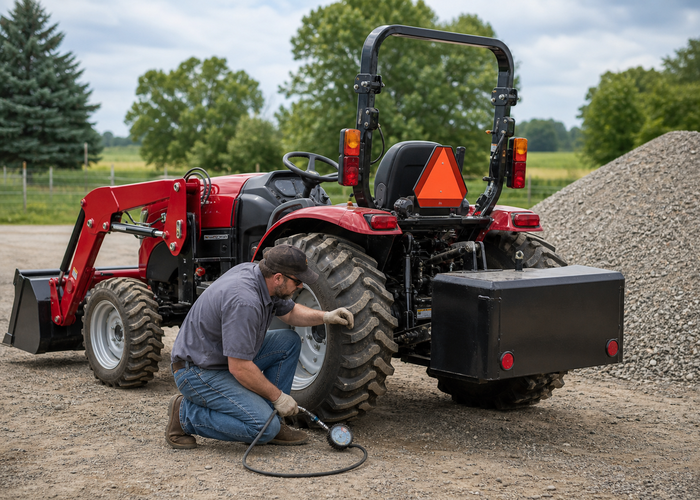
The first mistake is treating rear ballast as optional. A front-end loader transfers weight forward, reduces rear tire grip, and can make steering and braking unpredictable. Rear ballast, wheel weights, filled tires, or a heavy rear implement help restore balance, but they must be matched to the tractor and the loader rating.
The second mistake is driving with the bucket too high. A raised bucket lifts the center of gravity and makes a small obstacle feel larger than it is. Carry material low, travel slowly, avoid sudden turns, and lower the attachment before leaving the seat. These habits are simple because they need to work under pressure.
Rear Counterweight, Tire Pressure, and Load Size
Inspect the route before loading. Holes, ruts, wet grass, loose gravel, hidden curbs, and small slopes can change the tractor faster than the operator expects. If the job requires crossing a slope, reconsider the route or move less material per trip. Stability is cheaper than speed.
Public safety agencies keep repeating the same message because farm tractors concentrate weight, power, rotating shafts, hydraulics, and human judgement in one machine. Penn State Extension tractor safety guidance and University of Minnesota Extension tractor safety material both stress that safe operation begins before the work starts. The best checklist is not a wall poster; it is a sequence the operator can actually complete beside the tractor.
For a purchase team, the same thinking also improves specification choices. A buyer reviewing all machinery products should ask how the tractor will be inspected, serviced, connected, and stored. A machine that fits the work but cannot be checked easily will invite skipped steps. That is where product selection and daily practice meet.
When the job involves multiple tools, walk the whole work chain. Look at the tractor, the implement, the travel route, the loading point, the slope, the gate width, and the turnaround space. If the task depends on a loader, PTO, or hydraulic coupler, include that system in the first inspection rather than waiting until the tractor is already in position.
Loader attachment choice also matters. A bucket full of wet soil, gravel, manure, snow, or mulch does not weigh the same. Pallet forks can move the center of gravity farther forward than a bucket. Grapples and bale spears create their own risks. The correct ballast for one task may be inadequate for another.
Route Planning for Slopes and Soft Ground
Before lifting, check the loader pins, quick-attach latch, hydraulic hoses, cylinders, cutting edge, and tire pressure. Look for hose rub, damaged fittings, bent brackets, and uneven tire inflation. A loader should raise, curl, dump, and lower smoothly before the tractor travels under load.
Use four-wheel drive according to the machine instructions, but do not let it create false confidence. Traction helps the tractor move; it does not cancel gravity or raise the rollover threshold. Brakes, steering, and load control still depend on ground contact and careful speed.
If another worker is nearby, agree on hand signals or stop points before the tractor moves. The safest spotter is not close to the bucket. They should stand outside the travel path and never between the tractor, a wall, a trailer, a gate, or a pile of material.
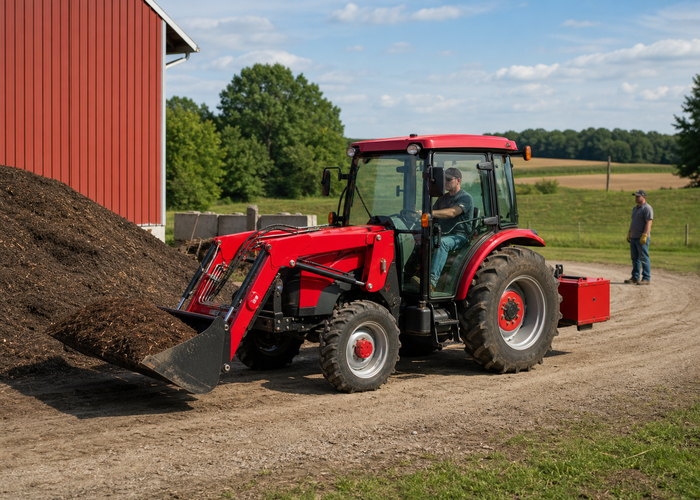
For buyers, loader work should influence tractor size, tire choice, hydraulic flow, wheelbase, rear ballast options, and implement package. A tractor that looks strong in a brochure may feel wrong if the rear end is too light for the jobs that happen every week.
For operators, the most useful rule is to stop when the tractor feels different. Rear wheels getting light, steering becoming vague, a tire slipping unexpectedly, or the bucket pulling the tractor sideways are not normal annoyances. They are warnings that the setup or route needs to change.
Keep the work area boring. Level staging, clear approaches, low travel height, smaller loads, and fewer bystanders rarely look dramatic, but they finish more jobs. Loader safety is built from ordinary choices repeated before they are needed.
When the workday ends, park with the loader and implement lowered, relieve hydraulic pressure as directed by the manual, clean packed material from the bucket, and inspect for new leaks or damage. Tomorrow?s safe start often depends on what the operator noticed at shutdown today.
How Operators Can Catch Instability Early
Good routines are simple enough to survive pressure. Keep the checklist near the key, toolbox, fuel point, or service bay. Keep spare hitch pins, lynch pins, gloves, shop towels, and tire pressure tools where they are actually used. For larger fleet planning, the same records can support service decisions around the QL 60HP tractor, the QL 904B tractor, and other equipment in a mixed yard.
The final test is whether the operator can explain the stop condition. If a leak, damaged guard, low tire, loose pin, warning light, unusual sound, or unstable load appears, the correct answer is to stop and fix the cause. University of Missouri farm machinery maintenance guidance and other extension publications frame maintenance as a prevention habit, not a paperwork exercise.
The safest loader setup is the one that makes the job feel uneventful. Correct rear ballast, low bucket travel, careful route choice, and realistic load size keep the tractor predictable. When a tractor starts to feel light, fast, or sideways, the right answer is not more confidence. It is a safer setup.
Rear ballast should be treated as part of the loader system, not as an accessory that happens to fit the three-point hitch. The loader capacity, front axle rating, tire type, wheelbase, terrain, and material density all influence the amount and kind of counterweight needed. A ballast box is compact and predictable. A rear implement may be useful, but its weight, length, and ground clearance can change how the tractor turns and stops. Filled tires add stability but do not replace all rear counterweight for every loader job.
Material weight is often underestimated. A bucket of dry mulch, wet clay, gravel, snow, manure, compost, firewood, or stone can vary dramatically even when the bucket looks equally full. Moisture is the hidden multiplier. The safest operator learns to take smaller bites, especially when working on soft ground or near slopes. A full bucket is not a goal if the tractor becomes hard to steer, brake, or hold level.
Slope work requires route planning before the bucket is loaded. Whenever possible, travel straight up or down gentle grades rather than turning across them. Avoid sudden stops, keep the bucket low, and never use loader lift height to compensate for poor positioning. If a task cannot be done without crossing an uncomfortable side slope, move the material to a flatter staging area with smaller loads or choose a different machine. The job should be adjusted before the tractor feels unstable.
Tire choice and pressure affect loader behavior more than many new owners expect. Agricultural tires, industrial tires, and turf tires grip and flex differently. Underinflated fronts can squat under loader weight; overinflated rears can reduce traction. If the tractor uses liquid ballast, confirm both rear tires are filled consistently. Uneven inflation or ballast can make the tractor lean or pull when the loader is loaded.
Shutdown, Parking, and Next-Day Inspection
Loader controls should be smooth, not abrupt. A sharp curl, dump, or lift movement can shift the load and surprise the operator. Practice on level ground with a modest load before working near a trailer, wall, ditch, or slope. Keep one hand ready for steering and one for controlled loader movement. If the loader drifts, chatters, or drops unexpectedly, stop and inspect hydraulics before continuing.
Parking discipline matters after loader work too. Lower the bucket flat to the ground, lower rear ballast or implements, relieve pressure as directed, and park away from children, livestock, or vehicle paths. A raised loader parked for convenience creates a stored-energy hazard. A lowered, clean, inspected loader makes the next job safer before it even starts.
Field Use Notes
Loader work should also be reviewed after near misses. If the rear wheels became light, the tractor slid, a load spilled unexpectedly, or an operator felt uncomfortable on a route, write down the material, terrain, tire condition, ballast setup, and bucket height. That record helps the farm decide whether to change ballast, reduce load size, improve the travel path, train operators again, or choose another machine for that job.
For managers, the most useful record is not a perfect archive but a pattern that can be acted on. If the same tire loses pressure, the same coupler leaks, the same operator reports unstable handling, or the same implement is difficult to attach, the farm has found a training or maintenance priority. Review the notes weekly, keep the language plain, and turn repeated observations into repairs, storage changes, or operator reminders before the busy season makes every small fault harder to fix.
A good loader policy also defines where loads should not be carried. Avoid operating close to ditch edges, pond banks, soft shoulders, recently filled trenches, manure pits, or traffic lanes unless the site has been prepared and the operator has a clear escape path. The ground that supports an empty tractor may not support a loaded front axle. When the surface is questionable, reduce the load, improve the route, or use equipment better suited to the site.
For more context before specifying a loader tractor, review QiLu Machinery’s tractor category, tractor application solutions, and the QL 60HP tractor page. Operators can also compare the safety logic with OSHA tractor guidance, University of Minnesota Extension tractor safety resources, and NIOSH agricultural injury prevention resources.
Practical FAQ
How often should a tractor checklist be used? Use a short walk-around before every work period and a more detailed inspection when the job changes, when an implement is attached, after transport, or after the tractor has been operated by someone else. The point is consistency, not paperwork volume.
Warning Signs That Mean Stop and Reconfigure
What should stop the job immediately? Stop for active fluid leaks, brake problems, steering problems, damaged guards, missing hitch retainers, warning lights, unstable loads, unusual vibration, overheated systems, damaged tires, or any condition that makes the operator unsure. A delayed repair is cheaper than a damaged tractor or injured worker.
Should the same checklist be used for every implement? Keep a common tractor checklist, then add a short implement-specific section. Loader work, PTO work, mowing, road travel, and tillage expose different risks. A few focused lines are more useful than one generic form that tries to cover every possible situation.
What is the most common reason a good checklist fails? The checklist fails when it is stored away from the machine, written in language operators do not use, or made too long for the morning routine. Keep it visible, practical, and connected to real stop conditions.
For more practical machinery topics, review the QiLu Machinery blog and the broader product application solutions pages. A farm tractor earns its keep when it is selected for real work, checked before real work, and operated with enough discipline to come home ready for tomorrow.